Light In The Darkest Of Times

Listen to the podcast of this post by clicking on the player below, and you can also subscribe on AppleSpotify, or Audible. 

One of the reasons I appreciate the Bible—in fact, one of the main reasons that continually convinces me of the truthfulness of the Bible—is the way it portrays life as it really is. It doesn’t avoid the difficult subjects, nor does it sugarcoat the bitterness of life. The Bible tells it as it is. 

The songs that have us singing praises to God “when the sun’s shining down on me and the world’s all as it should be” are great, but when we can also find hope when we’re “found in the desert place” is the real test. 

Dark times come to all of us. 

David is anointed king of Israel and given a promise by God for a lasting legacy (2 Samuel 7:8-9, 16, 27-29; Psalm 110:1). And yet David cried out one of the most painful phrases ever uttered in Psalm 22:1-2, “My God, my God, why have You forsaken me?”  

(Check out all of the Scriptures in this post by clicking here.) 

Despite the promises that God gave David, when any of us are in a dark place, there is a natural human tendency to focus on the darkness around us and second-guess what is happening to us. You know the questions:

  • How did I get here? 
  • How will I get out of here? 
  • When will I get out of here? 
  • Have I offended God and perhaps missed out on His promise? 
  • Has He forgotten me? 

The Bible does tell us, “If You, Lord, kept a record of sins, Lord, who could stand?” and we also know it’s true that “all have sinned and fall short of the glory of God” (Psalm 130:3; Romans 3:23). 

That’s for us, not for Jesus. He is the sinless One. He obediently became human to rescue us, knowing full well that He was the fulfillment of the promise God made to David (Matthew 1:1; 22:41-44). Yet He ended up uttering the same painful words David did (Matthew 27:41-46). 

Remember I said that King David was a visible picture to help us see the coming King of kings. David was inspired by the Holy Spirit with this knowledge (Acts 2:29-30, 25-28). 

The old hymn says, “When darkness veils His lovely face, I rest on His unchanging grace” and “When all around my soul gives way, He then is all my hope and stay.” Look at David’s preaching to himself:

  • I am feeling forsaken (Psalm 22:1-2) … YET You are on Your throne (vv. 3-5) 
  • I am scorned by others (vv. 6-8) … YET You are closer than my scorners (vv. 9-11) 
  • I am completely cut off (vv. 12-18) … BUT You are my rescue (vv. 19-24) 

What did Jesus know:

  • He would sit on the throne of Heaven—Matthew 26:62-64 
  • His Father was completing everything—John 19:30; Psalm 22:25-31 
  • He would conquer every enemy—Revelation 1:8, 18 

Jeremiah cries out about his dark time, and then like David he says, “YET this I call to mind and have hope.” Jeremiah then talks about the never-ending love and mercy of God, and concludes by preaching to himself, “I say to myself, ‘The Lord is my portion; therefore I will wait for Him’” (Lamentations 3:19-24). 

The Lord is my portion” means the Lord is my King who declares promises and fulfills promises. 

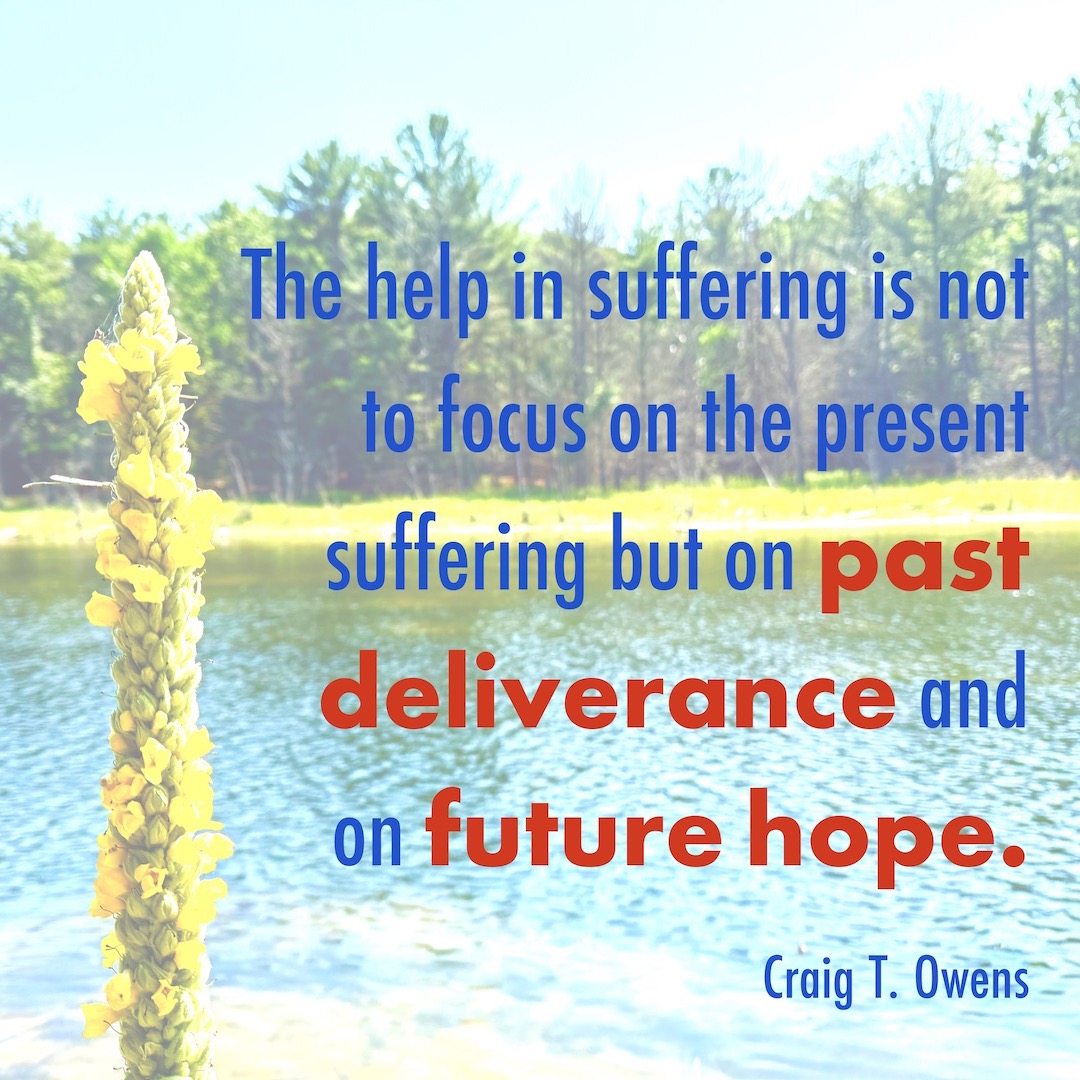
The help in suffering is not found in focusing on the present darkness—and all the questions—but to focus on God’s promises. Like David’s “yet” and “but” we need to preach to ourselves about God’s past deliverance and then be assured of our future hope. 

Just assuredly as our King of kings said, “I will be resurrected from the dead to sit on the throne of Heaven,” He also said, “I will come to take you where I am”! 

Take your eyes off the present, temporary darkness and put them on the eternal King! 

If you have missed any of the messages in this series on the Royal Psalms, you can find them all here. 

►► Would you please prayerfully consider supporting this ministry? My Patreon supporters get behind-the-scenes access to exclusive materials. ◀︎◀︎
New Inside

Listen to the podcast of this post by clicking on the player below, and you can also subscribe on AppleSpotify, or Audible. 

In the movie Groundhog Day, Bill Murray’s character (Phil) is stuck in a small town where February 2 keeps repeating. Phil tries desperately to get out of this town and out of this day, but nothing he seems to do gets him out of the endless loop. He becomes smarter and richer each day, but at the end of the day, everything resets to the beginning. 

It’s frustrating! 

God’s people of the Old Testament had their own “Groundhog Day”—the Day of Atonement that came every single year. This was the day their sins were confessed, forgiven, and atoned for, and had a very specific set of sacrifices and rituals. Much like Phil in the movie, they began to go through these motions almost entirely without thinking. 

Year after year, millennia after millennia “the same sacrifices repeated endlessly year after year, [couldn’t] make perfect those who draw near to worship” (see Hebrews 10:1-4). 

Even those who were God-fearing and tried their best to live perfectly righteous lives could find in the law provision for those who “sin unintentionally” (Leviticus 4:2, 13, 22, 27; 5:15, 18, 22, 24, 27-29). It was just another reminder that the loop of sin-confession-repentance-forgiveness-atonement was never ending. 

And as if all the requirements of the Torah weren’t enough, Jesus came on the scene and seemed to raise the bar, telling us even though our outward actions might look righteous, our inward thoughts and attitudes made us just as sinful (Matthew 5:21-22, 27-28). And then Jesus even dropped this on us, “Be perfect, therefore, as your heavenly Father is perfect” (Matthew 5:48)! 

Perfect?! As perfect as God?! This could easily make people throw their hands up in resignation, “I give up! Why even try?” 

Through Ezekiel, God prophesied an internal change. This wasn’t something I must do, but something GOD will do—

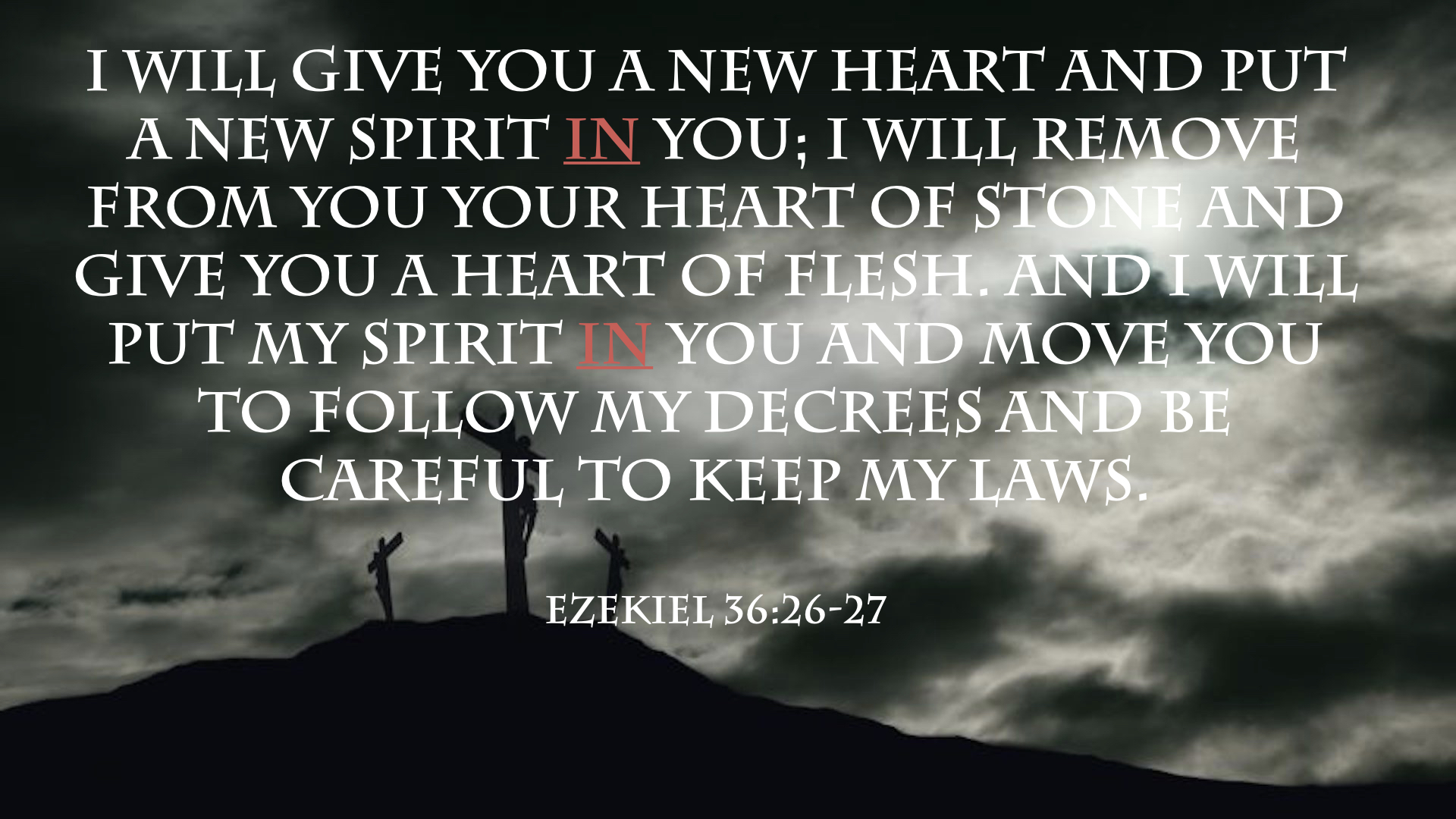
I will give you a new heart and put a new spirit in you; I will remove from you your heart of stone and give you a heart of flesh. And I will put My Spirit in you and move you to follow My decrees and be careful to keep My laws. (Ezekiel 36:26-27) 

The solution to our endless loop of sin-confession-repentance-forgiveness-atonement must become internal. It’s no use trying to correct the fruit if the root is still evil! That requires an inside job. 

On Good Friday, the last words Jesus spoke before His death were, “It is finished” (John 19:30). 

What was finished? Our struggle to get ourselves out of this endless loop. The writer of Hebrews had this to say about Jesus: 

But when this Priest had offered for all time one sacrifice for sins, He sat down at the right hand of God. … For by one sacrifice He has made perfect forever those who are being made holy. (Hebrews 10:12, 14) 

Remember Jesus told us we had to be perfect like God? The root word for “perfect” in that verse is telos. When Jesus cried out, “It is finished,” He said one word in Greek: tetelestai. This also comes from the root word telos. Jesus perfectly finished all that was necessary for us to become perfect in God’s sight. 

Christians often use the the phrase “I invited Jesus into my heart” as an expression of their faith in what Jesus did for them on the Cross. That word “IN” is a good reminder. 

Jesus comes IN and the fear of punishment—the fear of being eternally stuck in the endless loop—has to go out. “There is no fear IN love. But perfect love drives out fear, because fear has to do with punishment. The one who fears is not made perfect IN love” (1 John 4:18). 

The word “perfect” in that verse is also from the same root word telos. 

Not only does Jesus come IN to our hearts to make them new, but He also takes us IN to His perfection. “Looking away from all that will distract to Jesus, Who is the Leader and the Source of our faith—giving the first incentive for our belief—and is also its Finisher—bringing it to maturity and perfection…” (Hebrews 12:2 AMP). 

Jesus shared a last supper with His disciples. His last supper was the first Communion. At this time Jesus told them He was establishing a “new covenant.” How do we square this with His previous statement that He didn’t come to abolish the law but to fulfill it? 

Jesus said this new covenant was IN His blood. His blood doesn’t abolish the law, but it perfects the law. His perfect blood makes out hearts new and takes us out of the external loop and IN to His prefect righteousness. 

Jesus accomplished all that was needed to make us perfect inside, and then to perfectly take us into God’s presence. As the hymn The Old Rugged Cross reminds us, “In that old rugged Cross, stained with blood so divine, a wondrous beauty I see. For ’twas on that old Cross Jesus suffered and died to pardon and sanctify me!” 

May we always cherish the perfection that was purchased for us on that Cross. 

►► Would you please prayerfully consider supporting this ministry? My Patreon supporters get behind-the-scenes access to exclusive materials. ◀︎◀︎
“It Is Finished”

Listen to the podcast of this post by clicking on the player below, and you can also subscribe on Apple or Spotify.

Just before Jesus said, “I am thirsty,” John tells us that Jesus knew everything written about Him in the law had been completed and all of the prophecies about Him had been fulfilled. Jesus knew this to be true but no one else standing there would have said “Aha!” because of that statement. But Jesus left no doubt for any of us when He next said, “It is finished!

These three English words are just one word in Greek: tetelestai. It’s in the perfect tense, telling us that nothing more needs to be added to Christ’s work. It not only shares the same root word that John uses for completed and fulfilled, but it closes the circle of another dying declaration of Jesus when He quoted Psalm 22:1: “My God, My God, why have You forsaken Me?” His “It is finished” statement is also the last verse of Psalm 22.

The root word telos translated as completed, fulfilled, and finished has a very rich meaning. Here are three definitions we should consider: 

(1) To complete or bring to a conclusion

Jesus told His Father that He had finished (telos) His mission (John 17:4). Q: How do we know His mission was completed? A: Jesus sat down! Think about this: There were no chairs in the Old Testament temple because a priest never rested, there was always more work to do. But when Jesus finished His work, He sat down (see Hebrews 10:1-4, 11-12). 

(2) To discharge a debt

Since Jesus was the only One who could make the final “once for all” payment, that means that we were hopeless debtors prior to that. God foretold of His forgiveness using the picturesque language of a debt being “doubled up” when it was paid in full (see this video where I explain this concept more fully). Here’s what Jesus did: 

Having cancelled and blotted out and wiped away the handwriting of the note with its legal decrees and demands which was in force and stood against us. This note with its regulations, decrees, and demands He set aside and cleared completely out of our way by nailing it to His cross. (Colossians 2:14 AMP) 

Q: How do we know the debt was paid in full? A: The curtain that had separated us from God’s presence was torn in two.

(3) To fill up what’s missing

In this case, Jesus took what was missing by switching cups with us. He drank the cup of God’s righteous wrath—which was justly ours—and gave us His cup of righteousness in its place! (see Isaiah 51:17-22; Matthew 26:39).  

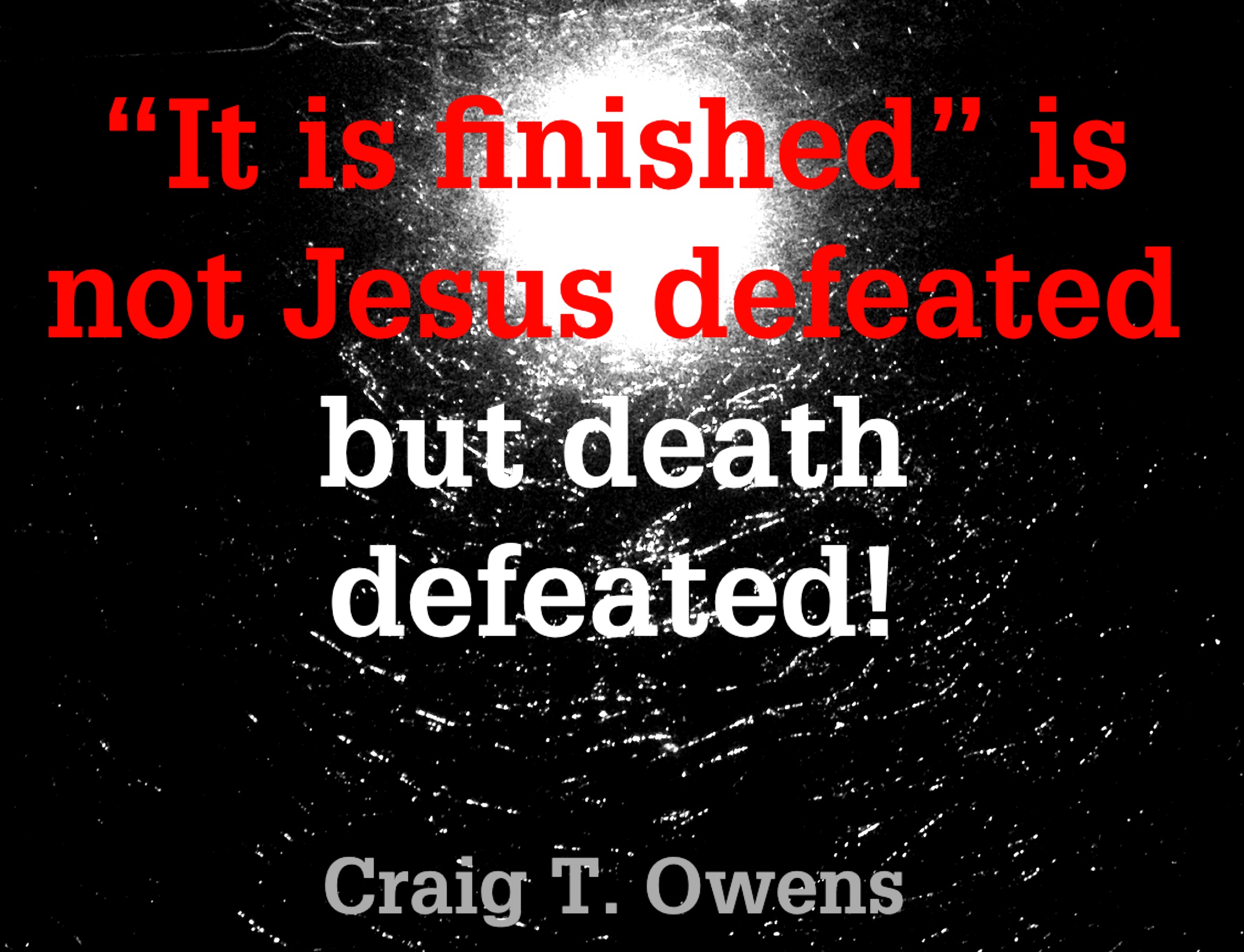
Q: How do we know we have a cup of righteousness in place of a cup of wrath? A: Dead saints of God were resurrected when Jesus died. “It is finished” was not Jesus giving up, but death giving up … it was not Jesus defeated, but death defeated! 

Jesus paid it all! There is nothing I can do to add to His completed—tetelestai—work, so I can now do what formerly was impossible: I can live a holy life for God’s glory. I can now finish (telos) my race on earth and receive the rewards God has stored up for me (see 2 Timothy 4:7-8). 

Christ’s tetelestai confession is our empowerment to live holy! 

If you’ve missed any of the messages in our series looking at the dying declarations of Jesus, you may access the full list by clicking here.

►► Would you please prayerfully consider supporting this ministry? ◀︎◀︎