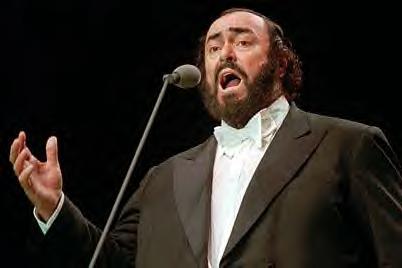
Luciano Pavarotti On Commitment

“When I was a boy, my father, a baker, introduced me to the wonders of song. He urged me to work very hard to develop my voice. Arrigo Pola, a professional tenor in my hometown of Modena, Italy, took me as a pupil. I also enrolled in a teachers college. On graduating, I asked my father, ‘Shall I be a teacher or a singer?’  

“‘Luciano,’ my father replied, ‘if you try to sit on two chairs, you will fall between them. For life, you must choose one chair.’  

“I chose one. It took seven years of study and frustration before I made my first professional appearance. It took another seven to reach the Metropolitan Opera. And now I think whether it’s laying bricks, writing a book—whatever we choose—we should give ourselves to it. Commitment, that’s the key. Choose one chair.” —Luciano Pavarotti (emphasis added)

Thursdays With Oswald—Second Mile Christianity

This is a weekly series with things I’m reading and pondering from Oswald Chambers. You can read the original seed thought here, or type “Thursdays With Oswald” in the search box to read more entries.

Second Mile Christianity

     To go the second mile means always do your duty, and a great deal more than your duty, in a spirit of loving devotion that does not even know you have done it. … The supreme difficulty is to go the second mile with God, because no one understands why you are being such a fool. The summing up of Our Lord’s teaching is that it is impossible to carry it out unless He has done a supernatural work in us. … 

     The interests of the Son of God and of the disciple are to be identical. How long it takes to manifest that identity depends on the private history of the disciple and his Lord. … 

     We do not need the grace of God to stand crises; human nature and pride will do it. We can buck up and face the music of a crisis magnificently, but it does require the supernatural grace of God to live twenty-four hours of the day as a saint, to go through drudgery as a saint, to go through poverty as a saint, to go through an ordinary, unobtrusive, ignored existence as a saint, unnoted and unnoticeable. The “show business,” which is so incorporated into our view of Christian work today, has caused us to drift far from Our Lord’s conception of discipleship. It is instilled in us to think that we have to do exceptional things for God; we have not. We have to be exceptional in ordinary things, to be holy in mean streets, among mean people, surrounded by sordid sinners. That is not learned in five minutes. 

From So Send I You

Jesus calls His disciples to go the second mile. Others won’t understand us, and few (if any) people will applaud us for doing so.

Like a novice runner, maybe we can’t go the whole second mile the first time out. Maybe not even the second or third time. But can we go a bit further the second time than we did the first? And a bit further the third time than we did the second? That’s what discipleship is all about: Letting Jesus help us go a bit further each time.

If you stick with it, soon you will be going the second mile and not even realize it. Other may not realize it either, but God always sees when we do, and He is pleased!

Keep Going

Keep GoingI don’t mean to say that I have already achieved these things or that I have already reached perfection. But I press on to possess that perfection for which Christ Jesus first possessed me. No, dear brothers and sisters, I have not achieved it, but I focus on this one thing: Forgetting the past and looking forward to what lies ahead, I press on to reach the end of the race and receive the heavenly prize for which God, through Christ Jesus, is calling us. (Philippians 3:12-14)

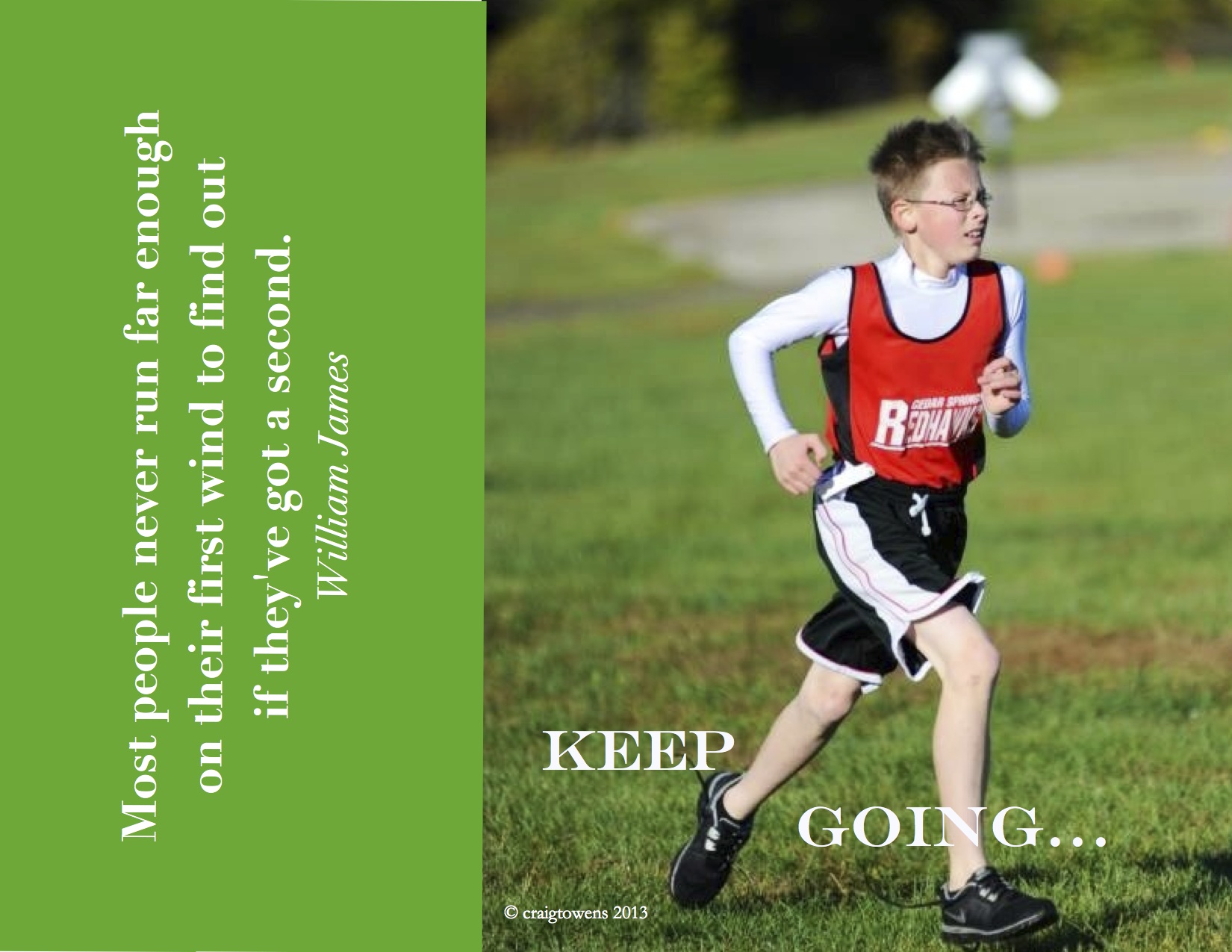
“Most people never run far enough on their first wind to find out if they’ve got a second.” —William James

When things go wrong, as they sometimes will,
When the road you’re trudging seems all uphill,
When the funds are low but the debts are high,
And you want to smile but you have to sigh,
When care is pressing you down a bit…
Rest if you must, but don’t you quit!

Life is queer with its twists and turns,
As every one of us sometimes learns,
And many failures turn about
When we might have won had we stuck it out.
Don’t give up though the pace seems slow…
You may succeed with another blow.

Often the struggler has given up
When he might have captured the victor’s cup;
And he learned too late when the night came down,
How close he was to the golden crown.

Success is failure turned inside out…
And you can never tell how close you are
It may be near when it seems so far.
So stick to the fight when you’re hardest hit
It’s when things seem worst that you must not quit. —Edgar A. Guest

Growing Pains

Listen to the podcast of this post by clicking on the player below, and you can also subscribe on AppleSpotify, or Audible. 

I remember when I was a teenager having such an ache in my legs at night. I’d be laying on my bed trying to sleep, but I couldn’t get comfortable because of that dull, unrelenting ache in my legs. I’d go ask my Mom what was going on, and her reply was simple: “Those are growing pains.”

In order to grow in any area of our lives—physically, emotionally, mentally, relationally—we have to go through a certain amount of pain.

No pain, no gain.

The process is not always a lot of fun, but that’s why we have to keep our eyes on the goal. The process may not be something we like, but the end results will make the pain worth it.

For instance, you may not like dieting but you like the weight loss or lower cholesterol numbers, so you stick with it. You may not like saying, “I’m sorry, I was wrong, please forgive me” but you like the healed relationship, so you say it.

Throughout the New Testament the phrase one another is frequently used to address how members of the Body of Christ should relate to each other. God desires that all of us operate interdependently with one another. In order to get there, we must get ready for some growing pains!

In Ephesians 4:2, Paul tells us what is required to get to a place of unity and maturity in the Church:

  • Be completely humble (the King James Version says lowliness). This Greek word means not letting our thoughts rise far from the ground. In other words, we are thinking of ourselves as God thinks of us, not independently as a self-made man or woman, but viewing all of my success as God-appointed. This process toward interdependence starts in our thoughts—in our attitudes about ourselves and about others.
  • Gentle means strength under control. Gentleness says, “I could do this, but for your sake I won’t.”
  • Patient interaction (KJV: longsuffering) with others is allowing them the freedom to grow just as others allowed me the freedom to grow.
  • Bearing with one another in love. Think of a load-bearing wall in a building that is holding up the weight of the roof and walls. When we bear with one another we are helping to share the burdens.

Being humble with ourselves and gentle and patient with others is the way we go through the growing pains of bearing with one another in love. The process may not be a lot of fun, but the end result is something that glorifies God, that’s why we must stick with one another through all our growing pains.

Check out all of the other messages in our series Live Together by clicking here.

►► Would you please prayerfully consider supporting this ministry? My Patreon supporters get behind-the-scenes access to exclusive materials. ◀︎◀︎

March!

Listen to the podcast of this post by clicking on the player below, and you can also subscribe on AppleSpotify, or Audible.

I’m convinced that many of us have missed answers to prayer because the answers seemed “too practical” or required “too much work” from us. Consider the well-known example of the defeat of the city of Jericho as recorded in the Bible.

Jericho was a massive fortress. Archeologists tell us that the city encompassed over eight acres, and was surrounded by walls which were 30-feet tall and 20-feet wide. Joshua was a brilliant military strategist who up to this point had never suffered a defeat. He asks God for help in defeating this fortress, and God tells him, “March!”

That’s it. Not pray, pray, and pray some more. Not go on a 40-day fast. Make no mistake, the Israelites had been in a period of renewed passion and prayer. As they entered Canaan, they sought God, renewed their vow to serve Him alone, and celebrated the Passover just days before encountering Jericho.

Sometimes our prayers have to have feet. 

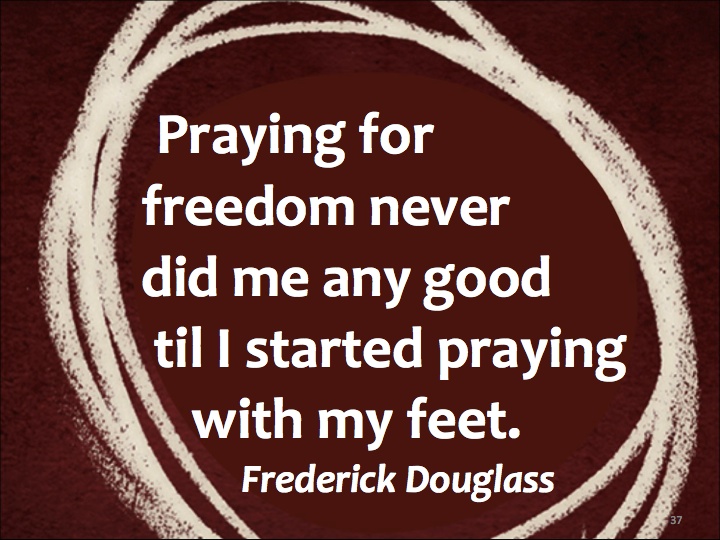
Sort of like abolitionist Frederick Douglass who said, “Praying for freedom never did me any good til I started praying with my feet.”

  • We need to pray for the salvation of our loved ones, and talk to them about Christ.
  • We need to pray for God to open the door for employment, and mail the resume.
  • We need to pray for God’s help on a test, and study hard.
  • We need to pray, and we need to march.

Jericho delieveredI love the verb tense in this story! God told Joshua, “I have delivered Jericho into your hands” (Joshua 6:2). Later on, after the Israelites completed their 13th hike around Jericho, Joshua said, “Shout! For the Lord has given you the city” (v. 16).

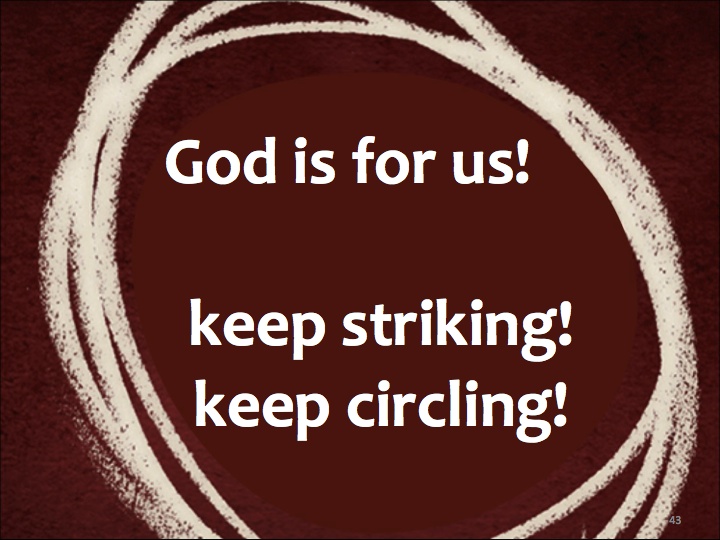
If you are praying for something that is in alignment with God’s Word, then God has given you your Jericho. But you may not see the walls come tumbling down until you march. Keep praying, keep marching, keep circling it in prayer, and watch those walls crumble!

To check out the others messages in this series on prayer called Praying Circles, please click here.

►► Would you please prayerfully consider supporting this ministry? My Patreon supporters get behind-the-scenes access to exclusive materials. Like this exceptional Bible study tool to help with Creation apologetics. ◀︎◀︎

Keep Striking

Keep strikingThere is an unusual story in 2 Kings about King Jehoash. Elisha the prophet was on his deathbed, Israel was morally bankrupt and on the brink of defeat. The entire Israeli army had been reduced to fifty horsemen, ten chariots, and ten thousand infantry. It was in this hour of desperation that Jehoash sought out the counsel of Elisha.

Elisha said [to Jehoash], “Get a bow and some arrows,” and he did so. “Take the bow in your hands,” he said to the king of Israel. When he had taken it, Elisha put his hands on the king’s hands.

“Open the east window,” he said, and he opened it. “Shoot!” Elisha said, and he shot. “The Lord’s arrow of victory, the arrow of victory over Aram!” Elisha declared. “You will completely destroy the Arameans at Aphek.”

Then he said, “Take the arrows,” and the king took them. Elisha told him, “Strike the ground.” He struck it three times and stopped. The man of God was angry with him and said, “You should have struck the ground five or six times; then you would have defeated Aram and completely destroyed it. But now you will defeat it only three times.”

What made Elisha angry is what I believe makes God angry. Jehoash came to God when the situation seemed impossible, but he wouldn’t pray it through. It’s almost as if he felt like three times was enough to pray, and then he needed to take it from there.

God wants us to pray BIG, but He also wants us to pray LONG.

We need to keep striking the ground (or as Mark Batterson would say, keep drawing the circle) until God answers. God gave Jehoash a promise of victory, but Jehoash didn’t pray long enough to see it through.

What are you praying for? What promise has God given you? God is glorified when you place your request in His hands, and leave it there. Keep on praying. Keep on striking. Keep on circling until God brings about what He has promised!

To check out the others messages in this series on prayer called Praying Circles, please click here.

I Want To Be Fascinated

If we are going to stick with anything for the long haul, we have to be fascinated by it. As soon as it becomes boring, humdrum, or monotonous, the downward spiral leading to us throwing in the towel is almost inevitable.

It looks like this:

Inattention → Fizzled passion → Lack of discipline → Quitting

This is bad enough for a diet, exercise routine, or any other healthy pursuit. But it becomes even more painful when this downward cycle occurs in our spiritual life. In that case, the “quitting” is called by another name: Sin.

In Psalm 119, the Beth section (verses 9-16) opens with two contrasting thoughts:

  • How can a young man keep his way pure? By LIVING according to Your Word.
  • I seek You with all my heart; do not let me STRAY from Your commands.

Stray is a passive word. No real attention or foresight is required to wander or meander around. On the other hand, living is an active word. In the Hebrew, this word carries the idea of keeping careful watch; protecting; carefully tending.

So the question that leads to my success is this: What fascinates me? What dominates my thoughts? What motivates me?

The answer to these questions will determine my stick-to-itiveness.

The remaining verses in this section show the upward spiral away from sin if we will keep careful watch over how closely we stick to God’s Word.

  • Living = guarding (v. 9)
  • Seek You with all my heart (v. 10) … Yearning (in the Amplified Bible)
  • Hidden Your Word (v. 11) … Treasured (in the Complete Jewish Bible)
  • → Personal praise (v. 12)
  • With my lips… (v. 13) = verbal, public praise
  • Rejoice (v. 14) … as in more than in any kind of wealth (in the CJB)
  • Meditate (v. 15) = constant companion
  • Delight (v. 16)

When we delight in God’s Word, the cycle is started over again—I will not neglect Your Word—but now with a renewed and intensified PASSION!

I want God’s Word to dominate my thoughts, and its principles to captivate me. I want to be fascinated by my relationship with Jesus Christ that comes through the revelation of the Bible to my heart.

There is no other way to live!

If you have missed any of the messages in our P119 series, you can access them all by clicking here.

Thursdays With Oswald—Obstinacy Or Determination?

This is a weekly series with things I’m reading and pondering from Oswald Chambers. You can read the original seed thought here, or type “Thursdays With Oswald” in the search box to read more entries.

Obstinacy Or Determination?

     It is easy to be determined, and the curious thing is that the more small-minded a man is the more easily he makes up his mind. If he cannot see the various sides of a question, he decides by the ox-like quality of obstinacy. Obstinacy simply means “I will not allow any discernment in this matter; I refuse to be enlightened.” We wrongly call this strong-mindedness. Strength of mind is the whole man active, not discernment merely from an individual standpoint. The determination in a disciple is a comprehending one, “For I determined not to know any thing among you, save Jesus Christ, and Him crucified,” says Paul.

From Facing Reality

     The difference between an obstinate man and a strong-minded man lies just here: an obstinate man refuses to use his intelligence when a matter is in dispute, while a strong-minded man makes his decision after having deliberately looked at it from all standpoints, and when opposed, he is willing to give reasons for his decision.

From Baffled To Fight Better

“The difference between perseverance and obstinacy is, that one often comes from a strong will, and the other from a strong won’t.” —Henry Ward Beecher

So in hanging onto (and defending) what I believe, am I being obstinate or justly determined? 

Hmmm? What do you think?