Sin

I know in politically correct circles it’s not very chic to talk about sin. After all, we’re not supposed to impose our personal values on someone else, right?

Well, I do believe in right and wrong, and the wrong is called sin. So if you are offended by me calling something sin, it would be best for you to stop reading now.

Are you still with me? Then read this: satan…incited David to sin… (1 Chronicles 21:1).

Incited means this wasn’t a straight-up fight. Sin seldom makes a bold, in-your-face attack. Sin isn’t really an ambush. It’s sort of a whispering campaign.

  • Sin is an appeal to ego
  • Sin is a half-truth
  • Sin is an attempt to be subtle
  • Sin is so innocent looking

The Bible says satan lurks like a lion in the underbrush (1 Peter 5:8).

He waits for the perfect opportunity to strike (Luke 4:13).

satan is sneaky (Genesis 3:1).

He lies (John 8:44).

He distorts the truth (Luke 4:9-11).

That’s why I cannot give sin an inch. I have to take every thought captive (2 Corinthians 10:5), and pull everything into the light of The Truth (John 3:20-21).

[Check out all of these verses by clicking here]

It’s not usually the blatant sin that brings down great men and women, but the subtle. So stay on your guard. Always!

Thursdays With Oswald—General Maxims

This is a weekly series with things I’m reading and pondering from Oswald Chambers. You can read the original seed thought here, or type “Thursdays With Oswald” in the search box to read more entries.

General Maxims

     (a) If you lack education, first realize it; then cure it.

     (b) Beware of knowing what you don’t practice.

From Approved Unto God

I know the maxim for some is, “Fake it until you make it.” I can’t do that. I won’t do that. The Bible has a word for doing that: Hypocrisy.

How can you say to your brother, “Brother, let me take the speck out of your eye,” when you yourself fail to see the plank in your own eye? You hypocrite, first take the plank out of your eye, and then you will see clearly to remove the speck from your brother’s eye (Luke 6:42).

But just as bad is when I know what I’m supposed to do, and then make excuses not to do that. The Bible has a word for not doing that: Sin.

Remember, it is sin to know what you ought to do and then not do it (James 4:17).

White As Snow

As I watch the snow falling outside today, slowly covering everything in a pure, unblemished whiteness, the same thought enters my mind every year at the first snowfall. God says,

Learn to do good. Seek justice. Help the oppressed. Defend the cause of orphans. Fight for the rights of widows. “Come now, let’s settle this,” says the Lord. “Though your sins are like scarlet, I will make them as white as snow. Though they are red like crimson, I will make them as white as wool.”

And this line from the great old hymn,

My sin, O the bliss of this glorious thought, my sin, not in part, but the whole, is nailed to the Cross and I bear it no more. Praise the Lord, praise the Lord, O my soul!

Doing good, seeking justice, helping the oppressed, defending orphans, and fighting for widows doesn’t cleanse my crimson sin, but when my sin has been covered I DESIRE TO do these things!

What do you think of the snow?

What do you think of God’s incredible whiteness applied to your life?

Loyalty

Listen to the podcast of this post by clicking on the player below, and you can also subscribe on AppleSpotify, or Audible.

How would you define loyalty? All of the dictionary definitions have to do with faithfulness. It’s almost implied that there is a blindness (at worst), or a dogged persistence (at best), to remain loyal to a person or to an idea. The thinking goes, “If I’m loyal to someone, like it or not, I become their Yes-man.”

But I think…

Loyalty is not telling people what they want to hear, but what they need to hear.

For an example, take the prophet Nathan in the Bible. We don’t know how old he is when he steps on the scene, or even where he came from. There isn’t a clue as to his tribal ancestry or even his father’s name.

King David wanted to build a temple for the ark of the covenant of the Lord, and he asked Nathan about this. Nathan immediately said, “Yes!” (kinda reinforces that idea of loyalty = Yes-man, doesn’t it?) But wait! That night, God speaks to Nathan and says, “Tell David he’s not the one to build the temple for Me.” So Nathan returns to David and loyally tells him no.

Later on, David steals another man’s wife and contrives a plan to have that man murdered on the battlefield. David thinks he’s gotten away with it until Nathan, the loyal friend, shows up to confront David with his sin. Nathan didn’t want to see David fail, but he wanted to give him a chance to confess and repent.

Near the end of David’s life, one of David’s sons, Adonijah, wanted to take the throne for himself. Many of the officials in David’s palace jumped on the bandwagon, but loyal Nathan did not. In fact, Nathan even got word to the King about Adonijah’s plans. As a result, David asked Nathan to anoint his son Solomon as king.

During David’s life, Nathan wrote David’s biography. If Nathan was just a mindless Yes-man, he could have easily left out the messy parts of David’s life. But the loyal friend wanted to show future readers that we all mess up, but God forgives and restores us when we repent.

Nathan’s name means the gift God gave or a giver. Both meanings fit this loyal man.

David was so blessed by Nathan’s loyalty that he named one of his own sons after the prophet.

Loyal friends give their friends the gift of life. They don’t let friends go down a destructive path. They don’t join with others when they attack. They remain constant, always-there, friends.

What a blessing to be called a loyal friend! And what an even greater blessing to have “Nathans” in our own lives!

►► Would you please prayerfully consider supporting this ministry? My Patreon supporters get behind-the-scenes access to exclusive materials. ◀︎◀︎

Lamenting Over The Fallen

How The Mighty Have Fallen! Long before Jim Collins entitled his latest book with this phrase, David said this when King Saul and Prince Jonathan were killed in battle. In fact, he said it not once, but three times in just eight verses.

It is understandable that David would lament the death of his friend Jonathan. They were covenant brothers, they shared the same heartbeat for God and for Israel, and they stood by each other through thick and thin.

But Saul? Why would David lament the death of Saul? This is the man who was jealous of David. So jealous that he did everything he could to trip David up. Including trying to kill him. Saul chased David from his home, from his family, from his wife, even from his country.

Why would David lament Saul’s death? Wouldn’t it be more appropriate to rejoice over it?

But David still saw Saul as “the Lord’s anointed.” David recognized the good in Saul. He called him…

  • the glory of Israel
  • a successful warrior
  • gracious
  • lovable
  • strong
  • Israel’s provider

When David heard Saul had been killed, he lamented, Oh, how the mighty have fallen!

When I see the mighty, God-anointed leader fall, do I lament?

I may shake my head, I may feel vindicated, I may be disgusted, but I don’t know that I have ever lamented or grieved when one of these mighty brothers has fallen. Or if I have, my lament has been short-circuited by other less appropriate emotions.

Despite their sin, they are still God’s anointed.

Who am I to sit in judgment? Who am I to do anything but lament their fall?

Lord, forgive me! Father, help me to see Your anointed ones in the proper perspective: as Your anointed. Holy Spirit, remind me of the tragedy of even one mighty one who falls. May my response be one of lament, and mercy, and prayer.

I Am The Judas

I received this email from a trusted ministry partner today and thought it was so impactful that I wanted to pass it along. The author of this story is a missionary in a heavily Muslim country.

Hassan has been a friend and confidant for ten years. He came to know the Lord as a refugee in Eritrea before moving back to the country I’m in looking for work. He started working with us as a teacher at one of our English centers, and over time rose up through the ranks to become its director. Personable, caring, charismatic, and intelligent, Hassan grew the center and it now ministers to over 500 people on a daily basis.

Different people on our team have interacted with Hassan over the years in his home, on ministry trips, and at the small Bible study that he led for other believers from a Muslim background. Many of us can point back to times of sweet fellowship, worship, praise, prayer, and ministry. I have seen Hassan cry real tears in the presence of the Lord.

Three months ago we discovered Hassan stole tens of thousands of dollars from the ministry center. Time revealed that he has taken a second wife, more time revealed he actually has three wives, is possibly a security informant (he knows everything about us), and allegedly paid other Muslims to pretend they were believers to widen the deception.

I am of two hearts on this. On one side I wonder how Hassan could live in both worlds so convincingly. I also realize that I am just as skilled an actor, I have two faces. I can move from praise and legitimate worship to carnality in a moment. I can read my Bible and my eyes mist up at some discovery of Jesus, and then rise up out of my chair to yell at my sons. I can stand in the pulpit and scan the audience for pretty ladies.

I am the “Judas” in the midst. Oh Lord, have mercy on me. O Lord, have mercy on us all.

May we take this word to heart and all take a deep look in our heart—

Search me, O God, and know my heart; test me and know my anxious thoughts. See if there is any offensive way in me, and lead me in the way everlasting. (Psalm 139:23-24)

Therefore let anyone who thinks he stands [who feels sure that he has a steadfast mind and is standing firm], take heed lest he fall [into sin]. (1 Corinthians 10:12)

Anger That Crosses The Line

Last night in our Bible study we looked at some words that David penned when he was angry. He was on the run from his son Absalom, and it seemed like everywhere he turned people were after him, or slandering him, or just doing their best to make him miserable. Yet in two back-to-back Psalms David says, “I lay down every evening and get a great night of rest.”

His sweet sleep comes from a moment of reflection before dozing off. He says:

In your anger do not sin; when you are on your beds, search your hearts and be silent. Selah.

  • Did my anger today cross the line into sin?
  • Am I allowing the time for the Holy Spirit to search my heart?
  • When the Holy Spirit points out where my anger crossed the line, do I justify my anger, or am I silent?

How do we know if our anger has not crossed that line and become sin?

Aristotle wrote, “Anybody can become angry—that is easy; but to be angry with the right person, and to the right degree, and at the right time, and for the right purpose, and in the right way—that is not within everybody’s power and is not easy.”

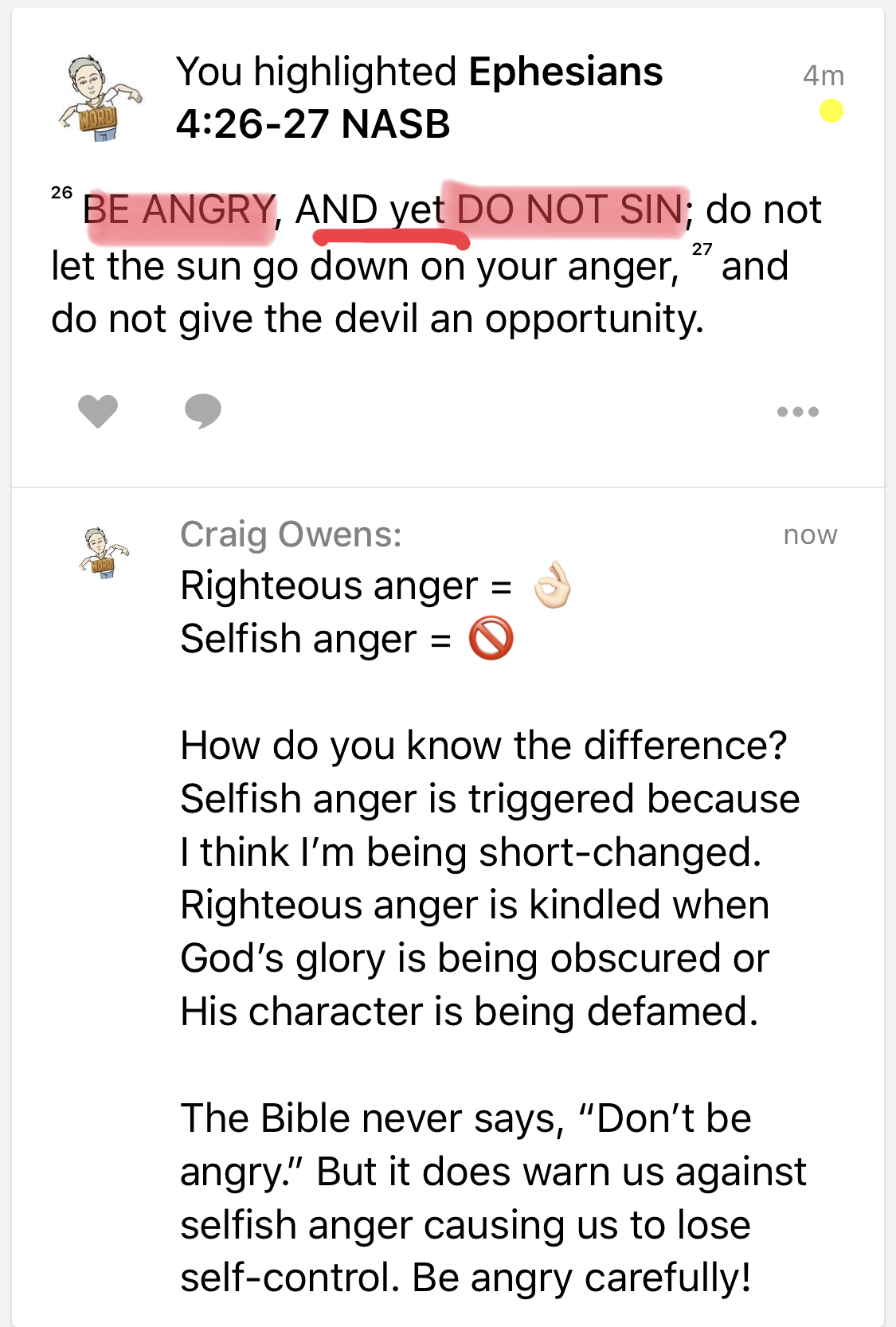
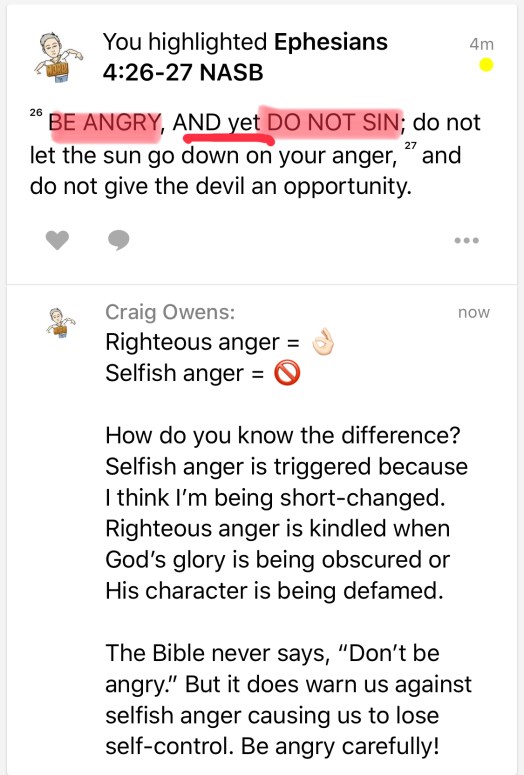
Being angry is not the issue. David said it (and Paul quoted it in Ephesians 4:26): “Be angry; just don’t sin.” God gets angry, but He does not sin. Jesus, in His public ministry, got angry, but He did not sin. We need to search our hearts to make sure our anger has not crossed the line to sin. We have to be angry in a godly way.

I see at least four ways to become angry without crossing the line into sin:

1.  Selfless Anger = anger at sin, but not angry at the sinner.

Love is not rude, it is not self-seeking, it is not easily angered, it keeps no record of wrongs. Love does not delight in evil but rejoices with the truth. (1 Corinthians 13:5, 6)

2.  Slow Anger = lengthen your fuse a bit.

Do not be quickly provoked in your spirit, for anger resides in the lap of fools. (Ecclesiastes 7:9)

My dear brothers, take note of this: Everyone should be quick to listen, slow to speak and slow to become angry, for man’s anger does not bring about the righteous life that God desires. (James 1:19, 20)

Good advice from Thomas Jefferson: “When angry, count to ten before you speak; if very angry, a hundred.”

3.  Protective Anger = when sinners entice others to join them in their sin. God is sad when people leave Him; He is angry at them when they take others with them.

But they put God to the test and rebelled against the Most High; they did not keep His statutes. Like their fathers they were disloyal and faithless, as unreliable as a faulty bow. They angered Him with their high places; they aroused His jealousy with their idols. When God heard them, He was very angry; He rejected Israel completely. (Psalm 78:56-59)

4.  Righteous Anger = against those who are keeping others from coming closer to God.

For I endure scorn for Your sake, and shame covers my face. I am a stranger to my brothers, an alien to my own mother’s sons; for zeal for Your house consumes me, and the insults of those who insult You fall on me. (Psalm 69:7-9)

This verse was recalled by Jesus’ disciples when they saw Him get angry and clear out the Temple in Jerusalem. Jesus was angry because of the religious clutter that was keeping God’s house from being a house of prayer for all nations.

I think everyone is familiar with the acrostic WWJD = What Would Jesus Do?

I’d like to propose something similar: WGGA = Would God Get Angry?

This is a great question to ask to make sure our anger does not cross that line into sin. Get angry—in a godly way—and do not sin.

The Immunization Of Tears

The Israelites had such a predictable pattern —

Loving God

Slipping away from Him

Sin

Oppressed by an enemy

Remorse & repentance

God’s deliverance

Return to loving God

Repeat


In the book of Judges there is a repeated phrase: But when they cried out to the Lord, He raised up for them a deliverer.

Perhaps is they cried in God’s presence more often, they cycle could have been broken.

It’s the same for us — instead of using tears as a cure, how about using them as an immunization? How about crying in God’s presence before sin has cruelly oppressed us?

I think if I shed tears over my “little” sins more frequently, it would keep me from much deeper hurts.

The Bible says, “A broken and contrite heart, O Lord, You will not ignore.” Holy Spirit, break my heart over the smallest of sins so I may quickly repent and return before I am enslaved by my sins.

I believe tears call God to our help, but how much better if they are used to immunize us against sin!

A Slight Case Of The “Ites”

As the Israelites were attempting to settle in the Promised Land, there is a repeated phrase, “They could not drive out the ites.” (The “ites” are people like Canaanites, Hivites, Jebusites, etc.) God told them that they should completely clear the land of the ites, but they didn’t. Instead, they just subjected them to forced labor.

Oops! These small ites eventually became the downfall of Israel. The ites continued to practice their pagan worship observances, and eventually enticed the people of Israel to join them. As a result, Israel was humiliated, defeated, and carried off into captivity.

Can I make a parallel to our lives?

The Promised Land is a Christ-follower’s life in Christ. The ites are our sinful tendencies.

I know the ites are there, but it seems so difficult to remove them: the Bible uses the phrase they were determined to live in that land. So the ites are allowed to coexist, and I determine to use my willpower to make sure they stay contained.

After awhile the ites have behaved themselves. They seem harmless enough. In fact, I’ve gotten so strong, so mature, in my Christian faith, I know I’ll never give in to the pull of the ites again. I can relax a little bit now.

But the ites wait. They bide their time. They find just a crack to slowly worm their way in. Then when I am at a vulnerable time, they strike. The slave becomes the master. The ites retake possession of my life.

Willpower will not work. Only complete elimination will work.

God will help you if you will let Him.

  • What ites are you trying to hold down by sheer willpower?
  • What ites do you tolerate now that you didn’t tolerate earlier in your faith walk?
  • Do you think you are immune to some ites now that you are more mature?

The Bible’s warning is loud and clear:

These are all warning markers—danger!—in our history books, written down so that we don’t repeat their mistakes. Our positions in the story are parallel—they at the beginning, we at the end—and we are just as capable of messing it up as they were. Don’t be so naive and self-confident. You’re not exempt. You could fall flat on your face as easily as anyone else. Forget about [willpower]; it’s useless. Cultivate [God-power].

A slight case of the ites is a serious thing! Don’t let it continue!

Says Who?

The book of Joshua is full of military campaigns, but there are two battles that are given significant “ink”—where we get an insight into the strategy, the battle itself, and the final outcome. They are the first two battles: Jericho and Ai.

They both ultimately ended in total victory for the Israelites, but the path to victory was starkly different.

Length

  • Jericho: a week-long campaign
  • Ai: a 3-day campaign

Strategy

  • Jericho: the Israelites surrounded the city
  • Ai: the Israelites made a direct frontal assault, followed by a feint and a rear ambush

Casualties

  • Jericho: 0
  • Ai: 36

I believe the difference can be traced to the planning stage:

Planning

  • Jericho: the Lord said to Joshua…
  • Ai: when the spies returned to Joshua, they said

I know that someone will say, “Hold on, Craig! It was Achan’s sin that caused the initial defeat at Ai.” And I wouldn’t disagree with you. But perhaps if Joshua had heard from the Lord before attacking Ai, God would have told him about Achan’s sin.

NO OTHER CASUALTIES are mentioned in the entire book! Thirty-six people died because Joshua listened to other men instead of God.

So that leads me to ask… Who am I listening to? Who are you listening to?