Listen to the podcast of this post by clicking on the player below, and you can also subscribe on Apple, Spotify, or Audible.
Godly leaders are always striving to use their leadership power to serve others. What exactly does this look like? On a recent Craig And Greg Show episode, Greg and I discussed this important leadership tension.
Check out the full Craig And Greg Show episode here.
Listen to the podcast of this post by clicking on the player below, and you can also subscribe on Apple, Spotify, or Audible.
Although Jesus spoke these words to His followers 2000 years ago, they are especially important to all of His followers who are awaiting His imminent return—
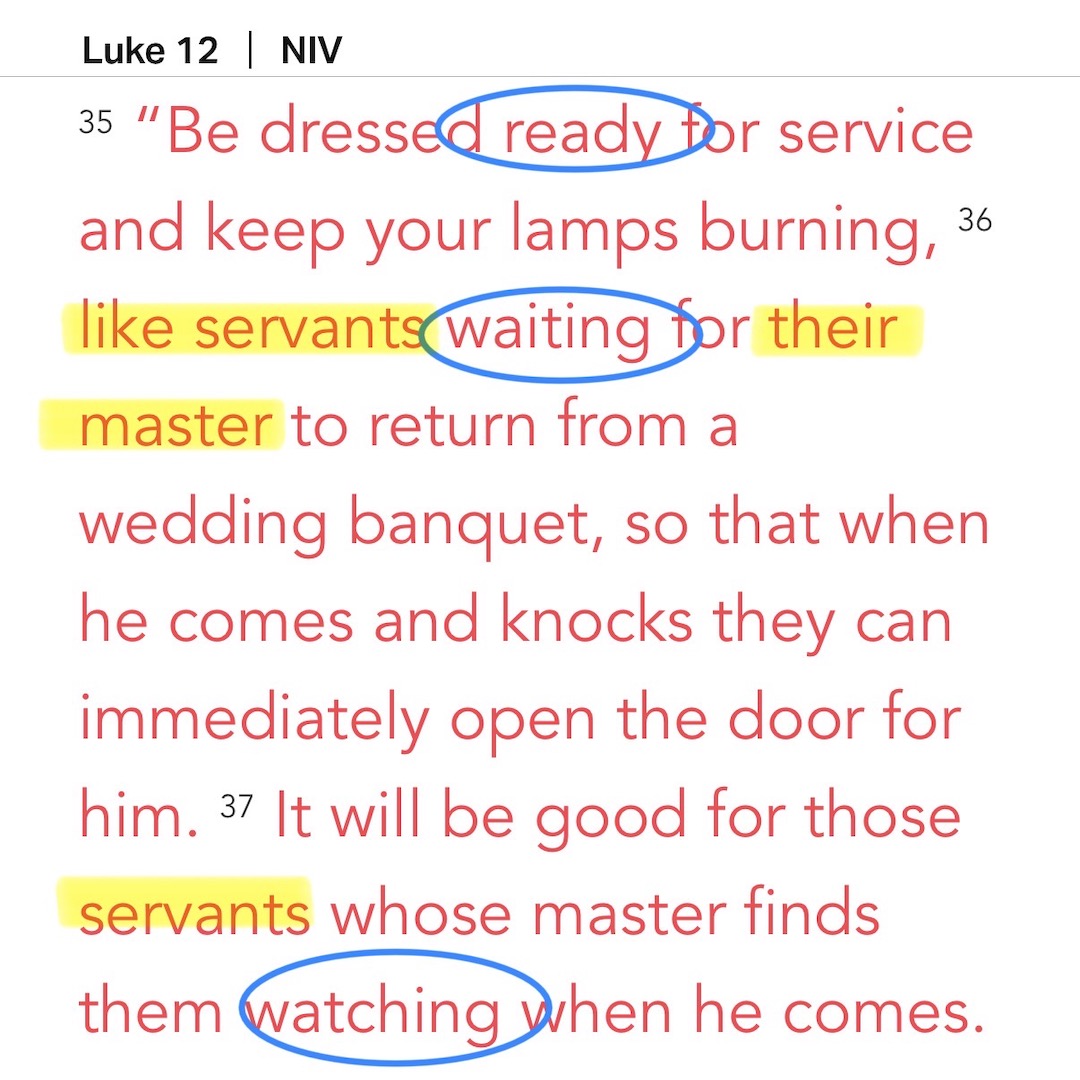
Be dressed ready for service and keep your lamps burning, like servants waiting for their master to return from a wedding banquet, so that when he comes and knocks they can immediately open the door for him. It will be good for those servants whose master finds them watching when he comes. Truly I tell you, he will dress himself to serve, will have them recline at the table and will come and wait on them. It will be good for those servants whose master finds them ready, even if he comes in the middle of the night or toward daybreak. But understand this: If the owner of the house had known at what hour the thief was coming, he would not have let his house be broken into. You also must be ready, because the Son of Man will come at an hour when you do not expect Him. (Luke 12:35-40)
There are three words that stand out to me: ready, waiting, and watching.
Ready is an adjective describing the Christian servant. Its etymology is from the noun meaning “fitness.” So the ready servant has all that he needs at hand. He is prepared for every opportunity, ready to serve and to receive whomever his Master sends him.
Waiting is a verb that is in the present tense. That means it is something we always have to be doing. The prefix of this Greek word—like the adjective for “ready”—also means that everything that we need to serve is close by and ready to be used, and the root word is to give hospitality. So the waiting servant is waiting with a purpose: always ready to serve at a moment’s notice.
Watching is also a present tense verb. This word means that we are giving undivided attention to the task that has been given us.
Jesus was addressing His disciples, but these words are still for you and for me. At every moment we need to be fit to serve, with all that we need close at hand for every opportunity God sends our way.
I want to be occupied in my heavenly service until the very moment Jesus returns to earth or calls me Home. There are no off days. There is no time to waste on frivolous matters, but I need to be solely focused on only doing what matters for eternity.
Will you join me in serving like this? We lead others to Jesus by serving those Jesus puts in our life. And as we do that, we serve our Master as well.
Listen to the podcast of this post by clicking on the player below, and you can also subscribe on Apple, Spotify, or Audible.
I was sitting with a couple of ladies in our school district who were trying to figure out the logistics for a food distribution program. I was offering them a couple of suggestions when one of them asked me, “Have you ever had any experience with something like this?”
I told her that I had, and then she responded, “But this is going to be pretty big. Probably about 40 families.”
I smiled and told her that the food distribution program I helped coordinate fed nearly 5000 people.
She said, “Well, I guess we don’t have to worry anymore!” And from then on, whenever any logistical concerns came up, these ladies confidently handed off the situation to me. Once they knew that I had some relevant experience, they didn’t have any more moments of questioning.
Unlike Jesus, I didn’t create all of the food from a few loaves and fish. I simply organized the distribution of the food others had donated. I am glad these ladies had confidence in me, but at the same time, I had to guard my heart against the pride that can so easily puff up my ego.
Can you imagine if you were one of the disciples of Jesus, and had seen all of the miraculous things He had done and heard all of the profound things that He had said, and then still had the audacity to ask, “Who is the greatest”?!
And yet that is exactly what they did (Mark 9:33-35).
How in the world could they argue about something like this when Jesus was right there with them? Maybe this thought finally sunk in a little because later on they pivoted a bit in their argument to ask who was the greatest after Jesus (Matthew 20:20-28).
Jesus minced no words and left nothing vague in His answer: “Anyone wants to be first must be the very last, and the servant of all” (Mark 9:34).
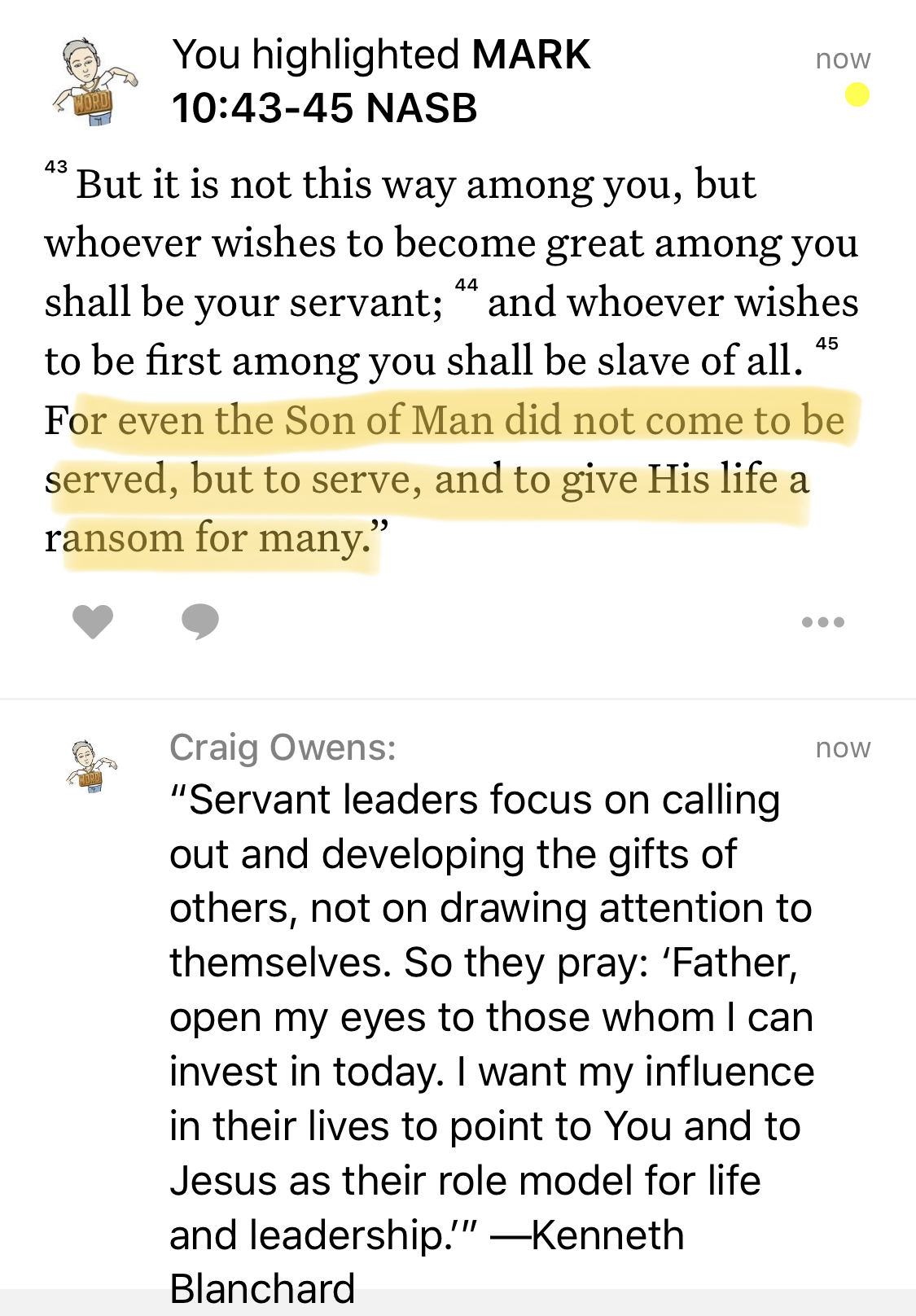
This is exactly what Jesus embodied. He literally lived and died to prove that the highest greatness is measured by the lowest of servanthood.
…Christ Jesus: Who, being in very nature God, did not consider equality with God something to be used to His own advantage; rather, He made Himself nothing by taking the very nature of a servant, being made in human likeness.And being found in appearance as a man, He humbled Himself by becoming obedient to death—even death on a Cross! (Philippians 2:5-8)
The very last. Jesus made Himself nothing.
Not above some and beneath some, but the servant of all.
A mark of a godly leader is one who strives to be last.
Not: “I am second.” But: “I am last.”
This is not just a declaration, but it is a declaration followed by a lifetime of submitting and serving. Not trying to lead others, but trying to out-serve all.
This is part 74 in my series on godly leadership. You can check out all of my posts in this series by clicking here.
Listen to the podcast of this post by clicking on the player below, and you can also subscribe on Apple, Spotify, or Audible.
I read something which is really challenging my leadership paradigm. It’s a challenge to look at successful organizations through the lens of both a servant-hearted leader and a servant-hearted follower.
Listen to the podcast of this post by clicking on the player below, and you can also subscribe on Apple, Spotify, or Audible.
T.M. Moore is an esteemed theologian and a good friend. I was excited to discover someone who shared my passion for viewing pastoring as “pasturing”—seeing ourselves as under-shepherds following The Chief Shepherd Jesus.
Listen to the audio-only version of this podcast by clicking on the player below, or scroll down to watch the video.
Accepting a new position is a very exciting experience! Whether it’s a promotion in your current organization or an opportunity elsewhere, it’s very tempting to want to immediately throw your full attention into the next project. In this episode, Greg and I discuss the necessity of maintaining a balance between that excitement and recognizing that the people on your team now still need your leadership. This might create more work for you in the short term, but the long-term benefits of transitioning well will be huge for you!
[0:33] Any fresh starts for leaders have to be handled thoughtfully.
[2:44] Leaders of integrity give their best effort all the way to the end.
[4:08] How can we maintain a humble attitude when we have been selected to be promoted to a new position?
[6:08] There are different things to keep in mind when moving to a new position in the same organization vs. moving to a new organization.
[8:02] Both of us share stories about friends who benefitted by leaving their old organizations well, and they identify what the true litmus test for leaving well is.
[10:14] Greg also has a negative example to share.
[11:03] How do senior leaders handle coworkers who leave poorly?
[13:06] How do we keep ourselves from being distracted by our new position while we attempt to finish well in our old position?
[16:15] How do we arrive well in our new position?
[18:35] We need to always keep in mind that we are leaving or joining a team of many—we aren’t a team of one.
[22:57] Finishing well is a compliment to the organization you are leaving, and beginning well is a compliment to the organization you are joining.
Check out this episode and subscribe on YouTube so you can watch all of the upcoming episodes. You can also listen to our podcast on Spotify and Apple.
Listen to the podcast of this post by clicking on the player below, and you can also subscribe on Apple, Spotify, or Audible.
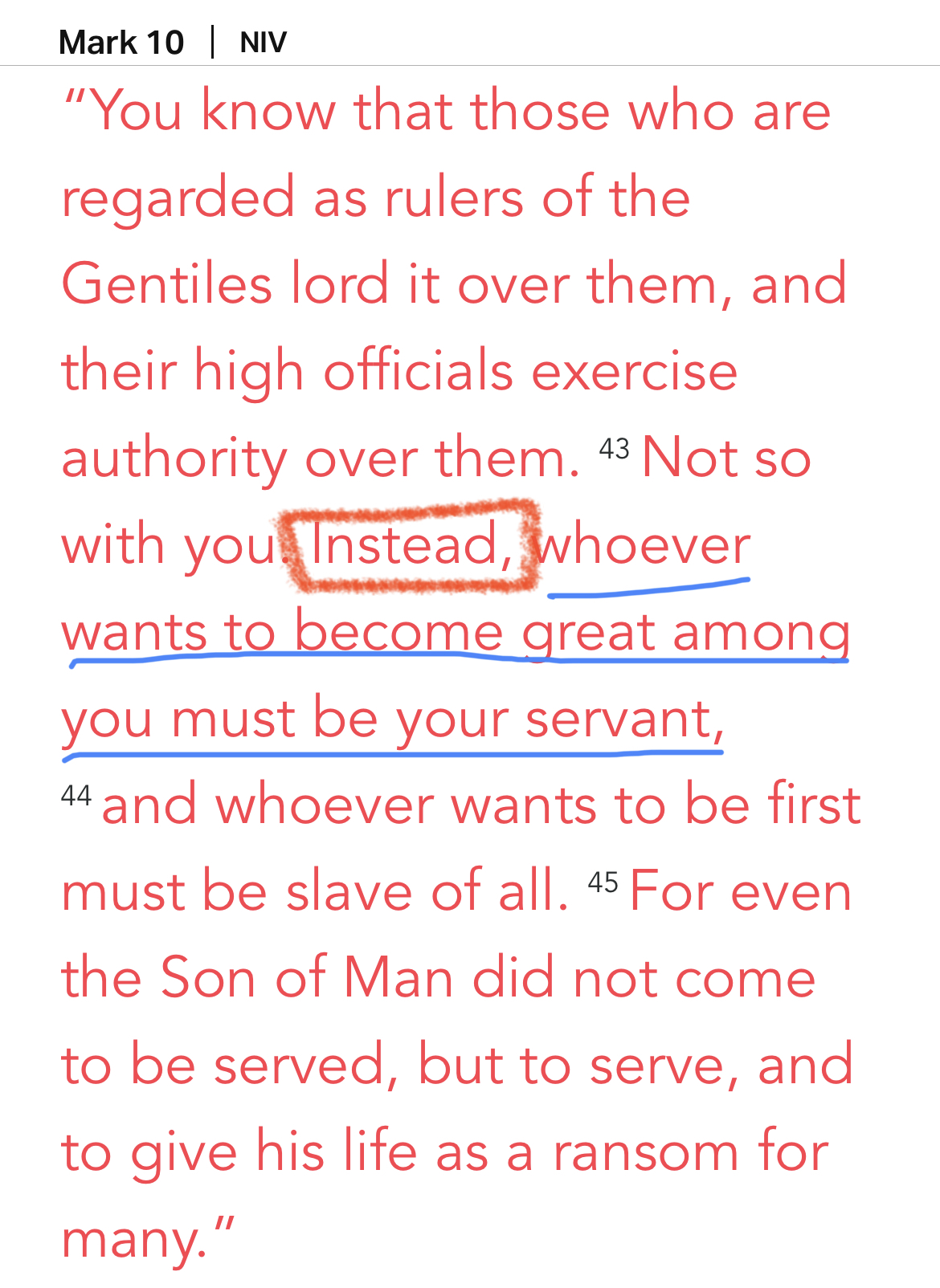
So Jesus called them together and said, “You know that the rulers in this world lord it over their people, and officials flaunt their authority over those under them. Not so with you. Instead…” (Mark 10:42-43).
A Christlike leader is an “instead” leader.
Instead of exercising authority, exercising humility.
Instead of being served, serving everyone else.
Instead of being first in line, being last in line.
Instead of seeking recognition, seeking anonymity.
Instead of collecting titles, collecting calluses.
Instead of receiving, giving.
Jesus, help me to be an “instead” leader—to strive to more consistently lead like You.