Radical Together (book review)

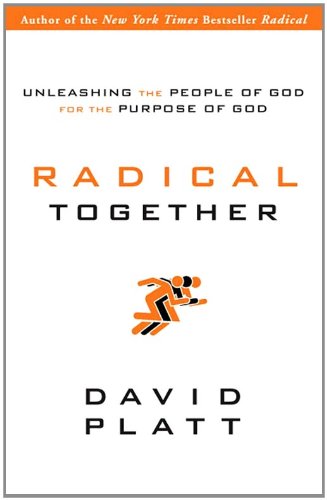
In Radical Together, David Platt follows up on his book Radical by focusing on how followers of Jesus need to rethink the purpose of the church.

Throughout the book, David continually challenges the age-old paradigms of “church,” and he calls on Christians to return to a more biblical approach to living out their faith. Some of my favorite wake-up calls come in these quotes:

“So we decided to stop planning, creating and managing outreach programs and to start unleashing people to maximize the ministry opportunities God had already planned and created for them.”

“Be careful not to let programs in the church keep you from engaging people in the world with the Gospel.”

“Discussions in the church more often revolve around what we want than what [God] wills. Almost unknowingly, the church becomes a means of self-entertainment and a monument to self-sufficiency.”

And he also addresses pastors specifically in the way they lead their churches. One quote from David really caused me to pause—

“The Bible is not in a church leader’s hands so he or she can give people answers to every question they have and guidance for every situation they face. Instead, the Bible is in a church leader’s hands to transform people into the image of Christ and to get people in touch with the Holy Spirit of God, who will not only give them counsel for every situation they face but will also walk with them through those situations. And when church leaders use God’s Word for this purpose, then church members develop a healthy dependence on God’s Spirit and a healthy admiration of God’s glory.”

Although Radical Together was really written as a sequel to Radical, I didn’t read the first book. With that being said, I didn’t feel like I was only getting part of the story, as Radical Together clearly stands alone.

If you are tired of same-old-same-old church, Radical Together just might be the wake-up call that you need.

I am a Multnomah book reviewer.
An Unabashed Appeal To Join Religion And Government

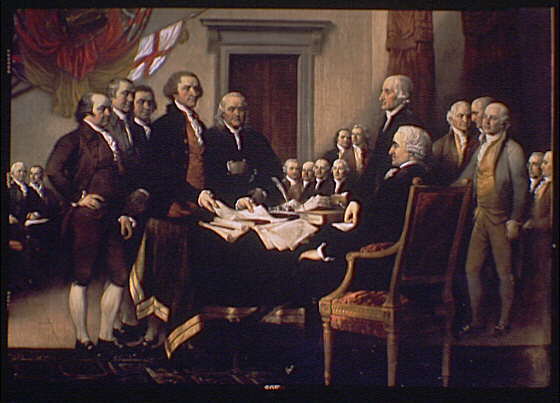
Talk about taking a passing remark out of context! In a personal letter, Thomas Jefferson mentions how church and state should be separate. But I’m convinced where we’ve ended up is no where close to what he intended! I’m so tired of historical revisionists trying to convince us that biblical values and Judeo-Christian ethics had no place in the founding of our nation. Or—worse yet—that they have no place now. Consider these founding remarks…

“…Having undertaken, for the Glory of God, and advancements of the Christian faith and honor of our King and Country, a voyage to plant the first colony in the Northern parts of Virginia….” —Mayflower Compact

“And for the support of this Declaration, with a firm reliance on the protection of Divine Providence….” —Declaration Of Independence

“I have lived, Sir, a long time; and the longer I live the more convincing Proofs I see of this Truth, That God governs in the Affairs of Men!—And if a Sparrow cannot fall to the Ground without His Notice, is it probable than an Empire can rise without His Aid? — We have been assured, Sir, in the Sacred Writings, that ‘except the Lord build the House, they labor in vain that build it.’ I firmly believe this; and I also believe that without His concurring Aid we shall succeed in this political Building no better than the Builders of Babel…. I therefore beg leave to move, That henceforth Prayers, imploring the Assistance of Heaven, and its Blessing on our Deliberations, be held in this Assembly every Morning before we proceed to Business.” —Benjamin Franklin, Constitutional Convention

It is impossible to rightly govern a nation without God and the Bible.” —George Washington

“Suppose a nation in some distant Region should take the Bible for their only law Book and every member should regulate his conduct by the precepts there exhibited! What a Utopia, what aParadise would this region be.” —John Adams

And, of course, the quotes could go on and on and on. But one of my favorites:

“Yes, if our religion had more to do with our politics; if, in the pride of our citizenship, we had not forgotten our Christianity; if we had prayed more and wrangled less about the affairs of our country, it would have been infinitely better for us at this day.” —John Mitchell Mason (1770-1829), in his book published in 1800

Happy Birthday, America! May GOD bless you!

The Pastor And The Holy Spirit

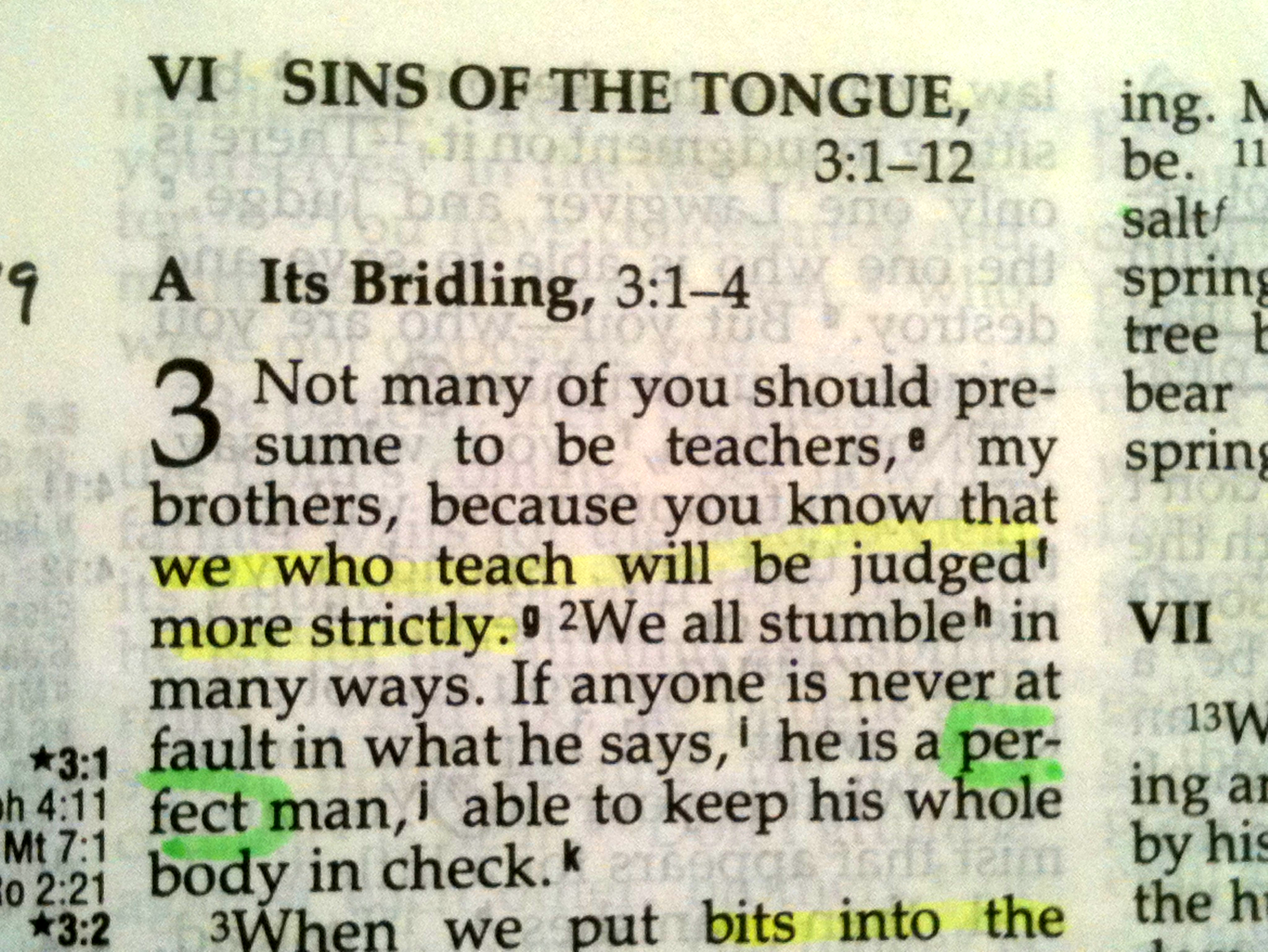
I’m sure I’m not the only pastor that feels occasionally (all right: frequently) overwhelmed by the heavy responsibility of sharing God’s Word with others. After all, the Apostle James said it pretty clearly: Not many of you should presume to be teachers, my brothers, because you know that we who teach will be judged more strictly (James 3:1).

“Judged more strictly”? Yikes!

But I take great consolation in knowing that if God called me, He will equip me. Just as He did with Jeremiah—The Lord reached out His hand, then He touched my mouth and said, “I am giving you the words to say” (Jeremiah 1:8)—I know He will do for me.

I also draw great confidence in knowing the Holy Spirit is helping me. Check out these words from Francois Fénelon:

“Of what efficacy would be the exterior word of pastors, or even the Scriptures themselves, if we had not within the word of the Holy Spirit giving to others all their vitality? The outward word, even of the Gospel, without the fecundating, vivifying, interior word would be but an empty sound. It is the letter that alone kills (2 Corinthians 3:6), and the Spirit alone can give us life.”

Then A.B. Simpson shares this encouraging story of the Holy Spirit’s help:

“They that possess this power will not always be popular preachers, but they will always be effectual workers. Sometimes the hearer will almost think that they are personal, and that someone has disclosed to them his secret sins. Speaking of such a sermon, one of our most honored evangelists said that he felt so indignant with the preacher under whom he was converted that he waited for some time near the door for the purpose of giving him a trashing for daring to expose him in the way he had done, thinking that someone had informed on him. Let us covet this power. It is the very stamp and seal of the Holy Spirit on a faithful minister.”

YES! I do covet this power of the Holy Spirit in my life. Without His help, I would be fearful to ever open my mouth to speak to others about the things of God.

My People

The prophet Jeremiah is often called “the weeping prophet.” Perhaps if we wept a bit more over the lost souls who are staggering toward Hell, we would be compelled to do more to rescue them.

What I love about Jeremiah is his identification with lost humanity. God called Jeremiah to be His prophet, so if anyone could have the opportunity to feel special or superior, it might be Jeremiah. But when the prophet heard about the approaching judgment, he called the residents of Jerusalem my people. Did you get that: MY people.

Not only did he call them my people, but his heart broke for them:

  • My heart is faint within me (Jeremiah 8:18)
  • I am crushed (8:21)
  • I mourn … horror grips me (8:21)
  • I weep day and night (9:1)
  • I weep and wail and take up a lament (9:10)

In Soul Work, Randy Harris has a passage that has been pounding on my heart—

Why don’t we cancel all those [church] meetings and make a field trip to the laundromat and the bars and the streets and listen to what makes sinners tick until we love them. I don’t mean try to convert anybody; I mean listen to them until we love them. Listen until we find ourselves in them. Listen to what they’re afraid of, listen to what they hope for, listen to what hurts, until we love them. And then we can try to be the church again. (emphasis added)

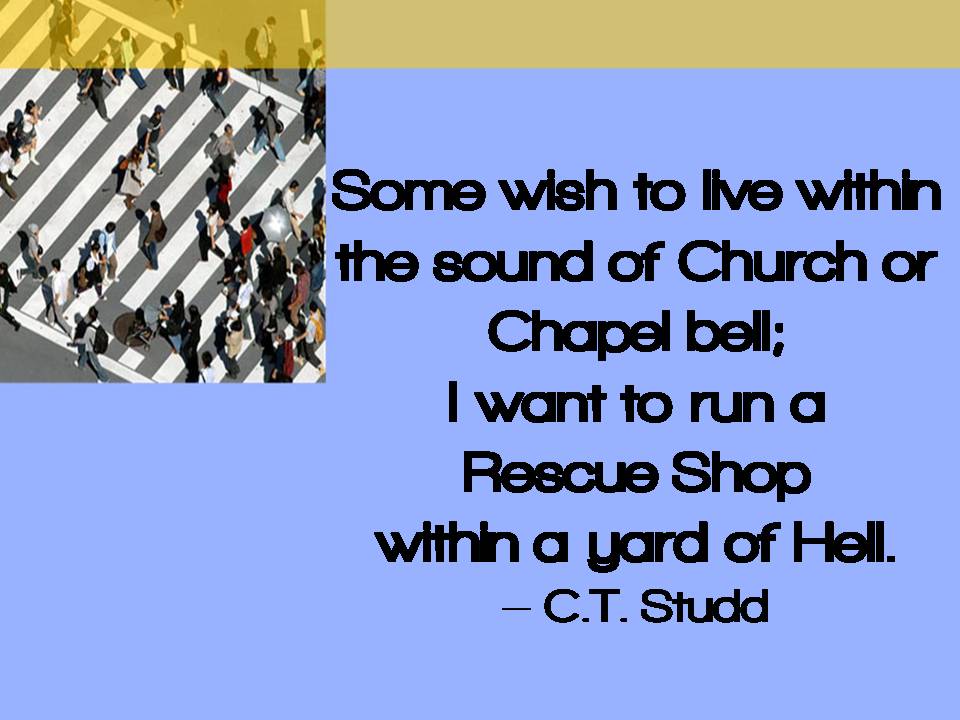
Or as C.T. Studd famously said:

“Some wish to live within the sound of Church or Chapel bell;

I want to run a Rescue Shop within a yard of Hell.”

What’s Your Take On “Church”?

Here’s what I want to see…

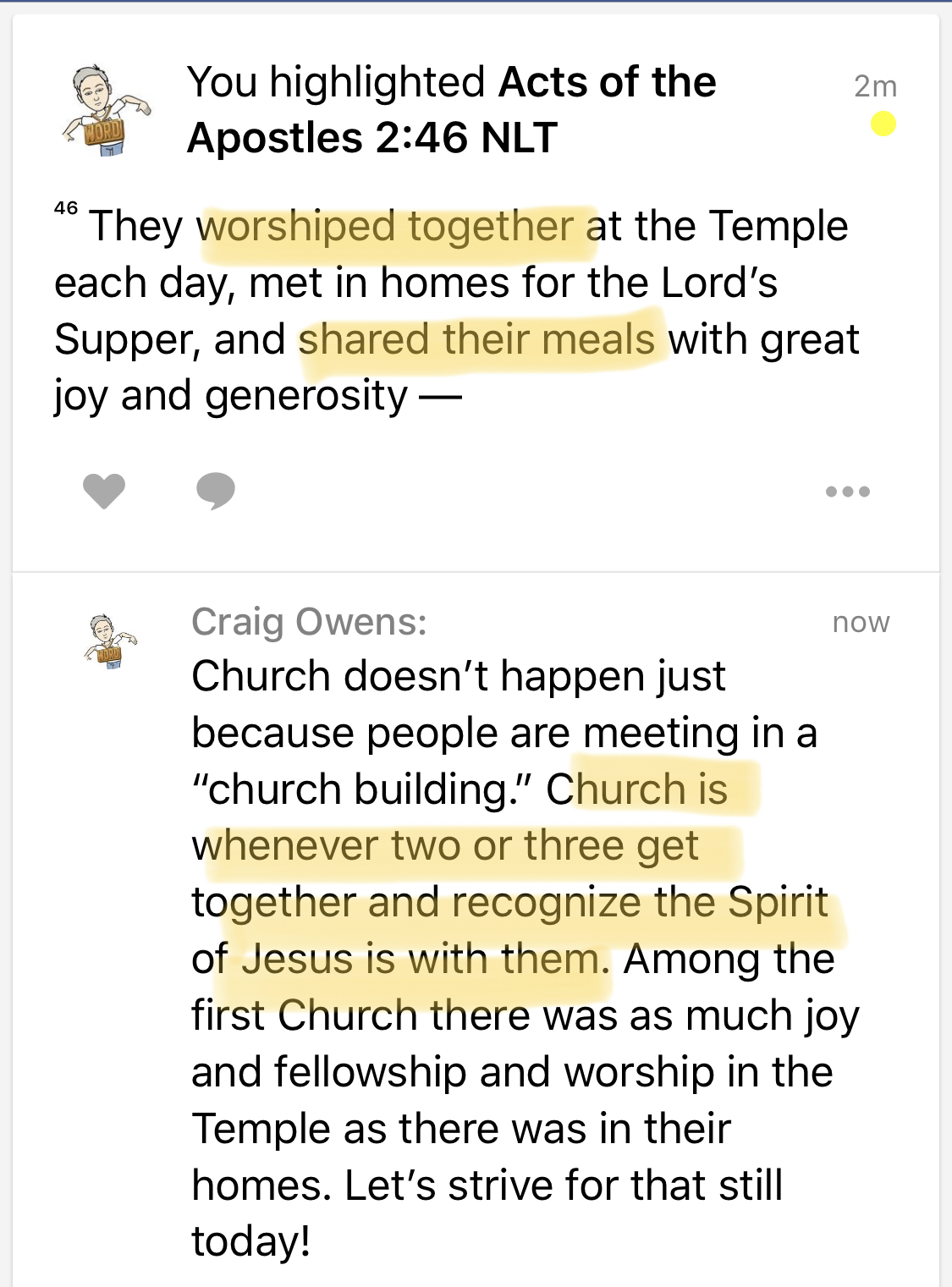
From the book of Acts:

All the believers devoted themselves to the apostles’ teaching, and to fellowship, and to sharing in meals (including the Lord’s Supper), and to prayer. A deep sense of awe came over them all, and the apostles performed many miraculous signs and wonders. And all the believers met together in one place and shared everything they had. They sold their property and possessions and shared the money with those in need. They worshiped together at the Temple each day, met in homes for the Lord’s Supper, and shared their meals with great joy and generosity—all the while praising God and enjoying the goodwill of all the people. And each day the Lord added to their fellowship those who were being saved. (Acts 2:42-47, New Living Translation)

Here’s how N.T. Wright puts it:

“The life of believers, individually and collectively, is intended to incarnate the biblical reality of human dignity. The church is called to be an alternative society, living in contrasting style in the midst of the world. Its members are, in God’s design, not self-promoting, as the world is; they are not competitive, as the world is; they do not advance at the expense of others, as the world does; they do not take advantage of the weakness of others, as the world does. They love one another and do good to and for one another. Failing that, there is no compelling reason for the world to pay attention. Which is to say that the only means by which Christians can commend a truly godly vision of human rights is to incarnate them in their individual and collective lives, to announce God’s actions and intentions that constitute the Gospel, and to act justly in the name of God.”

And Rubel Shelly’s take:

“It is a mistake of monumental proportions to think that the priestly ministry of the church is a Sunday-focused event. It is the whole life of the whole church that is our living-body sacrifice to the Lord. Sunday praise is to be joined with Tuesday work and Thursday golf, Wednesday family life and Saturday yard work. Everything in the life of a Christian is to be seamless in terms of its appropriateness for displaying the excellence of God’s heart and character.”

What’s your take?

Thursdays With Oswald—Stay Away From Controversies

This is a weekly series with things I’m reading and pondering from Oswald Chambers. You can read the original seed thought here, or type “Thursdays With Oswald” in the search box to read more entries.

Stay Away From Controversies

     That is the danger of putting theology first; it leads a man to tell a lie in order to be consistent with his point of view. …In a theological dispute the theologian is apt to put his point of view in the place of God. … Only one man in a thousand can maintain his spiritual life and controvert; he may increase his intellectual vim, but he does not increase his spiritual grasp of things. Dr. Alexander Whyte put this better than any other when he said:

     “…Eschew controversy, my brethren, as you would eschew the entrance to hell itself. Let them have it their way; let them talk; let them write; let them correct you; let them traduce you; let them judge and condemn you; let them slay you. Rather let the truth of God suffer itself, than that love suffer. You do not have enough of the divine nature in you to be a controversialist.”

From Baffled To Fight Better

Augustine prayed: “Heal me of this lust of mine of always vindicating myself.”

When David was attacked he prayed: “I cry out to God Most High, to God, who vindicates me” (Psalm 57:2).

Who cares what others say? Who cares if you “lose” the argument? What does God say? Let Him—and Him alone—vindicate you.

Doing Virtuous Business (book review)

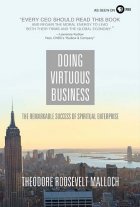
The quote on the front cover of Doing Virtuous Business by Theodore Roosevelt Malloch says it well: “Every CEO should read this book.” I agree!

It seems that our mainstream media has become more and more anti-capitalism and anti-private business. It seems a small — but very vocal — group would prefer that our government oversee every business enterprise. According to Theodore Malloch, nothing could be farther from the biblical way of thinking about business.

By using both real-time examples of virtuous businesses and the wisdom of Scripture, Mr. Malloch makes the strong case that businesses operating on biblical virtues become spiritual enterprises that can benefit all of society. As a former business owner myself, I couldn’t agree more.

A few quotes from the book to whet your appetite—

By creating wealth, we use God’s gifts responsibly, and provided that we work toward that goal in a spirit of humility and gratitude, we benefit all those with whom we deal long the way.

When people join together in an enterprise, they create a new person, the firm itself, which is something greater than the sum of its parts. It, too, has a soul, and if its members honor God, then it, too, honors God.

Profitability comes last among the principles: it is not the primary goal of the company, but the consequence of doing business in the right way, so as to honor God.

A company guided by faith will possess the virtues that I have described in this book: it will have the courage and perseverance to pursue its goals and also the humility, compassion, and forgiveness to guard against arrogance and offensiveness.

This is the first book I have read in quite awhile that deals head-on with the weak arguments the anti-capitalists use. And it does so winsomely, kindly, and quite persuasively. I repeat it again: every CEO should read this book!

I am a Thomas Nelson book reviewer.

Winner Or Whiner?

This morning on John Maxwell’s “Minute With Maxwell” he said: “Winners know they have to do the right thing and then they’ll feel good. Whiners want to feel good before they do the right thing.

I have learned this is true in my life. If I wait until I feel like do something, I’ll make all kinds of excuses to avoid doing it. But if I do what I know I’m supposed to do I’ll feel good that I did it.

Good feelings follow good actions.

Winners do right to feel good.

Whiners wait to feel right before they do anything.

Behavioral psychologist William James wrote: “Action seems to follow feeling, but really action and feeling go together; and by regulating the action, which is under the more direct control of the will, we can indirectly regulate the feeling, which is not. Thus the sovereign voluntary path to cheerfulness, if our cheerfulness be lost, is to sit up cheerfully and to act and speak as if cheerfulness were already there.” (emphasis mine)

So let me ask you: Are you going to be a winner or a whiner today?

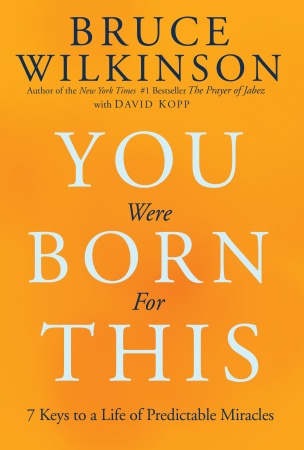
You Were Born For This (book review)

I love the way Bruce Wilkinson makes biblical truths so exciting and live-able. You Were Born For This is no exception.

The idea behind this book is that God does miracles every day, but He usually calls on people to deliver those miracles. That’s what we were born to do. Bruce writes:

“You see, God did not place you on this earth to notice Him at work only once or twice in your whole life. He did not create you to consistently miss out on the wonder of His presence and power. The truth is, you were born to live a supernatural life doing God’s work by God’s power. You were born to walk out your door each morning believing that God will use you to deliver a necessary miracle today.”

Using a powerful combination of scriptural and personal examples, Bruce makes the case that God wants to use everyone of us as His delivery agents. He shows us that the Holy Spirit is nudging us to see the needs right in front of us. And then Bruce shows us how we can be a part of the delivery process.

One more quote from the book:

“When you and I purposely ask God to send us to do His work on earth, we take on a completely different role in our day. We are now people sent from God, His delivery agents. We walk out the door knowing that He could have a miracle (a delivery through us) for anyone we meet. Why? Because, from God’s point of view, everyone, everywhere, at all times is in need. God knows about every need, and He cares about each one. That’s why He loves to send servants who are passionate about delivering visible proofs of His goodness and glory.

As always when I finish a Bruce Wilkinson book, I’m seeing the world differently now. I’m ready to be God’s miracle delivery agent. If you are ready to see God’s miracles happen around you time and time again, I highly recommend this book as a great place to start.

Three For Pastors (book reviews)

I consider it such an awesome privilege—and a heavy responsibility—to be called to be a pastor. Despite the challenges, I love doing what I’m doing! And although I don’t want this message to become diminished by over-use, I truly do mean it: I My Church!

Because I want to be the best pastor I can be, I frequently study the lives of historical pastors, and I try to keep current on thoughts from my contemporaries as well. So, if you are a pastor (or if you want to better support your pastor), here are three books I recently read which I would highly recommend to you.

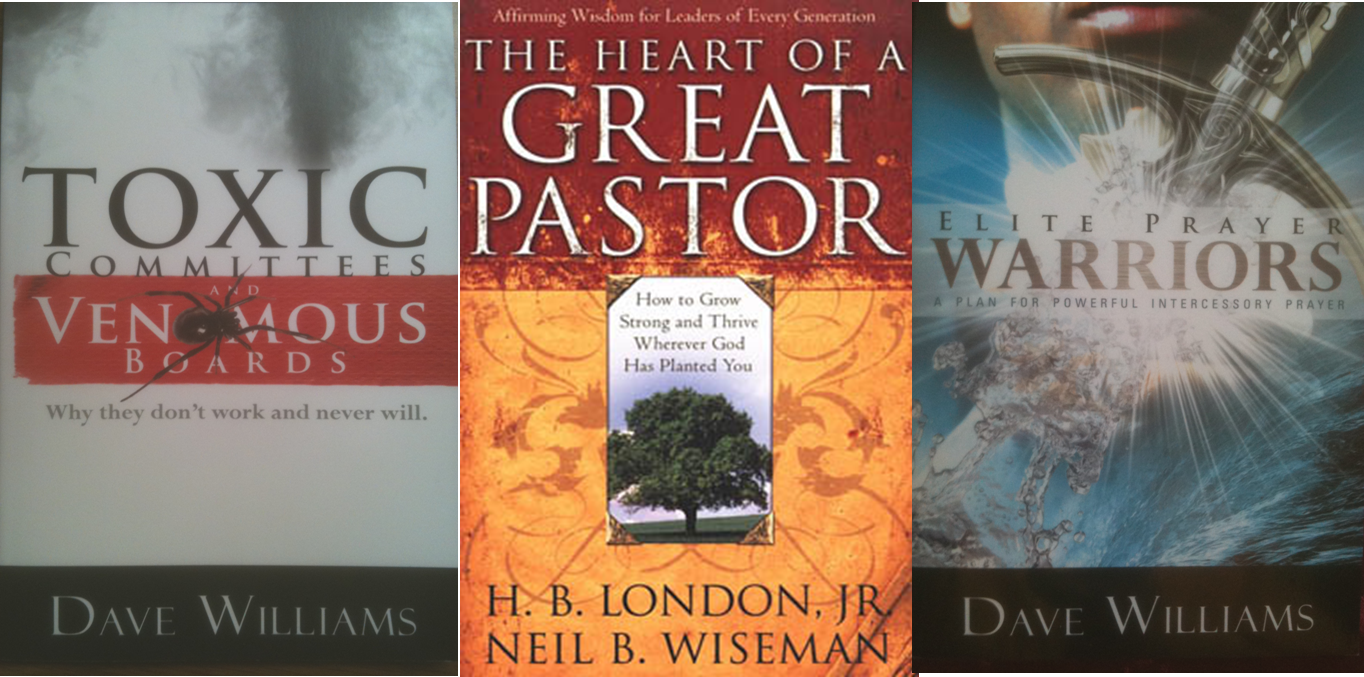
The Heart Of A Great Pastor by H.B. London and Neil B. Wiseman emphasizes how pastors need to take personal responsibility to make sure they are continually giving their best. From revisiting the call of God on their lives, to maintaining a vibrant private prayer and devotional life, to organizing ministries in the church, pastors can never coast. I love this insight from the authors:

“The God-initiated summons takes us [pastors] into life’s main arena where people wrestle with ultimate issues such as birth, life, death, sickness, broken relationships, health and hope, as well as ambiguities and apprehension. This partnership with God takes us to private and public places and to sorrowful and cheerful places. It is our lifetime ticket to represent Jesus at weddings, hospital waiting rooms, grave sites, baptisms, Holy Communion and life-shaping questions that good people have reason to ask, such as ‘Where is God now?’”

Elite Prayer Warriors by Dave Williams is a renewed call to prayer. I grew up with a cliché ringing in my ears and my heart: The church moves forward on her knees.  If this is true for the church (and I firmly believe it is), it is even more true for pastors who serves the church as her under-shepherd. Elite Prayer Warriors encourages pastors  to raise up a team of people who will commit to the spiritual battle of praying for their pastor.

Then Pastor Dave Williams addresses an area that can derail a church in Toxic Committees And Venomous Boards. I’ll let the cat out of the bag right up front: Pastor Williams states unequivocally that committees are unscriptural. After showing the biblical basis for his claim, he then makes the case for a scriptural form of pastoral support: teams. He says, “Committees meet; teams score!”

I also like this quote in the book from Rick Warren:

“Committees discuss it, but ministries do it. Committees argue, ministries act. Committees maintain, ministries minister. Committees talk and consider, ministries serve and care. Committees discuss needs, ministries meet needs.”

Three outstanding books to help you be the best pastor that God has called you to be.

I am a Decapolis book reviewer.