Integrity At Home

I read this verse the other day in my devotions, and it’s really been doing a number on my heart.

…I will lead a life of integrity in my own home. (Psalm 101:2 NLT)

I would hate it if I was considered a hero at work, but considered a zero in my own home.

Here’s what I’m processing:

  • Do I earn the same level of respect at home as I do at the office?
  • Do I put in the same diligence into growing my home life as I do growing my career?
  • Am I as forgiving with my family as with friends and coworkers?
  • Do I have the same level of preparation at home as I do at work?
  • Am I learning the craft of being a husband and father like I’m learning the craft of being a pastor?
  • Do I honor my commitments at home like I do with others?

I don’t want to live as John Bunyan described Talkative in Pilgrim’s Progress: “He was a saint abroad and a devil at home.”

Instead one of my life verses is this: I have no greater joy than knowing my children all walk in the truth (3 John 4).

The only way this will be possible is if I led a life of integrity in my own home.

Max On Life (book review)

Have you ever wanted to have a conversation with Max Lucado? Just sit with him for awhile and pick his brain? With Max On Life you can do just that!

Max On Life is a compilation of 172 questions that Max has been asked. Some of his answers come from his previously written books, some are answers formed with brand new insights, but all of the answers come from his very pastoral heart.

The book is divided into seven sections – hope, hurt, help, him/her, home, have/have-nots, and hereafter. But even more helpful is the index of topics at the back of the book, as well as a listing of all of the scriptural references Max uses throughout Max On Life. I can imagine this book staying very close at hand, because I’m going to be referring to it often.

If you are a pastor or counselor, I think you will find a lot of helpful insights in this book to pass on to others. If you have a friend with lots of questions about the Christian faith, this book would make an excellent gift. Or if you just want to be a helpful friend when others are in need, this book will help prepare you to be a blessing to them.

I am a Thomas Nelson book reviewer.

Anger That Crosses The Line

Last night in our Bible study we looked at some words that David penned when he was angry. He was on the run from his son Absalom, and it seemed like everywhere he turned people were after him, or slandering him, or just doing their best to make him miserable. Yet in two back-to-back Psalms David says, “I lay down every evening and get a great night of rest.”

His sweet sleep comes from a moment of reflection before dozing off. He says:

In your anger do not sin; when you are on your beds, search your hearts and be silent. Selah.

  • Did my anger today cross the line into sin?
  • Am I allowing the time for the Holy Spirit to search my heart?
  • When the Holy Spirit points out where my anger crossed the line, do I justify my anger, or am I silent?

How do we know if our anger has not crossed that line and become sin?

Aristotle wrote, “Anybody can become angry—that is easy; but to be angry with the right person, and to the right degree, and at the right time, and for the right purpose, and in the right way—that is not within everybody’s power and is not easy.”

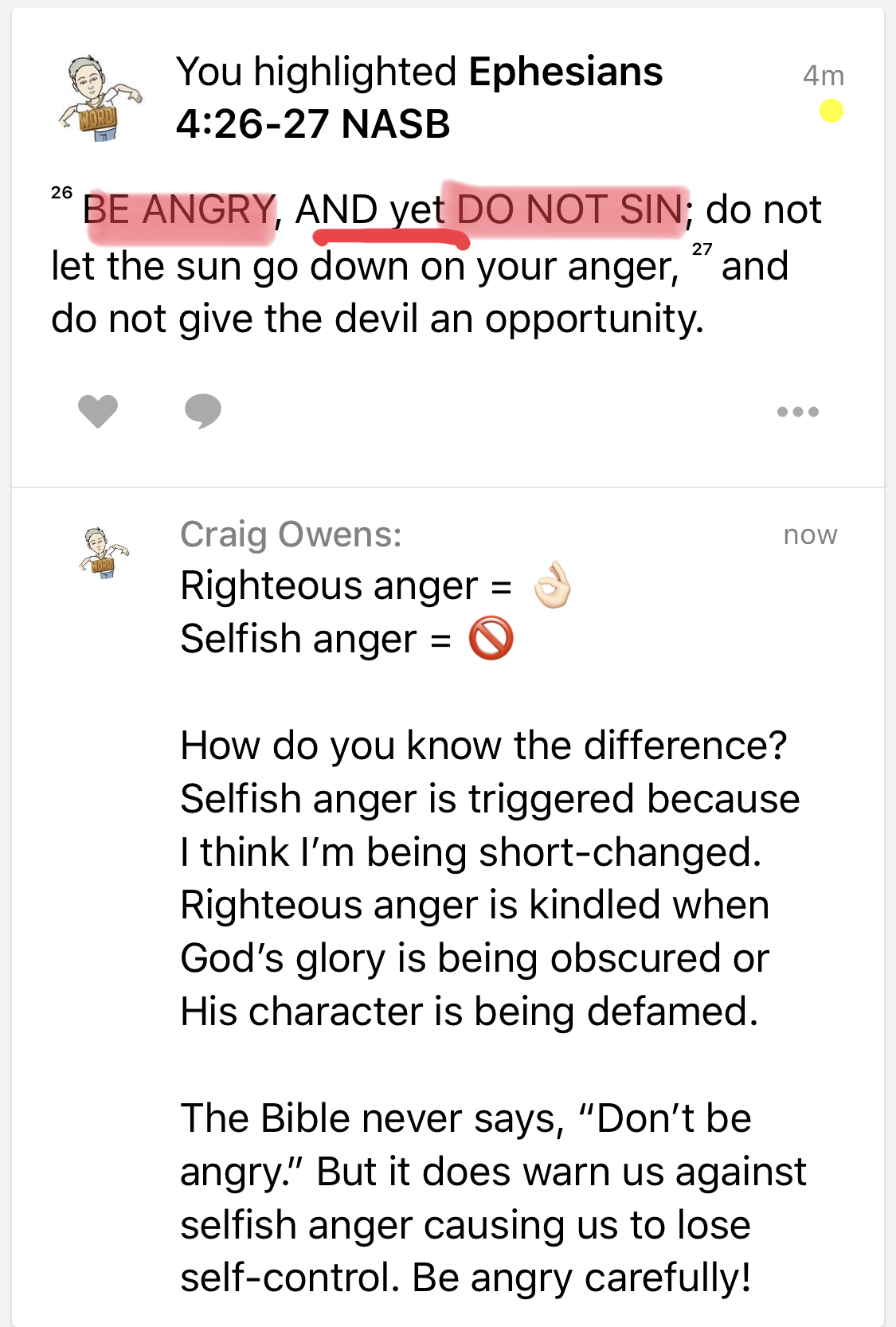
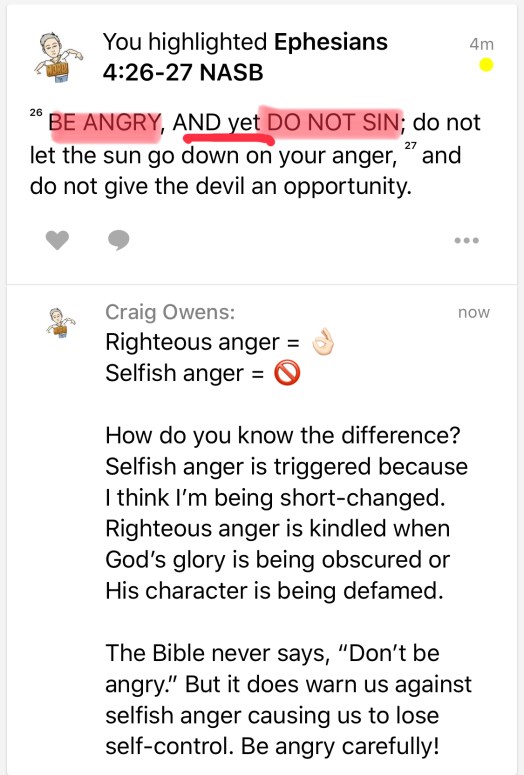
Being angry is not the issue. David said it (and Paul quoted it in Ephesians 4:26): “Be angry; just don’t sin.” God gets angry, but He does not sin. Jesus, in His public ministry, got angry, but He did not sin. We need to search our hearts to make sure our anger has not crossed the line to sin. We have to be angry in a godly way.

I see at least four ways to become angry without crossing the line into sin:

1.  Selfless Anger = anger at sin, but not angry at the sinner.

Love is not rude, it is not self-seeking, it is not easily angered, it keeps no record of wrongs. Love does not delight in evil but rejoices with the truth. (1 Corinthians 13:5, 6)

2.  Slow Anger = lengthen your fuse a bit.

Do not be quickly provoked in your spirit, for anger resides in the lap of fools. (Ecclesiastes 7:9)

My dear brothers, take note of this: Everyone should be quick to listen, slow to speak and slow to become angry, for man’s anger does not bring about the righteous life that God desires. (James 1:19, 20)

Good advice from Thomas Jefferson: “When angry, count to ten before you speak; if very angry, a hundred.”

3.  Protective Anger = when sinners entice others to join them in their sin. God is sad when people leave Him; He is angry at them when they take others with them.

But they put God to the test and rebelled against the Most High; they did not keep His statutes. Like their fathers they were disloyal and faithless, as unreliable as a faulty bow. They angered Him with their high places; they aroused His jealousy with their idols. When God heard them, He was very angry; He rejected Israel completely. (Psalm 78:56-59)

4.  Righteous Anger = against those who are keeping others from coming closer to God.

For I endure scorn for Your sake, and shame covers my face. I am a stranger to my brothers, an alien to my own mother’s sons; for zeal for Your house consumes me, and the insults of those who insult You fall on me. (Psalm 69:7-9)

This verse was recalled by Jesus’ disciples when they saw Him get angry and clear out the Temple in Jerusalem. Jesus was angry because of the religious clutter that was keeping God’s house from being a house of prayer for all nations.

I think everyone is familiar with the acrostic WWJD = What Would Jesus Do?

I’d like to propose something similar: WGGA = Would God Get Angry?

This is a great question to ask to make sure our anger does not cross that line into sin. Get angry—in a godly way—and do not sin.

Get A Better Story

My friend Chuck and I run through a silly routine to make a point about the superficial conversations that many people have. It goes something like this—

Chuck: Hi! How are you?

Craig: I’m good. And you?

Chuck: Good. I’m good.

Craig: How’s work going?

Chuck: It’s good. How about for you?

Craig: Good.

Chuck: How’s your family?

Craig: They’re good. And yours?

Chuck: Good.

You get the idea. At the end of this conversation have I learned anything new about Chuck? Of course not. Has he learned anything new about me? Nope. Do you think either one of us is telling the truth? No, because we don’t want to really open up what’s going on inside us.

(In case you haven’t figured this out, this is just a silly thing Chuck and I do on purpose. After joking around, we do get down to the more “real life” conversation!) 

Last week I had several great sit-down meetings with some people that I already knew, but I wanted to get to know better.

In order to get to know them better, I have to get them to tell me a better story!

A better story about who they really are and what they’re really feeling.

This requires two things:

  1. I have to ask better questions. Not questions that can just be answered with a simple “good” or “fine” or “yes” or “no.”
  2. I have to be willing to tell the other person a real story about me, one that reveals who I really am and how I’m really feeling.

Sometimes asking these questions or telling these stories may seem awkward. But you have to pass through the awkward if you truly want to get to know someone better. Don’t just settle for “good,” but take a risk to go deeper.

Two Helpful Questions

Some people tell me that they don’t read the Bible for themselves because they don’t understand parts of what they read, or they don’t know what to do with the parts they do understand.

To which I reply, “That’s understandable.”

The Bible is filled with timeless principles given to us by an Eternal God. The principles may be timeless, but their application is not universal. For example, God’s timeless principle of, say, honoring your parents may be applied one way by someone living in the 12th century B.C. and applied completely differently by someone living today.

Same principle. Different application.

This is easy to say, but much harder to put into action. But I believe it is imperative that we continue to read God’s timeless principles in His Word and find daily application for our lives. So I’d like to suggest two questions to help you in this pursuit. They are the same two questions that people asked the day of Peter’s first sermon after the birth of the Christian church. Try these the next time you read your Bible:

  • What does this mean? (Acts 2:12)
  • What should I do? (Acts 2:37)

Don’t avoid reading the Bible. And don’t approach the Bible the way Søren Kierkegaard said some people do: “Many read the Bible the way a mouse tries to remove the cheese from a trap: trying not to get caught.”

I’m still learning too. Two things that help me immensely: (1) Pray before I read my Bible, asking the Holy Spirit to illuminate His inspired Word, and (2) Talk with other wise friends about the application questions I have.

If you have some strategies that are working for you, please share them in the comments below.

Is My Church Worldly?

I read this quote this morning from David F. Wells. It’s very challenging. I believe my responsibility as a pastor is to always be wrestling with issues like this.

What do you think about this quote:

“. . . Where Christian faith is offered as a means of finding personal wholeness rather than holiness, the church has become worldly.

“There are many other forms of worldliness that are comfortably at home in the evangelical church today. Where it substitutes intuition and feelings for biblical truth, it is being worldly. Where its appetite for the Word has been lost in favor of light discourses and entertainment, it is being worldly. Where it has restructured what it is and what it offers around the rhythms of consumption, it is being worldly, for customers are actually sinners whose place in the church is not to be explained by a quest for self-satisfaction but by a need for repentance. Where it cares more about success than about faithfulness, more about size than spiritual health, it is being worldly. Where the centrality of God to worship is lost amidst the need to be distracted and to have fun, the church is being worldly because it is simply accommodating itself to the preeminent entertainment culture in the world.

“Is it not odd that in so many church services each Sunday, services that are ostensibly about worshiping God, those in attendance may not be obliged to think even once about His greatness, grace, and commands? Worship in such contexts often has little or nothing to do with God.” —David F. Wells

More Questions

Time for some more questions. Periodically I turn the subject matter for our Impact! youth group over to the students. It’s their time to fire away with the questions on their mind. I love answering questions because answering them helps me learn more too.

So now’s the time to get your question(s) in. You can get them to me in a few ways:

  • Leave a comment on this blog post.
  • Contact me via Twitter.
  • Contact me via Facebook.
  • Or if you want to remain anonymous, there’s a drop box at the church.