Listen to the podcast of this post by clicking on the player below, and you can also subscribe on Apple, Spotify, or Audible.
Misunderstandings happen all the time. Leaders can help their teammates navigate these verbal landmines—and avoid a lot of trouble—by asking the clarifying questions that will bring the whole team together.
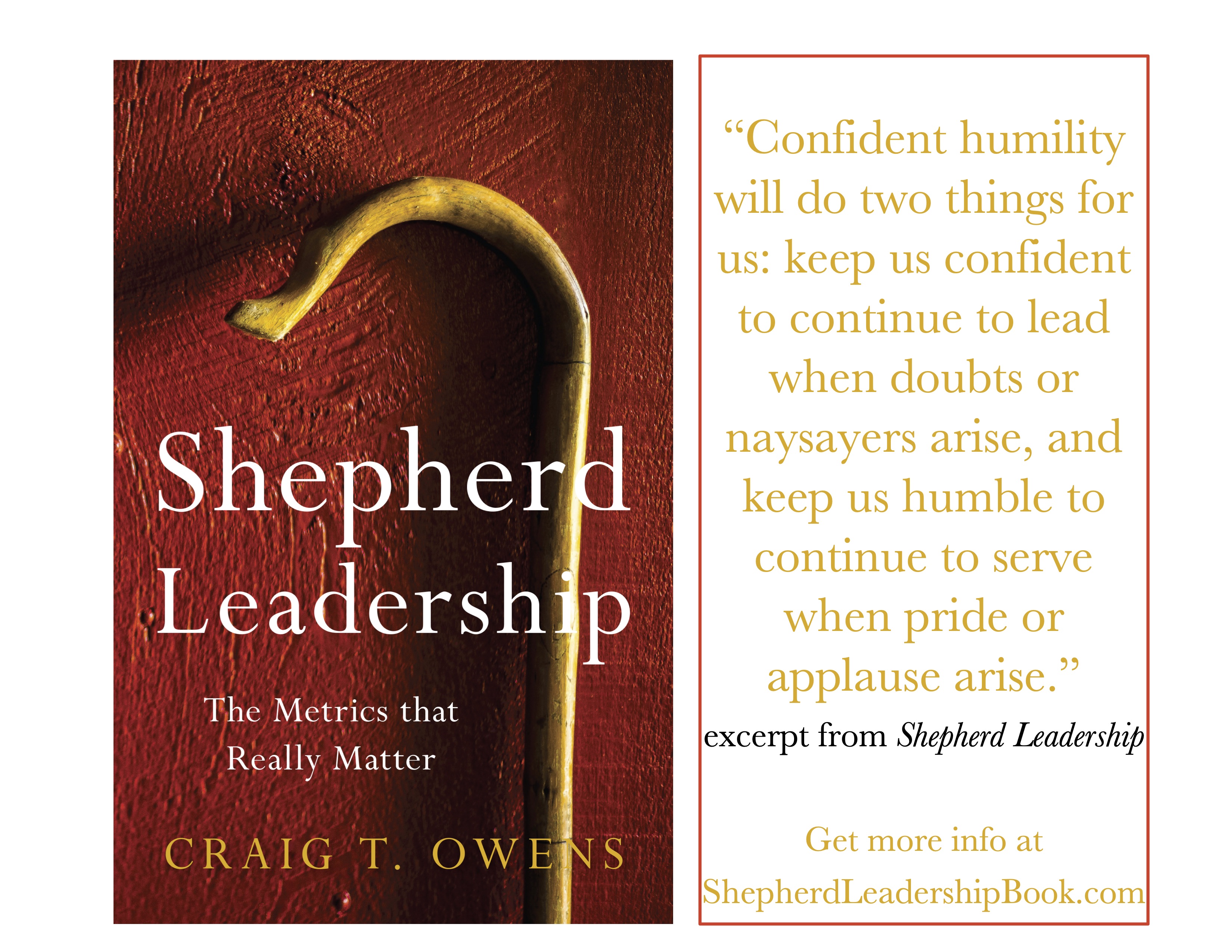
We would love to serve as your leadership coach, so get in touch with us. My book Shepherd Leadership also has some biblical principles that leaders can immediately apply to their organizations.
Listen to the podcast of this post by clicking on the player below, and you can also subscribe on Apple, Spotify, or Audible.
This one is for my fellow pastors. I want to give you THE question to ask to help you in crafting the most applicable and memorable sermons.
It’s a question that Paul asks in Romans 4: “What does the Scripture say?” (v. 3). Preachers must make sure they get their ideas from the text of the Bible, not just from their own good ideas. Look at this amazing example from Paul in just this one chapter of his letter to the saints at Rome.
He starts off with a question: “What then shall we say?” (v. 1).
Then he answers his question with another question: “What does the Scripture say?” and he proceeds to give his answer by quoting from the Book of Genesis.
From this, Paul makes a conclusion in vv. 4-5 that is signaled by the word “Now…”.
In order to support his conclusion, Paul then quotes from Psalm 32: “David says the same thing” (vv. 6-8).
Next Paul alternates between questions and answers in vv. 9-12, bringing this Q&A to a logical conclusion in vv. 13-16.
He supports his conclusion with even more Scripture: “As it is written” (v. 17), and “Just as it had been said” (v. 18).
Finally, Paul wraps up this part of his sermon by both quoting more Scripture (vv. 22-23) and then reminding his audience, “The words ‘it was credited to him’ were written not for him alone, but also for us” (vv. 23-24). This shows that God’s words weren’t just for Abraham, nor just for Paul’s audience, but for anyone reading the Scripture today.
This is a short, masterful, and powerful sermon! Why? Simply because it is totally banked on God’s timeless words.
The way that preachers can design THE perfect sermon—that is both applicable and memorable—is to start with the same question Paul did: “What does the Scripture say?”
Listen to the podcast of this post by clicking on the player below, and you can also subscribe on Apple, Spotify, or Audible.
A meme that makes me chuckle every time I see it is a “quote” attributed to Abraham Lincoln in which he says, “The problem with quotes found on the internet is that they are often not true.”
(Not to spoil the joke for you, but unless Lincoln knew how to time travel to the future, I don’t think he knew about the modern internet! 😂)
I love this meme because it captures something that so many people fall into: a quick acceptance of a statement without verifying its source or thinking through the implications of the statement’s truthfulness.
Some insightful comments sound Shakespearean, but William never wrote them.
Some pieces of wisdom sound Socratic, but Socrates never taught them.
Some religious maxims sound godly, but the Bible never recorded them.
I would like to invite you to join me as we relaunch this series called Is That In The Bible? I think you may be surprised to discover just how many phrases we call biblical aren’t, and how many phrases there are that we never realized are actually in the Bible.
By the way, if you have a phrase that you would like to have us explore in this series, please leave it in a comment below. You may want to check out the questions we have already addressed:
Listen to the podcast of this post by clicking on the player below, and you can also subscribe on Apple, Spotify, or Audible.
Did God really call me to this position? Did I hear God correctly when I made that big decision? Now that times are tough, is that an indication that it may be time for me to move on, or am I supposed to persevere through this?
I have experienced this myself, and I have walked with many other leaders who have experienced this same thing. A situation arises in your organization that makes you question whether you are truly the leader for this time, or whether it may be time for someone else to step in.
In my book Shepherd Leadership, I share a story from my leadership journey where I had to wrestle with the thought of whether I truly heard from God or not. Check out how I shared my story with some ministry interns…
Because of this incident, and many like it, I am a huge proponent of journaling. I have found it so comforting to be able to return to thoughts, answered prayers, Scriptures that have been revealed to me, and confirmations from friends. To read what God spoke to me on specific dates has helped to renew my confidence in His call for my life. I would highly recommend that you take up this discipline of journaling as well, especially during the times that you are contemplating a big decision.
I would also humbly recommend that you check out Shepherd Leadership, particularly two chapters where I talk about a leader’s confidence and a leader’s humility. When these are correctly balanced, we can make much better decisions during the questioning times. My book is available in print or ebook and as an audiobook.
Question marks invite a conversation; whereas, periods or exclamation points tend to end the conversation. Clearly, God enjoys dialogue.
God sometimes asks questions to get Zechariah to evaluate his surroundings or the prevailing culture. Sometimes God asks Zechariah a question to get him to clarify what he is seeing or thinking.
But without a doubt, most of the questions are posed by Zechariah to either God or to the angelic messenger who sometimes serves as Zechariah’s guide. Not once does God nor the angel tell Zechariah to hold his tongue. Zechariah’s questions are never belittled nor treated as though they were a bother. Nor are his questions ignored.
Rather, every single question is answered.
God enjoyed talking with Adam and Eve in the garden of Eden, He walked and talked with Enoch, He listened to the questions asked by Job and the psalmists, and here He engages Zechariah in conversation too.
Prayer is never designed to be a monologue—with us just speaking to God—nor is Bible reading designed to be a monologue—with just God speaking to us. Both prayer and Bible reading are used by the Holy Spirit to keep a dialogue active and engaging. You and I should never be afraid to approach God with our questions, nor should we be afraid to listen to the questions God asks us.
The dialogue between us and God builds an intimacy that cannot be developed in any other way. So keep asking those questions!
Listen to the podcast of this post by clicking on the player below, and you can also subscribe on Apple, Spotify, or Audible.
A meme that makes me chuckle every time I see it is a “quote” attributed to Abraham Lincoln in which he says, “The problem with quotes found on the internet is that they are often not true.”
(Not to spoil the joke for you, but unless Lincoln knew how to time travel to the future, I don’t think he knew about the modern internet! 😂)
I love this meme because it captures something that so many people fall into: a quick acceptance of a statement without verifying its source or thinking through the implications of the statement’s truthfulness.
Some insightful comments sound Shakespearean, but William never wrote them.
Some pieces of wisdom sound Socratic, but Socrates never taught them.
Some religious maxims sound godly, but the Bible never recorded them.
I would like to invite you to join me as we relaunch this series called Is That In The Bible? I think you may be surprised to discover just how many phrases we call biblical aren’t, and how many phrases there are that we never realized are actually in the Bible.
By the way, if you have a phrase that you would like to have us explore in this series, please leave it in a comment below. You may want to check out the questions we addressed in both the first installment and second installment of this series.
In this installment of this series, we asked: Is this in the Bible…
Listen to the podcast of this post by clicking on the player below, and you can also subscribe on Apple, Spotify, or Audible.
A meme that makes me chuckle every time I see it is a “quote” attributed to Abraham Lincoln in which he says, “The problem with quotes found on the internet is that they are often not true.”
(Not to spoil the joke for you, but unless Lincoln knew how to time travel to the future, I don’t think he knew about the modern internet! 😂)
I love this meme because it captures something that so many people fall into: a quick acceptance of a statement without verifying its source or thinking through the implications of the statement’s truthfulness.
Some insightful comments sound Shakespearean, but William never wrote them.
Some pieces of wisdom sound Socratic, but Socrates never taught them.
Some religious maxims sound godly, but the Bible never recorded them.
I would like to invite you to join me as we relaunch this series called Is That In The Bible? I think you may be surprised to discover just how many phrases we call biblical aren’t, and how many phrases there are that we never realized are actually in the Bible.
By the way, if you have a phrase that you would like to have us explore in this series, please leave it in a comment below. If you would like to check out the questions we addressed previously, please click here.
In this installment of this series we asked: Is this in the Bible…
At different times when people encountered Jehovah God in a profound way, they would give Him a name that was representative of what He did. The first instance of this is when God miraculously provided a substitute sacrifice for Issac, prompting Abraham to call God Jehovah Jireh.This name means the One who foresees perfectly and knows just what to provide to meet the need. God’s provision is perfectly proportioned and perfectly timed.
Jehovah sent a great wind on the sea. It was a perfectly proportioned and perfectly timed storm that caused pagan sailors to fall on their knees in worship of the one true God.
Jehovah provided a great fish to rescue Jonah. It was a perfectly proportioned and perfectly timed vehicle of rescue that caused Jonah to acknowledge salvation only comes from God.
Jehovah provided a uniquely-prepared prophet. He becamea perfectly prepared and perfectly timed messenger of God’s mercy. Prior to Jonah’s visit, Nineveh had experienced two plagues (765 and 759 BC) and a solar eclipse (763 BC), which put the people in a state of heightened expectation. When Jonah arrived in the city, he was a whale-bleached prophet[*] of Jehovah which showed up with a message of God’s impending judgment unless the people repented. The response: the Ninevites believed God.
Jehovah provided a vine that shielded Jonah from the sun, even though Jonah was waiting for God’s judgment to fall on Nineveh.
Jehovahprovided a worm to destroy the vine and get Jonah’s attention.
I believe this story gives us three important lessons and three introspective questions—
God is sovereignly in control of everything—storms, fish, prophets, plants, worms, astrological events, and agricultural calamities. God foresees perfectly and knows just what to provide to meet the need or to get someone’s attention.
Question: Will I let Jehovah Jireh be Jehovah Jireh for others, or will I try to tell Him what to do and when to do it?
Question: As Peter asked, “What kind of people ought you to be?” Will I allow God to extend as much mercy as is necessary to others, just as He extended it to me?
God’s saving grace is boundless and undeserved—Salvation is not a reward for the good things we have done, so none of us can boast about it. (Ephesians 2:9 NLT)
Question: I love that this book ends with an unanswered question from God Himself, because it is our question to answer today: Should I not be concerned about that great city? What will I do with the good news that Jehovah Jireh has gone the full measure to make His grace and mercy and love and forgiveness available to ALL people?
I hope you will take the time to prayerfully consider these questions.
[*] “Ambrose John Wilson in the Princeton Theological Review for 1927 mentions a case of a sailor on a whaling ship near the Falkland Islands who was swallowed by a large sperm whale. The whale was later harpooned, and when it was opened up on the deck the surprised crew found their lost shipmate unconscious inside its belly. Though bleached from the whale’s gastric juices, he recovered, though he never lost the deadly whiteness left on his face, neck, and hands.” —Walter Kaiser
Here’s the seed thought for this episode of Think On This…
Do not answer a fool according to his folly, or you yourself will be just like him. Answer a fool according to his folly, or he will be wise in his own eyes. (Proverbs 26:4-5)
Think on this:
Do I have a solid relationship with this person?
Do I need to respond for their benefit?
Can I ask any clarifying questions before I speak?
Where is God in our trials? When we call, Jesus runs to our cry. He is able to help us because He knows exactly what our cries sound like. Aren’t you glad He does?!
While we are in these difficult times, you might find yourself asking a question I have asked, “Okay, God, I believe You are doing something, but what exactly are You doing?”
I can’t tell you specifically what God is doing in your life, because your story is unique and special. But I can tell you that during the hard, painful chapters of our lives, God is accomplishing at least five things in all of us.
God is opening our eyes to new paradigms
We will learn lessons in these fiery trials that we couldn’t possibly learn any other way.
God is building empathy in us which we didn’t have before
One dictionary definesempathy as “the power of understanding and imaginatively entering into another person’s feelings.” It’s only because of our trials that we no longer have to imagine what someone else is feeling, but instead we know exactly what they’re feeling and how we can help.
God is growing our patience
It’s been said that patience is the “mother of all other virtues.” Paul said that “these troubles produce patience” (Romans 5:3). As God grows your patience, He will also help you to grow all of the other Christlike virtues.
God is refining His character in us
Paul went on to add that not only does trouble produce patience, but “patience produces character” (Romans 5:4). During the times of difficulty and uncertainty, we become more aware of deficiencies in our character.
God is building in us an unshakable hope in His future grace
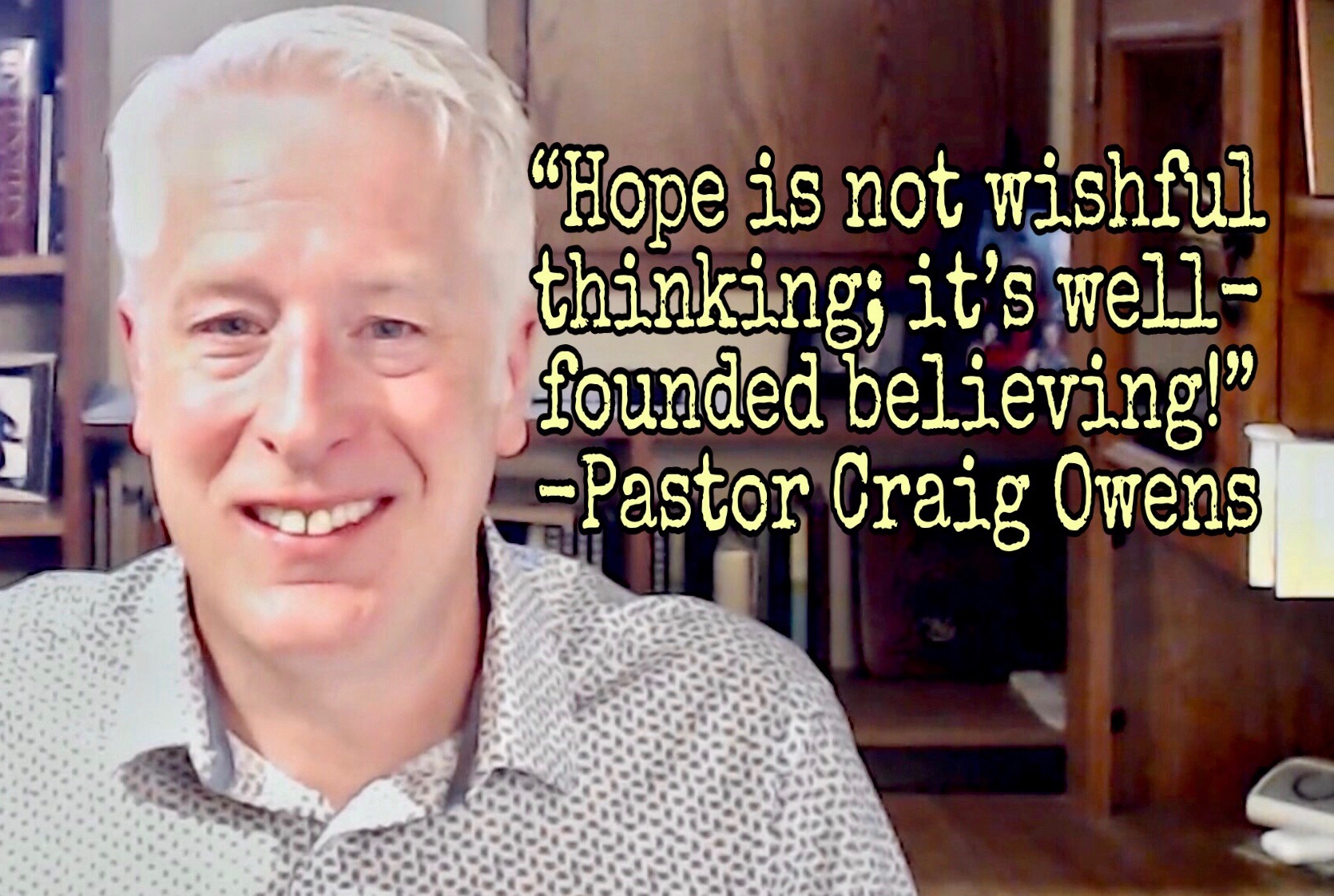
Hope is not wishful thinking; it’s well-founded believing!
I want to circle back to that word refining because I think that best sums up what God is doing in our painful times. Romans 8 tells us—The Spirit Himself thus testifies together with our own spirit, assuring us that we are children of God. And if we are His children, then we are His heirs also: heirs of God and fellow heirs with Christ—sharing His inheritance with Him; only we must share His suffering if we are to share His glory. But what of that? For I consider that the sufferings of this present time—this present life—are not worth being compared with the glory that is about to be revealed to us and in us and for us and conferred on us! (Romans 8:15-18)
So where’s God in this time of fire? He is overseeing our trial as a Perfect Refiner. Do you know how the silversmith knows he has purified the impurities from the silver ore? The silver is pure when he can see his own reflection in the silver!
In the heat of your trial, God is close to you. He knows the perfect temperature and the precise time that it will take to allow His face to be seen in you!
Sometimes you will see what God is doing through your furnace time, sometimes you won’t. But don’t ever bail out! God IS working! He is giving you a new perspective, a deeper empathy, more patience, an unshakable hope, and most of all—He is removing the impurities that will allow His face to be seen more clearly in you!










 Craig T. Owens