Links & Quotes

link quote

Some interesting reading from this weekend…

Assemblies of God missionaries were addressing the issue of sex slaves and sex trafficking as far back as 1917.

Chilly Chilton challenges us to view worship as serving: Serving Up Some Worship!

This infuriates me … a Planned Parenthood staffer recommends abusive sex to a 15-year-old! And guess what? Our tax dollars are paying for this garbage.

More medical evidence that stress is bad for your heart.

“It will take an infinite number of ages for God to be done glorifying the wealth of His grace to us—which is to say He will never be done. And our joy will increase forever and ever. Boredom is absolutely excluded in the presence of an infinitely glorious God.” —John Piper

Don’t just study; study well. Here are some important questions to ask yourself.

The Overview Bible Project has a cool look at the Psalms.

How can we ever hope that our kids will become moral, ethical, committed people when we can’t keep our word, can’t keep our pants on, and can’t seem to hold our tongue or liquor? To all three groups of leaders, I simply say: We don’t expect you to be perfect, but we do expect you to embody integrity.” Read more from Tim Elmore’s post The Only Way To Turn Students Into Ethical Leaders.

“As Christians we are called upon to exhibit the character of God, and this means the simultaneous exhibition of His holiness and His love.” —Francis Schaeffer


God’s Blessings Aren’t Primarily For You

God's blessingsGod’s blessings are wonderful, and we should pray for them, but they are showered upon us for a specific purpose.

“May God be gracious to us and bless us and make His face shine upon us…” is the prayer of the psalmist. Why does he pray this?

“…SO THAT Your ways may be known on earth, Your salvation among the nations.” (Psalm 67:1-2)

God’s blessings are sent to His people SO THAT the whole earth will know Him and praise Him, and turn to Him for their salvation.

God’s blessings aren’t primarily for my benefit, but for His!

“And God, our God, will bless us. God will bless us, SO THAT all the ends of the earth will fear Him.” (verses 6-7)

Sola Deo gloria—it’s all for His glory!

So, yes, Lord, pour out Your blessings on me again and again SO THAT all people may know You and Your salvation. May all who see Your blessing on me turn to You as their God too!

The Rest In Political Unrest

© 2013 craigtowens.com

© 2013 craigtowens.com

Due to it’s placement in Book II of the Psalms, these words were most likely penned during a time of political uncertainty in Israel—

God is our refuge and strength, an ever-present help in trouble. (Psalm 46:1).

These words are recorded after Israel has been torn apart into two kingdoms, with rival kings from the northern and southern kingdoms constantly scheming against each other. It’s a time of assassins, and throne usurpers, and even other kings looking to swoop in.

During times like this it is tempting to turn to political means to achieve some sense of stability or security. But the psalmist urges us to remember that God is our fortress of strength, not politicians. In Him is our safe and stable place.

God’s plan for kings, governments, armies and parliaments will always prevail!

  • Be still and know that I am God; I will be exalted among the nations, I will be exalted in the earth. (Psalm 46:10, emphasis added).
  • God makes wars cease (46:9).
  • He subdues nations (47:3).
  • God is the King of all the earth (47:7).
  • He reigns over every nation (47:8).
  • All the kings of the earth belong to God. (47:9).

Be still, my soul, your King is THE King over all of the politicians, princes and nobles. Your God is your refuge and strength, your safety and stability. Put your trust in Him!

Do You Smell Like Jesus?

Christ's aromaScientists tell us that the sense of smell contributes to more vivid and clear memory recall than any of the other human senses. Have you ever thought about the things Jesus smelled? Or about the memories others recalled about Jesus because of the way He smelled?

Less than a week before His crucifixion, Mary anointed Jesus with a highly-scented spice called spikenard (see John 12:1-8; Mark 14:3-9; and Matthew 26:6-13). Let me rephrase that: Mary didn’t just “anoint” Jesus as we think about that word today, she doused Him in a lifetime supply of this fragrance. Some people complained, but Jesus told those sour people that it was absolutely beautiful what she had done, as Jesus carried this aroma with Him to the Cross.

After He died on the Cross, Joseph and Nicodemus prepared Jesus for burial with 75 pounds of myrrh and aloes (see John 19:38-40). Think about that: seventy-five pounds! In doing so they actually fulfilled a prophesy from the Old Testament about King Jesus’ triumphal return to life—

Your throne, O God, will last for ever and ever; a scepter of justice will be the scepter of Your kingdom. You love righteousness and hate wickedness; therefore God, Your God, has set You above Your companions by anointing You with the oil of joy. All Your robes are fragrant with myrrh and aloes and cassia… (Psalm 45:6-8).

Jesus carried a powerful aroma with Him all the way to the Cross, into the tomb, and when He burst forth alive from the tomb! 

Without Christ, our lives carry the stench of death. We cannot come into our Heavenly Father’s presence because of that putrid smell clinging to us. But when God forgives us of our sins as we place our faith in Jesus, we are wrapped in the robes of Christ: we smell like Him and are welcomed into the Father’s presence.

Easter is a reminder of how a forgiven Christian should now live—

Live a life filled with love, following the example of Christ. He loved us and offered Himself as a sacrifice for us, a pleasing aroma to God (Ephesians 5:2).

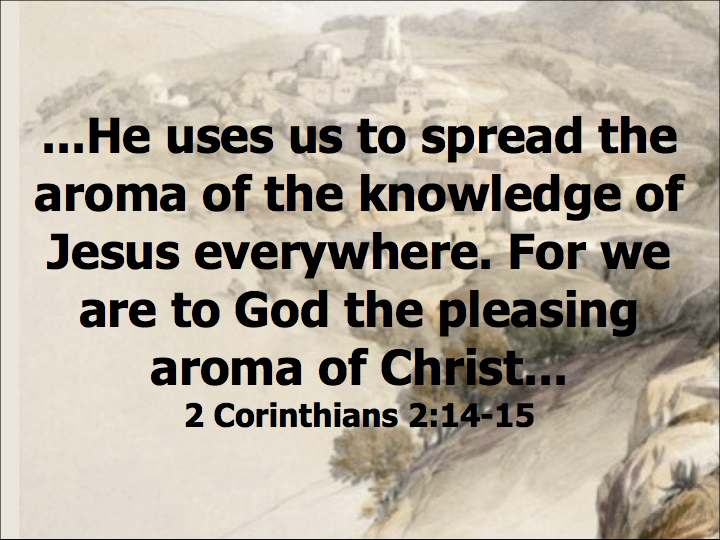
…Now [God] uses us to spread the knowledge of Christ everywhere, like a sweet perfume. Our lives are a Christ-like fragrance rising up to God (2 Corinthians 2:14-15).

How do you smell? Do you smell like Jesus? Are others attracted to the aroma of Christ because of what they smell in you? Smelling good honors the work Jesus did on the Cross and in overcoming the grave.

(Super)Man Of Prayer

Man of prayerKing David’s wholehearted devotion to God is well known. We can see it especially in the most trying moments of his life. And what I see is a real man … a (super)man of prayer.

David opens the 108th Psalm with a declaration: “My heart is steadfast, O God; I will sing and make music with all my soul” (108:1).

He is really saying, “No matter what, I will praise God. The situation will never distract me from focusing on the One who is worthy to receive the very best praise I can offer!” And it’s a good thing he made this declaration, because in the very next psalm he begins a nasty description of wicked and deceitful men who would almost cause David to focus on them instead of God.

David responds, “BUT I am a man of prayer” (109:4). David’s knee-jerk reaction when slandered by bad guys was to hit his knees in prayer! And, boy oh boy, did he let loose in prayer!

I love how honest David is with his hurt feelings in God’s presence. Never in all the narratives in the books of Samuel or Kings or Chronicles do we read anything of David saying these sorts of things to his enemies. But since these thoughts are in his heart, he must get them out in the presence of his God.

I also love David’s singular desire for God to receive all the glory—“Help me, O Lord my God; save me in accordance with Your love. Let them know that it is Your hand, that You, O Lord, have done it” (109:26-27).

I pray that I can become more and more a (super)man of prayer like David! Look! Down on his knees … it’s a (super)man of prayer!

Come On In

Come On InThe Bible tells us that the Holy Spirit is constantly calling us to “Come!” He wants to draw us nearer to God’s presence. But sin separates. Let me be more specific and more personal: My sin can make me believe I can’t come closer to God.

In Psalm 99:8, notice how the psalmist focuses first on God’s forgiveness, and then on His punishment. It’s as though he is saying, “Yes, God punishes sin, but He is first and foremost a forgiving God”—

…You were to Israel a forgiving God, though You punished their misdeeds. (Psalm 99:8)

God is slow to anger, but He must punish sin. His punishment is always to encourage reconciliation. He wants to remove the sin that separates us. This has always been His focus since the very first sin.

In fact the next psalm celebrates coming into God’s presence with joy—

  • Shout for joy
  • Worship with gladness
  • Come in with joyful songs
  • Remember that God made us and we are His
  • Enter with thanksgiving
  • Enter with praise
  • Come give Him thanks
  • Praise Him
  • He is good
  • His love endures forever
  • His faithfulness never diminishes

This should encourage me all the more to quickly confess my sin and repent from it, so that I can once again answer the Holy Spirit’s call to come deeper into God’s presence.

God Sees An Indiv1dual

God sees an individualThe Bible often recounts the history of Israel. In one particular psalm the history of the Israelites sounds like one story repeated over and over:

  • But they continued to sin against God… (Psalm 78:17)
  • In spite of all this, they kept on sinning… (v. 32)
  • Their hearts were not loyal to God, they were not faithful to His covenant… (v. 37)
  • They put God to the test and rebelled against the Most High… (v. 56)

After experiencing God’s blessing, they fall away from God, experience the pain of punishment, repent of their wickedness, get restored, only to fall away again.

So what’s the use in serving God? In following His ways? In keeping His commands?

God sees indiv1duals, not a mass of humanity.

The culture may have been unfaithful to Him, but God saw ONE who was faithful and obedient. He saw ONE who loved God so deeply—“He choose David His servant and took him from the sheep pens; from tending the sheep He brought him to be the shepherd of His people Jacob, of Israel His inheritance” (vv. 70, 71).

God saw the ONE man who was consistently faithful and rewarded him. God doesn’t miss a thing! He sees every ONE who keeps his or her heart set on Him. Whether in this life or the next, that ONE will be rewarded by God.

Don’t give in to the everyone’s-doing-it-so-it-must-be-okay mindset. God sees YOU as an indiv1dual, and He longs to reward YOU for your faithfulness to Him.

Such Confidence!

Such Confidence“May God give you the desires of your heart and make all your plans succeed.” (Psalm 20:4)

How confident David is! How bold! And yet through the inspiration of the Holy Spirit, David says exactly what Our Lord taught—

If you remain in Me and My words remain in you, ask whatever you wish, and it will be given to you. (John 15:7)

I tell you the truth, My Father will give you whatever you ask in My name. (John 16:23)

This assurance to ask largely of our loving Heavenly Father looks to His provision alone. It believes and it asks. It knows that God can answer—“now I know (Psalm 20:6)—and that He does answer—You have granted all the desires of his heart and have not withheld the request of his lips” (Psalm 21:2).

Oh, for faith to believe You and ask You for more!

How would your prayers change if you had the confident assurance of David?

Singing Your Prayer

Be honest: have you ever crammed for an exam? You’re up late into the night “cramming” info into your brain, then chugging Coke or Mt. Dew or coffee the next morning to try to wake up.

You get to class and fly through your test, trying to get all of the information out of your brain before it evaporates. Perhaps you do well on the test, but if someone were to quiz you on the same material a week later, you’d probably recall very little of what you studied. If the teacher asks you the next school year what you remember from that exam, your mind might be blank.

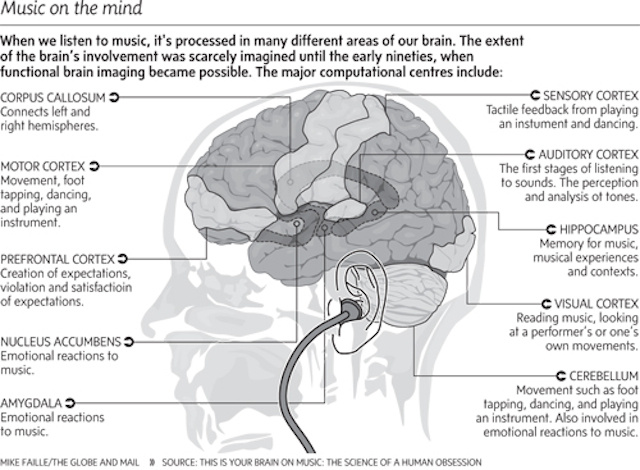
Music & the brainYears later you might be flipping through the radio dial, and a song comes on that you haven’t heard for years. You turn up the volume, and start singing along to the song, recalling that this was the very song you were listening to the night you were cramming for that exam.

Why is it that can you recall everything about this song, and very little about what you studied? The answer is that music engages the whole brain. Both the left hemisphere of your brain (which remembers facts) and the right hemisphere (which remembers music) work together as a powerful memory tool.

Did you know this can be just as powerful in your prayers?

There is a  Hebrew word (tephillah) for prayer which means a prayer set to music; a poetic prayer; a sacred song. This is the word used heavily in the first 72 psalms.

In other words, the psalmists linked words and melodies—left and right brain hemispheres—together to help our songful prayers get locked into our memory banks. The more we remember what God has done for us in answering our prayers, the more likely we are to keep on praying and keep on trusting Him in the future. 

Many times when I am reading Scripture, a song or hymn will come to my mind, and I pause to hum that melody. Maybe God will give you a new song to sing, or perhaps you will write your own personal melody as you pray. There’s no wrong way to sing your prayers.

However you do it, it’s a powerful memory tool when we sing our prayers to our Heavenly Father.

Monologue Or Dialogue

Dialogue with GodTrue prayer, according to the Bible, is a dialogue. If we ever think of it as a monologue, it ceases to be true prayer.

Look at the contrasting statements in the opening verses of Psalms 13 and 14—

How long, O Lord? Will You forget me forever? (13:1)

The fool says in his heart, “There is no God.” (14:1)

We can have a dialogue with God—even asking questions of the Almighty—or we can monologue to ourselves.

The dialoguer asks a lot of questions (five of them in the first two verses of chapter 13) and anticipates that God will answer. In fact, David wrote in an earlier psalm, “In the morning, O Lord, You hear my voice; in the morning I lay my requests before You and wait in expectation” (Psalm 5:3).

God’s answers are expected, as the dialoguer stops asking questions of God and begins to express his trust in God’s love, as he rejoices in God’s salvation, and sings about God’s goodness (13:5-6). Clearly, this trust, rejoicing, and singing come from assurances received in his dialogue with God.

The monologuer asks no questions of God, but makes definitive conclusions that he himself concocted. He talks to himself, making himself the final authority! The result is inevitable: “There they are, overwhelmed with dread” (14:5).

Jesus told a similar account of a man whom Jesus said, “prayed about himself” (see Luke 18:9-14). That word “about” is probably better translated “to.” That’s right: this man was so sure of himself that he now monologued to himself and thought he was praying. But Jesus said this about the monologuer: He went home without God taking notice of his prayer.

May we always be dialoguers in prayer, and never monologuers.

God wants to talk with you, even hearing and answering your many questions. Be sure you allow Him time to speak with you, as you anticipate His loving reply.

I will be continuing our series on prayer next Sunday, and I would love to have you join me!