How Confident Are Your Prayers?

David hasn’t done anything wrong. He’s never tried to lead a rebellion against King Saul. In fact, he’s never even talked poorly about Saul. And yet Saul is out to kill David!

David tries to get as far away as he can, choosing to live in the desert so that he might get some relief from Saul. Still Saul comes after him with a force of 3000 men! Every time David moves, Saul’s men are hot on his trail. David described his situation like this

My mortal enemies surround me. Their hearts are cold and calloused toward me, and they speak terrible things about me. They track me down and surround me. They are like hungry lions, crouching, waiting to pounce on me!

If you were in David’s sandals, how confident would you be that God could get you out of the situation? Remarkably, David’s confidence was as high as it could be!

David not only was confident that God would hear him, but that He would listen to him. More than that, David knew God would pay attention to him. And then David boldly said, “I call on You, O God, for you WILL answer me.”

How could David pray such a confident prayer? The answer is in this principle…

There is a direct correlation between intimacy and confidence.

David made two very intimate claims about his relationship with God:

  1. You will keep me as the apple of Your eye
  2. You hide me in the shadow of Your wings

The apple of the eye is the pupil. Our eyes are amazingly designed to not only take in information but to protect themselves. If something is getting too close to our eye, the eyelids blink in protection faster than we can consciously tell them to. So David was claiming that God would protect him by reflex!

The shadow of Your wings was a reference to the top of the Ark of the Covenant; a place called the mercy seat. Here is where the priest sprinkled the blood of a sacrificial lamb to atone for the people’s sin and to appeal to God’s mercy. The mercy seat was over-shadowed by two angels’ wings.

David was saying that God kept him in this intimate place—covered by God’s mercy and protection!

Jesus also told us about intimate confidence when He said, “If you remain in Me, and My words remain in you, ask whatever you wish, and it will be given you” (John 15:7).

  • Intimacy: remain IN Jesus, and let His words remain IN you
  • Confidence: ask whatever you wish, and it will be given you

Are your prayers this confident? If not, don’t work on raising your confidence, but work on increasing your intimacy. Check your intimacy level with questions like:

  • Am I abiding in Jesus?
  • Are His words abiding in me?
  • Do I have any unconfessed sin?
  • Is my prayer a “Your kingdom come, Your will be done” prayer?

Focus on intimacy, and then watch your confidence soar! 

If you are interested in learning more about the prayers of David, I have also discussed his prayer for help, his prayer of crying out loud, and his prayer of praise.

Saturday In The Psalms—Resolutions

I will… (9x in Psalm 101).

Psalm 101 is only eight verses long, but David makes nine I will resolutions to God. Perhaps you might consider making these resolutions yourself—

(1) I will sing of mercy and justice. These are two sides of the same coin; in fact, it’s only when we know God’s justice that we can appreciate His mercy. Both God’s justice and His mercy need to be celebrated.

(2) I will sing praises. Regardless of our situation or setting, God is worthy to be praised.

(3) I will behave wisely in a perfect way AND (4) I will walk within my house with a perfect heart. A commitment to integrity, living a godly lifestyle, and leaving a godly legacy.

(5) I will set nothing wicked before my eyes AND (6) I will not know wickedness. A commitment to be childlike in regard to wickedness, and watchfulness of anything impure.

(7) I will destroy AND (8) I will not endure AND (9) I will destroy all the wicked. A resolution to cut-off all relationships that are not God-honoring.

Resolutions aren’t just for New Year’s Day. Resolutions can be made any time we sense something in our life isn’t as God-pleasing as it could be.

What resolutions are you willing to make?

We Usually Believe The Opposite

The Lord is gracious and compassionate, slow to anger and rich in love. (Psalm 145:8)

Let those words sink in because most of us live like the exact opposite is true. Check out this 2-minute explanation …

A “Hallelujah!” Lifestyle

David shows us a picture of a man who made prayer the cornerstone of all he did. He’s quick to cry, “Help!” when he’s in trouble, and he doesn’t hold back when he’s crying out to God.

But he also shows us that prayer isn’t just for times of trouble. Prayer should be an ongoing conversation with God so that we can get to know His heart. God knows what’s going to happen (Isaiah 46:10), and He wants us to ask Him to make things clear to us (Jeremiah 33:3).

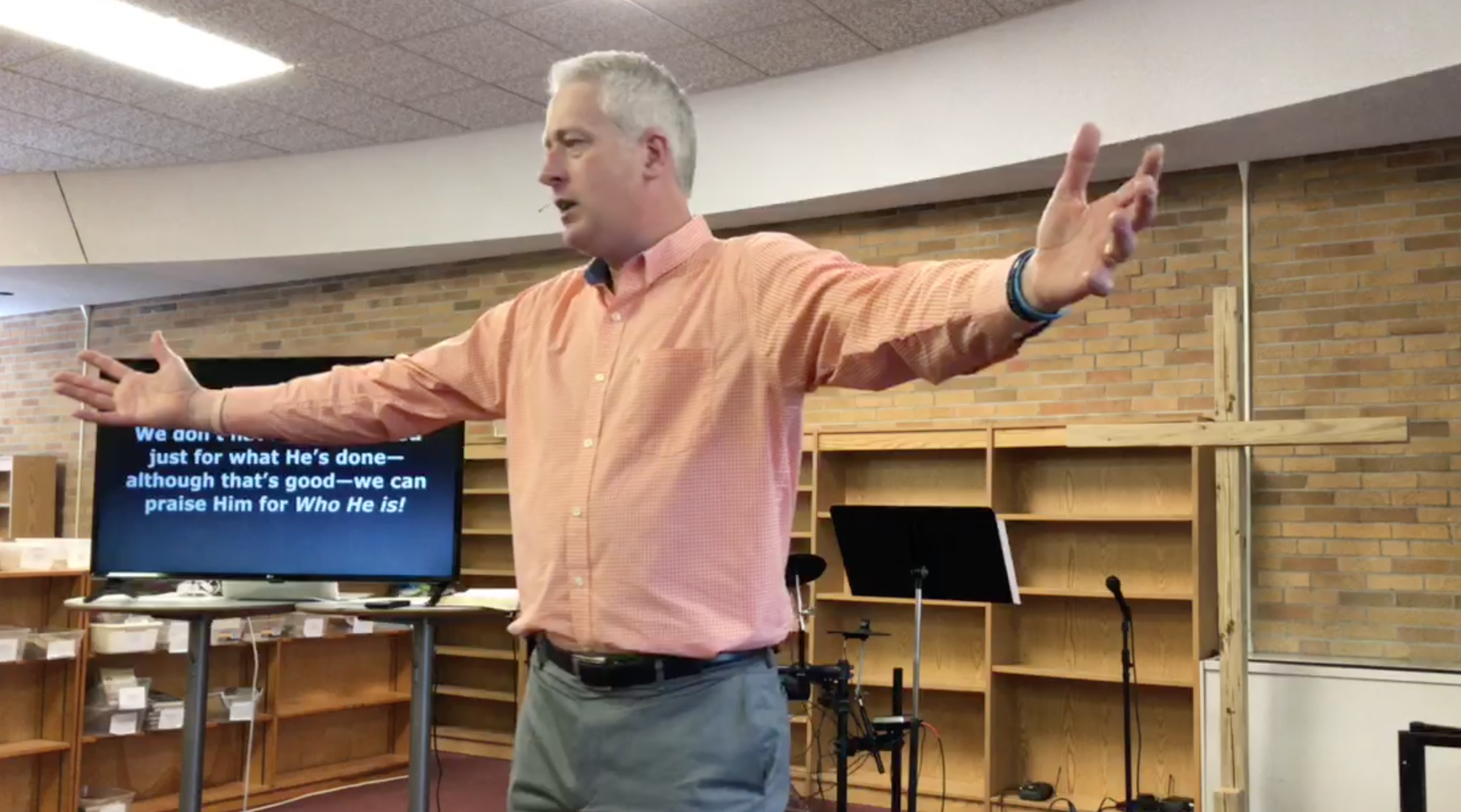
In Psalm 145, David challenges us to lift up our praise to God, as well as our prayers. This psalm of praise teaches us that we don’t have to only praise God for what He’s done—although that’s a great thing to do—but we can also praise God simply for Who He is!

In this psalm, David says God is…

…worthy of praise (v. 3a) 
…great beyond comprehension (v. 3b) 
…majestic (v. 5)
…awesome (v. 6)
…abundantly good (v. 7)
…gracious, compassionate, slow to anger, rich in love (v. 8)
…good to all (v. 9)
…mighty (v. 11)
…everlasting (v. 13)
…strong (v. 14)
…righteous and loving (v. 17) 
…near to us (v. 18)
…fulfilling (v. 19)
…watchful (v. 20)

Let’s not be known just for our petitions, but for our praise.

Let’s not be known just for our “Help!” but for our “Hallelujah!

Please join me in our continuing look at the Prayers Of David.

Saturday In The Psalms—Sing A New Song

Oh, sing to the Lord a new song! (Psalm 96:1).

God is so great—His worth is infinite—that He deserves a new song every time we sing to Him. There is no need to copy or duplicate something done before, but we should continually find new ways to praise Him.

Look at the angels encircling God’s throne. They continually sing out, “Holy! Holy! Holy!” as they perceive new dimensions of God’s grace, love, faithfulness, beauty, and majesty.

“Oh! Did you see that? Holy!” 

“Look at that! Amazing!” 

“Wow, I just saw something else breathtaking” Worthy!”

Our praise of God should follow that example: “Holy! Holy! Holy!” This is what Psalm 96 tells us…

Sing!
Bless His name!
Tell how good He is!
Declare His glory everywhere!
He is great!
He is greatly to be praised!
Look at His majesty!
Stand in awe of His beauty!
Give Him the glory due His name!
Worship! 
Thrill at the beauty of His holiness!
Bow before His majesty!
Rejoice!
Be glad!
Listen to creation praising their Creator!
Join creation in their song!
He is coming soon!
Maranatha!
Oh, sing to the Lord a new song!
Sing it now and forever and ever!

For Crying Out Loud!

There’s a time when David was fainting and had no one to help him—my spirit was overwhelmed and fainted, throwing all its weight on me. I look for someone to come and help me, but no one gives me a passing thought! No one will help me; no one cares a bit what happens to me (Psalm 142:3-4).

Here’s the backdrop to this prayer. King Saul has tried to kill David twice, not including the time Saul sent assassins to David’s house to kill him there. Even Jonathan, Saul’s son, was embarrassed and grieved at his father’s shameful treatment of David.

David runs away from Saul so quickly that he doesn’t take any food or even a weapon. He literally only has the clothes on his back and the sandals on his feet. He’s able to get some day-old bread from Ahimelech the priest, and he also takes Goliath’s sword from the temple.

David is clearly not thinking clearly. He is wearing Goliath’s sword on his side. Remember that David killed Goliath. Goliath is from Gath. And where does David run? To Gath!! He has to pretend he’s gone insane in order to escape from Gath, and he flees to the cave of Adullam.

It’s here that he prays an intense prayer. How intense? David literally shouts this prayer. He uses phrases like:

    • I cry aloud to the Lord
    • I lift up a thundering voice to God to plead for mercy
    • I let my complaint gush out in front of God, not holding anything back
    • He cries to God, “You are all I really want in life” and “You’re my last chance, my only hope for life”
    • After he did all that, he still says, “God, listen to my even louder cry!

Just how desperate is your situation? Just how heavy is your burden? Have you come to the realization that God is your ONLY help? Then, like David, cry out louder and louder to Him until He answers you!

A blind man got the attention of Jesus by yelling at the top of his lungs, “Jesus, Son of David, have mercy on me!!” Jesus said that this man’s faith healed him. What was the demonstration of his faith? It was the persistent calling out to the only One who could help him.

Earlier in this chapter, Jesus says this: So what makes you think God won’t step in and work justice for His chosen people, who continue to cry out for help? Won’t He stick up for them? I assure you, He will. He will not drag His feet. But how much of that kind of persistent faith will the Son of Man find on the earth when He returns? (Luke 18:7-8).

Once again Jesus links a continual cry for help to the definition of persistent faith. 

So I’ll ask again: just how desperate are you for God to answer you? If you will cry out loud to Him, God will see your persistent faith and will step in and work for you.

Please join me on Sunday as we continue to learn more lessons from David’s prayers.

Saturday In The Psalms—No One!

The Lord reigns… (Psalm 93:1).


When biblical authors use repetition or parallelism, it’s important to take note. They are wanting to make sure their message is heard loud and clear. They want what they’re sharing to stand out from everything around it. This is sort of how we would use bold or italics, a different colored font, or even a LARGER FONT to make something stand out.

In this Psalm…

…the Lord is clothed in majesty and strength

…He is established, immovable, everlasting, from time immemorial, firm, unshakeable

…“God is mightier than the thunder of the great waters, mightier than the breakers of the sea—the Lord on high is mighty

…His Word is very sure, lasting forever, holy, unchangeable, endless

The bottom line—

There is no one more sure, strong, reliable, and everlasting than Jehovah God!

Demolishing Antichrist Strongholds

“This week we pray that God will demolish Antichrist strongholds We are surrounded by systems and strongholds that oppose Christ the Lord and King. There are social, political, economic, and legal structures and schemes that try to disparage God. We are not for or against a particular political system. We are Bible-believers, Christ-worshippers; and we come from all walks of life and backgrounds. We seek the glory of God and His alone. We align ourselves with His Word. We should not harbor enmity or hatred toward anyone. Even if they oppose us, deride our faith, doubt our God, and insult our Savior and King, they are not our enemies. The real enemy is satan who manipulates them. Our war is against satan and his strongholds. Such people are poor humans who need love and compassion from us, and mercy and forgiveness from God. We do not depend on human methods or material weapons, because this is spiritual warfare against satanic powers. Rather, our method is prayer, and that is all.

“O Lord our God, may You be praised for ever and ever! Why do the nations rage? Why do the peoples plot in vain? The kings of the earth set themselves, and the rulers take counsel together, against You and against Your Anointed One (Psalm 2:1-2). Help us arm ourselves with the weapons You gave us in Your Word: the belt of truth, the breastplate of righteousness, the readiness of the gospel of peace, the shield of faith, the helmet of salvation, and the sword of the Spirit (Ephesians 6:14-17). He who sits in the heavens laughs; the Lord derides them. At the name of Jesus every knee will bow, in heaven and on earth and under the earth, and every tongue confess that Jesus Christ is Lord, to the glory of God the Father (Psalm 2:4; Philippians 2:10-11).” —Sobhi Malek, in Praying For Muslims

If you haven’t already, check out my review of Praying For Muslims here. I shared some other prayers from this book here, and I also shared some quotes here.

Help!

David and his men are on the run from King Saul, but they hear that the small town of Keilah is being harassed by the Philistines. The bad guys are stealing the harvest from the people of Keilah, making it a very real possibility that they would starve during the upcoming winter. In his usual habit, David prays and asks God if he should help the people of Keilah, and God gives him the go-ahead to attack.

David and his men defeat the Philistines, not only returning the crops that had been stolen but also delivering some livestock that they took from the defeated Philistines. You might expect that David and his men were given a ticker-tape parade. Instead, as soon as David was within the city’s walls, he finds out that the people of Keilah are planning to sell him out to King Saul. Talk about ingratitude!

David and his men flee to the Desert of Ziph, where they won’t be a bother to anyone. Except the Ziphites get word to King Saul that they will gladly turn him over to the King whenever he asks for it.

What is David’s response? As usual, it’s prayer. His prayer is short and straight to the point—

Help, Lord, for the godly are no more; the faithful have vanished from among men.

In other words, David asks God, “Where have all the decent people gone?” It’s no different in our day, as Paul told his friend Timothy that people will only become more hypocritical liars, with their conscience not bothering them a bit!

What I love about David’s prayer is that he quotes God back to God. Check out the quotation mark: “Because of the oppression of the weak and the groaning of the needy, I will now arise. I will protect them from those who malign them.” And then David is quick to add that God’s words never fail! 

I am convinced that our spiritual battles are largely lost or won in our minds. We need to recall God’s Word—Yet this I call to mind and therefore I have hope: Because of the Lord’s great love we are not consumed, for His compassions never fail (Lamentation 3:21-22).

So we cry, “Help!” to God because He is the only One who can help us: The Lord is my Helper; I will not be afraid. What can man do to me? (Hebrews 13:6).

But David has an important question to ask: “How long do we continue to call for help?” Have you ever asked God that?

Jesus said that the key to our successful praying is for us to remain in Him and for His Words to remain in us, like a branch remains connected to the vine (John 15:7). So let me ask you a question: How long should the branch remain connected to the vine before it’s ready to go off on its own?

The answer is simple—if the branch wants to remain alive and fruitful, it must stay in relationship with the vine forever!

So once again, look at how Jesus answers the “How long?” question—Keep on asking and it will be given you; keep on seeking and you will find; keep on knocking reverently and the door will be opened to you. (Matthew 7:7)

“Help!” is a great prayer that God loves to answer. “How long” do we pray that prayer? Until it’s answered … keep on, keep on, KEEP ON!

A Leader’s Observations

When I consider Your heavens, the work of Your fingers… (Psalm 8:3).

David starts and ends this psalm with the same phrase: O Lord, our Lord, how excellent is Your name in all the earth! In the middle, David marvels at the diversity and beauty of God’s creation. David observes…

  • the blue skies
  • the wide-eyed wonder of children
  • the moon and stars
  • the marvel of man
  • the flocks and herds of the field
  • the birds in the air
  • the fish in the seas

David takes nothing for granted. He observes, he sees God, and then he worships God as Creator. David’s constant cycle is—observation and contemplation which leads to adoration.

A mark of a godly leader is one who is continually learning about his Creator.

Don’t ever stop observing; don’t ever stop learning. Become a lifelong learner, and let your contemplation lead you to adoration of our excellent Lord and Creator!

This is Part 18 in my series on godly leadership. You can check out all of my posts on this topic by clicking here.