What Are You Whispering?

Wise King Solomon gave us this advice:

Never say anything that isn’t true. Have nothing to do with lies and misleading words. (Proverbs 4:24)

Most decent people don’t have an issue with this one. We would never dream of whispering to someone we care about things like…

  • …you’re a loser.
  • …you can’t seem to do anything right.
  • …hey, stupid, nice job. Not!

But the verse just before says this:

Be careful how you think; your life is shaped by your thoughts. (v. 23)

I wonder how many times we whisper words like loser, failure, or stupid to ourselves. The things we’d never say to someone else, we seem all too ready to say to ourselves!

What are you whispering to yourself? Listen closely. Are you whispering things to yourself that you would never whisper to someone else? Then it’s time to start whispering something new.

Solomon preceded this with these words of affection that seem to come right from our Heavenly Father’s mouth:

My child, pay attention to what I say. Listen to my words. Never let them get away from you. Remember them and keep them in your heart. (vv. 20-21)

God’s Spirit will never, ever, EVER speak cutting, hurtful, unkind, or untrue words to you. God loves you as if you were the only person on earth to love! He loves you so much that He sent His Son to rescue you.

Listen closely because He’s saying it right now, “I love you!

Yeah, whisper that to yourself instead!

Thursdays With Oswald—Hate Properly

This is a weekly series with things I’m reading and pondering from Oswald Chambers. You can read the original seed thought here, or type “Thursdays With Oswald” in the search box to read more entries.

Hate Properly

     A Quaker friend of mine referring to a certain man said he did not like him because he did not hate properly. … The Christian standpoint should be one of positive anger when anyone is made to stumble. To remain indifferent when there is injustice abroad is to come under the curse of Meroz, who “came not to the help of the Lord…against the mighty” (Judges 5:23).

From Baffled To Fight Better

There are six things the Lord hates, seven that are detestable to Him: haughty eyes, a lying tongue, hands that shed innocent blood, a heart that devises wicked schemes, feet that are quick to rush into evil, a false witness who pours out lies and a man who stirs up dissension among brothers. (Proverbs 6:16-19)

But if anyone causes one of these little ones who believe in Me to sin, it would be better for him to have a large millstone hung around his neck and to be drowned in the depths of the sea. (Matthew 18:6; Mark 9:42; Luke 17:2)

And the word of the Lord came again to Zechariah: “This is what the Lord Almighty says: ‘Administer true justice; show mercy and compassion to one another. Do not oppress the widow or the fatherless, the alien or the poor. In your hearts do not think evil of each other.’ But they refused to pay attention; stubbornly they turned their backs and stopped up their ears. They made their hearts as hard as flint and would not listen to the law or to the words that the LORD Almighty had sent by his Spirit through the earlier prophets. So the Lord Almighty was very angry.” (Zechariah 7:8-12)

It’s time for us to get positively angry and hate the things that God hates.

Watch Your Mouth

I was reading Proverbs 10 the other day, and a recurring theme seemed to show up in this chapter. Since you’re reading this blog, I know you are highly intelligent, so I’m sure you can spot the theme as well as I can…

If you have good sense, you will listen and obey; if all you do is talk, you will destroy yourself.

If you have good sense, it will show when you speak….

If you have good sense, you will learn all you can, but foolish talk will soon destroy you.

You will say the wrong thing if you talk too much—so be sensible and watch what you say.

Honest people speak sensibly, but deceitful liars will be silenced.

If you obey the Lord, you will always know the right thing to say….

I’d say the theme was pretty obvious, wouldn’t you?

But one question still remains: What are YOU going to do with this?

Seeing Only The Best In Your Spouse

Researchers have found that the biological responses of your body and brain to being “in love” only last two years. So guess when most newlyweds begin experiencing problems in their marriage? Yep, you guessed it: about two years into marriage.

After the in love buzz wears off, what can you do to maintain a happy, fulfilling marriage? Quite simply you have to choose to see only the best in your spouse.

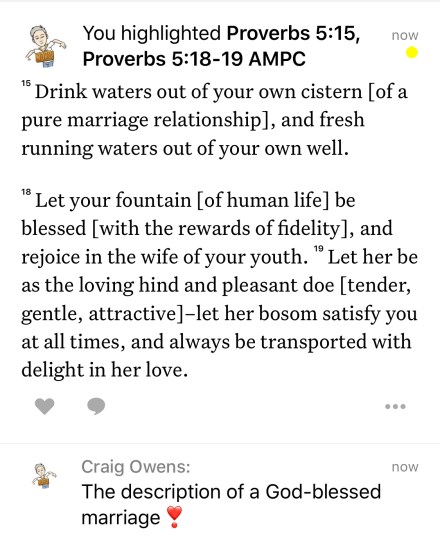
Solomon was so wise to write to us that our spouse should be the only one who captivates us … the only one who satisfies us … the only one who keeps making our hearts go pitter-pat! When we choose to see the best in our mate, we can keep that in love buzz going for the life of the marriage.

Check out this excerpt from a WebMD article (you can read the full article here)—

Most often, self-assessments are grounded in reality, the researchers write. The way we see ourselves is fairly accurate. The way we see others, they continue, is often shaped by hope. With that in mind, they took one partner’s self-assessment at face value and compared it to the other partner’s assessment, as well as that partner’s description of his/her ideal partner.

For example, John’s ideal mate is funny and warm. And that is how he chooses to see Jane, who he has just married, despite the fact that Jane describes herself as moody and distant. Will John change his tune over time and come to regret his marriage to Jane? Or will his positive—if skewed—view of his wife help maintain his happiness?

Fortunately for John, the researchers found the latter to be true. In tallying the data, they discovered that those who did not idealize their partners when they got married tended to be more dissatisfied with their marriage by the end of the study compared to those who had an unrealistically idealistic view of their partner. Those in the “idealistic” group tended to be happier and more satisfied with their marriage.

In other words: you will bring out of your spouse what you see in your spouse.

Do you want a fun-loving wife? See her as your favorite playmate.

Do you want a confident husband? See him as a strong, self-assured provider for your home.

I like how the Apostle Paul states this (especially in the Amplified Bible)—

However, let each man of you without exception love his wife as being in a sense his very own self; and let the wife see that she respects and reverences her husband—that she notices him, regards him, honors him, prefers him, venerates, and esteems him; and that she defers to him, praises him, and loves and admires him exceedingly.

Just as God sees the best in you and loves you for who He sees you becoming, love your spouse and see only the best in him/her.

Bommerang

A kind man benefits himself, but a cruel man brings trouble on himself. (Proverbs 11:17)

There are those who [generously] scatter abroad, and yet increase more; there are those who withhold more than is fitting or what is justly due, but it results only in want. (Proverbs 11:24)

The people curse him who holds back grain [when the public needs it], but a blessing [from God and man] is upon the head of him who sells it. (Proverbs 11:26)

Pretty straightforward…

If you want others to help you later, help others now.

If you want God to bless you later, bless others now.

If you want people to honor you later, be honorable now.

Boomerang!

It will only come back to you IF you throw it first!

Stay Farther Away

The little boy was all dressed up in his brand new clothes for Easter Sunday. He was pretty excited to be sporting his new duds on this special day. And what a beautiful day it was! A rain shower the night before had given way to brilliant sunshine on this Resurrection Sunday morning. The birds were singing, the flowers were so fragrant, and the puddles were shimmering like diamonds. A picture-perfect morning!

While waiting for the rest of his family to finish getting dressed for church, the little boy ran outside into the sunshine. He breathed deeply of the fresh spring air, closed his eyes as he turned his face upward to feel the warmth of the sunshine on his freshly-washed face. Ahhh!

He opened his eyes again and saw those shimmering puddles. He just had to get a closer look!

He ran over to the edge of a puddle and poked a stick into the water. Then he spotted some pebbles and picked up a handful to throw in the water and watch the splash. Cool! He looked for something bigger to throw in the water, when he saw a really big rock in the garden. He ran over, grabbed it, sprinted back to the puddle, wound up to make his biggest throw yet, swung his arm forward with the rock, and as his foot slipped on the wet pavement, he and the rock sprawled right in the middle of the puddle. His new Sunday-best clothes were ruined for Easter Sunday!

It doesn’t seem that hard of a concept: To avoid falling into something, stay far away from it.

Parents lecture their kids on this all the time. And our Heavenly Father warns us about this too:

Let your way in life be far from [the seductress], and come not near the door of her house [avoid the very scenes of temptation].

I have people tell me all the time, “I slipped up,” after they have said or done something wrong. Yes, they slipped and sprawled and ruined something beautiful, but if they hadn’t been so close to their puddle in the first place, they probably wouldn’t have slipped.

Solomon wisely said don’t even get close to the danger zone … stay as far away as you can.

That’s the way to live in true freedom!

Baaaa!

Listen to the podcast of this post by clicking on the player below, and you can also subscribe on AppleSpotify, or Audible.

Of all the things God could have used as a picture of our relationship with Him, He used an animal. And, no, it wasn’t an animal that seems particularly powerful or smart or noble.

He picked a sheep.

A fuzzy, sometimes dimwitted, needs-a-lot-of-help animal.

I’m a sheep. Baaaa!

But then I have the great picture of God as my loving Shepherd. How wonderful to know that the Lord is my Shepherd, I shall not be in want!

As a pastor I am called to be the shepherd to God’s flock of sheep under my watchful eye. Jesus set the example for me:

But the one who enters through the gate is the shepherd of the sheep. The gatekeeper opens the gate for him, and the sheep recognize his voice and come to him. He calls his own sheep by name and leads them out. After he has gathered his own flock, he walks ahead of them, and they follow him because they know his voice.

And Solomon said:

Be sure you know the condition of your flocks, give careful attention to your herds.

Pastors, here are the questions I’m asking of myself, and I invite you to ask them of yourself too:

  • Do my sheep recognize my voice? Or am I trying to sound like someone else?
  • Do I know all my sheep by name?
  • Are my sheep following me as I follow Jesus?
  • Am I willing to go first?
  • Do I find fresh pastures and clean water for my sheep? Or is it recycled food I’m serving them?
  • Am I spending enough time with my sheep to know the condition of each one?
  • Do my sheep get my undivided attention?

What a privilege to be a pastor! What a responsibility! What a joy to know my sheep and to be known by them!

Baaaa!

UPDATE: This post was one of the seed thoughts that went into fashioning my book Shepherd Leadership: The Metrics That Really Matter.

►► Would you please prayerfully consider supporting this ministry? ◀︎◀︎

Closed Door = Open Window

Yesterday God closed a pretty significant door in my life. It will mean some short-term changes, but I am confident that it also means some great long-term rewards! I’m not worried; just prayerful for the next steps I need to take.

Here’s where I base my confidence:

This didn’t take God by surprise: All the days ordained for me were written in Your book before one of them came to be.

In fact, God was the One who closed this door: A man’s steps are directed by the Lord.

And now I’m just waiting: Behold, I am doing a new thing! Now it springs forth; do you not perceive and know it and will you not give heed to it? I will even make a way in the wilderness and rivers in the desert.

Or as Corrie ten Boom so beautifully said it:

“When God closes a door, He opens a window.”

What Is Valid Criticism?

Okay, I’ll need some help on this one.

Solomon, the wisest king ever, said in Proverbs 25:12:

To one who listens, valid criticism is like a gold earring or other gold jewelry. (New Living Translation)

I don’t really like criticism of any kind, but it says it right there in the Bible that valid criticism is good for me. So what is “valid criticism”? Look at this same verse in two other versions:

Like an earring of gold or an ornament of fine gold is a wise man’s rebuke to a listening ear. (NIV)

A wise friend’s timely reprimand is like a gold ring slipped on your finger. (The Message)

I’ll start…

Valid criticism comes from someone with wisdom and experience in the area they are critiquing.

Valid criticism is intended to help me get better.

Valid criticism comes in measured, well-thought-out words.

Now it’s your turn. In the comments below, please share with us how you define “valid criticism.”

Also check out 20 Helpful Thoughts On Criticism for some insights from other wise people.

Codependent?

Modern psychologists have coined the term codependent to mean someone who allows their life to be controlled by another person, much like the moon controls the tides on the earth’s oceans. Almost always this relationship ends up being a lose-lose relationship: both the person being controlled and the person doing the controlling are headed the wrong way.

Codependent is not a biblical term.

But there is a concept in Scripture that is the anti-codependent. I would call it interdependent. Here’s a couple of verses to back it up…

Dear brothers and sisters, if another believer is overcome by some sin, you who are godly should gently and humbly help that person back onto the right path. And be careful not to fall into the same temptation yourself. Share each other’s burdens, and in this way obey the law of Christ. (Galatians 6:1-2)

Wounds from a friend can be trusted, but an enemy multiplies kisses. (Proverbs 27:6)

It is absolutely clear that God has called you to a free life. Just make sure that you don’t use this freedom as an excuse to do whatever you want to do and destroy your freedom. Rather, use your freedom to serve one another in love; that’s how freedom grows. (Galatians 5:13)

God has given each of you a gift from His great variety of spiritual gifts. Use them well to serve one another. (1 Peter 4:10)

This isn’t excusing bad behavior, or winking at poor choices, or rescuing someone from the consequences of sin. Excusing, winking, and rescuing are symptoms of codependency.

Interdependency is saying, “I need you to be stronger—to be healthy—because I may need to lean on you someday.”

Christians try to get stronger and develop their own spiritual gifts so that they can help a friend-in-need get stronger and develop his/her spiritual gifts.

The Body of Christ needs you to be interdependent, which completely trumps codependent.