What Is Valid Criticism?

Okay, I’ll need some help on this one.

Solomon, the wisest king ever, said in Proverbs 25:12:

To one who listens, valid criticism is like a gold earring or other gold jewelry. (New Living Translation)

I don’t really like criticism of any kind, but it says it right there in the Bible that valid criticism is good for me. So what is “valid criticism”? Look at this same verse in two other versions:

Like an earring of gold or an ornament of fine gold is a wise man’s rebuke to a listening ear. (NIV)

A wise friend’s timely reprimand is like a gold ring slipped on your finger. (The Message)

I’ll start…

Valid criticism comes from someone with wisdom and experience in the area they are critiquing.

Valid criticism is intended to help me get better.

Valid criticism comes in measured, well-thought-out words.

Now it’s your turn. In the comments below, please share with us how you define “valid criticism.”

Also check out 20 Helpful Thoughts On Criticism for some insights from other wise people.

Codependent?

Modern psychologists have coined the term codependent to mean someone who allows their life to be controlled by another person, much like the moon controls the tides on the earth’s oceans. Almost always this relationship ends up being a lose-lose relationship: both the person being controlled and the person doing the controlling are headed the wrong way.

Codependent is not a biblical term.

But there is a concept in Scripture that is the anti-codependent. I would call it interdependent. Here’s a couple of verses to back it up…

Dear brothers and sisters, if another believer is overcome by some sin, you who are godly should gently and humbly help that person back onto the right path. And be careful not to fall into the same temptation yourself. Share each other’s burdens, and in this way obey the law of Christ. (Galatians 6:1-2)

Wounds from a friend can be trusted, but an enemy multiplies kisses. (Proverbs 27:6)

It is absolutely clear that God has called you to a free life. Just make sure that you don’t use this freedom as an excuse to do whatever you want to do and destroy your freedom. Rather, use your freedom to serve one another in love; that’s how freedom grows. (Galatians 5:13)

God has given each of you a gift from His great variety of spiritual gifts. Use them well to serve one another. (1 Peter 4:10)

This isn’t excusing bad behavior, or winking at poor choices, or rescuing someone from the consequences of sin. Excusing, winking, and rescuing are symptoms of codependency.

Interdependency is saying, “I need you to be stronger—to be healthy—because I may need to lean on you someday.”

Christians try to get stronger and develop their own spiritual gifts so that they can help a friend-in-need get stronger and develop his/her spiritual gifts.

The Body of Christ needs you to be interdependent, which completely trumps codependent.

Light For Life

This week is Sanctity Of Human Life week. I’m passionate about this issue; in fact, it’s one of the main issues in politics in which I really get involved.

We’ll be celebrating Sanctity Of Human Life this Sunday, January 23, at Calvary Assembly of God. We’ll have an update on 38 years of pain since the infamous Roe v. Wade decision, and a presentation from Alpha Family Center, an organization in Cedar Springs that I wholeheartedly support.

This Sunday evening, I’m encouraging everyone to shine a light in support of life. We’ll have some special candle bags to hand out on Sunday, and we’re encouraging everyone to line their driveway or carport or sidewalk with these “I Support Life” bags. Even if you can’t come to Calvary on Sunday, you can put a small candle in a paper lunch bag. Let’s light up the darkness and speak up for those who can’t speak for themselves:

Speak up for those who cannot speak for themselves; ensure justice for those being crushed.

Can You Have Too Much Blessing?

I seldom turn on religious TV shows, because when I do I typically hear the same two messages: (1) God wants you to be rich; (2) God wants you to be healthy. I believe God is good all the time, but that doesn’t mean those who follow Him always get wealth and health.

Consider this:

After Rehoboam’s position as king was established and he had become strong, he and all of Israel with him abandoned the law of the Lord.

Notice: When Rehoboam was healthy and wealthy, he abandoned God. When things looked bleak—when the future for Rehoboam was very much in doubt—Rehoboam was “walking in the ways of David and Solomon” (2 Chronicles 11:17). When the Egyptians attacked, Rehoboam and his court officials “humbled themselves before God” (12:6).

Health and wealth derailed Rehoboam, but difficulties kept him close to God.

Maybe a better prayer than “Bless me” would be “Build Your character in me.” Or as it says in Proverbs:

Give me neither poverty nor riches, but give me only my daily bread. Otherwise, I may have too much and disown You and say “Who is the Lord?” Or I may become poor and steal, and so dishonor the name of my God.

The prayer that Jesus taught us to pray is perfect: Give us today our daily bread—no more, no less. That keeps me focused on my Heavenly Father.

Reciprocity

Listen to the podcast of this post by clicking on the player below, and you can also subscribe on AppleSpotify, or Audible.

Reciprocity is a big word that simply means: You will get what you give.

Hear me correctly. I’m not saying give more just to get more. It doesn’t work that way because that’s not true reciprocity; that’s just plain selfishness.

Reciprocity is giving to others just because you have it in your power—and in your heart—to give, and it will “bounce back” to you.

Reciprocity is from your heart. God makes sure you get the return blessings.

And, by the way, if you have something you could give but you don’t give it, your “bounce back” becomes a world that is smaller and smaller, with greater scarcity.

Reciprocity is win-win. Selfishness is lose-lose.

When you’re kind to others, you help yourself; when you are cruel to others, you hurt yourself. (Proverbs 11:17)

The world of the generous gets larger and larger; the world of the stingy gets smaller and smaller. (Proverbs 11:24)

The one who blesses others is abundantly blessed; those who help others are helped. (Proverbs 11:25)

►► Would you please prayerfully consider supporting this ministry? ◀︎◀︎
Get In Their Way

It’s true that you should not get in their way when your friends are pursuing their dreams.

But if you are a true friend, you will get in their way when they are heading for danger. Setup roadblocks, wave flags, intervene, tackle them (if you have to) to keep them from hurting themselves.

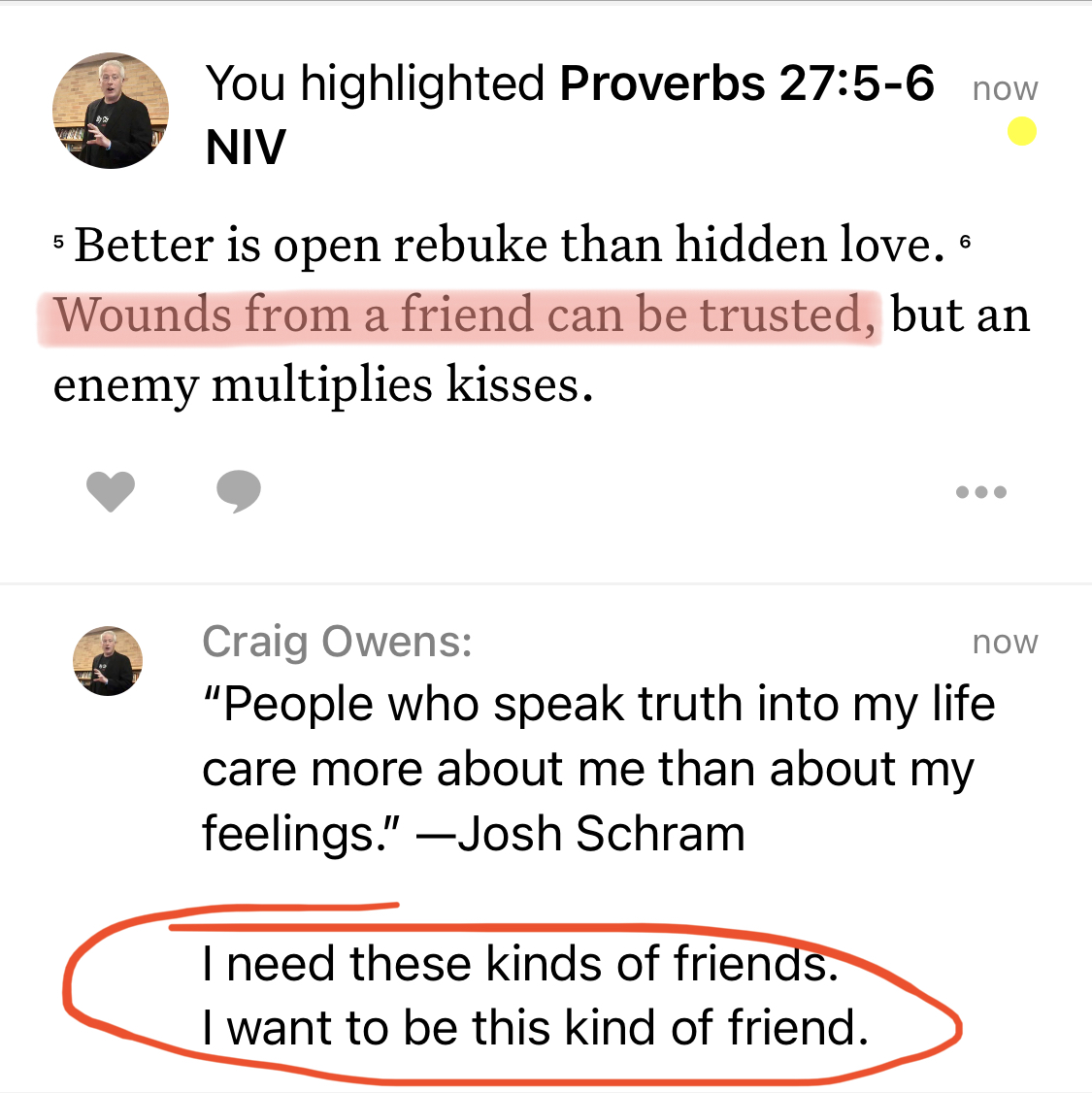
As my good friend Josh Schram said, “People who speak truth into my life care more about me than about my feelings.”

If you don’t get in their way when they are headed for danger, you’re not really a friend at all, you are their enemy.

Wounds from a sincere friend are better than many kisses from an enemy (Proverbs 27:6).

Are you a true friend? Cheer on their pursuit of their dreams, and get in their way if they are headed for danger.

My Best Friend

Craig & Betsy

My Dearest Betsy,

Twenty-six years ago I began a relationship with my first girlfriend. Twenty years ago today I married my first and only girlfriend. Today I am more in love with you than I ever thought would be possible!

You are my best friend, my confidant, my favorite playmate, and still the only woman I’ve ever had eyes for.

Solomon wrote:

He who finds a wife finds what is good and receives favor from the LORD.

I’m so grateful that Solomon’s words have been a massive understatement for me. Being married to you has been so beyond good, and God’s favor has saturated my life.

So here’s to the next 20 years… I can hardly wait to see all that God has in store for us. And having you right by my side to share this adventure makes it all the more fulfilling.

I love you, my bride!

Shop With A Purpose

Why do you go shopping?

Just for fun?

As a stress-buster?

For real needs?

Where do you go shopping?

Whichever store is closest?

The one with the best prices?

     The one with the most desirable styles?

How about shopping somewhere that really makes a difference?

Betsy and I were wandering around Rockford, MI, last weekend and stumbled upon an incredible store called The W.A.R. Chest Boutique. W.A.R. stands for Women At Risk. (Please read more about the mission of W.A.R. on their website.)

In a nutshell, W.A.R. sells items made by women who have been rescued from slavery or other oppressive conditions. These women have been taught a skill to make jewelry or clothing or other one-of-a-kind items for your home. And here’s the great part: 90% of the proceeds go back to the women who made the items! Yes, 90 percent!

You can get involved by:

  • Educating yourself on the plight of at-risk women around the world.
  • Shopping at the two W.A.R. boutique locations in West Michigan.
  • Shopping W.A.R.’s items online.
  • Hosting a W.A.R. party in your home.
  • Praying for these women, and for organizations that are helping them.

Don’t just shop. Shop with a purpose.

Never walk away from someone who deserves help; your hand is God’s hand for that person. (Proverbs 3:27)

Don’t Be That Guy

I love studying leadership books and learning from the lives of great men and women of history. The leadership section of my library is only slightly larger than the biography section. One of the saddest things to see is a leader who self-destructs. I was just reviewing some of my notes about leadership failures when Tim Elmore’s latest e-newsletter arrived entitled Self-Destructive Leaders.

Check out a couple of blurbs from this excellent article:

Projecting their self-worth.
There are few things more unappetizing than a leader who has to constantly talk about how important they are. They name drop, they remind others of their busyness, accomplishments, authority, past positions, degrees, or pedigree. It’s like they’re lobbying for attention and affirmation. It’s a sad commentary when so much of a leader’s energy is spent doing this instead of helping their team reach their goals.

Possessing a controlling spirit.
Often, insecure leaders react to their inward desperation with control. They feel if they can control people, they’ll maintain absolute authority. … They resort to more regulations and policies to enforce compliance among staff instead of trusting them and earning their loyalty….

Comparing themselves to others obsessively.
When a leader has a low EQ [emotional intelligence quotient], they naturally tend to look around them; they look outward rather than inward (at their own natural strengths and style) or upward (to their Creator for their sense of identity).  They become consumed with comparing their own traits or achievements to those of other leaders. Soon, their team ceases to operate in a healthy way. They’re driven by comparing and competing with others instead of capitalizing on their own core competencies.

Possessing self-imposed blindness.
This one is huge. All leaders have blind spots. Like in a car, blind spots happen not so much because of stupidity but position. The driver can’t see certain things. Sadly, self-destructive leaders refuse help. They repel any input from colleagues and insist on living in a bubble that makes them feel good. All is well, or so they think. Their insecurity won’t let them face the facts. They prefer a perspective that’s limited, but comfortable. Their narrow view will eventually lead to an accident.

Here’s what wise King Solomon said about the self-destructive leader:

Arrogant know-it-alls stir up discord, but wise men and women listen to each other’s counsel. (Proverbs 13:10)

If you ignore criticism, you will end in poverty and disgrace; if you accept correction, you will be honored. (Proverbs 13:18)

The saddest part is this – the self-destructive leader will read this and then say to himself, “Nope, that’s not me. This is describing someone else.”

Don’t be that guy (or gal)!

  • Look in the mirror of Scripture.
  • Listen to the counsel of others.
  • Listen to the criticism of your teammates. (Hint: if your teammates aren’t telling you anything that you need to improve on, it’s not because you’re perfect. Either you have intimidated them into silence, or you’re deaf to what they’re telling you.)
  • Learn from the lives of great leaders from the past. Read their biographies and autobiographies.

Apathy Is Not An Option

The old joke goes like this—

Q: What’s the difference between ignorance and apathy?

A: I don’t know and I don’t care.

Corny, I know, but it does make a point.

For followers of Jesus Christ, sometimes ignorance of a situation is acceptable, but apathy is never an option. In other words, you may not know what’s happening around you, but once you know, you’re on the hook. You cannot do nothing. Especially when people need help.

Nowhere in Scripture will you ever see something like this:

  • “If you feel like helping the poor, go for it. If you don’t feel like it, that’s okay.”
  • “It’s okay to look away from the hurting.”
  • “If you’re too busy to get involved, God will understand.”
  • “If it makes you uncomfortable to see that, just pretend you didn’t see it.”

Nope. I cannot do that and call myself a follower of Jesus.

Anyone, then, who knows the good he ought to do and doesn’t do it, sins. (James 4:17)

The consistently righteous man knows and cares for the rights of the poor…. (Proverbs 29:7 AMP)

The godly care about the rights of the poor; the wicked don’t care at all. (Proverbs 29:7 CEV)

Get informed and then get involved.