My People

The prophet Jeremiah is often called “the weeping prophet.” Perhaps if we wept a bit more over the lost souls who are staggering toward Hell, we would be compelled to do more to rescue them.

What I love about Jeremiah is his identification with lost humanity. God called Jeremiah to be His prophet, so if anyone could have the opportunity to feel special or superior, it might be Jeremiah. But when the prophet heard about the approaching judgment, he called the residents of Jerusalem my people. Did you get that: MY people.

Not only did he call them my people, but his heart broke for them:

  • My heart is faint within me (Jeremiah 8:18)
  • I am crushed (8:21)
  • I mourn … horror grips me (8:21)
  • I weep day and night (9:1)
  • I weep and wail and take up a lament (9:10)

In Soul Work, Randy Harris has a passage that has been pounding on my heart—

Why don’t we cancel all those [church] meetings and make a field trip to the laundromat and the bars and the streets and listen to what makes sinners tick until we love them. I don’t mean try to convert anybody; I mean listen to them until we love them. Listen until we find ourselves in them. Listen to what they’re afraid of, listen to what they hope for, listen to what hurts, until we love them. And then we can try to be the church again. (emphasis added)

Or as C.T. Studd famously said:

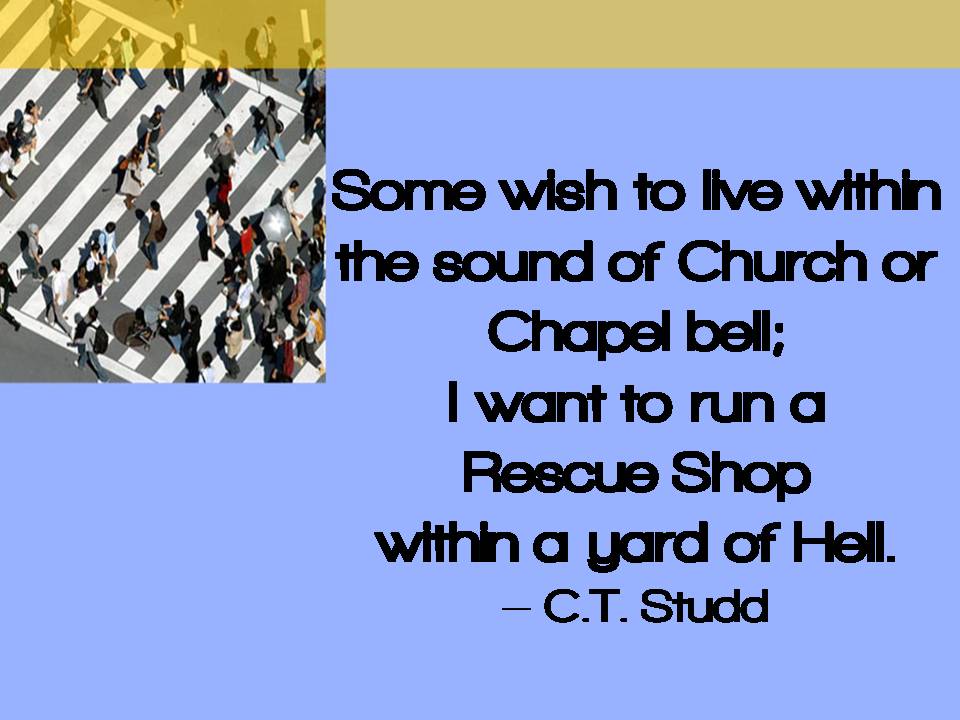
“Some wish to live within the sound of Church or Chapel bell;

I want to run a Rescue Shop within a yard of Hell.”

My Blind Spot

Listen to the podcast of this post by clicking on the player below, and you can also subscribe on AppleSpotify, or Audible.

Blind spots can be deadly. I simply don’t see what’s right there until—wham!—it crashes into me.

These blind spots have been called our “unconscious incompetence” zone. I’m not doing well in a certain area, but I just don’t know it yet until—wham!

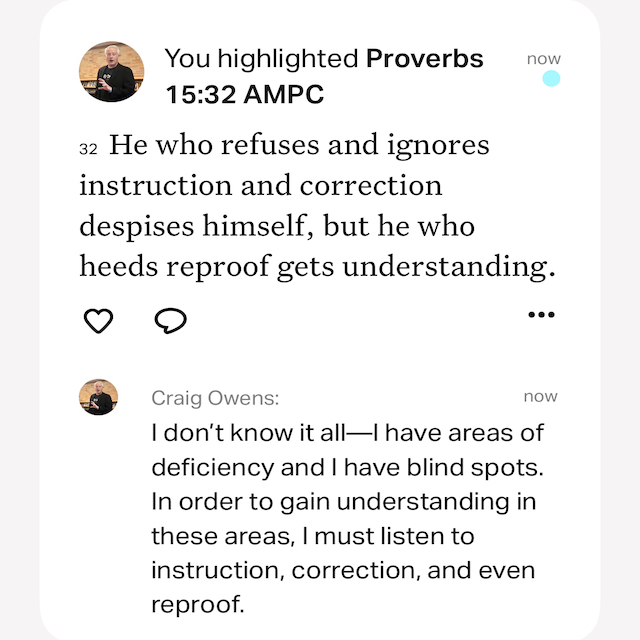
Up to that point everything seems fine, but wise King Solomon said, “Smugness will destroy fools” (Proverbs 1:32).

It seems there are two ways I could deal with my unconscious incompetencies. (1) I could wait until I get blindsided by one of them; or (2) I could ask the Holy Spirit to reveal them to me. Neither option seems very pleasant, but if I’m going to get hit—wham!—it seems like a better option to let Someone who loves me, and wants the best for me, to do it (see Hebrews 12:5-11).

David thought so too. He prayed—

Search me thoroughly, O God, and know my heart! Try me and know my thoughts! And see if there is any wicked or hurtful way in me, and lead me in the way everlasting. (Psalm 139:23-24)

Or, how about Sir Francis Drake’s prayer:

Disturb us, Lord, when
We are too well pleased with ourselves,
When our dreams have come true
Because we have dreamed too little,
When we arrived safely
Because we sailed too close to the shore.

Disturb us, Lord, when
With the abundance of things we possess
We have lost our thirst
For the waters of life;
Having fallen in love with life,
We have ceased to dream of eternity
And in our efforts to build a new earth,
We have allowed our vision
Of the new Heaven to dim.

Disturb us, Lord, to dare more boldly,
To venture on wider seas
Where storms will show Your mastery;
Where losing sight of land,
We shall find the stars.

We ask You to push back
The horizons of our hopes;
And to push us into the future
In strength, courage, hope, and love.

The wham! moments will come. The question is how do you want them to come?

►► Would you please prayerfully consider supporting this ministry? My Patreon supporters get behind-the-scenes access to exclusive materials. ◀︎◀︎

Don’t Become Illiterate

Wise King Solomon:

Intelligent people are always ready to learn. Their ears are open for knowledge. (Proverbs 18:15)

Futurist Alvin Toffler:

“The illiterate of the 21st century will not be those who cannot read and write, but those who cannot unlearn, learn, and relearn.”

Questions:

  1. What did you unlearn this week?
  2. What did you learn this week?
  3. What did you relearn this week?

Benefit Package

See if you can spot the common theme in Proverbs 10:

The Lord will not let the godly go hungry (v. 3)

The godly are showered with blessings (v. 6)

We have happy memories of the godly (v. 7)

The words of the godly are a life-giving fountain (v. 11)

The earnings of the godly enhance their lives (v. 16)

The words of the godly are like sterling silver (v. 20)

The words of the godly encourage many (v. 21)

The hopes of the godly will be granted (v. 24)

The godly have a lasting foundation (v. 25)

The hopes of the godly result in happiness (v. 28)

The godly will never be disturbed (v. 30)

The mouth of the godly person gives wise advice (v. 31)

The lips of the godly speak helpful words (v. 32)

I may not be a genius, but it seems like living a God-pleasing life has quite a few desirable benefits. What do you say we give it a try?

(For another look at Proverbs 10, check out this post.)

Coasting

When I was in the 6th grade my school was at the end of a dead-end street, which was at the top of a not-too-steep hill. Coming home from school we would try to see how far we could coast on our bikes before we had to start pedaling. We’d pedal really hard across the parking lot, and then start coasting as we hit the top of the hill. I think my record was nearly four blocks!

Coasting is so much fun! It’s easy and exciting, and involves no work at all. Your legs are never tired at the end of a long coasting spree.

But you can only coast downhill. (Well, okay, I guess you might be able to coast for a short distance on level ground, but not nearly as far.)

Downhill might be fun on a bike, but it’s a lousy way to live. Solomon wrote:

The path of life leads upward for the wise to keep him from going down to the grave. (Proverbs 15:24)

Coasting is easy, but it’s taking you in the wrong direction.

Coasting doesn’t cause any muscle pain, but it doesn’t build any muscle strength either.

Coasting is fun for awhile, but the longer you coast, the harder the journey back.

Save coasting for your bike rides, but in your life be very cautious of coasting too long.

Instead…

  • Keep learning new things
  • Keep reading challenging things
  • Keep growing in new areas
  • Keep setting stretching goals
  • Keep forgiving
  • Keep strengthening relationships
  • Keep climbing higher and higher

It may be work to climb to the top, but the view is incredible!

Smile Away

Sometimes the shortest distance between two people is a simple smile.

I love a scene in The Bourne Identity where Jason and Marie are hatching this highly-detailed plan to get an invoice from a hotel. Marie walks into the hotel lobby to execute their well-designed scheme, and before spy/assassin Jason Bourne has time to walk her through it, Marie is back outside. “What happened? What went wrong?” Jason asks. Marie simply replies, “The man at the desk was smiling at me, so I thought I would simply ask him for the invoice.”

When I was a kid we used to sing a little ditty in Sunday School that went like this —

If you’re happy and you know it clap your hands.
If you’re happy and you know it then your face will surely show it,
If you’re happy and you know it clap your hands.

Here’s what the Bible says about smiling faces:

Smiling faces make you happy. (Proverbs 15:30)

What a relief to see your friendly smile. It is like seeing the face of God! (Genesis 33:10)

When I smiled at them, they could hardly believe it; their faces lit up, their troubles took wing! (Job 29:24)

Don’t just do what you have to do to get by, but work heartily, as Christ’s servants doing what God wants you to do. And work with a smile on your face. (Ephesians 6:6)

Why are you down in the dumps, dear soul? Why are you crying the blues? Fix my eyes on God—soon I’ll be praising again. He puts a smile on my face. He’s my God. (Psalm 42:5)

George Eliot said, “Wear a smile and have friends; wear a scowl and have wrinkles.”

So if people feel miles away from you, perhaps they’re just a SMILE AWAY.

Try it. Smile! You’ll feel better and others will feel better about you too.

What Are You Whispering?

Wise King Solomon gave us this advice:

Never say anything that isn’t true. Have nothing to do with lies and misleading words. (Proverbs 4:24)

Most decent people don’t have an issue with this one. We would never dream of whispering to someone we care about things like…

  • …you’re a loser.
  • …you can’t seem to do anything right.
  • …hey, stupid, nice job. Not!

But the verse just before says this:

Be careful how you think; your life is shaped by your thoughts. (v. 23)

I wonder how many times we whisper words like loser, failure, or stupid to ourselves. The things we’d never say to someone else, we seem all too ready to say to ourselves!

What are you whispering to yourself? Listen closely. Are you whispering things to yourself that you would never whisper to someone else? Then it’s time to start whispering something new.

Solomon preceded this with these words of affection that seem to come right from our Heavenly Father’s mouth:

My child, pay attention to what I say. Listen to my words. Never let them get away from you. Remember them and keep them in your heart. (vv. 20-21)

God’s Spirit will never, ever, EVER speak cutting, hurtful, unkind, or untrue words to you. God loves you as if you were the only person on earth to love! He loves you so much that He sent His Son to rescue you.

Listen closely because He’s saying it right now, “I love you!

Yeah, whisper that to yourself instead!

Thursdays With Oswald—Hate Properly

This is a weekly series with things I’m reading and pondering from Oswald Chambers. You can read the original seed thought here, or type “Thursdays With Oswald” in the search box to read more entries.

Hate Properly

     A Quaker friend of mine referring to a certain man said he did not like him because he did not hate properly. … The Christian standpoint should be one of positive anger when anyone is made to stumble. To remain indifferent when there is injustice abroad is to come under the curse of Meroz, who “came not to the help of the Lord…against the mighty” (Judges 5:23).

From Baffled To Fight Better

There are six things the Lord hates, seven that are detestable to Him: haughty eyes, a lying tongue, hands that shed innocent blood, a heart that devises wicked schemes, feet that are quick to rush into evil, a false witness who pours out lies and a man who stirs up dissension among brothers. (Proverbs 6:16-19)

But if anyone causes one of these little ones who believe in Me to sin, it would be better for him to have a large millstone hung around his neck and to be drowned in the depths of the sea. (Matthew 18:6; Mark 9:42; Luke 17:2)

And the word of the Lord came again to Zechariah: “This is what the Lord Almighty says: ‘Administer true justice; show mercy and compassion to one another. Do not oppress the widow or the fatherless, the alien or the poor. In your hearts do not think evil of each other.’ But they refused to pay attention; stubbornly they turned their backs and stopped up their ears. They made their hearts as hard as flint and would not listen to the law or to the words that the LORD Almighty had sent by his Spirit through the earlier prophets. So the Lord Almighty was very angry.” (Zechariah 7:8-12)

It’s time for us to get positively angry and hate the things that God hates.

Watch Your Mouth

I was reading Proverbs 10 the other day, and a recurring theme seemed to show up in this chapter. Since you’re reading this blog, I know you are highly intelligent, so I’m sure you can spot the theme as well as I can…

If you have good sense, you will listen and obey; if all you do is talk, you will destroy yourself.

If you have good sense, it will show when you speak….

If you have good sense, you will learn all you can, but foolish talk will soon destroy you.

You will say the wrong thing if you talk too much—so be sensible and watch what you say.

Honest people speak sensibly, but deceitful liars will be silenced.

If you obey the Lord, you will always know the right thing to say….

I’d say the theme was pretty obvious, wouldn’t you?

But one question still remains: What are YOU going to do with this?

Seeing Only The Best In Your Spouse

Researchers have found that the biological responses of your body and brain to being “in love” only last two years. So guess when most newlyweds begin experiencing problems in their marriage? Yep, you guessed it: about two years into marriage.

After the in love buzz wears off, what can you do to maintain a happy, fulfilling marriage? Quite simply you have to choose to see only the best in your spouse.

Solomon was so wise to write to us that our spouse should be the only one who captivates us … the only one who satisfies us … the only one who keeps making our hearts go pitter-pat! When we choose to see the best in our mate, we can keep that in love buzz going for the life of the marriage.

Check out this excerpt from a WebMD article (you can read the full article here)—

Most often, self-assessments are grounded in reality, the researchers write. The way we see ourselves is fairly accurate. The way we see others, they continue, is often shaped by hope. With that in mind, they took one partner’s self-assessment at face value and compared it to the other partner’s assessment, as well as that partner’s description of his/her ideal partner.

For example, John’s ideal mate is funny and warm. And that is how he chooses to see Jane, who he has just married, despite the fact that Jane describes herself as moody and distant. Will John change his tune over time and come to regret his marriage to Jane? Or will his positive—if skewed—view of his wife help maintain his happiness?

Fortunately for John, the researchers found the latter to be true. In tallying the data, they discovered that those who did not idealize their partners when they got married tended to be more dissatisfied with their marriage by the end of the study compared to those who had an unrealistically idealistic view of their partner. Those in the “idealistic” group tended to be happier and more satisfied with their marriage.

In other words: you will bring out of your spouse what you see in your spouse.

Do you want a fun-loving wife? See her as your favorite playmate.

Do you want a confident husband? See him as a strong, self-assured provider for your home.

I like how the Apostle Paul states this (especially in the Amplified Bible)—

However, let each man of you without exception love his wife as being in a sense his very own self; and let the wife see that she respects and reverences her husband—that she notices him, regards him, honors him, prefers him, venerates, and esteems him; and that she defers to him, praises him, and loves and admires him exceedingly.

Just as God sees the best in you and loves you for who He sees you becoming, love your spouse and see only the best in him/her.