Love Is… (part 3)

Love Is… worsheet 3True love—or the Greek word agape—is a hard-working verb. It’s not mushy. It’s not puppy love. It’s not even romantic. It’s a love that is determined to love another no matter what! It’s the kind of love God extended toward us when we weren’t doing anything worthy of His love, and it’s the kind of love Jesus told we as us His disciples would be known for.

We just wrapped up a series called Loving The Unloveable where we explored what the Bible says about how we are to live out this agape love, especially to those who seem “unloveable.” We went through a list of 15 facets of this love spelled out in 1 Corinthians 13.

You can read about the first five facets by clicking here.

You can read about the second set of attributes by clicking here.

Here are the final five—

Love is protecting

  • The King James Version says love bears all things. So we need to ask, “What does love bear?”
  • The Greek word means: “protecting by covering with silence.”
  • In other words, we bear with the insults of an unloveable/unloving person by refusing to talk about them in a negative way.
  • Agape doesn’t talk about people (unless it’s a conversation with God); agape only talks lovingly to people. Agape protects their reputation.

Love is trusting

  • Love has a high confidence in success. Not my success, but God’s success. So we keep believing for a breakthrough; keep trusting God to accomplish something; keep doing our part in pointing out the best (or the best that is yet to be) in others.

Love is hopeful 

  • The Amplified Bible says: love’s hopes are fadeless under all circumstances.
  • So we work now, but we are always looking forward to the future with joy and full confidence.
  • Think about a farmer: After he plants the seed, he doesn’t see it any more. But his outlook remains hopeful. So he waters a seed he cannot see. He fertilizes a seed he cannot see. He works the ground for a seed he cannot see.
  • Our acts of love may be planting a seed, or fertilizing, or watering. Every part is vital; no part can be skipped. And we remain hopeful of a harvest.
  • Let us not become weary in doing good, for at the proper time we will reap a harvest if we do not give up. (Galatians 6:9)

Love is persevering

  • I love the Greek definition: “enduring through every circumstance without ever weakening.”
  • Never let your love waver. Keep on being patient, and kind, and forgiving, and all of the other characteristics of agape listed in 1 Corinthians 13. All of them are irreplaceable and effective! 

Love is maturing

  • Love continues to grow up.
  • Agape is creative, never stagnant or stuck in a rut. Agape finds new ways to express itself.

Here’s where the real test comes in: How will you apply these attributes of love to someone in your life? More specifically: to someone you think is “unloveable”?

I know you have someone in your life that you think is unloveable. With that person’s face clearly in mind, how will you fill in the blanks:

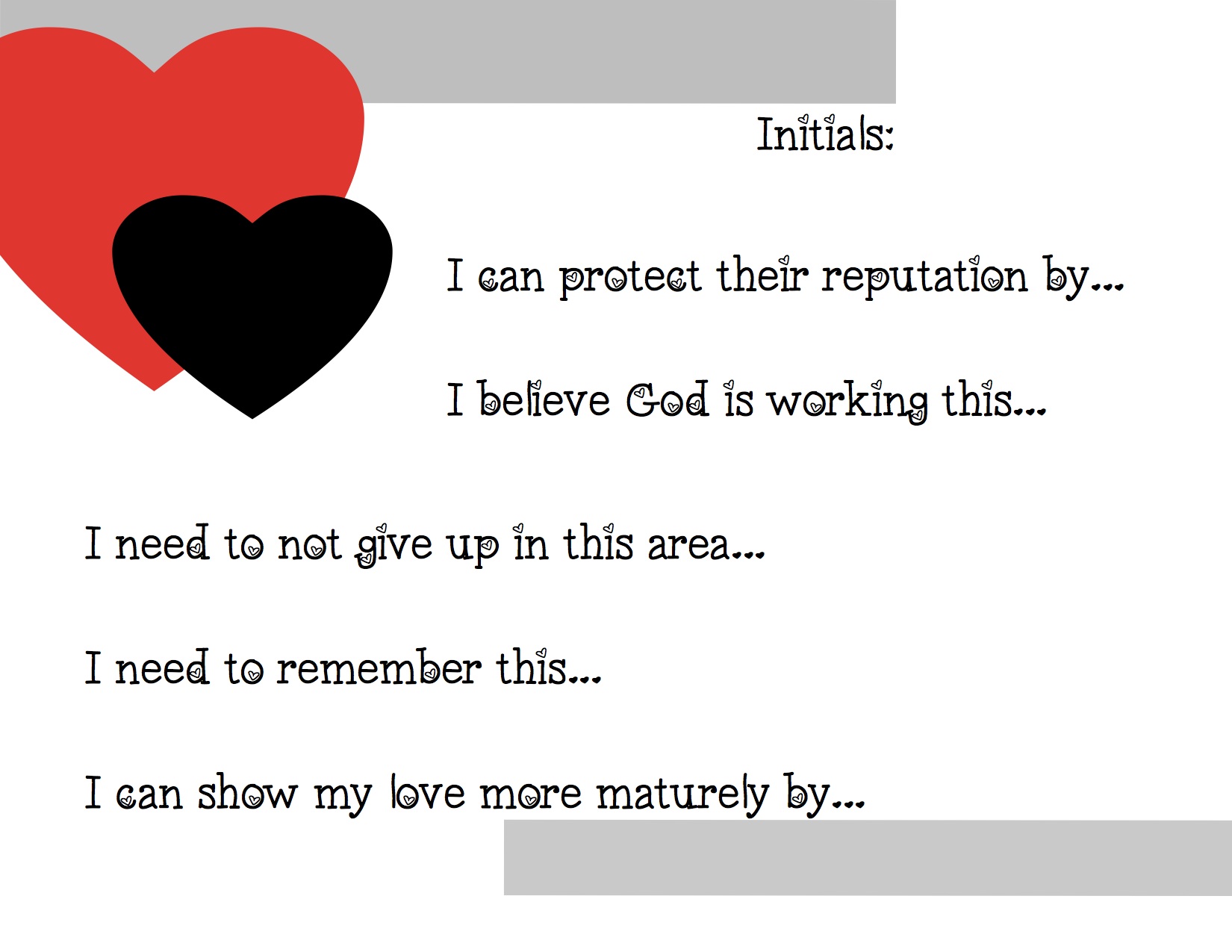
  1. I can protect their reputation by…
  2. I believe God is working in this…
  3. I need to not give up in this area…
  4. I must remember this…
  5. I can how my love more maturely by…

If you would like a downloadable PDF of this worksheet, click here -–> Love Is… worsheet 3

If you would like to download the other worksheets, or if you missed any of the messages in our Loving the Unlovable series, you can check them all our here.

15 Quotes From “Draw The Circle”

Draw The CircleI loved the challenging message about prayer in Draw The Circle by Mark Batterson. You can read my full book review by clicking here. Here are 15 quotes that especially stood out to me.

“You don’t need to seek opportunity. All you have to do is seek God. And if you seek God, opportunity will seek you.”

“Sometimes the purpose of prayer is to get us out of circumstances, but more often than not, the purpose of prayer is to get us through them. I’m certainly not suggesting we shouldn’t pray deliverance prayers, but there are times we need to pray prevailing prayers. …We’re often so anxious to get out of difficult, painful, or challenging situations that we fail to grow through them. We’re so fixated on getting out of them that we don’t get anything out of them. We fail to learn the lessons God is trying to teach us or cultivate the character God is trying to grow in us. We’re so focused on God changing our circumstances that we never allow God to change us! So instead of ten or twenty years of experience, we have one year of experience repeated ten or twenty times. Sometimes we need to pray ‘get me out’ prayers. But sometimes we need to pray ‘get me through’ prayers. And we need the discernment to know when to pray what.”

“After hitting our knees, we need to take a small step of faith. And those small steps of faith often turn into giant leaps. Like Noah, who kept building an ark day after day, we keep hammering away at the dream God has given us. Like the Israelites, who kept circling Jericho for seven days, we keep circling God’s promises. Like Elijah, who kept sending his servant back to look for a rain cloud, we actively and expectantly wait for God’s answer. …We can pray until our knees are numb, but if our praying isn’t accompanied by acting, then we won’t get anywhere. We need to put feet to our faith. After kneeling down, we need to stand up and step out in faith.”

“Maybe our normal is so subnormal that normal seems abnormal. Maybe we need a new normal. Bold prayers and big dreams are normal. Anything less is subnormal.”

“Prayer gives us a God’s-eye view. It heightens our awareness and gives us a sixth sense that enables us to perceive spiritual realities that are beyond our five senses.” 

“Praying is planting. Each prayer is like a seed that gets planted in the ground. It disappears for a season, but it eventually bears fruit that blesses future generations. …Even when we die, our prayers don’t. Each prayer takes on a life, an eternal life, of its own.”

“It’s our childlike faith, not our theological vocabulary, that moves the heart of our Heavenly Father.” 

“Praying hard is not the path of least resistance; it’s usually the path of most resistance because we engage in spiritual warfare. …It’s the prayers you pray when you feel like you want to quit praying that can bring the greatest breakthroughs.”

“Our problem typically isn’t overclaiming the promises of God; it’s underclaiming them.” 

“You’ve got to praise God if the answer is yes and trust Him if the answer if no. If the answer is not yet, you’ve got to keep circling. It’s always too soon to give up! What other option do you have? To pray or not to pray. Those are the only options.”

“Drawing prayer circle isn’t some magic trick to get what you want from God. God is not a genie in a bottle, and your wish is not His command. His command better be your wish. If it’s not, you won’t be drawing prayer circles; you’ll end up walking in circles. …Until His sovereign will becomes your sanctified wish, your prayer life will be unplugged from its power supply.” 

“Sin doesn’t just harden the heart; it also hardens our hearing. In fact, it makes us turn a deaf ear to God because we don’t want to hear the convicting voice of the Holy Spirit. But if you aren’t willing to listen to the convicting voice of the Spirit, you won’t hear His comforting voice, forgiving voice, or merciful voice either. Sin creates relational distance, and distance makes it harder to hear the still, small voice of the Holy Spirit. But if you get close to God, you won’t miss a thing he says. And if you incline your ear to God, God will incline His ear to you.”

“There comes a moment when praying becomes a form of spiritual procrastination. It’s time to stop praying and start acting. …One of the great mistakes we make is asking God to do for us what God wants us to do for Him. …Prayer that doesn’t lead to action isn’t true prayer; it’s self-talk. When we talk to God, God will talk back to us. He will provoke us, rouse us, stir us, goad us, and prompt us. When we say ‘amen,’ inaction is no longer an option.” 

“When God answers a prayer, no matter how big or how small, we need to share it. It’s a stewardship issue. If we don’t turn the answer to prayer into praise, it may very well turn into pride.”

“Our prayers have the potential to write and rewrite history.”

March!

Listen to the podcast of this post by clicking on the player below, and you can also subscribe on AppleSpotify, or Audible.

I’m convinced that many of us have missed answers to prayer because the answers seemed “too practical” or required “too much work” from us. Consider the well-known example of the defeat of the city of Jericho as recorded in the Bible.

Jericho was a massive fortress. Archeologists tell us that the city encompassed over eight acres, and was surrounded by walls which were 30-feet tall and 20-feet wide. Joshua was a brilliant military strategist who up to this point had never suffered a defeat. He asks God for help in defeating this fortress, and God tells him, “March!”

That’s it. Not pray, pray, and pray some more. Not go on a 40-day fast. Make no mistake, the Israelites had been in a period of renewed passion and prayer. As they entered Canaan, they sought God, renewed their vow to serve Him alone, and celebrated the Passover just days before encountering Jericho.

Sometimes our prayers have to have feet. 

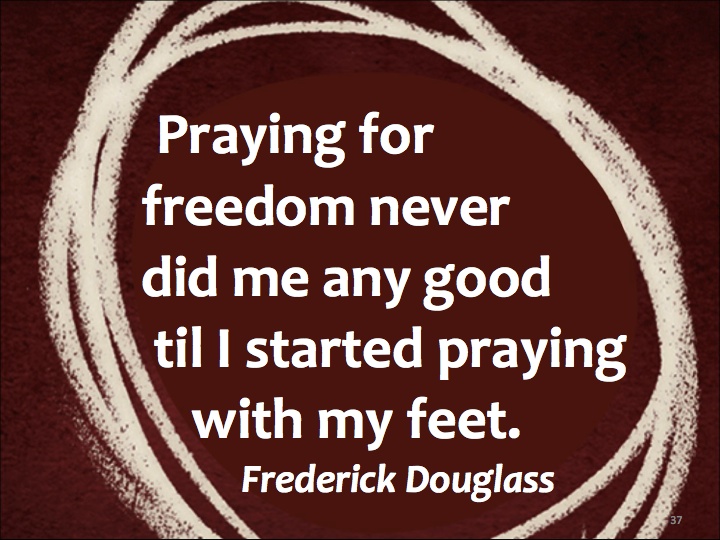
Sort of like abolitionist Frederick Douglass who said, “Praying for freedom never did me any good til I started praying with my feet.”

  • We need to pray for the salvation of our loved ones, and talk to them about Christ.
  • We need to pray for God to open the door for employment, and mail the resume.
  • We need to pray for God’s help on a test, and study hard.
  • We need to pray, and we need to march.

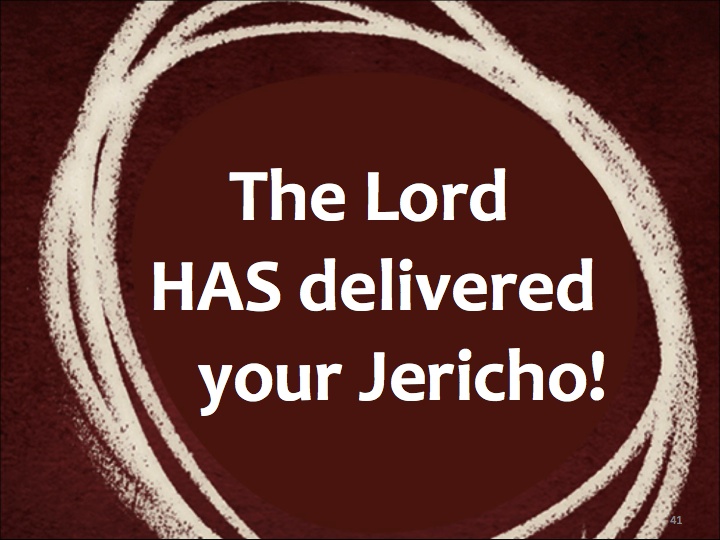
Jericho delieveredI love the verb tense in this story! God told Joshua, “I have delivered Jericho into your hands” (Joshua 6:2). Later on, after the Israelites completed their 13th hike around Jericho, Joshua said, “Shout! For the Lord has given you the city” (v. 16).

If you are praying for something that is in alignment with God’s Word, then God has given you your Jericho. But you may not see the walls come tumbling down until you march. Keep praying, keep marching, keep circling it in prayer, and watch those walls crumble!

To check out the others messages in this series on prayer called Praying Circles, please click here.

►► Would you please prayerfully consider supporting this ministry? My Patreon supporters get behind-the-scenes access to exclusive materials. Like this exceptional Bible study tool to help with Creation apologetics. ◀︎◀︎

Don’t Settle

C.S. Lewis at his deskI shared this quote with Calvary Assembly of God this morning to remind us that we shouldn’t settle. God wants us to pray BIG and to pray LONG. He wants us to claim His promises. He wants to be glorified by answering our prayers.

“If we consider the unblushing promises of reward and the staggering nature of the rewards promised in the Gospels, it would seem that our Lord finds our desires, not too strong, but too weak. We are half-hearted creatures…like an ignorant child who wants to go on making mud pies in a slum because he cannot imagine what is meant by the offer of a holiday at the sea. We are far too easily pleased.” —C.S. Lewis

Eye On It

Keep Striking

Keep strikingThere is an unusual story in 2 Kings about King Jehoash. Elisha the prophet was on his deathbed, Israel was morally bankrupt and on the brink of defeat. The entire Israeli army had been reduced to fifty horsemen, ten chariots, and ten thousand infantry. It was in this hour of desperation that Jehoash sought out the counsel of Elisha.

Elisha said [to Jehoash], “Get a bow and some arrows,” and he did so. “Take the bow in your hands,” he said to the king of Israel. When he had taken it, Elisha put his hands on the king’s hands.

“Open the east window,” he said, and he opened it. “Shoot!” Elisha said, and he shot. “The Lord’s arrow of victory, the arrow of victory over Aram!” Elisha declared. “You will completely destroy the Arameans at Aphek.”

Then he said, “Take the arrows,” and the king took them. Elisha told him, “Strike the ground.” He struck it three times and stopped. The man of God was angry with him and said, “You should have struck the ground five or six times; then you would have defeated Aram and completely destroyed it. But now you will defeat it only three times.”

What made Elisha angry is what I believe makes God angry. Jehoash came to God when the situation seemed impossible, but he wouldn’t pray it through. It’s almost as if he felt like three times was enough to pray, and then he needed to take it from there.

God wants us to pray BIG, but He also wants us to pray LONG.

We need to keep striking the ground (or as Mark Batterson would say, keep drawing the circle) until God answers. God gave Jehoash a promise of victory, but Jehoash didn’t pray long enough to see it through.

What are you praying for? What promise has God given you? God is glorified when you place your request in His hands, and leave it there. Keep on praying. Keep on striking. Keep on circling until God brings about what He has promised!

To check out the others messages in this series on prayer called Praying Circles, please click here.

Praying Circles

Praying CirclesI grew up hearing a constant refrain from my Grandma Owens, “I prayed it through.” Grandma prayed until God answered.

Sadly, one of the biggest hindrances to our prayer lives today is that we are in too much of a hurry to pray it through.

I grew up hearing another reminder from my boyhood pastor, “The church moves forward on her knees.” So I like to begin each new year with a reminder of the importance of prayer.

This year I’m using the thoughts I read a year ago in Mark Batterson’s powerful book The Circle Maker as the inspiration behind our series on prayer that I’m calling Praying Circles. This series of messages is intended to remind us of the power of praying with perseverance. Or as my Grandma might have said, the power of praying it through.

Mark Batterson said this in The Circle Maker

“Just like the sound barrier, there is a faith barrier. And breaking the faith barrier in the spiritual realm is much like breaking the sound barrier in the physical realm. If you want to experience a supernatural breakthrough, you have to pray through. But as you get closer to the breakthrough, it often feels like you’re about to lose control, about to fall apart. That is when you need to press in and pray through. If you allow them to, your disappointments will create drag. If you allow them to, your doubts will nosedive your dreams. But if you pray through, God will come through and you’ll experience a supernatural breakthrough.

Please join me as we rediscover the power of praying through with perseverance. Check out all of the messages in this series:

Commissioned = Struggling

As I like to do on Fridays, this post is especially for my fellow pastors.

I have become [the church’s] servant by the commission God gave me to present to you the Word of God in its fullness. (Colossians 1:25)

Let’s be honest: What pastor wouldn’t say he/she wants to “serve” the church?

But look at Paul’s definition of a servant of the church (Colossians 1:24-2:5):

  • Suffering
  • Rejoicing in that suffering
  • Proclaiming the gospel
  • Admonishing the saints
  • Teaching with all wisdom
  • Maintaining a passion for everyone’s perfection
  • Laboring
  • Struggling

That’s quite a list!

Paul also says, “I want you to know how much I am struggling for you” (2:1). The word here and in 1:29 come from the same root word meaning: A contest (whether sports or a courtroom trial) in which there is a large audience, and in which one contestant is representing a larger group.

It’s like an Olympic athlete competing for his country, or an attorney speaking on behalf of her clients.

Then Paul adds, “I tell you this so that no one may deceive you by fine-sounding arguments” (2:4). In other words, actions speak louder than words. As Teddy Roosevelt famously said—

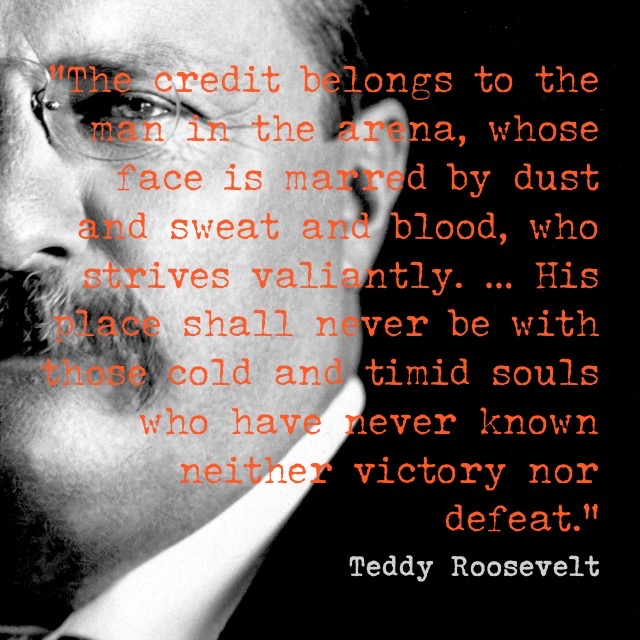
“It is not the critic who counts; nor the many who point out how the strong man stumbles, or where the doer of deeds could have done them better. The credit belongs to the man in the arena, whose face is marred by dust and sweat and blood, who strives valiantly…who knows the great enthusiasms, the great devotions, who spends himself in a worthy cause, who at the best knows in the end the triumph of high achievement, and who at the worst, if he fails, at least fails while daring greatly, so that his place shall never be with those cold and timid souls who have never known neither victory nor defeat.”

Pastor, stay in the arena!

Don’t walk away from the struggles!

Persevere through the difficulties!

People are watching you. What people? Specifically those sheep whom God has commissioned you to shepherd in His pasture. So stay in the fight!

I’m praying for you!

I Want To Be Fascinated

If we are going to stick with anything for the long haul, we have to be fascinated by it. As soon as it becomes boring, humdrum, or monotonous, the downward spiral leading to us throwing in the towel is almost inevitable.

It looks like this:

Inattention → Fizzled passion → Lack of discipline → Quitting

This is bad enough for a diet, exercise routine, or any other healthy pursuit. But it becomes even more painful when this downward cycle occurs in our spiritual life. In that case, the “quitting” is called by another name: Sin.

In Psalm 119, the Beth section (verses 9-16) opens with two contrasting thoughts:

  • How can a young man keep his way pure? By LIVING according to Your Word.
  • I seek You with all my heart; do not let me STRAY from Your commands.

Stray is a passive word. No real attention or foresight is required to wander or meander around. On the other hand, living is an active word. In the Hebrew, this word carries the idea of keeping careful watch; protecting; carefully tending.

So the question that leads to my success is this: What fascinates me? What dominates my thoughts? What motivates me?

The answer to these questions will determine my stick-to-itiveness.

The remaining verses in this section show the upward spiral away from sin if we will keep careful watch over how closely we stick to God’s Word.

  • Living = guarding (v. 9)
  • Seek You with all my heart (v. 10) … Yearning (in the Amplified Bible)
  • Hidden Your Word (v. 11) … Treasured (in the Complete Jewish Bible)
  • → Personal praise (v. 12)
  • With my lips… (v. 13) = verbal, public praise
  • Rejoice (v. 14) … as in more than in any kind of wealth (in the CJB)
  • Meditate (v. 15) = constant companion
  • Delight (v. 16)

When we delight in God’s Word, the cycle is started over again—I will not neglect Your Word—but now with a renewed and intensified PASSION!

I want God’s Word to dominate my thoughts, and its principles to captivate me. I want to be fascinated by my relationship with Jesus Christ that comes through the revelation of the Bible to my heart.

There is no other way to live!

If you have missed any of the messages in our P119 series, you can access them all by clicking here.

Thursdays With Oswald—Practice, Practice, Practice

This is a weekly series with things I’m reading and pondering from Oswald Chambers. You can read the original seed thought here, or type “Thursdays With Oswald” in the search box to read more entries.

Practice, Practice, Practice 

     If we do not go on practicing day by day and week by week, working out what God has worked in, when a crisis comes God’s grace is there right enough, but our nature is not. Our nature has not been brought into line by practice and consequently does not stand by us, and down we go and then we blame God. We must bring our bodily life into line by practicing day by day, hour by hour, moment by moment, then when the crisis comes we shall find not only God’s grace but our own nature will stand by us, and the crisis will pass without any disaster at all, but exactly the opposite will happen, the soul will be built up into a stronger attitude towards God. 

From Biblical Psychology

Allen Iverson (in)famously said, “We’re talking practice. Not a game, not a game, not a game. We’re talking practice.”

Guess what? As Christians, we cannot skip practice.

If we want to be victorious in the big things, we have to practice doing the little, moment-by-moment things right. We cannot just flip a switch and win a victory.

Do you want to be successful? You’ve got to practice!

Do you not know that in a race all the runners run, but only one gets the prize? Run in such a way as to get the prize. Everyone who competes in the games goes into strict training. They do it to get a crown that will not last; but we do it to get a crown that will last forever. Therefore I do not run like a man running aimlessly; I do not fight like a man beating the air. No, I beat my body and make it my slave so that after I have preached to others, I myself will not be disqualified for the prize. (1 Corinthians 9:24-27)