Links & Quotes

link quote

Now that the Spring weather is here, get outside for some fresh air … listen to the birds, smell the flowers, look at the beauty around you! “A study of rodents, published in Science in 2013, indicated that the brain’s place cells are much less active when animals make their way through computer-generated landscapes than when they navigate the real world.” —Nicholas Carr

“We have men of science, too few men of God. We have grasped the mystery of the atom and rejected the Sermon on the Mount. The world has achieved brilliance without conscience. Ours is a world of nuclear giants and ethical infants. We know more about war than we know about peace, more about killing than we know about living. If we continue to develop our technology without wisdom or prudence, our servant may prove to be our executioner.” —Omar Bradley

“No man who enters upon the office to which I have succeeded can fail to recognize how every president of the United States has placed special reliance upon his faith in God. Every president has taken comfort and courage when told…that the Lord ‘will be with thee. He will not fail thee nor forsake thee. Fear not—neither be thou dismayed.’ … Each of our presidents in his own way has placed a special trust in God. Those who were strongest intellectually were also strongest spiritually.” —John F. Kennedy

Frank Turek has a fascinating post on why the Supreme Court of the United States shouldn’t allow homosexual “marriages” because of our 14th Amendment.

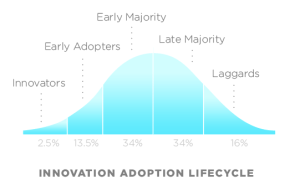
Innovation Adoption Lifecycle“If you want a population to adopt your innovation, you have to create a problem that is solved by adoption. And that problem is almost always related to, ’what about the others?’” Check out this insight from Seth Godin on product adoption.


[VIDEO] Greg Koukl addresses on Christians can demonstrate Christ-like tolerance and Christ-like tolerance—

[VIDEO] Dr. Bobby Conway and Nel Brace discuss a great tool for helping Christians defend their faith—

Nature Is A Sacrament

Nature is a Sacrament

“We do not get at God through Nature, as the poets say, we get at Nature through God when once we are rightly related to Him, and Nature becomes a sacrament of His Presence.” —Oswald Chambers

Links & Quotes

link quote

“Accept these [euphoric] sensations with thankfulness as birthday cards from God, but remember that they are only greetings, not the real gift. I mean, it is not the sensations that are the real thing. The real thing is the gift of the Holy Spirit which can’t usually be—perhaps not ever—experienced as a sensation or emotion. The sensations are merely the response of your nervous system. Don’t depend on them. Otherwise when they go and you are once more emotionally flat (as you certainly will be quite soon), you might think that the real thing had gone too. But it won’t. It will be there when you can’t feel it. May even be most operative when you can feel it least.” —C.S. Lewis

Discipline motivates—Punishment mortifies.
Discipline is based on trust—Punishment is based on fear.
Discipline is time in—Punishment is time out.
Discipline is practice—Punishment is penalty.”  Read more from Ken Davis in his post The Power Of The D Word.

Before you go anywhere else with your disappointments, go to God. Maybe you don’t want to trouble Him with your hurts. ‘He’s got famines and wars; He won’t care about my little struggles,’ you think. Why don’t you let Him decide that? He cared enough about a wedding to provide the wine. He cared enough about Peter’s tax payment to give him a coin. He cared enough about the woman at the well to give her answers. He cares about you! Your first step is to go to the right person. Go to God.” —Max Lucado 

Brian Thomas asks, “Has evolutionary faith blinded biologists from seeing the forensic clues within the insect symbiosis they study?” in his post about the beauty and elegance of Creation shown in symbiosis.

[INFOGRAPHIC] How President Obama’s end-run around Congress is going to cost you money. A lot of money!

“Scripture will ultimately suffice for a saving knowledge of God only when its certainty is founded upon the inward persuasion of the Holy Spirit. Indeed, these human testimonies which exist to confirm it will not be vain if, as secondary aids to our feebleness, they follow that chief and highest testimony. But those who wish to prove to unbelievers that Scripture is the Word of God are acting foolishly, for only by faith can this be known. Augustine therefore justly warns that godliness and peace of mind ought to come first if a man is to understand anything of such great matters.” —John Calvin

The Central Miracle

C.S. Lewis at his deskI recently re-read C.S. Lewis’ book Miracles (you can read my full book review by clicking here). As you may have noticed, after reading and reviewing books on this blog, I also like to share some quotes that caught my attention. Doing this with Lewis is difficult, because in order to get the context of a particular quote, I think I would have to cite almost a full page or more. So over the next few weeks I plan to share some quotes from Miracles that require not as much context, or I will provide a bit of background to set the stage.

Lewis talks a great deal about the Creator entering His creation, quoting from passages in the Bible that talk about Christ’s pre-existence before Time, and His choice to descend into Nature.

“The central miracle asserted by Christians is the Incarnation. They say that God became Man. Every other miracle prepares for this, or exhibits this, or results from this. … Everywhere the great enters the little—its power to do so is almost a test of its greatness. In the Christian story God descends to re-ascend. He comes down; down from the heights of absolute being into time and space, down into humanity; down further still, if embryologists are right, to recapitulate in the womb ancient and pre-human phases of life; down to the very roots and seabed of the Nature He has created. But He goes down to come up again and bring the whole ruined world up with Him. One has the picture of a strongman stooping lower and lower to get himself underneath some great complicated burden.”

For other quotes from this book see Miracle Or “Cheating”?Miracles And NatureChristianity And PantheismCorrecting The Pantheist, and Absolute Fact.

Correcting The Pantheist

C.S. Lewis at his deskI recently re-read C.S. Lewis’ book Miracles (you can read my full book review by clicking here). As you may have noticed, after reading and reviewing books on this blog, I also like to share some quotes that caught my attention. Doing this with Lewis is difficult, because in order to get the context of a particular quote, I think I would have to cite almost a full page or more. So over the next few weeks I plan to share some quotes from Miracles that require not as much context, or I will provide a bit of background to set the stage.

Democritus was a Greek philosopher who proposed the universe was made up of invisible atoms and empty space. The atoms perpetually bounced around and sometimes connected with other atoms to form our tangible universe. Erwin Schrödinger put a ‘concreteness’ or ‘definiteness’ to the atomic theories previous held. In other words, Democritus saw an almost pantheistic, indescribable vagueness about Nature, whereas Schrödinger gave it definition. Lewis says that Christians need to put Monotheistic definitions on Nature and Supernature. 

“At every point Christianity has to correct the natural expectations of the Pantheist and offer something more difficult, just as Schrödinger has to correct Democritus. At every moment he has to multiply distinctions and rule out false analogies. He has to substitute the mappings of something that has a positive, concrete, and highly articulated character for the formless generalities in which Pantheism is at home.” 

 “If God is the ultimate source of all concrete, individual things and events, then God Himself must be concrete, and individual in the highest degree. Unless the origin of all other things were itself concrete and individual, nothing else could be so; for there is no conceivable means whereby what is abstract or general could itself produce concrete reality. Bookkeeping, continued to all eternity, could never produce one farthing. Metre, of itself, could never produce a poem. Bookkeeping needs something else (namely, real money put into the account) and metre needs something else (real words, fed into it by a poet) before any income or any poem can exist. If anything is to exist at all, then the Original Thing must be, not a principal nor a generality, much less an ‘ideal’ or a ‘value,’ but an utterly concrete fact.”

For more quotes from this book, check out Miracle Or “Cheating”? and Miracles And Nature.

Miracles And Nature

C.S. Lewis at his deskI recently re-read C.S. Lewis’ book Miracles (you can read my full book review by clicking here). As you may have noticed, after reading and reviewing books on this blog, I also like to share some quotes that caught my attention. Doing this with Lewis is difficult, because in order to get the context of a particular quote, I think I would have to cite almost a full page or more. So over the next few weeks I plan to share some quotes from Miracles that require not as much context, or I will provide a bit of background to set the stage.

Lewis talks at great length how Nature (and our natural laws) had to come out of something, which he calls Supernature. What we commonly refer to as a miracle is not a miracle in the sense of natural laws being broken, but in Nature accommodating Supernature. Thus, Lewis writes…

“This perhaps helps to make a little clearer what the laws of Nature really are. We are in the habit of talking as if they caused the events to happen; but they have never caused any event at all. … Thus in one sense the laws of Nature cover the whole field of space and time; in another, what they leave out is precisely the whole real universe—the incessant torrent of actual events which makes up true history. That must come from somewhere else. To think the laws can produce it is like thinking that you can create real money by simply doing sums. … It is therefore inaccurate to define a miracle as something that breaks the laws of Nature. It doesn’t. … The divine art of miracle is not an act of suspending the pattern to which events conform but of feeding new events into that pattern. It does not violate the laws proviso, ‘If A, then B’: it says, ‘But this time instead of A, A2,’ and Nature, speaking through all her laws, replies, ‘Then B2’ and naturalizes the immigrant, as she well knows how. She is an accomplished hostess. A miracle is emphatically not an event without cause or without results. Its cause is the activity of God: its results follow according to Natural law.”

For another quote from this book, see Miracle Or “Cheating”?

Miracle Or “Cheating”?

C.S. Lewis at his deskI recently re-read C.S. Lewis′ book Miracles (you can read my full book review by clicking here). As you may have noticed, after reading and reviewing books on this blog, I also like to share some quotes that caught my attention. Doing this with Lewis is difficult, because in order to get the context of a particular quote, I think I would have to cite almost a full page or more. So over the next few weeks I plan to share some quotes from Miracles that require not as much context, or I will provide a bit of background to set the stage.

This particular quote is fairly long in itself, but I think you will understand the context within the quote—

“It is certain that the billiard balls will behave in a particular way, just as it is certain that if you divide a shilling unequally between two recipients then A’s share must exceed the half and B’s share fall short of it by exactly the same amount. Provided, of course, that A does not by sleight-of-hand steal some of B’s pennies at the very moment of the transaction. In the same way, you know what will happen to the two billiard balls—provided that nothing interferes. If one ball encounters a roughness in the cloth which the other does not, their motion will not illustrate the law in the way you had expected. Of course what happens as a result of the roughness in the cloth will illustrate the law in some other way, but your original prediction will have been false. Or again, if I snatch up a cue and give one of the balls a little help, you will get a third result: and that third result will equally illustrate the laws of physics, and equally falsify your prediction. I shall have ‘spoiled the experiment.’ All interferences leave the law perfectly true. But every prediction of what will happen in a given instance is made under the proviso ‘other things being equal’ or ‘if there are no interferences.’ Whether other things are equal in a given case and whether interferences may occur is another matter. The arithmetician, as a arithmetician, does not know how likely A is to steal some of B’s pennies when the shilling is being divided; you had better ask a criminologist. The physicist, as a physicist, does not know how likely I am to catch up a cue and ‘spoil’ his experiment with the billiard balls: you had better ask someone who knows me. In the same way, the physicist, as such, does not know how likely it is that some supernatural power is going to interfere with them: you has better ask a metaphysician. But the physicist does know, just because he is a physicist, that if the billiard balls are tampered with by any agency, natural or supernatural, which he has not taken into account, then their behavior must differ from what he expected. Not because the law is false, but because it is true. The more certain we are of the law the more clearly we know that if new factors have been introduced the result will vary accordingly. What we do not know, as physicists, is whether Supernatural power might be one of the new factors. … Miracle is, from the point of view of the scientist, a form of doctoring, tampering, (if you like) cheating.”

Miracles (book review)

MiraclesReading C.S. Lewis elaborate on theology is no easy task. But for those willing to work through his profound thoughts, a treasure trove of new insights into Scripture await. Miracles: How God Intervenes In Nature And Human Affairs is no exception to this.

“Miracle” is directly mentioned so 30 times in Scripture, but the Bible never explicitly defines miracle. Lewis gives this definition: “I use the word Miracle to mean an interference with Nature by supernatural power.” He then proceeds to explain what philosophers such as Socrates, Plato and Aristotle meant by “nature” and “super-nature” and how those understandings have been dismissed, adapted or corrupted throughout history.

Lewis moves through several chapters without admitting miracles are probable (or even possible) and without ascribing any possible miracles to God. When he finally reveals that there is a God, he states, “From the admission that God exists and is the author of Nature, it by no means follows that miracles must, or even can, occur.” He then moves to the Scripture to show how God could—and indeed, does—work miraculously.

Even after all of Lewis’ brilliant arguments, I appreciate one of his final admissions in this book: “If you find that [these ideas] so distract you, think of them no more. I most fully allow that it is of more importance for you or me today to refrain from one sneer or to extend one charitable thought to an enemy than to know all that angels and archangels know about the mysteries of the New Creation.”

Even for those who accept his arguments, Lewis offers this counsel: “My work ends here. If, after reading it, you now turn to study the historical evidence for yourself, begin with the New Testament and not with the books about it.” Ultimately I recommend this book for this one reason—Miracles creates a hunger to study God’s Word more.

Heaven’s Dew

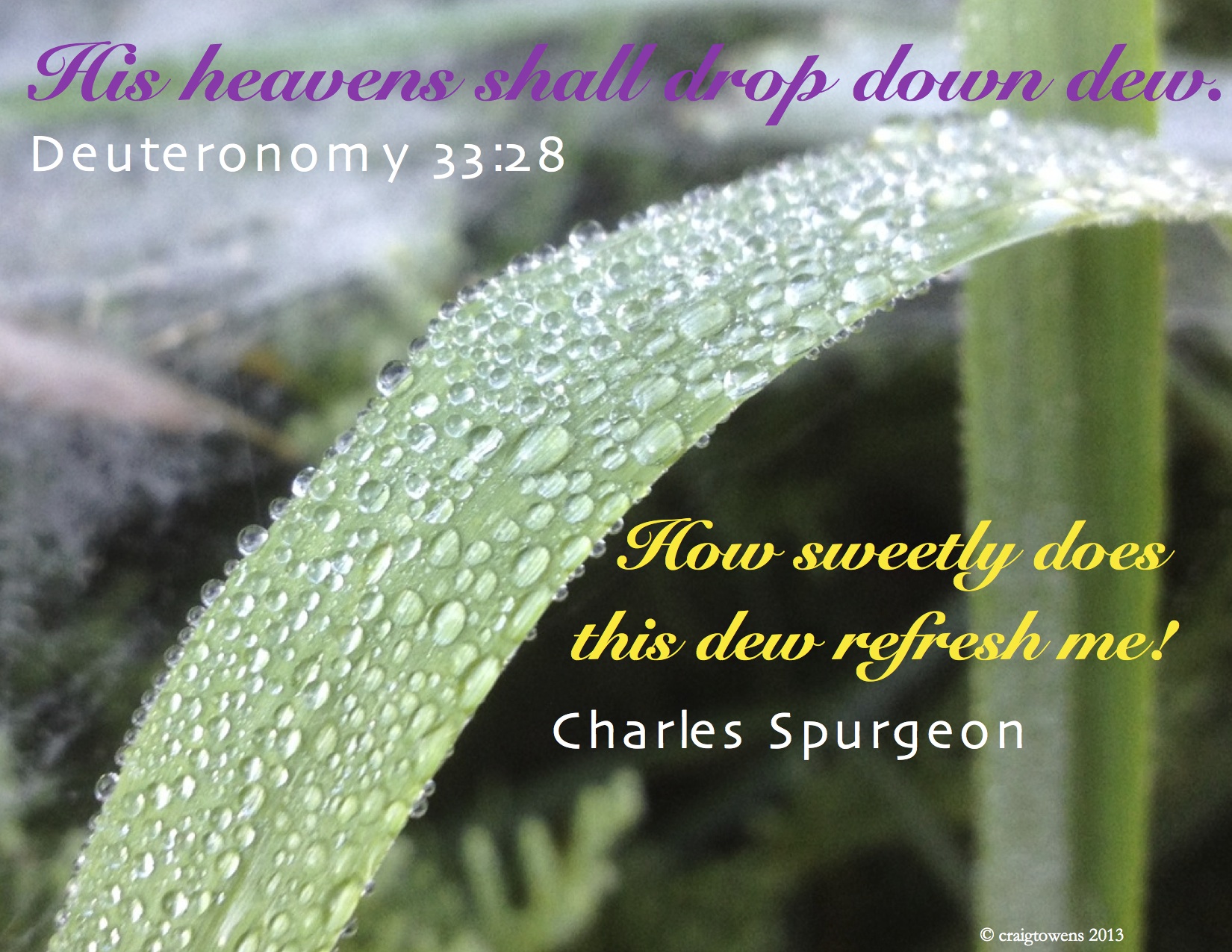
Heaven's dewHis heavens shall drop down dew (Deuteronomy 33:28).

“What the dew in the East is to the world of nature, that is the influence of the Spirit in the realm of grace. How greatly do I need it! Without the Spirit of God I am a dry and withered thing. I droop, I fade, I die. How sweetly does this dew refresh me!” (Charles Spurgeon)

May you find the refreshment of the dew of God’s Holy Spirit today!

God, Flowers & You

God & Flowers & You

And why worry about your clothing? Look at the lilies of the field and how they grow. They don’t work or make their clothing, yet Solomon in all his glory was not dressed as beautifully as they are. And if God cares so wonderfully for wildflowers that are here today and thrown into the fire tomorrow, He will certainly care for you.

Matthew 6:28-30