What’s In A Name?

Listen to the podcast of this post by clicking on the player below, and you can also subscribe on AppleSpotify, or Audible.

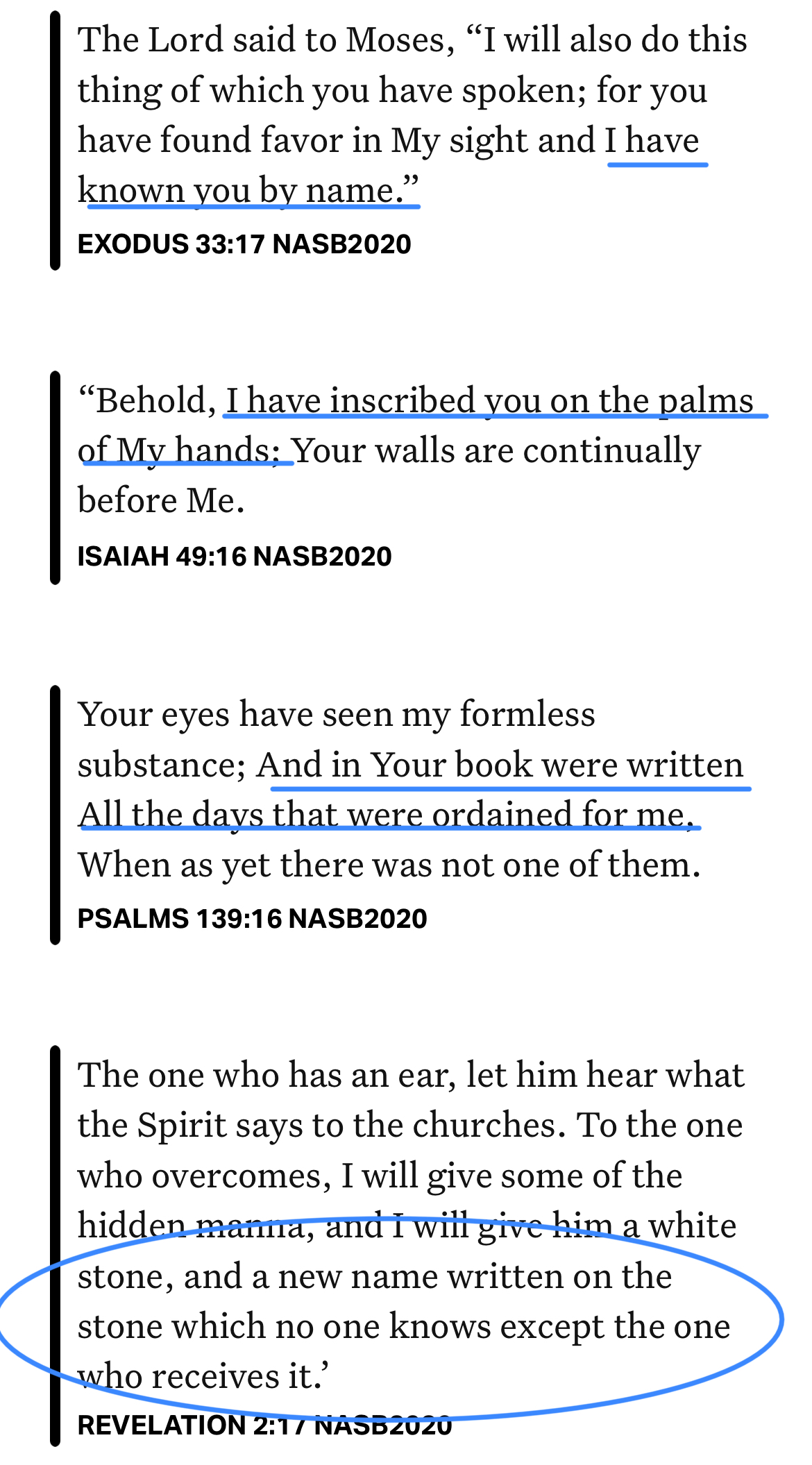
And the Lord said to Moses, “I will do the very thing you have asked, because I am pleased with you and I know you by name.” (Exodus 33:17)

When we use someone’s name properly, our message gets through all of the other noise. That’s why misusing someone’s name or using their name in a hurtful way is so painful. 

Names convey character traits, honoring of the past, and hopes for the future. God knows all of our days and how our name will be remembered at each pivotal moment of our lives (Psalm 139:16). Our names are lovingly tattooed on His hands so He always sees them (Isaiah 49:16).  

God not only knows and uses the name our parents have given us, but He has a name for each of us that only He knows. When we get to Heaven, He will reveal to each of us the unique name He has for us (Revelation 2:17). 

You don’t have to try to make a name for yourself—let God do that for you!

►► Would you please prayerfully consider supporting this ministry? My Patreon supporters get behind-the-scenes access to exclusive materials. ◀︎◀︎

The Power Of Using Names

Listen to the podcast of this post by clicking on the player below, and you can also subscribe on AppleSpotify, or Audible.

It is important for leaders to use the right words to encourage their teammates. The most memorable, motivating, and beautiful word a leader can use is their teammates’ names. 

You can check out this full conversation Greg and I had about taking people up with our words on this episode of The Craig And Greg Show.

And I would also invite you to check out this blog post and this blog post about significant name changes recorded in the Bible.

►► Would you please prayerfully consider supporting this ministry? My Patreon supporters get behind-the-scenes access to exclusive materials. ◀︎◀︎

Links & Quotes

Every Monday I share a 1-minute thought to get your week started. It’s my weekly Monday Motivation series of videos. Check out this week’s video that I posted the day after Christmas, and please subscribe on YouTube.

T.M. Moore wrote one of the endorsements for my book Shepherd Leadership. In an interview I then did on his Fellowship of Ailbe podcast, I shared my dismay over unbiblical ideas and practices that have crept into the church. Both T.M. and I share a passion to see our church leadership return to our secure biblical foundation. 

In a recent blog post, T.M wrote, “From the days of the apostles onward, a tendency has existed among church leaders to drift from the plain teaching of the Word of God into forms of Christian life and ministry that derive from sources other than Scripture. Or that stretch the meaning of Scripture to fit the shape of certain cultural forms.” Please check out T.M.’s post “Do not go beyond.”

In a fascinating post from Rabbi Benjamin Blech, I read these thoughts about the power of a name: “The Hebrew word for soul is neshamah. Central to that word, the middle two letters, shin and mem, make the word shem, Hebrew for ‘name.’ Your name is the key to your soul. … When the Torah says, ‘God created,’ it doesn’t suggest that He worked with what He fashioned by labor, but merely that He spoke—and the very words describing the object came into being. God said, ‘Let there be light and there was light.’ The Almighty merely gave it a name, and the very letters defined its atomic structure.” Check out the full post here.

And once again archeologists discover evidence that corroborates the biblical accounts. In this case, more evidence is found from King Hezekiah. As I have said numerous times, the historicity of the Bible is amply verified.

“Success” doesn’t always mean bigger numbers. King David got into trouble with God when he wanted to measure his success by how many fighting men he had under his command. Consistently throughout the Bible God’s measure of success is our trust in Him. This thought was a key part of the sub-title of my book Shepherd Leadership: The Metrics That Really Matter.

Cold-case detective J. Warner Wallace tackles an important topic: Does objective truth exist, and how can it be defined? This is a quite lengthy post but it is well worth your time.

“Pain nourishes courage. You can’t be brave if you’ve only had wonderful things happen to you.” —Mary Tyler Moore

Whose Fight Is It?

In great fear and distress Jacob divided the people who were with him into two groups… (Genesis 32:7). 

Jacob’s brother Esau is approaching with 400 men! 

Esau is the man who sold his birthright to Jacob, and then had his father’s blessing swindled away from him by Jacob. And now he is rapidly approaching Jacob and his entourage. 

Jacob’s natural response is, well, natural: great fear and distress grip his heart (v. 7). In his agitated state of mind “he thought” of a strategy to try to appease his brother and save as many of his family members and possessions as he could. 

And then another strategy popped into Jacob’s agitated mind: Then he prayed (v. 9). He concocted his own plans first and then he prayed. Prayer should have been his first response, but at least he finally did get around to praying!

In his prayer, Jacob twice reminds God, “You said” (vv. 9, 12), and in-between those reminders he confesses to Him, “I am afraid” (v. 11). 

As he speaks to God, reminds God of His promises, and confesses his own heart-quaking, knee-knocking fear, God says:  [crickets chirping in the warm evening]. 

God is silent. 

So Jacob returns to his own strategizing—once again we read “for he thought” (v.20)—until he is utterly out of options. All he can do now is wrestle with God (vv. 22-30). All out of his own options, Jacob now tenaciously clings to God and will not let Him go! 

In the Hebrew language, the name Jacob means a man who struggles, thinks, and strategizes using his own abilities*. 

After finally submitting to God, Jacob’s name is changed to Israel**. Now Israel lets God do the strategizing and the fighting. Jacob tried to figure things out on his own; Israel lets God’s plan prevail. When Israel bought his first plot of ground after his name had been changed, he built an altar there and named it El Elohe Israel—The Almighty God is my God (33:20). 

Israel now says, “I’m done striving with men on my own. I’m done fighting people and trying to figure out how to make things happen for me. From now on I will only wrestle with God, and I’ll let Him fight the battles for me!” 

How often do I strategize on my own first, and only after I have run out of options do I run to God in prayer? This is a Jacob spirit in me! I don’t want to live this way. I want to be like Israel—clinging to God as my first and only Source of help. 

How about you?

* In the Faithlife Illustrated Study Bible, there is an interesting note on Jacob’s name. For instance, when Esau says, “Isn’t he rightly named Jacob?” (Genesis 27:36), the FSB editors offer this commentary: “Esau uses the Hebrew word ‘aqab here, which is a wordplay on Jacob’s name in Hebrew, ya-aqov. … Esau suggests that Jacob’s name actually has to do with him being a person who supplants or cheats other people.” 

** Your name will no longer be Jacob, but Israel (Genesis 32:28). The FSB commentary points out, “Jacob’s name must be changed due to its association with his misdeeds. Here, the reasoning for the name Israel (yisra’el in Hebrew) is the verbal phrase ‘you have striven with (or struggled with) God.’ This suggests the name derives from the Hebrew verb sarah, meaning ‘to struggle,’ ‘to strive’ or ‘to fight.’ The name yisra’el itself could mean ‘God will struggle,’ ‘May God struggle’ or ‘God fights’….” 

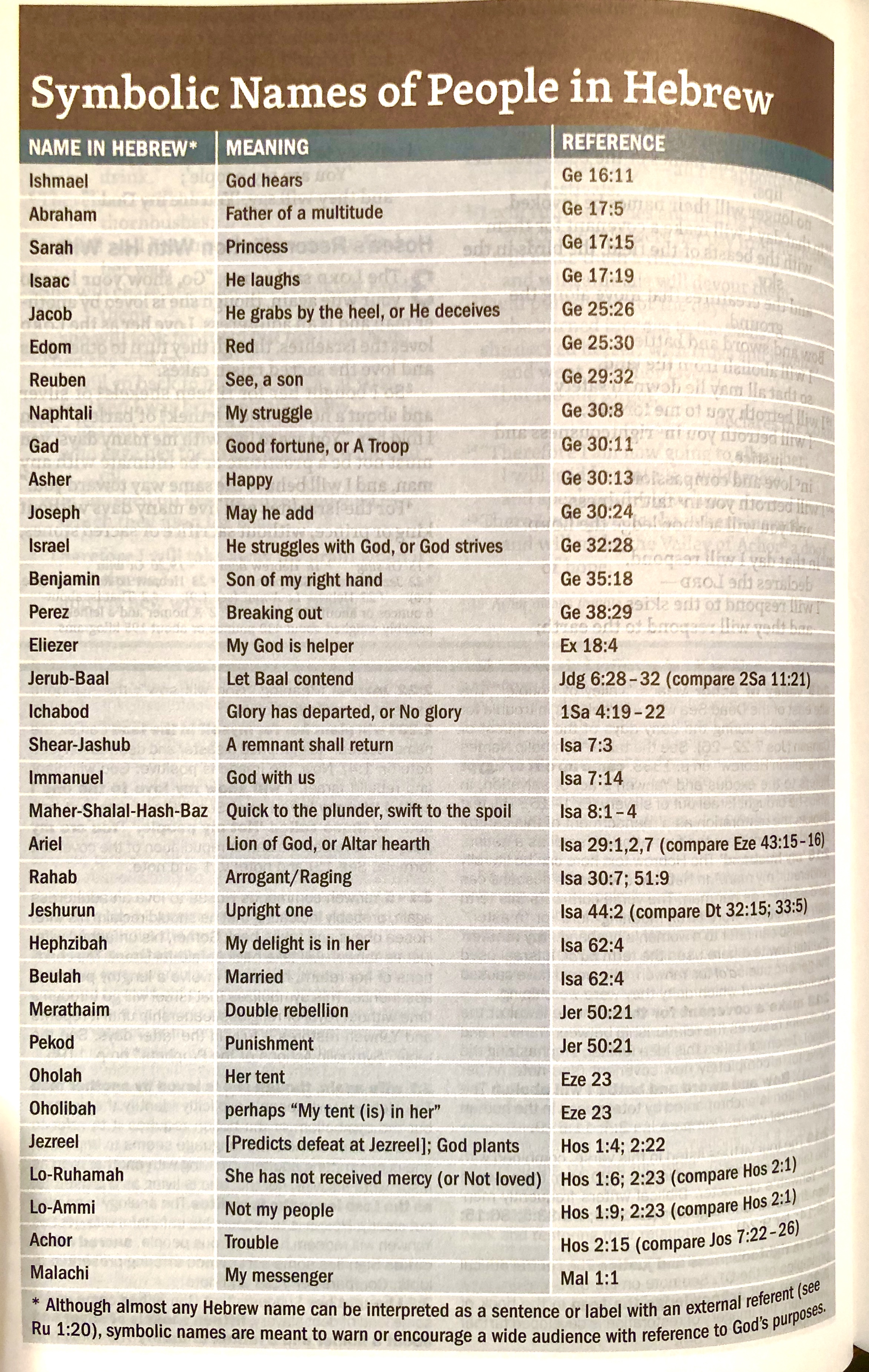
Symbolic Hebrew Names In The Old Testament

In studying for our ongoing series Major Lessons From Minor Prophets, I came across this chart in my Faithlife Illustrated Study Bible. This isn’t an exhaustive list by any means, but it is a good list to get you started on your own Bible study. 

I always find it fascinating when God names something, or instructs parents to name their children, or especially when a name gets changed. Many study Bibles contain a footnote by these names to give you the Hebrew or Greek definition, so don’t breeze by those too quickly! 

You can also find this list from the Faithlife Bible by clicking here. 

Happy studying! 

P.S. I also invite you to check out this name change which all of us can relate to!

New Name = New Nature

All throughout the Old Testament we find hints about Jesus. Then as the New Testament dawns, the brilliant light of Jesus makes sense of all the hints we had previously seen.

One of the way God hints at the arrival of Jesus and what He would do for mankind is found in the names of people. Hebrew names are interesting things. Sometimes they are quite literal. For instance…

    • A baby who was born at one of Israel’s lowest points was named Ichabod = God’s glory has departed.
    • A baby who was born with quite a lot of hair was named Esau = hairy baby.
    • Esau’s twin brother was hanging on to his heel when he was born, so they named him Jacob = the one who grabs the heel.

At other times God tells parents what to name their babies before they are born. These names tell a story in themselves of what is coming…

    • After a time of upheaval in Israel’s history, God directed the parents to give their son two names: Solomon (which means peace) and Jedidiah (which means beloved by God). This brought reassurance to the parents and to the country.
    • When God was about to bring a quick answer to a problem, He directed the parents to name their son Maher-Shalal-Hash-Baz, which means God will bring the reward sooner than you think.

But what is most interesting to me is when God changes someone’s name to reflect the new nature in their life.

Abram’s name meant exalted father, but God changed his name to Abraham, which means father of a multitude. His wife’s birth name was Sarai (princess) and it was changed to Sarah (a noble woman).

In these name changes, two things happened (see Genesis 17:1-15):

  1. God put His own name into theirs. God’s name means I AM. We sometimes pronounce it Yahweh, but that is only a guess since the Jews wrote His name without the vowels. That means His name was the unpronounceable YHWH, sort of a breath-sound. So Abram became Abrahaaam and Sarah became Saraaaaah. 
  2. God took the burden off them and put it on Himself. It was no longer Abram’s responsibility to become an exalted father, or Sarai’s responsibility to make herself a princess. God said, “Only with Me in you can you become who I want you to be!”

As you follow Abraham and Sarah’s descendants, you will see time and time again God reminding people: You can’t do it on your own. You must have Me in you in order to live the life I have for you!

Hoshea was born as an Israelite slave in Egypt, yet his parents gave him this name that means deliverer. Before God could use Hoshea to bring the Israelites into the Promised Land, He first changed his name to Joshua, which means God is the ultimate deliverer.

Joshua in the BC Hebrew language is the same as Jesus in the AD Greek language.

Jesus Christ is the ultimate example of being able to fully deliver people not just from physical slavery, but from the eternal consequences of sin. Man cannot save himself, but Jesus Christ can.

That’s why when you surrender to Christ and allow Him to be your Lord and Master, He puts His name in you: CHRISTian! A new name, and a brand new nature because of what it means to have Christ in you.

Check out this video where I explain the cool story behind more name changes—

Don’t Misuse God’s Name

Representing God's nameYou’ve heard the old nursery rhyme: Sticks and stones may break my bones but words will never hurt me. We all know this isn’t true: words do hurt, and names that people call us may leave lasting wounds.

Words and names are important to God. God used His word to create the universe (God said, “Let there by light”); Jesus was called The Word (see John 1:1); God has named people and even renamed them to reflect their character or destiny.

The most important name of all is God’s own name, so the Third Commandment says, “You shall not misuse the name of the LORD your God…” (Exodus 20:7). How can we misuse God’s name? There are five ways—

(1) As emptiness or nothingness

  • Are our words empty? Do we use filler phrases like “Oh my God!” that neither talk to Jehovah or about Jehovah? We shouldn’t use God’s name unless we’re talking to Him or about Him in a respectful way.

(2) In vanity

  • In reality this means calling ourselves a Christian, but speaking in an un-Christlike way.
  • “Giving God a ‘bad name’ might diminish or demolish people’s belief, respect, and awe for God, a tragedy for a world that needs holiness. … It is a major responsibility to represent God; one which should not be taken lightly.” —Dr. Laura Schlessinger

(3) Being insincere

  • Are our promises empty, or is our word our bond? If we have to use phrases like “I swear to God that I will…” then that means we cannot be trusted on our own merits. When we claim to be Christians but cannot be trusted, we undermine the trustworthiness of God in the minds of other people.
  • “The godly man, therefore, will make promises cautiously but keep them conscientiously once they are made, knowing that irresponsibility and unreliability here are great and grievous sins.” —J.I. Packer

(4) Having an unholy vocabulary

  • Holy means something set apart for a special use. Perhaps there are words we use to describe God that we are also using for lesser things. It might be good to listen to how the Holy Spirit would challenge us to have a unique vocabulary to talk to or about our unique God.

(5) Worthlessness of conduct

  • As the cliche goes, “What you do speaks so loudly that I cannot hear what you are saying.” So we need to make sure that we both talk like Jesus talked and live like Jesus lived.

Anything less than these standards just may be misusing God’s holy name and character by misrepresenting Him or giving Him a “bad name.” What do you think?

If you have missed any of the messages in our series The Love In The Law, you can find them all by clicking here.

A Name Change

I was reading the biography of Jabez this morning. His whole life is told in just two verses, but what an insightful snapshot we get.

Here’s the part that stood out to me today: Jabez means one who causes pain or causes others to grieve. How would you like to go through life with a name like that? The Bible doesn’t give us the details as to why his mother gave him this name, but he seemed stuck with it. Everywhere he went throughout his life, people said,

“Hey, here comes Pain-In-The-Neck!” or

“You remind me of something bad!” or even

“Why don’t you do us all a favor and leave!”

Jabez wanted a name change, and God granted his request.

I wonder…

You can try to run from your reputation, you can try to change the way you think, you can try to act differently to see if people will treat you differently, or you can ask God to change your name.

God is in the name-changing business. And when He changes your name, it’s so much more powerful than when you try to do it.

When the Bible says, “Jabez cried out to God,” the root word means to encounter. Jabez encountered God. Jabez went face-to-face with God, and God granted his request.

If you want a new name, a new reputation, a new outlook, get face-to-face with God and He WILL grant your request.

(For some other significant name changes recorded in the Bible, check out this list.)