The Danger In Multitasking

Listen to the podcast of this post by clicking on the player below, and you can also subscribe on AppleSpotify, or Audible. 

Peter Drucker noted, “It wasn’t until the twentieth-century that we pluralized the word priority. For most of its history, the word has been singular.” 

If we have too many priorities, we can frequently find them in conflict with each other. This forces us to make an extremely difficult decision: Which priority has a higher priority?! 

My friend Greg Heeres and I recently addressed this in an episode of our leadership podcast called The Craig And Greg Show.  

Ultimately, whatever business or industry or profession we are in, we are in the people business. All of our efforts fail without good investment in people. So our overriding priority must be on the people God has placed around us.

(I wrote post earlier about this called “Am I interruptible?” which is worth your time to check out.)

Marcus Buckingham noted, 

“The human brain is simply not designed to multitask. You can get by doing multiple things at once, but you can’t do them well. Your brain is physically unable to process more than one set of instructions at a time, so while you are juggling all of those actions at once, your brain is scrambling to keep up. Through a variety of experiments measuring brain activity, scientists have discovered that the constant switching back and forth from one activity to another energizes regions of the brain that specialize in visual processing and physical coordination, while simultaneously disrupting the brain regions related to memory and learning. According to the research, ‘We are using our mental energy to concentrate on concentrating at the expense of whatever it is that we’re supposed to be concentrating on.’ Got that? 

“More simply: when we multitask we’re dumber. How much dumber? A recent study for Hewlett Packard exploring the impact of multitasking on performance revealed that the average worker’s functioning IQ drops ten points when multitasking…. (The analogy the researchers used is that a ten-point drop in IQ is equivalent to missing one night of sleep.)”Marcus Buckingham  

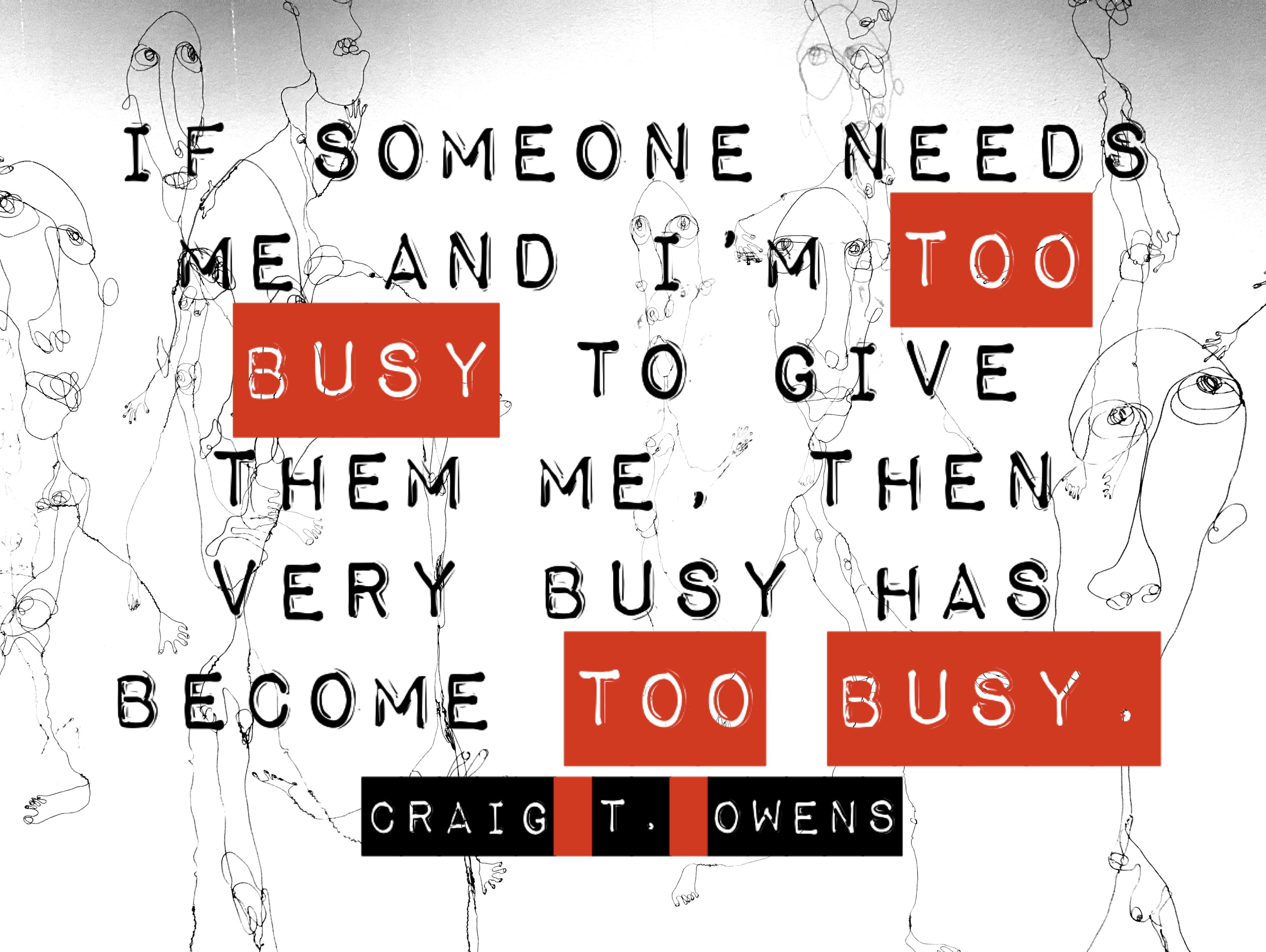
The biggest victim of attempting to multitask is your relationships. Those closest to you suffer the most. If someone needs me and I’m too busy to give them me, then very busy has become too busy and it’s time for me to evaluate who—not what—is my highest priority.

►► Would you please prayerfully consider supporting this ministry? My Patreon supporters get behind-the-scenes access to exclusive materials. ◀︎◀︎

4 + 4 Strategies To Eliminate Distractions To Your Prayer Time

There’s a quote that has been the theme for this series on prayer: “Prayer pursues joy in fruitful fellowship with Jesus, knowing that God is glorified when we bear fruit in answer to prayer. Why do God’s children so often fail to have consistent habits of happy, fruitful prayer? Unless I’m badly mistaken, one of the reasons is not so much that we don’t want to, but that we don’t plan to.” —John Piper 

And unless I’m badly mistaken, the most obvious thing we need to plan to eliminate is distractions. 

Some people say they can juggle a lot of things at once. “I’m a really good multitasker,” they say. But science says differently. MIT neuroscientist Earl Miller concluded that our brains are “not wired to multitask well…. When people think they’re multitasking, they’re actually just switching from one task to another very rapidly. And every time they do, there’s a cognitive cost.” What is that cognitive cost? “Multitasking can drop IQ as much as 15 points, essentially turning you into the cognitive equivalent of an 8-year-old” (Inc. Magazine). 

If the devil can make you think you can multitask prayer with other things, he has seriously inhibited the effectiveness of your prayers. 

Jesus was not a multitasker—but He was singularly focused on His Father’s plan. And yet He accomplished more in His three years of public ministry than anyone else in history! 

Here are 4 strategies to help you get ready to pray:

  1. Try to have your prayer time in the same place and at the same time. Your brain likes routine and it will help you zero-in during your scheduled prayer times. 
  2. Silence your cell phone or other noisy distractions. 
  3. Keep a notepad handy for random thoughts that pop into your head. Writing them down will keep your brain from switching back-and-forth to them.
  4. Focus on listening, not on talking—Eugene Peterson said, “Prayer is first of all a means of listening. Prayer is an act of attention.” 

When we get right down to it, prayer is spiritual warfare (2 Corinthians 2:11; Ephesians 6:10-18). In the context of warfare, the word strategy means the maneuvering that takes place prior to the battle. The devil is a masterful tactician, and he will do everything he can to keep you distracted. 

That’s why three times Peter tells us to be clear-minded and singularly-focused in our thoughts SO THAT we can pray without the hindrances of distractions (1 Peter 1:13-14; 4:7; 5:8-9). And Paul tells us to take all our thoughts captive, so that no un-Christlike thoughts are inhibiting our prayer time (2 Corinthians 10:4-5). 

Here are 4 strategies to help you stay focused in prayer:

  1. A—adoration. Enter into God’s presence with a Psalm or worship music. 
  2. C—confession. Deal with unconfessed sin, unforgiveness, or relationship strife as quickly as possible (Psalm 66:18; Matthew 5:21-24). 
  3. T—thanksgiving. Paul counseled us, “Do not be anxious about anything, but in everything, by prayer and petition WITH thanksgiving, present your requests to God” (Philippians 4:6).  
  4. S—supplication. Intercede for your brothers and sisters in the battles they are facing (James 5:16; Job 42:10; Ephesians 6:18).  

Remember—

Prayer isn’t preparation for the battle; prayer IS the battle! Let’s not be distracted from that!

5 Quotes On Problem Solving From “Brain-Savvy Leaders”

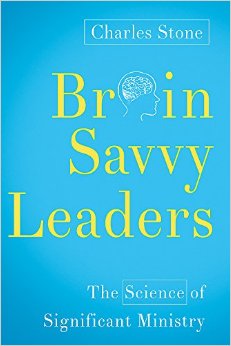
Brain-Savvy LeadersCharles Stone’s book Brain-Savvy Leaders is chockfull of helpful information! When you understand more how your brain works, you can leverage its power more efficiently. Here are some quotes he shared about problem solving.

“Only in the mystery of the incarnate Word does the mystery of man take on light.” —Pope Paul VI 

“As a part of the C-system, the prefrontal cortex processes bits of information one after the other (serial) instead of several at the same time (parallel). … When we try to process too much information at once, the prefrontal cortex’s serial processing nature can result in mental processing bottlenecks that in turn can lead to unfinished thoughts and tasks. … When we attempt many mental tasks at once, our thinking degrades, accuracy drops, we focus on the urgent instead of the important, we forget things, and the quality of future decisions gets muddied.”

Coffee, caffeinated drinks (but not too many), exercise, and novelty can increase the amount of these neurotransmitters and get us into a more productive and focused state.”

“Charlan Nemeth, a psychology professor at the University of California-Berkeley, performed a creativity study in 2003. She divided 265 female students into groups of five and asked them to generate as many ideas as possible on how to decrease traffic congestion in the San Francisco Bay area. Each team received one of three conditions and was given twenty minutes to complete the task. Either they used the traditional ‘no criticism’ brainstorming technique, or they generated as many ideas as possible but could debate and criticize each one, or they received no instructions. The ‘debate and criticize’ teams generated 20 percent more ideas than the other two groups. … Debate…adds the element of surprise that engages the brain.”

“When trying to solve problems, encourage your team to imagine themselves a year from now instead of imagining themselves tomorrow. Studies show that this time perspective fosters more creativity.”

You can read my book review of Brain-Savvy Leaders by clicking here.

I have also shared other quotes from this book on learning, brain health, and emotional health.

Being Quiet

I love technology. But along with all of the technology comes a whole lot of noise. Not necessarily the noise that your ears pick up, but the noise in your mind.

  • We’ve got Facebook for the latest social updates
  • Twitter and blogs for the latest news and commentary
  • Flickr, Twitpic, and Intragram for the latest pictures
  • LinkedIn for the latest business interactions
  • Smart phones for instant messaging

And if we miss out on any of those things, we feel left behind.

Here’s the ironic thing about all of this social media. Trying to keep up with everything and everyone raises the level of cortisol (a stress hormone) in our bodies. And cortisol actually increases anti-social behavior.

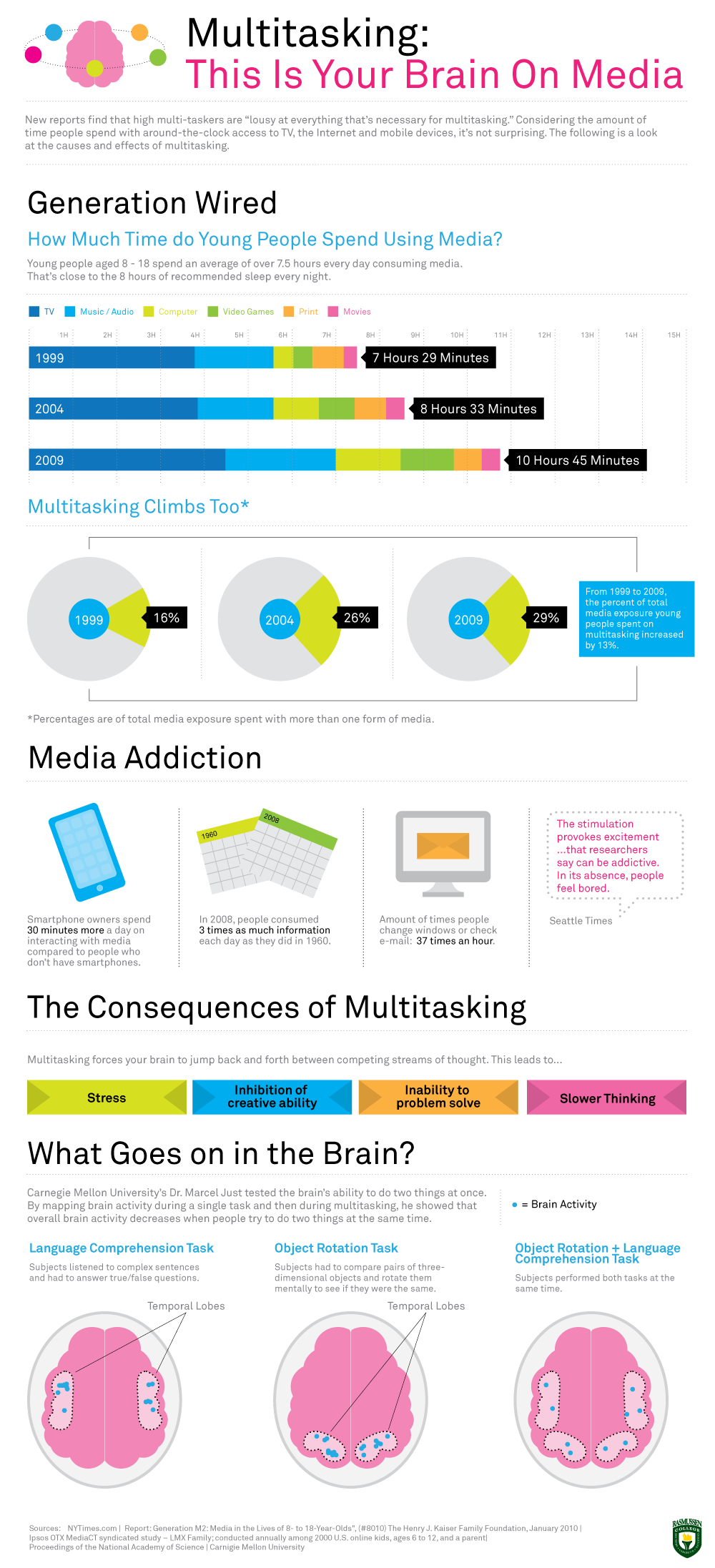
Look what multi-tasking does to our brains


In the midst of trying to tune in and keep up with all of these other voices, we often miss out on the most important Voice.

Jesus says: Listen! I am standing and knocking at your door. If [not when] you hear My voice and open the door, I will come in and we will eat together. (I added the bracketed commentary.)

Today I’m trying to quiet all of the other voices and just listen to The Voice. So today is a media/technology fast.

  • No blogging (I wrote this post yesterday)
  • No Twitter or Facebook
  • No texting
  • No iPod or TV or computer time

I’m taking time to make sure I’m tuning into the most important Voice. I challenge you to try it too. Listen to see what Jesus has to say to you.

Be All There

Once a friend of mine (whom I happen to think is more tuned-in to people’s needs than almost anyone else I know) went on a first date. He said the evening was pleasant, but felt his date was a bit distant. At the end of the evening when he brought up the subject of possibly going out again she informed him, “No, I don’t think we can go out again. You’re just not emotionally available for me.”

I know this wasn’t true for my friend, but have you ever been there? Ever been with someone, but it was obvious that they weren’t really there with you in the room? Frustrating, isn’t it?

[Insert tongue firmly in cheek as you read this next paragraph.] Now I’m certain that none of the readers of my blog would ever be distracted like this. And I know I’ve never done this myself. Since you and I, dear reader, always are 100% attentive to the people in the room with us, these next two quotes probably won’t pertain to you, but here they are anyhow:

“The human brain is simply not designed to multitask. You can get by doing multiple things at once, but you can’t do them well. Your brain is physically unable to process more than one set of instructions at a time, so while you are juggling all of those actions at once, your brain is scrambling to keep up. Through a variety of experiments measuring brain activity, scientists have discovered that the constant switching back and forth from one activity to another energizes regions of the brain that specialize in visual processing and physical coordination, while simultaneously disrupting the brain regions related to memory and learning. According to the research, ‘we are using our mental energy to concentrate on concentrating at the expense of whatever it is that we’re supposed to be concentrating on.’ Got that?

“More simply: when we multitask we’re dumber. How much dumber? A recent study for Hewlett Packard exploring the impact of multitasking on performance revealed that the average worker’s functioning IQ drops ten points when multitasking…. (The analogy the researchers used is that a ten-point drop in IQ is equivalent to missing one night of sleep.)” —Marcus Buckingham, Find Your Strongest Life

“Concentration, which leads to meditation and contemplation, is therefore the necessary precondition for true hospitality. When our souls are restless, when we are driven by thousands of different and often conflicting stimuli, when we are always ‘over there’ between people, ideas and the worries of this world, how can we possibly create the room and space where someone else can enter freely without feeling himself an unlawful intruder?” —Henri Nouwen, The Wounded Healer

This week I’m making it my goal to be all there for whomever is here with me. I’m going to try my best to eliminate multitasking and truly concentrate on the one spending time with me. Are you ready to try this with me? Let me know how it goes.