
Who’s Your Promoter?

Check out this verse where God speaks to Joshua:

Today I will begin to exalt you in the eyes of all Israel, so they may know I am with you as I was with Moses.

Self-promoted leadership requires that I know what the current whims of the people are, and then I cater to those special-interest whims. But people are fickle, so I have to be constantly reinventing myself. I have to wear the right mask for the right group. I have to become a slick politician, giving the right speech to the right special interest group, promising them what they want to hear. I have to pander for votes to stay in leadership.

God-promoted leadership requires that I have faith in God alone. No focus groups to find out what people want. No advisors whispering in my ear. No masks, no special interest speeches, no pandering for votes. God knows the hearts of the people, and if He has called me to be a leader, He will equip me to be His leader.

Joshua was a God-promoted leader. When he was on the eve of his first major campaign as the new leader of Israel, he gave just one speech: “Let’s get ready to go.” A self-promoting leader would have given one motivational speech to the priests, one pep talk to the generals, one persuasive speech to the troops, an encouraging speech to the stay-at-home moms, and possibly one more convincing speech to those who wanted to pursue an alternative strategy.

The results of God-promoted leadership?

  1. So the Israelites did just as Joshua commanded them (Joshua 4:8).
  2. That day the Lord exalted Joshua in the sight of all Israel; and they revered him all the days of his life (Joshua 4:14).

Who’s your promoter?

My prayer is that I always allow God to be my promoter and that the Holy Spirit will convict me anytime I try to promote myself.

4 Leadership Requirements

I love studying leadership—leadership principles, leadership practices, and leadership people. There’s a great leadership case study in the Bible in the life of Joshua that always intrigues me.

Joshua had been through extensive preparation to become Moses’ successor. He was a recognized leader in his tribe, the general of the army, and an aide-de-camp to Moses for a number of years. But his most important leadership qualification: He was called by God.

As the story of his leadership opens in the first chapter of the Book of Joshua, God gives four requirements for Joshua (and you and me) to be effective in our leadership roles.

1.  Be yourself. God didn’t say, “Be like Moses.” In fact, the only time God talks about Moses to Joshua is to reassure him, “I will be with you like I was with Moses.” But never once does God uses a “Moses Grading Scale” for Joshua. God simply says, “You will lead these people.”

2.  Have an objective measuring stick. Feelings may change, but God’s Word never does. So God counsels Joshua to always rely on the Book of the Law.

3.  Guard your thoughts. Leaders have so many people “in their ear” wanting to lobby for their way. So God tells Joshua to not only read the Bible but meditate on it as well. One definition of meditation is to hum God’s Word. In other words, humming God’s Word will help a leader know which lobbying voice is in harmony with God’s Voice, and which lobbying voice is off-key.

4.  Guard your attitude. God repeats this to Joshua, “Do not be afraid; do not be discouraged.” Even doing everything they are supposed to be doing, leaders can become afraid to make a change, or discouraged because people aren’t following along. These feelings must be driven out with one firm declaration: “I know the Lord has called to this leadership position, so I know the Lord is with me. He will enable me to complete what He has called me to do.”

God’s direction to Joshua is still great counsel for leaders today.

Be Careful

In the final instructions before the Israelites were going to enter the Promised Land, the book of Deuteronomy uses the phrase be careful fifteen (15) times:

  • Be careful not to forget
  • Be careful to obey
  • Be careful to avoid making idols
  • Be careful to honor your leadership
  • Be careful of your thoughts

In the dictionary careful is defined as being attentive to potential danger, error, or harm. It implies paying special attention to accuracy and being discerning.

God doesn’t ask this of me to cramp my style but to put me in a place where He can bless me. And not just me: being careful leads to generational blessings. Here’s my favorite be careful verse:

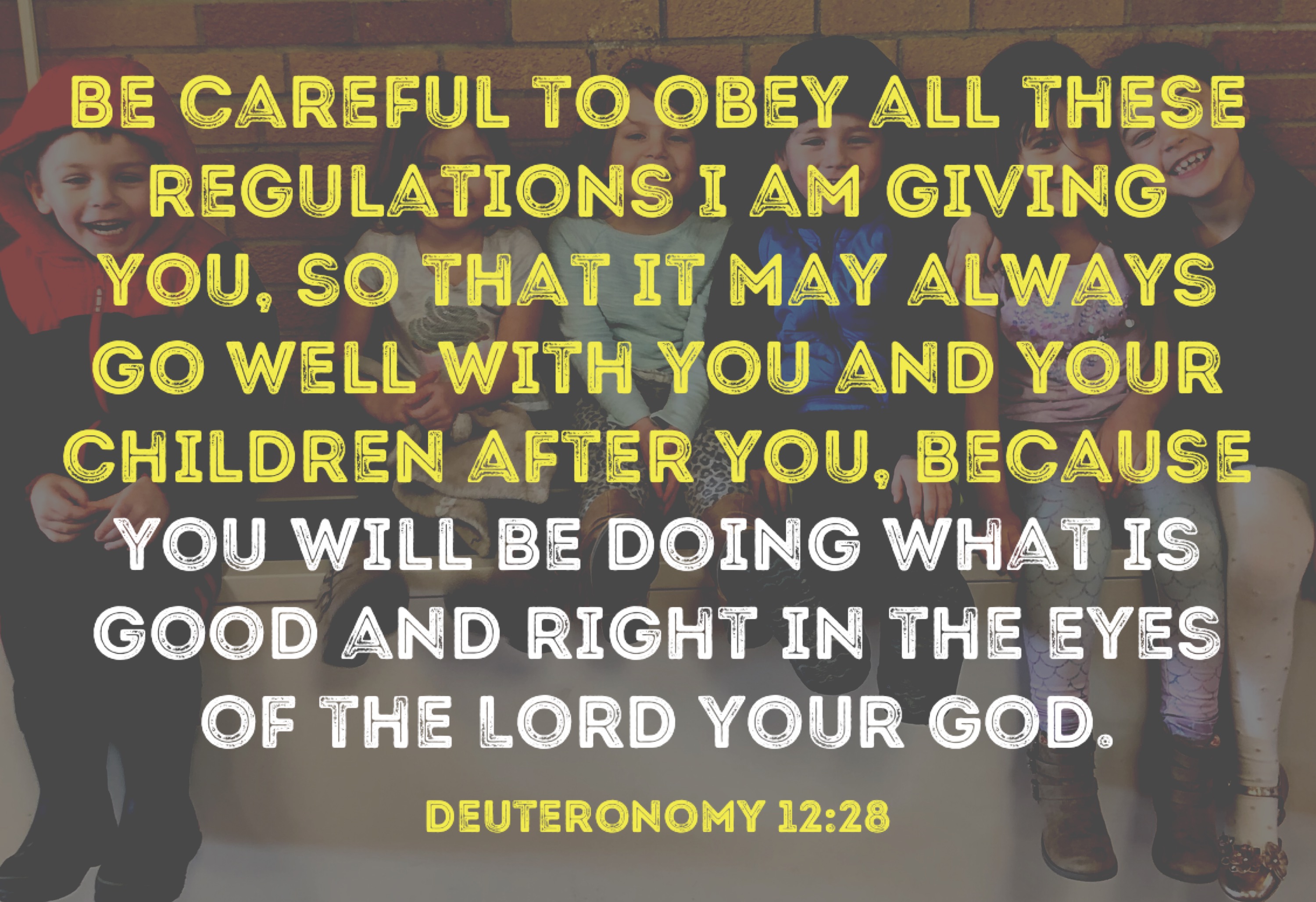
Be careful to obey all these regulations I am giving you today, so that it may always go well with you and your children after you, because you will be doing what is good and right in the eyes of the Lord your God.

Sometimes to be careful we have to slow down. We seem to want everything quickly and with as little effort as possible. Remember the cliché “Haste makes waste”?

What if you slowed down a bit today?

What if you took just a little time to be attentive to potential danger?

What if you paused long enough to discern if you were giving your best to God?

What if you took a moment to simply ask God to give you the wisdom needed to make a godly decision?

Being careful so that it may ALWAYS go well with you and your children after you….

Isn’t that worth it?

Don’t Be That Guy

I love studying leadership books and learning from the lives of great men and women of history. The leadership section of my library is only slightly larger than the biography section. One of the saddest things to see is a leader who self-destructs. I was just reviewing some of my notes about leadership failures when Tim Elmore’s latest e-newsletter arrived entitled Self-Destructive Leaders.

Check out a couple of blurbs from this excellent article:

Projecting their self-worth.
There are few things more unappetizing than a leader who has to constantly talk about how important they are. They name drop, they remind others of their busyness, accomplishments, authority, past positions, degrees, or pedigree. It’s like they’re lobbying for attention and affirmation. It’s a sad commentary when so much of a leader’s energy is spent doing this instead of helping their team reach their goals.

Possessing a controlling spirit.
Often, insecure leaders react to their inward desperation with control. They feel if they can control people, they’ll maintain absolute authority. … They resort to more regulations and policies to enforce compliance among staff instead of trusting them and earning their loyalty….

Comparing themselves to others obsessively.
When a leader has a low EQ [emotional intelligence quotient], they naturally tend to look around them; they look outward rather than inward (at their own natural strengths and style) or upward (to their Creator for their sense of identity).  They become consumed with comparing their own traits or achievements to those of other leaders. Soon, their team ceases to operate in a healthy way. They’re driven by comparing and competing with others instead of capitalizing on their own core competencies.

Possessing self-imposed blindness.
This one is huge. All leaders have blind spots. Like in a car, blind spots happen not so much because of stupidity but position. The driver can’t see certain things. Sadly, self-destructive leaders refuse help. They repel any input from colleagues and insist on living in a bubble that makes them feel good. All is well, or so they think. Their insecurity won’t let them face the facts. They prefer a perspective that’s limited, but comfortable. Their narrow view will eventually lead to an accident.

Here’s what wise King Solomon said about the self-destructive leader:

Arrogant know-it-alls stir up discord, but wise men and women listen to each other’s counsel. (Proverbs 13:10)

If you ignore criticism, you will end in poverty and disgrace; if you accept correction, you will be honored. (Proverbs 13:18)

The saddest part is this – the self-destructive leader will read this and then say to himself, “Nope, that’s not me. This is describing someone else.”

Don’t be that guy (or gal)!

  • Look in the mirror of Scripture.
  • Listen to the counsel of others.
  • Listen to the criticism of your teammates. (Hint: if your teammates aren’t telling you anything that you need to improve on, it’s not because you’re perfect. Either you have intimidated them into silence, or you’re deaf to what they’re telling you.)
  • Learn from the lives of great leaders from the past. Read their biographies and autobiographies.

Learning To Distinguish

In Moses’ instructions to the priests, he said, “You must distinguish between the holy and common, between the unclean and the clean.”

Why? Because these men were to be leaders. He went on to say, “You must teach the Israelites all the decrees.”

If I’m going to be a leader, I must be able to distinguish.

Here’s where the Holy Spirit is challenging me. I am working on distinguishing between…

Good and Best

Acceptable and Excellent

Common and Holy

Ordinary and Extraordinary

Want and Need

Present and Participant

Quantity and Quality

I am certain that this list is just a start, and that it’s going to be a lifetime pursuit.

God’s Favor

It’s a well-known story: Moses is on the mountaintop with God while all the Israelites back at camp think he’s dead. They then convince Aaron to make a golden calf to be their god. The True God is ready to bring down His punishment on these idol worshipers when two incredible words stop God’s judgment dead in its tracks…

But Moses.

God was ready to wipe them out and start all over with Moses. Think about it: God offered Moses the opportunity to be on the same level of remembrance with Abraham. Years later people would be saying, “The God of Abraham, Isaac, Israel, and Moses.” What an incredible honor for Moses!

But Moses.

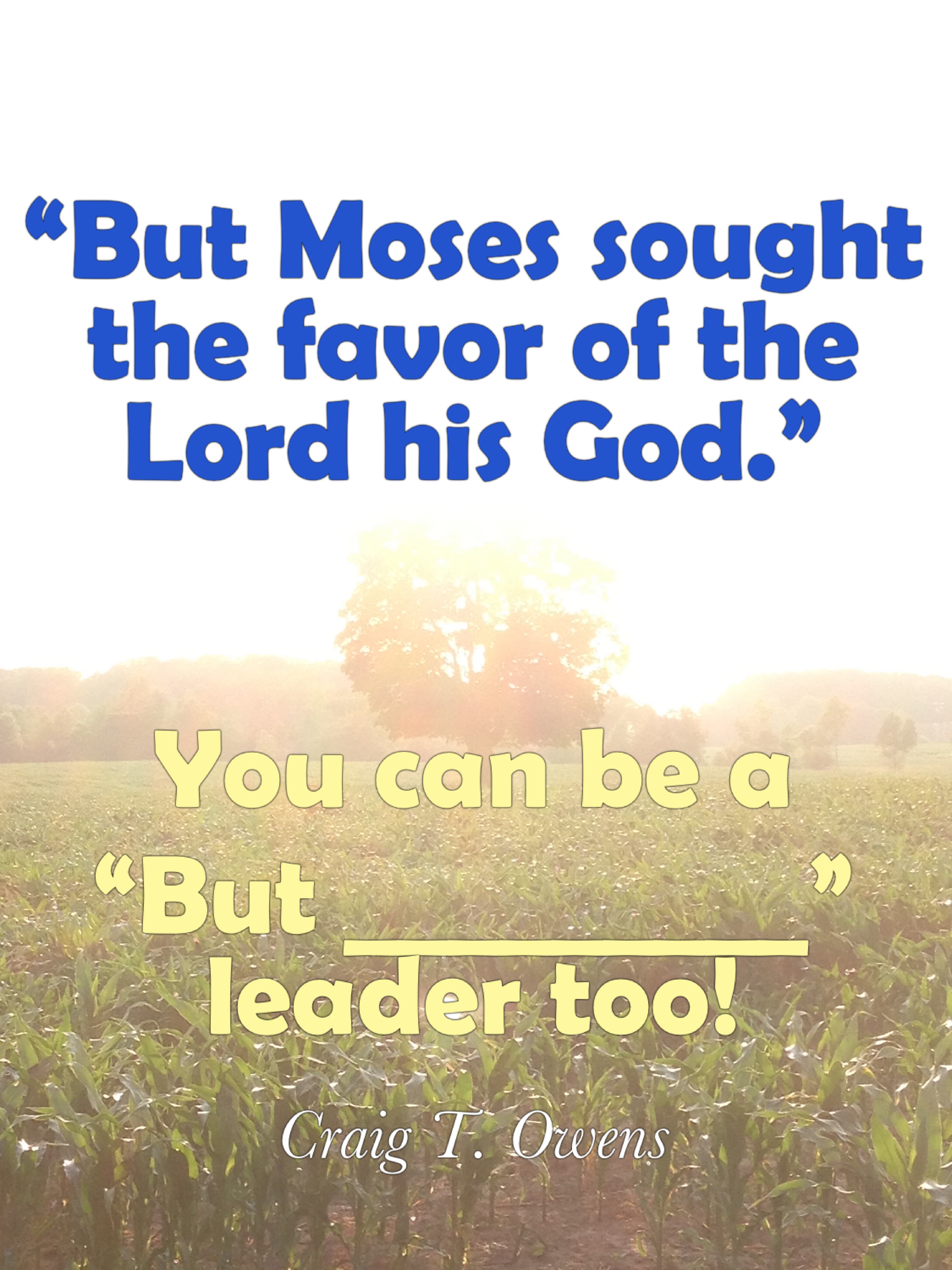
Instead, Moses interceded for his people. Moses sought God’s favor. He knew God to be the compassionate and gracious God, slow to anger, abounding in love and faithfulness, maintaining love to thousands and forgiving wickedness, rebellion and sin. He could have had it all for himself.

But Moses.

He asked God to forgive the people’s idolatry and betrayal. God replied, “I know you by name and you have found favor with Me.” If you had God’s favor, what would you do with it? Would you ask for great things for yourself? Your family? Your friends?

But Moses.

Moses used this favor to ask God to help him stay in His favor. “If You are pleased with me, teach me Your ways so I may know You and continue to find favor with You.” Moses knew that it was God’s favor that distinguishes one man from the crowd, that sets a man apart as a leader.

But Moses…

just wanted God to be glorified. And God responded: “My Presence will go with you.”

I want to be a “But Craig” leader… one that stands apart as God’s leader; one who only seeks to bring glory to God.

How about you? Do you want to be that “But ____________” leader too?

Higher Standards For Greater Rewards

Most people think of the Ten Commandments as God’s law given through Moses. Actually the Ten Commandments are just the beginning of the laws, practices, and regulations that God gives to His people. The rest of the book of Exodus, the entire book of Leviticus, and the first ten chapters of Numbers compromise the bulk of the law.

For those of you keeping track, that’s nearly 60 chapters of rules and regulations.

Why so many? I think the answer is found in the lead-up to the Ten Commandments:

Now if you obey Me fully and keep My covenant, then out of all nations you will be My treasured possession. Although the whole earth is Mine, you will be for Me a kingdom of priests and a holy nation.

God wants people who are treasured. A people who are priests. A people who are holy. In short: He wants pacesetting leaders.

Priests have intimate access to God, and they are people who set an example for others to follow. In order to enjoy these special privileges, priests must be held to higher standards.

These are not standards just for those of Jewish ancestry, but for anyone who is a follower of Jesus Christ. Look what John recorded in the last book of the Bible:

To Him who loves us and has freed us from our sins by His blood, and has made us to be a kingdom and priests to serve His God and Father—to Him be glory and power for ever and ever! Amen.

…With Your blood You purchased men for God from every tribe and language and people and nation. You have made them to be a kingdom and priests to serve our God, and they will reign on the earth.

Yes, the standards to be a priest—to be a holy leader—are higher. But the rewards are immeasurable!

Are you ready to bring greater glory to God? Do you want to be a pacesetting leader for the Kingdom of heaven? Then ask the Holy Spirit to sanctify you as you take on the discipline of greater responsibility. Live up to higher standards, and you won’t be disappointed by the rewards!

Let Me Give You A Piece Of Advice

How many times have you heard someone say you, “Let me give you a piece of advice”? Ah, yes, everyone has some advice to share. Everyone has an opinion. Everyone wants to give you a piece of their mind. Everyone is an expert in an area where they think you’re deficient.

I remember going through comment cards at the end of a long week of youth camp. I’d read one card that would say the food was excellent. Just a couple of cards later some “expert” would share how terrible the food was. One would say they loved the evangelist, another would give their “advice” on where the evangelist missed it.

Whom should I listen to? Who should get my ear?

In William Shakespeare’s Hamlet, Polonius gives this counsel to Laertes “Give every man thine ear, but few thy voice: Take each man’s censure, but reserve thy judgment.”

Nice prose, but how do we live it out?

I like the example I see from a man named Jethro in the Bible. Jethro is Moses’ father-in-law, and he really only appears on the scene in just one chapter (Exodus 18), but his method of giving advice should be a model for us all.

Credentials—Jethro was a God-fearing man. If you are a follower of Jesus Christ, weigh carefully the advice given to you by those who don’t have the same biblical foundation.

Relationship—Jethro had a personal relationship with Moses, he wasn’t just a business acquaintance. That means Jethro had a vested interest in Moses’ success or failure.

Firsthand—Jethro heard about what was happening, but he came to see it for himself. Beware of those “experts” who only have secondhand information about you or your situation.

Up-Close—Jethro spent an entire day right by Moses’ side just watching and listening. He saw what was going on from the front row.

Questions—Jethro led with questions, not with advice. Before giving Moses his opinion, Jethro asked clarifying questions.

Wisdom—Only after all of this did Jethro give his opinion to Moses. The words that he shared were then received by Moses as God-given wisdom.

Your counselors should earn the right to be heard. Just because someone has an opinion doesn’t make him an expert. And just because someone has been-there-done-that doesn’t mean that her way should be your way.

Screen out the clamoring voices by making sure they have credentials, a relationship with you, firsthand experience, and godly wisdom.

Wind Or Anchor

I so appreciate my church Board!

They are by no means a bunch of “yes men” (especially since one of our Board members is a woman!), but they are definitely great teammates. When I want to dream, they dream along with me. When I’m looking for a new way to do something, they help me explore our options. When I propose that we experiment, they give me the latitude to make the attempt.

They are the wind in my sails.

Unfortunately I’ve been around too many board members who feel it is their job to play devil’s advocate, or to hold the pastor to the time-honored traditions (without any regard to their effectiveness), or to always play everything safe.

They are an anchor around a pastor’s ankle.

French novelist Andre Gide noted,

“One doesn’t discover new lands without consenting to lose sight of the shore for a very long time.”

Thanks, Calvary A/G Board, for allowing us to lose sight of the shore every once in awhile so that we can see what new lands God will help us discover. You are definitely the wind in my sails.

What about you, dear reader? You may not be on an official board, but your comments and attitudes can either be wind or an anchor to someone close to you. Which are you?

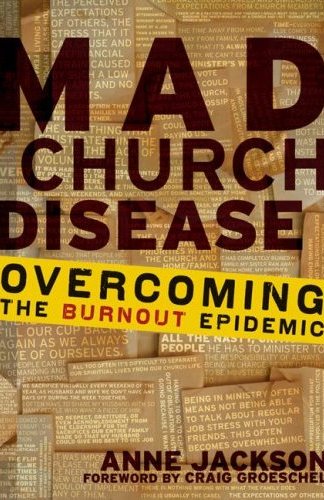
Mad Church Disease (book review)

Read this book and save your life.

Seriously.

I have seen far too many good people get burned-out in the most unlikely place. The one place where you would expect wholeness and vitality and safety and health: Church! In Mad Church Disease Anne Jackson draws the comparison to bovine spongiform encephalopathy (better known as mad cow disease) to confront mad church disease head-on.

Here’s the insidious thing about the way mad cow disease spreads: after infected cows die, they are ground up and fed to healthy cows. So unwittingly the disease is perpetuated because no one recognizes it’s there. Sadly that’s what happens far too often in the church. We have developed cultures that continue to burn-out people, and then we let those burned-out people feed (develop) new people

Anne shines the light of truth on this ugly disease. She confronts the symptoms head-on, and offers practical steps for helping people get healthy.

As someone who came very close to getting burned-out by mad church disease, I can attest how right-on-the-mark Anne’s book is. And to bolster her diagnosis, Anne interviews several leading pastors whose “second opinion” confirm the original diagnosis. I liked this observation from Bill Hybels:

“Especially as leaders in the church, we consistently need to be filled up and buoyed in our spirits because everybody takes their cue from the leader. If the leader is exhausted, then the people following that leader will feel exhausted. If the leader is wearing thin on hope, then people start losing hope too. If the leader gets pessimistic, everybody gets pessimistic.”

So who should read Mad Church Disease?

  • Pastors
  • Paid church staff
  • Volunteer church ministers
  • Counselors
  • Church board members

Whether you have been infected by mad church disease or not, you need to read this book. It will either be a source of healing for you, or an eye-opener to help protect yourself and others around you from this deadly disease.

The first step to eliminating mad church disease is recognizing its symptoms. Mad Church Disease does just that, and then goes further to talk about the steps for healing. Thanks, Anne, for a straightforward look at this serious disease.