When To Seek Consensus

David conferred with each of his officers…. He then said to the whole assembly of Israel, “If it seems good to you and if it is the will of the Lord our God…let us bring the ark of our God back to us….” The whole assembly agreed to do this, because it seemed right to all the people. (1 Chronicles 13:1-4) 
David cast a vision, consulted with his inner circle of leaders, shared the vision with the people, and got unanimous agreement from everyone. 

And yet things went horribly wrong: a man was killed and David became terrified of God.

In the above verses, notice all of the plural pronouns: we and us. David worked hard to build a consensus among the people. 

David was quick to notice that the ark of the covenant of the Lord wasn’t used to consult God during the reign of King Saul (v. 3), but that’s exactly what David didn’t do. He built a consensus among the people without getting a “yes” from God. Even a unanimous decision of the people will fail if God isn’t in it! 

Thankfully, in chapter 15, David corrects this omission. We read phrases like: 

  • “we did not inquire of [God] about how to do it in the prescribed way” 
  • we should do this “in accordance with the word of the Lord” 

I also notice that David no longer sought consensus but merely announced to the people what was happening. In this successful attempt to move the ark, David’s only consultation was with God. After that, he made arrangements with the Levites, gathered his inner circle of leaders, and then asked the people to join in the celebration. 

God had already spoken about how the ark of the covenant was to be moved: it was written in His word. Therefore, as noble as it might sound, there was no reason for David to seek a consensus from the people.

Even if it is not an area or activity explicitly addressed in the Bible, God’s will is to be sought before others are consulted. If God says “yes,” the leader must proceed even if the people say “no.” And the leader must not listen to the people’s “yes” if God has said “no.” 

Consensus is fine in its place, but only in its proper place. 

A mark of a godly leader is one who knows when to seek consensus among the people.

This is part 53 in my series on godly leadership. You can check out all of my posts in this series by clicking here.

How A Leader Gains Followers

And David became more and more powerful because the Lord Almighty was with him (1 Chronicles 11:9). 

David had followers from all twelve tribes of Israel—warriors, leaders, talented men, fierce men. David wasn’t recruiting them or promising them any rewards, but they volunteered, coming in “one accord” and creating “joy in Israel” in the process (12:1-40). 

David was prepared to go alone. He fled from Saul without a single helper. David’s attitude was one of all-in trust in God, so all of these warriors came to David because of what he represented, not because of what he advertised. It was David’s wholehearted commitment to God that won the wholehearted commitment of these valiant men.

Their unity of purpose—“fully determined … one mind” (12:38)—was not because of a compelling vision that David cast but because of a mighty God David fully feared and loved. 

A leader’s focus should never be on building a following or casting a compelling vision, but on wholehearted, single-minded love and commitment to God. Any power or following only comes “because the Lord Almighty was with him.” 

A mark of a godly leader is his wholehearted devotion to God which creates a wholehearted devotion in his followers. 

This is part 52 in my series on godly leadership. You can check out all of my posts in this series by clicking here

The Craig And Greg Show: Fearless Leaders

On this episode of “The Craig And Greg Show” we talk about: 

  • Greg used to trick his younger sister into doing something he was afraid to do  
  • fear makes us tunnel-visioned   
  • I teach Greg a new phobia  
  • doctors say only two fears are innate; all the rest are learned fears   
  • “If fear is learned, it can be unlearned, and a new path relearned,” says Craig 
  • the lessons we’ve learned in the past can help us conquer today’s fears
  • what we can learn from the acrostic F.E.A.R.  
  • how Greg’s Dad helped him overcome a fear of failure  

Check out this episode and subscribe on YouTube so you can watch all of the upcoming episodes. You can also listen to our podcast on Spotify and iTunes.

9 Quotes From “War As I Knew It”

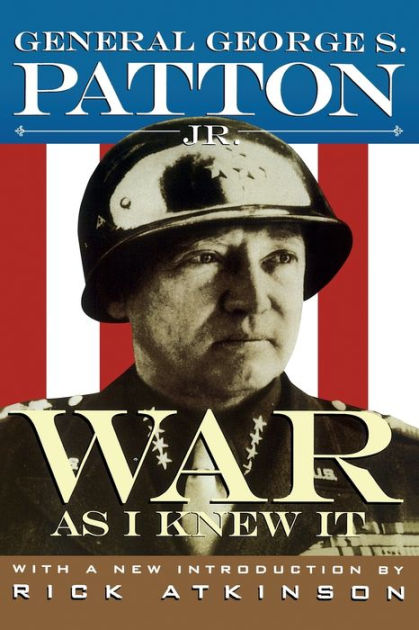
General George Patton gives us an insightful leadership look into how his army was able to accomplish so much during such a short time in World War II. Check out my full book review by clicking here. 

“An ounce of sweat saves a gallon of blood.” 

“This is another example of the many I’ve encountered in life where great disappointments have proven to be the road to future success.” 

“Successful generals make plans to fit the circumstances, but do not try to create circumstances to fit plans.” 

“The 8th of May, 1945, marked exactly two-and-a-half years since we had landed in Africa. During all that time we had been in practically continuous battle, and when not in battle had been under the strain of continuous criticism, which I believe is harder to bear.” 

“It is unfortunate and to me a tragic fact, that in our attempts to prevent war we have taught our people to belittle the heroic qualities of the solider.” 

“Wars are not won by defensive tactics. … The best armor and the best defense is a rapid and well-directed fire.” 

“An army commander does what is necessary to accomplish his mission, and that nearly eighty percent of his mission is to arouse morale in his men.” 

“Don’t delay. The best is the enemy of the good. By this, I mean that a good plan violently executed now is better than a perfect plan next week.” 

“Fatigue breeds pessimism.”

War As I Knew It (book review)

Throughout my life, I’ve had the privilege of meeting World War II soldiers who fought in the Third Army in Europe. I’ve said to them, “Oh, so you were Patton’s man.” And the response is always the same, “Yes sir!” they proudly respond with a smile. General George Patton was a unique military leader, and his memoirs called War As I Knew It capture his uniqueness. 

George Patton lived as if he were always in pursuit of something big. He always pushed himself, those under his command, and even those in leadership over him, to keep moving forward. His memoirs cover the final 2+ years of World War II, from the time he landed his troops in Africa until Germany surrendered. 

Patton’s Third Army was an unstoppable force! They covered more ground, took more territory, captured or killed more enemy combatants, liberated more cities, and destroyed more enemy material than any other army in US history! This was because of Patton’s drive, and because of his strenuous personal preparation before the war even started. 

These memoirs record Patton’s successes, but he also is transparent enough to list where he miscalculated and where he was simply a beneficiary of good fortune. 

For students of leadership, US history, or military history, War As I Knew It is a very insightful book. 

The Craig And Greg Show: Winning Teams

On this episode of “The Craig And Greg Show” we talk about: 

  • Greg’s college football experiences  
  • how do teammates get along better?  
  • the 3 Ts that help make teams stronger and more effective  
  • how leaders can help teammates who make a mistake  
  • the strategic importance of “timeouts” 
  • the importance of a leader’s confident humility 
  • the attractiveness of a team’s enthusiasm  
  • an insightful quote from Rich DeVos 

Check out this episode and subscribe on YouTube so you can watch all of the upcoming episodes. You can also listen to our podcast on Spotify and iTunes. 

Get more information at Maximize Leadership.

The Lingering Effects Of Poor Leadership

Surely these things happened to Judah according to the Lord’s command… (2 Kings 24:3). 

I am intrigued by the succession of the last kings of Judah just before Jerusalem falls in 586 BC. The leadership authority has been completely undermined by the downward spiral of sin in the previous leaders. As a result, the kings of Judah are now just an “empty suit,” with someone else exerting the real influence.

King Josiah was the last God-fearing king Judah had. After Josiah died, “the people of the land” made Jehoahaz king of Judah. He only reigned three months. 

After Jehoahaz died, “Pharaoh Neco made Eliakim son of Josiah king” after Egypt subdued Judah. Pharaoh changed his name to Jehoiakim, took all of Judah’s treasures, and imposed a tribute on Judah, forcing Jehoiakim to tax all the citizens. 

Later on, Jehoiakim became a vassal king of Nebuchadnezzar. After Jehoiakim died, his son Jehoiachin only reigned as king for three months before he was deposed by Nebuchadnezzar. 

Nebuchadnezzar then “made Mattaniah” king. He also imposed tribute and changed the king’s name to Zedekiah. 

King Zedekiah rebelled and was executed, after which Nebuchadnezzar “appointed Gedaliah as governor.” Gedaliah was assassinated shortly thereafter, completing the collapse of Judah and sending the people into exile in Babylon for the next 70 years. 

[Check out all of the biblical references for these sad events by clicking here]

Oh, what misery for the people of Judah for this last 20-year span under these final kings! The consequences of the leaders’ continual rebellion against God brought such uncertainty and heartache for the citizens. 

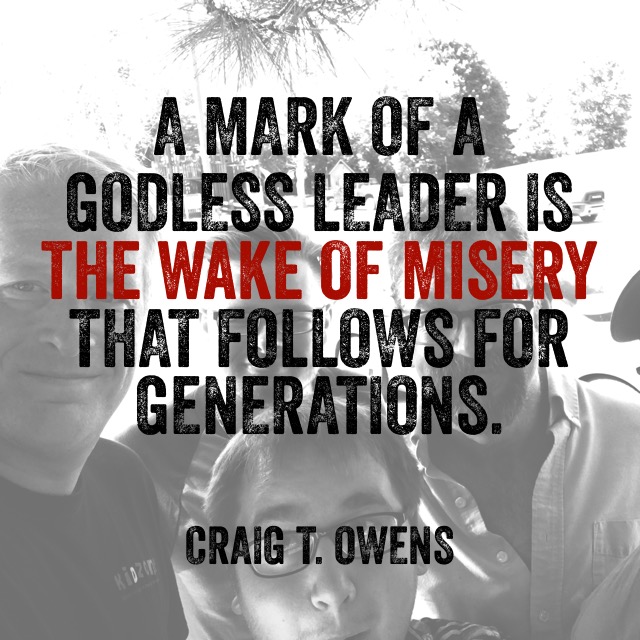
A mark of a godless leader is the wake of misery that follows him for generations afterward. 

Lord God, help me to see that my actions today have consequences for tomorrow. I want to leave an empowering, God-honoring legacy for the next generations, but this can only happen as I remain obedient to You! 

This is part 51 in my series on godly leadership. You can check out all of my posts in this series by clicking here

Leadership Cycle

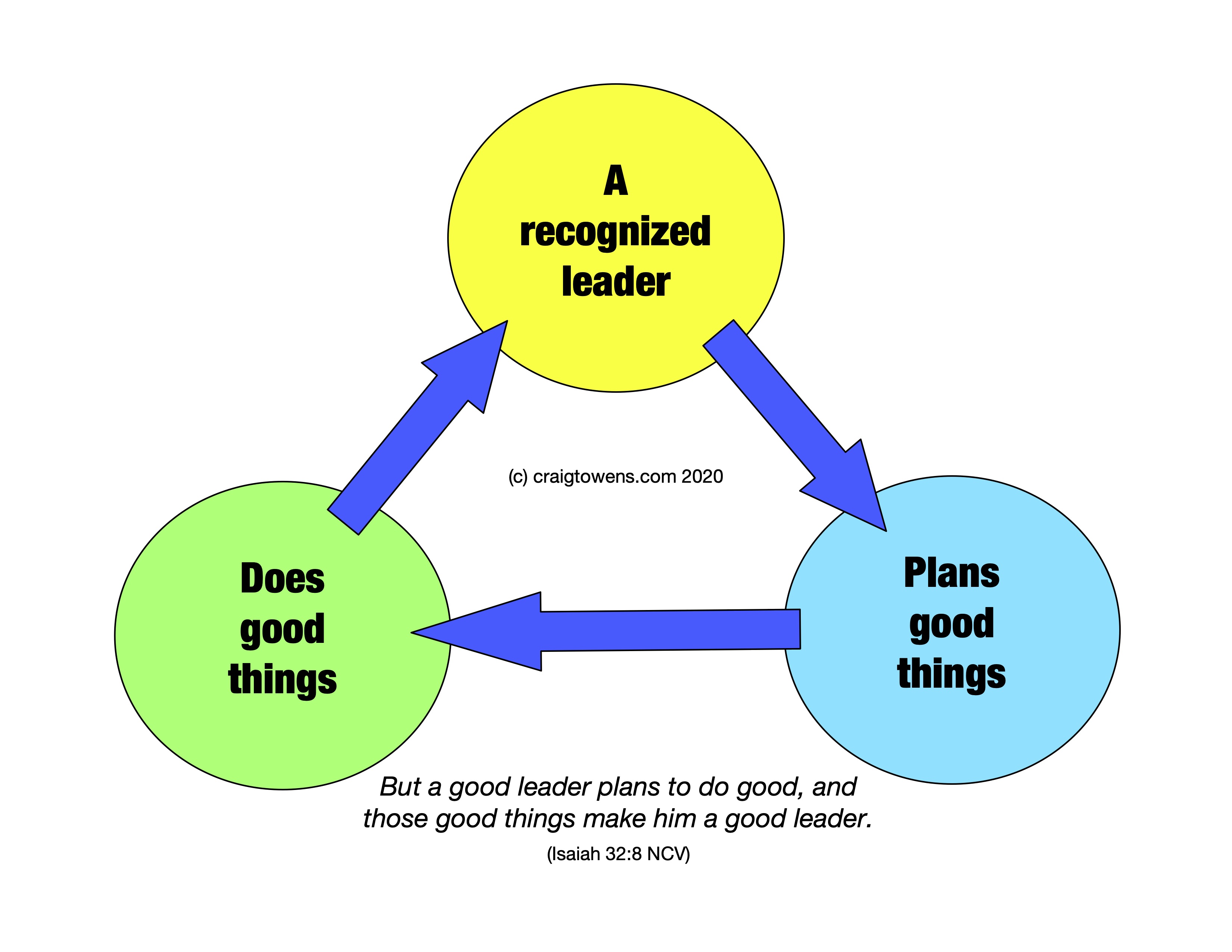
But a good leader plans to do good, and those good things make him a good leader. (Isaiah 32:8 NCV) 

A recognized good leader → Plans good things → Does good things → which makes that leader more recognizable, and on and on it goes. 

A good leader has to make good plans and has to followthrough on those good plans in a good way. The leader may have started off with just the title of “leader” but the good followthrough on good plans will help that leader be recognized by others as a good leader. 

That recognition of a leader by his/her teammates makes it that much easier the next time to make the good plans and then followthrough on them. 

This is a virtuous cycle that pays dividends for everyone involved!

Check out another virtuous leadership cycle I shared here. This is a part of my ongoing godly leadership series of blog posts.

Impossible To Unstoppable

King David was a unifier. He took people that were territorial and possessive of their own tribes and unified them into the strong nation of Israel. 

The way he responded to the murders of Saul, Abner, and Ish-Boseth prompted this response: “All the people took note and were pleased; indeed, everything that the king did pleased them. So on that day all the people there and all Israel knew that the king had no part in the murder of Abner son of Ner” (2 Samuel 3:36-37). 

The leaders of Israel’s various tribes then followed the lead of Abner—“All the tribes of Israel came to David at Hebron” and “all the elders of Israel” joined with David (5:1, 3). 

David accepted all of this in confident humility. He knew that it wasn’t his doing but God’s. He made sure to stay reliant on God (5:19, 23), keeping in mind that he was leading to win victories for all Israel: “Then David knew that the Lord had established him as king over [all] Israel and had exalted his kingdom for the sake of His people Israel” (5:12).

Result: “[David] became more and more powerful, because the Lord God Almighty was with him” (v. 10). 

God delights to empower leaders who have a humble heart to unify God’s people. God will let self-made leaders struggle in their own ability, but He will unleash all His resources to help the humble, God-dependent leader.

These God-empowered leaders are the only ones who can bring lasting unity. 

Leading on my own strength: Impossible.

Leading in God’s strength: Unstoppable! 

[read all of these passage in the Bible for yourself by clicking here]

The Craig And Greg Show: Leaders Are Hope Dealers

On this episode of “The Craig And Greg Show” we talk about: 

  • why it’s so vital for leaders to be hope-filled and hopeful for their teammates 
  • how do leaders increase their own hopefulness 
  • the importance of a leader’s temporary retreat 
  • hope-filled leaders are healthy leaders 
  • the dangers of pessimism, isolation, and comparison 
  • the importance of H.O.P.E. for leaders 
  • insights from Napoleon Bonaparte, Desmond Tutu, King Solomon, Joe Montana, Daniel Goleman 

Check out this episode and subscribe on YouTube so you can watch all of the upcoming episodes.

Get more information at Maximize Leadership.