There are two ways of dealing with any undesirable things around you: You can curse the darkness or light a candle. Nowhere in the Bible does Jesus say, “Tell bad people how bad they are.” Instead, He tells His followers to love … bless … serve … SHINE …
I suppose you could choose to curse…
There’s too much pollution
Respect is no longer seen
Politicians are crooked
Newspapers only report bad news
Too many marriages end in divorce
My kid’s teacher is never available
People hide behind Facebook and email
My church is boring
Halloween is dark and scary
Or you can SHINE…
Pick up one piece of trash … recycle your metal and plastic …
Write a thank-you note to your local police chief …
Run for office yourself … volunteer for a politician you believe in … be an informed voter …
Do something newsworthy … use social media to only highlight good news …
Date your mate … have dinner with another married couple …
Volunteer in a classroom … send an encouraging email to a teacher …
Take some cookies to your neighbor … send a handwritten note to a friend …
Start praising before you go to church … get involved in a ministry …
I read something very interesting: Next to Christmas, more money is spent on Halloween than on any other holiday event. Halloween?!? Wow! We’re in the midst of planning our church’s role on Halloween night, so I’ve been thinking quite a bit about engaging our culture.
It’s better to light a candle than to curse the darkness.
So here’s how I think followers of Jesus Christ should light a candle to engage culture:
(1) Have the right motivation. In Jesus’ inaugural sermon, He said He was coming to preach the Good News about God’s love. He purposely left out the part of Isaiah’s prophesy that talked about God’s coming judgment. There will be a time for that, but for now, our motivation should be to make known the favor of the Lord.
(2) Get out of your box. If you only hang around with Christians, your ability to effectively engage culture will be diminished. If you never get around others, it’s sort of like salt that sits in the saltshaker too long. Paul told the Athenians that he had been walking around their city looking at their culture.
(3) Listen. As Paul talked to the Athenians, he quoted their poets to them. He knew what they were listening to because he was listening too. What are people watching on TV? What movies are they talking about? What music are they listening to? You can find the key to their heart by knowing something about what interests them.
(4) Collaborate. There are lots of other faith-based organizations, non-government organizations, and churches that are already active in your community. Join forces with them.
(5) Just be there. Go to local restaurants, cheer on the local sports teams, join a rec league team, attend the city council meetings, volunteer at a shelter or food pantry. Just be there! After a while, people will begin to ask you why you are so involved, and you’ll have a great platform to speak to them.
It started when God said, “Light up the darkness!” and our lives filled up with light as we saw and understood God in the face of Christ, all bright and beautiful.
Are you engaging your culture? It’s time to go shine!
Listen to the podcast of this post by clicking on the player below, and you can also subscribe on Apple, Spotify, or Audible.
Does success come from hard work, or does it have another origin? We can certainly manufacture success by doing some public relations, some spin, some creative promotion. And from the outside, it can look very successful. Someone may even do such a good job manufacturing their success that they begin to believe their own press releases.
But humanly manufactured success rarely lasts.
Consider the case of a man named Adonijah. He was the heir-apparent in Israel. As the oldest living son of the famed King David, Adonijah was the odds-on favorite to be the next king. And so Adonijah began to manufacture a successful transfer of power for himself. He invited all the right people and ignored those who he knew wouldn’t go along with his plan. He set up everything just the way a prince ascending the throne should have it. His followers joined him for a party and began to raise their glasses in a toast: Long live King Adonijah!
Except God—and King David—had other plans. Just as God directed, David had his son Solomon anointed king. When the few followers that were toasting Adonijah heard this, they all bailed on him and ran away. Even Adonijah recognized that something else can trump manufactured success. Here’s what he said:
“As you know, the kingdom was mine. All Israel looked to me as their king. But things changed, and the kingdom has gone to my brother; for it has come to him from the LORD.” (1 Kings 2:15)
“Success has come to him from the Lord.” God’s success always trumps humanly manufactured success.
Manufactured success leads to pride (the kingdom was mine). And pride over-exaggerates our self-worth and obscures reality (all Israel looked to me as their king). God’s success comes to the humble who recognize His lordship and their place in His Kingdom. God’s success lasts.
Although Adonijah eventually recognized this, he didn’t learn from it. In the next scene, he is again trying to manufacture a way to ascend to the throne. And this time he not only loses his position but his life as well.
Here’s what Jesus says: For whoever exalts himself will be humbled [manufactured success], and whoever humbles himself will be exalted [God’s success].
Listen to the podcast of this post by clicking on the player below, and you can also subscribe on Apple, Spotify, or Audible.
I have a friend who has a photo album on Facebook called “Me.” The description says, “Sometimes it is just all about me.” And, sure enough, all of the pictures in that album are just her. I know her well enough to know that this is tongue-in-cheek, because she is not a self-absorbed prima donna.
Sadly, some Christian leaders exhibit the It’s-All-About-Me attitude. This really irks me, especially because we see the exact opposite characteristic in Jesus.
Let me key in on just one example from His public ministry. John the baptizer has just been martyred by King Herod. John was Jesus’ cousin. I’m not sure if you’ve ever had a loved one martyred or even murdered, but I’m sure we’ve all lost a loved one at some point. It might be a little easier to take if we saw it coming, but the sudden deaths always jar us the most. We have to have time to grieve our loss.
Jesus had all of the same emotional responses that you and I have, and He wanted some time away to grieve. He got into a boat with His disciples and headed to a remote place on the other side of the lake. Looking for a little time alone to grieve the death of His cousin, Jesus was met by a huge crowd. He would have been perfectly justified in saying, “Not today.” Or even in saying, “I’m going to let My disciples pray with you today.” Instead,Jesus put the needs of others first.
Jesus healed all who were sick
He taught them
Then He provided food for the nearly 10,000 people who were there
After the meal, Jesus sent His disciples (who also needed some grieving time) back across the lake without Him
Jesus stayed behind and dismissed the entire crowd. I sort of imagine Him hugging people, shaking hands, and continuing to listen to the questions and concerns of everyone
It was onlyafter this that Jesus went up into the hills to spend some time alone in prayer.
I unpack this idea in even great detail in my book Shepherd Leadership. If you want to be used as a leader, you must allow the Holy Spirit to cultivate this others-first attitude in you.
In any culture where it exists, leprosy makes its victim an outcast. People might feel bad for the afflicted, but they quickly look away. No one invites the leper to dinner, few even go to visit the leper. Shunned, closeted away, quickly forgotten.
In every culture where it exists today, pain and suffering are treated almost like leprosy. We’ll talk about the problem, pray for the victims, form organizations to address the problem, and even give money to address the issue. But few people do more.
We feel safe at a distance.
We feel sanitized if we don’t have to touch the hurting.
We feel we’ve done our part if we throw a few dollars at it.
But not Jesus. He handled the hurting … literally.
A man with leprosy came and knelt in front of Jesus. He said, “Lord, You have the power to make me well, if only You wanted to.” Jesus put His hand on the man and said, “I want to! Now you are well.” At once the man’s leprosy disappeared.
Jesus put His hand on the man. He didn’t just pray. He didn’t give money. He didn’t organize a rally to address the problem of leprosy. He touched a hurting man.
He got messy.
He conveyed love to a hurting man like nothing else could have.
Robert Shuller wisely noted, “Being a Christian is offering yourself to Him. Your mind for Christ to think through; your heart for Christ to love through; your lips for Christ to speak through; your hands for Christ to touch through.”
What about it? Are you ready to convey the love of Christ by touching—literally—people’s problems? Nothing says “I love you” like the human touch.
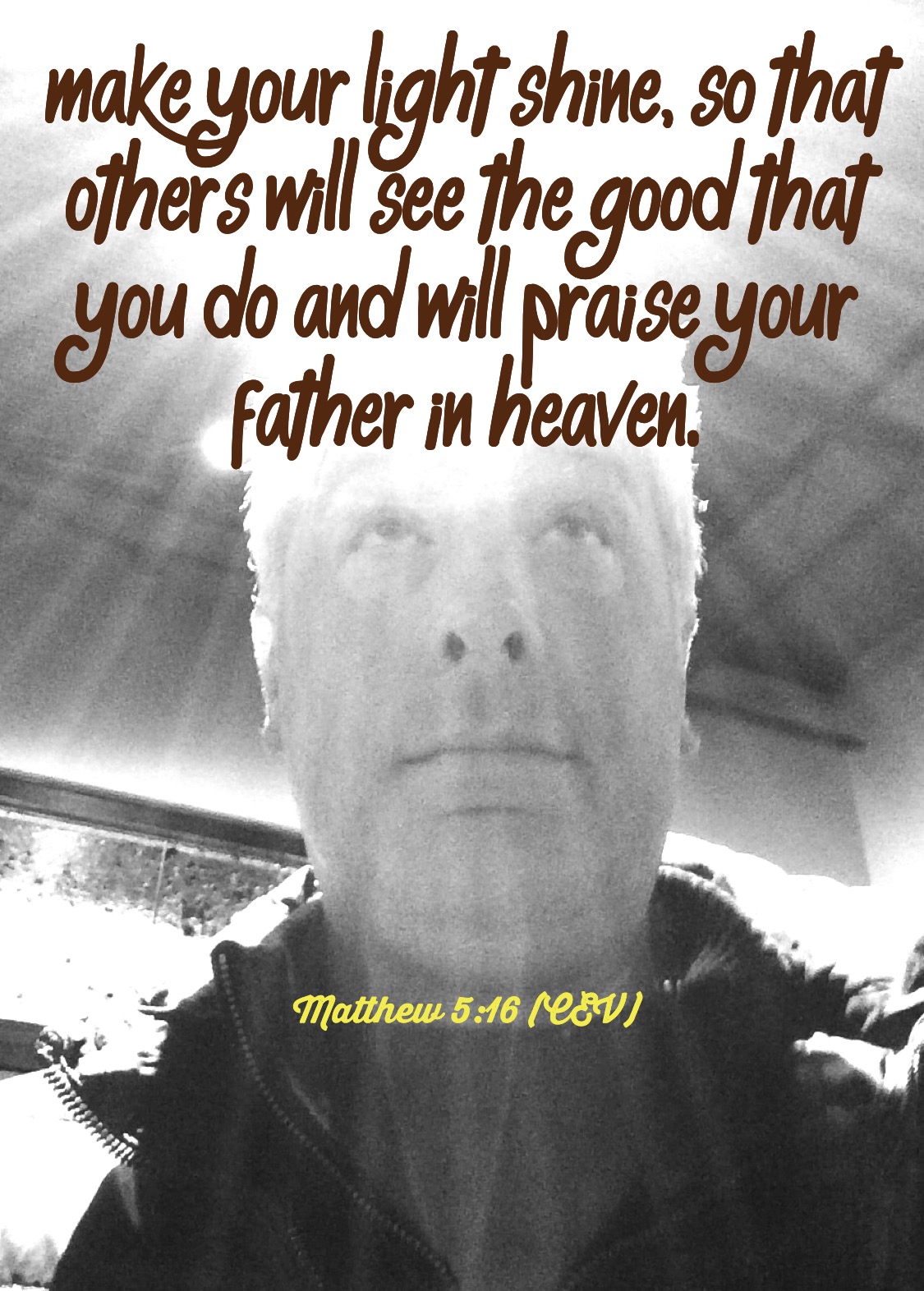
Why did I stop singing that as a “grown-up”? Yesterday I was reading in Matthew 5 where Jesus talked about shining. Many of the translations read, “Let your light shine.” But I really like the Contemporary English Version —
Make your light shine, so that others will see the good that you do and will praise your Father in heaven.
Make it shine!
That’s really the most accurate translation. Let it shine sounds passive. Almost like, “Well, it’s shining already, so I guess I won’t put it out.” But make it shine is definitely in the active tense
… it’s right now
… it’s burning brightly and deliberately and unashamed
I grew up in a Christian home, so maybe I just assumed that my lamp was lit already and I could just let it shine. Maybe you’ve just assumed your light was shining too.
But today I want to be active in making my light shine. I’m going to do good so that others can praise God too.
Won’t you join me in making your light shine brightly today too?
Listen to the podcast of this post by clicking on the player below, and you can also subscribe on Apple, Spotify, or Audible.
David is on the run from Saul. He leaves town so quickly that he didn’t have time to kiss his wife goodbye. He didn’t even have enough time to grab a weapon, a change of clothes, companions, or food. So he stops by Ahimelech’s house to see if this priest has any food.
Remember this old nursery rhyme?
Old Mother Hubbard
Went to the cupboard,
To give the poor dog a bone:
When she came there,
The cupboard was bare,
And so the poor dog had none.
That’s just about what happened here. Ahimelech said, “The only bread I have is the holy showbread.” This consecrated bread was 12 loaves laid out each Sabbath in God’s presence. When this bread was replaced each week, it became food for the priests. Ahimelech recognized he had a moral obligation to save David’s life which superseded the ceremonial rules.
Jesus used this incident as an example when the Pharisees accused Him of breaking the law concerning the Sabbath day. Jesus and His followers had been walking through a wheat field, plucking some pieces of grain on which they could munch. The rule-keeping Pharisees said this amounted to work, and a violation of Sabbath rules.
I think sometimes we get so caught up in keeping the rules (or following tradition, or preserving decorum) that we forget the meaning behind the rule. Or, more accurately, we forget God’s design behind the rule.
Every rule God gives is to keep us in a place where we can experience His presence. Rules are not life, but they are boundaries that keep us on the path to life.
Ahimelech kept David alive with showbread. Jesus and His disciples sustained themselves with wheat kernels. Jesus healed the sick on the Sabbath to bring life and wholeness.
Following rules just to follow rules misses the point. What is the point? Following God’s rules to find God’s heart is THE point.
I was talking to a friend who is a missionary in Africa who had just experienced an interesting church service. Many times Africans will hear a worship song from a visiting group of Americans, and they will try to implement that worship song into their church services. Sometimes this can be quite beautiful.
And sometimes it’s quite comical.
These precious African saints were trying their best to imitate the English words they had heard sung in the song Friend Of God. However, their chorus sounded something like this:
I am afraid of God
I am afraid of God
I am afraid of God
He calls me Fred
Comical? Sure. But it’s also very instructional.
How many times do you and I go into a church service and just mimic words, without really thinking about the meaning behind the words?
We go through the motions—we imitate the sounds we have heard before—and think we are really worshiping.
“Worry indicates we’re not willing to let God handle certain things—at least not in His way, and certainly not in His time.” —Craig Groeschel, in The Christian Atheist
Worry is a control issue…
…that is, I want to be in control.
Worry is a sovereignty issue…
…that is, I think I know best how things should work out.
Worry is a trust issue…
…that is, I trust God only when things are happening on my timeframe.
Bottom line: Worry is sin when…
…I allow something else to be bigger than God.
…I allow something else to be more important than God.
…I allow something to limit God.
…I look more to myself for solutions than I look to God.
Any worry should be a call to prayer:Don’t worry about anything; instead, pray about everything. Tell God what you need, and thank Him for all He has done. Then you will experience God’s peace, which exceeds anything we can understand. His peace will guard your hearts and minds as you live in Christ Jesus. (Philippians 4:6-7)
Any extended worry should be a call to repentance: Jesus commands us four times, “Do not worry” (Matthew 6:25-34).
Worry can be disguised in a lot of different forms, but it’s still worry. And it’s still sin. I’m working on this.
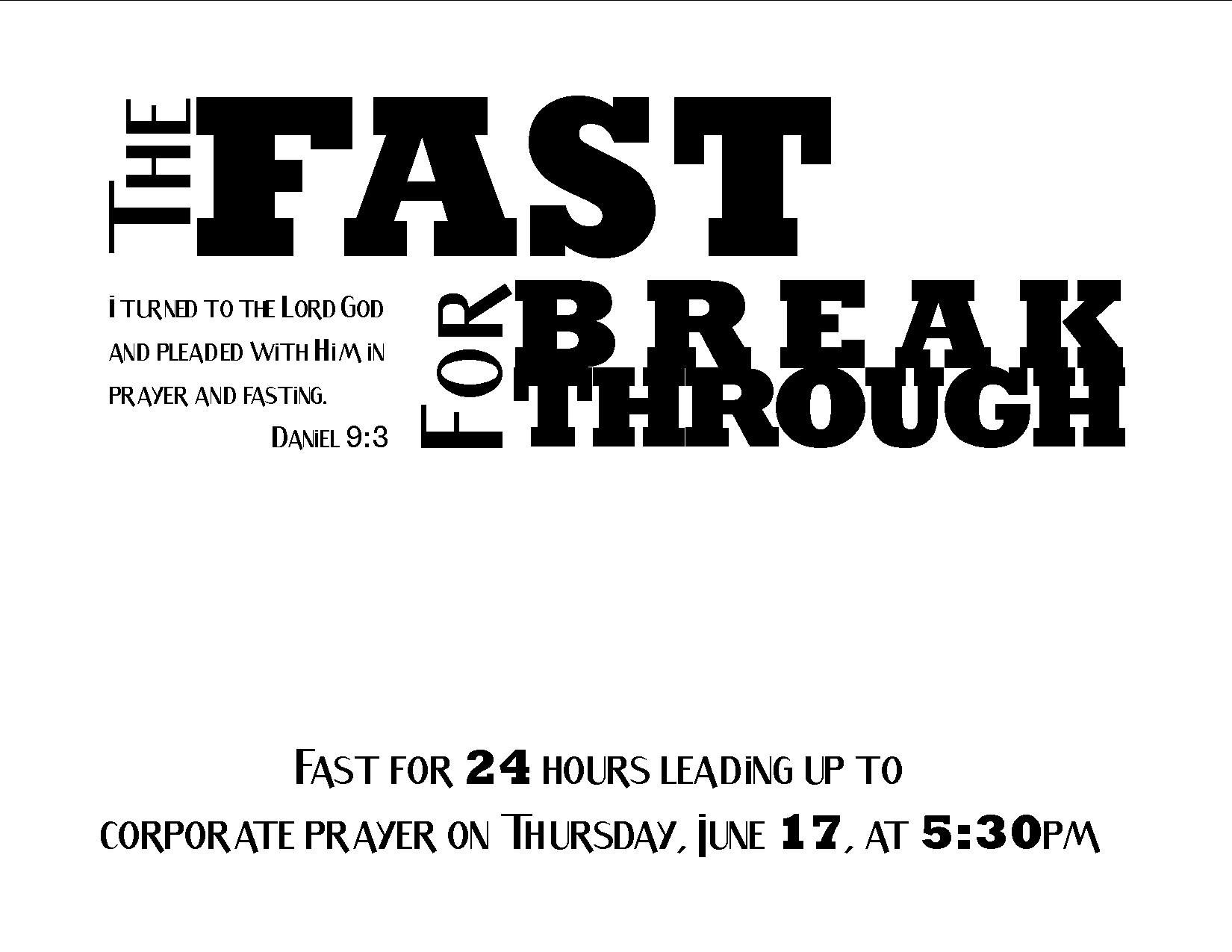
I believe in this: Prayer + Fasting = Breakthroughs.
Even though this looks like a mathematical formula, it doesn’t work like a formula. Jesus challenged religious people who fasted just because. Jesus was really echoing the words God spoke in Isaiah about religious people simply going through pious acts, but their hearts were still far away from God. They thought God operated on a formula: “If we fast, then God has to….” It doesn’t work that way.
We met together for a time of worship and Bible study last night, and we’ll conclude our fast with corporate prayer this evening. We are focusing on our heart attitude. Not fasting just because or even the pastor asked us to.But fasting becausewe are hungry for God to move … for Him to break chains … for Him to set people free … for breakthroughs!
I can’t wait to see what God is going to do in us and then through us as we spend this time seeking His heart. Prayer + Fasting = Breakthroughs.



 There are two ways of dealing with any undesirable things around you: You can curse the darkness or light a candle. Nowhere in the Bible does Jesus say, “Tell bad people how bad they are.” Instead, He tells His followers to love … bless … serve … SHINE …








 Craig T. Owens