Don’t Forget To Remember

Listen to the podcast of this post by clicking on the player below, and you can also subscribe on AppleSpotify, or Audible. 

I was honored to be invited to offer the commencement address for some amazing students graduating from the Parent Teacher Co-op program. 

I think we rush too quickly through our celebrations. It seems that at each milestone, we pause only briefly to move on toward the next milestone. But if we don’t celebrate well, we are actually setting ourselves up for a disappointing future. 

It’s very telling that after the perfection of Creation, God took time to celebrate His own handiwork. And then He called us to do the same. That’s what a sabbath really is: A time to celebrate what God has done for us, and what He has empowered us to do for His glory. I think the reason many older people become more contemplative and nostalgic is because they rushed through their life without taking time for sabbath celebrations.

If you look at the history of the Israelites, you will see majestic mountain peaks followed by depressing valleys. What sent them sliding into their valley was one thing: forgetfulness. Time and time again, God sends His prophet to chastise the Israelites for failing to take a sabbath rest. They forgot to honor God and celebrate Him, but instead they rushed along to the next thing. What brought them out of their valley and back to the mountain was also one thing: remembering. Celebrating God for who He is.

So I challenged these graduates—and you—with this. At each milestone in your life…

  1. Thank God for His blessings
  2. Celebrate your own hard work. 
  3. Recognize the help you’ve received from others. 
  4. Determine which lessons to keep, which to enhance, and which to leave behind. 
  5. Find someone to share the journey with you.

Don’t forget to remember!

I would suggest at a minimum celebrating the sabbath each week as God gave us that example, but you may find that you have a moment to celebrate even a small win in the middle of the day in the middle of your week. If you do that, I think your appreciation for God’s blessings will keep you even more dependent on His abiding presence. 

You may also be interested in a couple of related blog posts and videos:

►► Would you please prayerfully consider supporting this ministry? My Patreon supporters get behind-the-scenes access to exclusive materials. ◀︎◀︎
Who Is Your Provider?

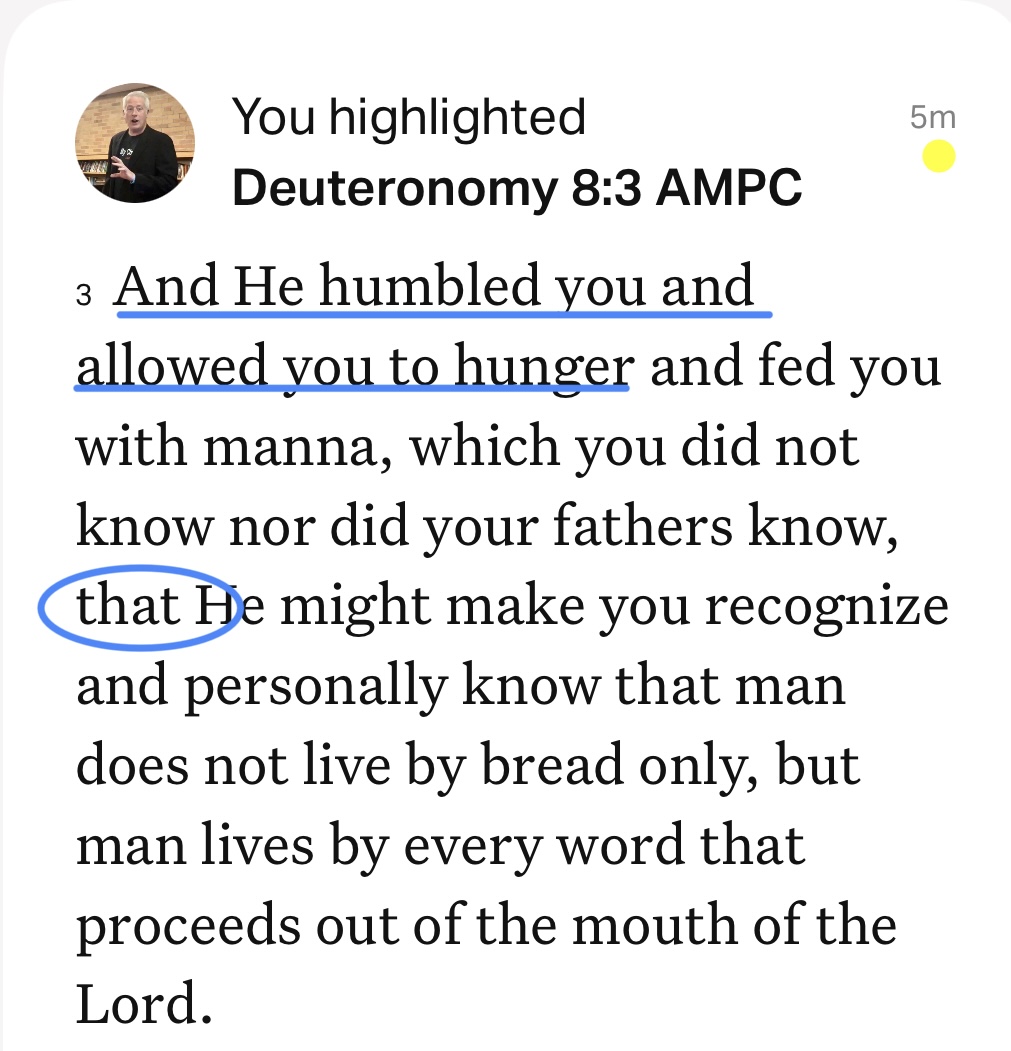
And [God] humbled you and allowed you to hunger and fed you with manna, which you did not know nor did your fathers know, that He might make you recognize and personally know that man does not live by bread only, but man lives by every word that proceeds out of the mouth of the Lord. … Know also in your [minds and] hearts that, as a man disciplines and instructs his son, so the Lord your God disciplines and instructs you. (Deuteronomy 8:3, 5 AMPC)

God allows us to be humbled and hungry so that we can learn that He is our only source. Proud people will not open their hearts and minds to learn because they see themselves as know-it-alls. 

Because He loves us, God humbles us. If we will yield, we can learn from God and grow in intimacy with Him. “Know also in your minds and hearts that, as a man disciplines and instructs his son, so the Lord your God disciplines and instructs you” (Deuteronomy 8:5). But the proud are deprived of all of these blessings. 

Verses 11-20 add a warning about forgetfulness. Success tends to make us think we have accomplished something in our own power, which stokes our pride. Twice we are told to “beware”…

  • …of forgetting that God is our Provider 
  • …of thinking we are our own provider 

Humility keeps us dependent on God and increasingly intimate with Him. Pride pushes God away. 

Check out my series of posts about forgetfulness called Fading Gratitude. 

I address the pride issue for leaders in a post called Don’t Putrefy Your Leadership, and in a video Healthy Leaders Ask For Help.

MVP: Most Valuable Praise

Listen to the podcast of this post by clicking on the player below, and you can also subscribe on AppleSpotify, or Audible. 

In preparing for our Be Thankful series at my church, I have been reading and studying quite a bit about gratitude. For example, my wife and I are reading a devotional on the YouVersion Bible app call “Practicing Gratitude.” 

The other morning, our devotional writer shared this thought: “When the prophet Jonah was having a terrible day at work, he found gratitude by looking at God’s provision through the physical environment. God made a bush for shade and ‘Jonah was very happy about the bush’ (Jonah 4:6).” 

In our shared notes, my wife had an insightful word. She wrote, “Jonah’s gratitude didn’t last long. This is a great reminder to pursue a lifestyle of gratitude. It is sometimes very challenging in the midst of hard days to recognize God’s blessings, but it forces me to take my eyes off myself and place them back on my Lord and Savior!” 

My studies, this devotional plan, and Betsy’s insight got me thinking even more about the most valuable praise we can offer to our God. 

Jonah was indeed happy about the shade. But as soon as the shade was gone because the plant withered, he was back to his sullen complaining all over again! 

Ah, yes, poor Jonah is a microcosm of the whole Old Testament: God’s blessings are only appreciated for a moment until the complaining starts up again. 

Oh, wait! That’s still our story today. All of God’s blessings are so quickly forgotten unless we are intentionally grateful.

Especially in the hard times where it feels like our difficulties are just so unfair. 

Paul wrote, “In everything give thanks; for this is the will of God for you in Christ Jesus” (1 Thessalonians 5:18). 

In everything” is not the same thing as “for everything.” This means that I can still be God-focused in my painful circumstances, even though I may not be thankful for those circumstances. 

But as I remain thankfully God-focused, perhaps I may begin to see what He is accomplishing because of my painful circumstances. Just as Jesus saw “the joy set before Him” (Hebrews 12:2) and knew that His Father would triumph even in that horrific time, perhaps as I keep my eyes on Jesus I can begin to get a glimpse of God’s coming glory. 

Isn’t it “the will of God” that I know—beyond a shadow of a doubt—that I am irremovable from my position “in Christ Jesus”? 

For I am convinced that neither death, nor life, nor angels, nor principalities, nor things present, nor things to come, nor powers, nor height, nor depth, nor any other created thing will be able to separate us from the love of God that is IN Christ Jesus our Lord. (Romans 8:38-39 NASB)

Shouldn’t my assurance of that truth produce a joy that prompts praise from my lips that brings glory to God? Isn’t that praise of greater value precisely because it comes from a person in a setting where thankfulness seems impossible? 

God is magnified even more when praise comes from a thankful heart that is in a place where humanly there seems to be absolutely nothing praiseworthy. 

It is in this place that my praise is to God simply because He is God and He is worthy to be praised simply because of who He is! 

So I will praise Him no matter what—“in all things”—because I am secure that I am “in Christ Jesus.” That hope produces a reward that is invaluable. That hope produces a praise that is beautiful in God’s ears. 

…And we boast IN the hope of the glory of God. Not only so, but we also glory IN our sufferings, because we know that suffering produces perseverance; perseverance, character; and character, hope. And hope does not put us to shame, because God’s love has been poured out INTO our hearts through the Holy Spirit, who has been given to us. (Romans 5:2-5) 

We give God our MVP—our most valuable praise—when it is lifted to Him in that place and time where the natural response would be grumbling and complaining. In those moments, remind yourself that you are IN Christ Jesus, which means even here in this dark moment you can be thankful IN all things. 

(You may also be interested in my post and video Praising God in the Troughs.) 

►► Would you please prayerfully consider supporting this ministry? My Patreon supporters get behind-the-scenes access to exclusive materials. ◀︎◀︎

Grateful Remembering Fortifies Us Against Temptation

Listen to the podcast of this post by clicking on the player below, and you can also subscribe on AppleSpotify, or Audible. 

It is so much easier to complain than to compliment. We can slide into the negative conversations almost without thinking about it. 

In one of the last things that Paul wrote to Timothy—as he’s in prison, quite possibly awaiting execution—he warns his friend against the darkness of the last days (2 Timothy 3:1-5). We need to engage our minds, our wills, and our emotions to not go with the flow of culture’s negativity. 

(Check out all the Scriptures I mention in this post by clicking here.) 

Remember the wise words from George Santayana: “Those who do not learn from history are doomed to repeat it.” The apostle Paul said this before Mr. Santayana (1 Corinthians 10:1-6). We need to learn the lessons of the dangers of forgetfulness that leads us to ingratitude. 

Even before Paul, the Old Testament is filled with repeated reminders to remember God’s blessings and gratefully look to Him to supply every need. Let’s unpack some lessons on the importance of gratitude from Israel’s history in Psalm 106. 

  1. In Psalm 106:7, the Israelites forget what God has done for them in Egypt. Now that they appear to be pinned between the Red Sea and the onrushing Egyptian army, their forgetfulness becomes grumbling against God (Exodus 14:10-12). 

Here’s the lesson for us to learn: Even when we are in a tough spot, God put us there on purpose so that His glory could be displayed (Exodus 14:1-3, 13-14). This should remind us to be grateful. 

  1. In Psalm 106:13-14, instead of being grateful for the miraculous supply of manna, the Israelites are grumbling about the meat they don’t have (Numbers 11:4-6). 

Here’s the lesson for us to learn: God wants to teach us to be thankful for His daily provisions for us (Joshua 5:12; Matthew 6:11). 

  1. In Psalm 106:21, 28-29, the next generation of Israelites didn’t remember to be thankful because they had seldom heard their parents express gratitude (Judges 2:10-11). 

Here’s the lesson for us to learn: Our daily thankfulness fortifies future generations (Psalm 37).  

Here is the repeated pattern we see—

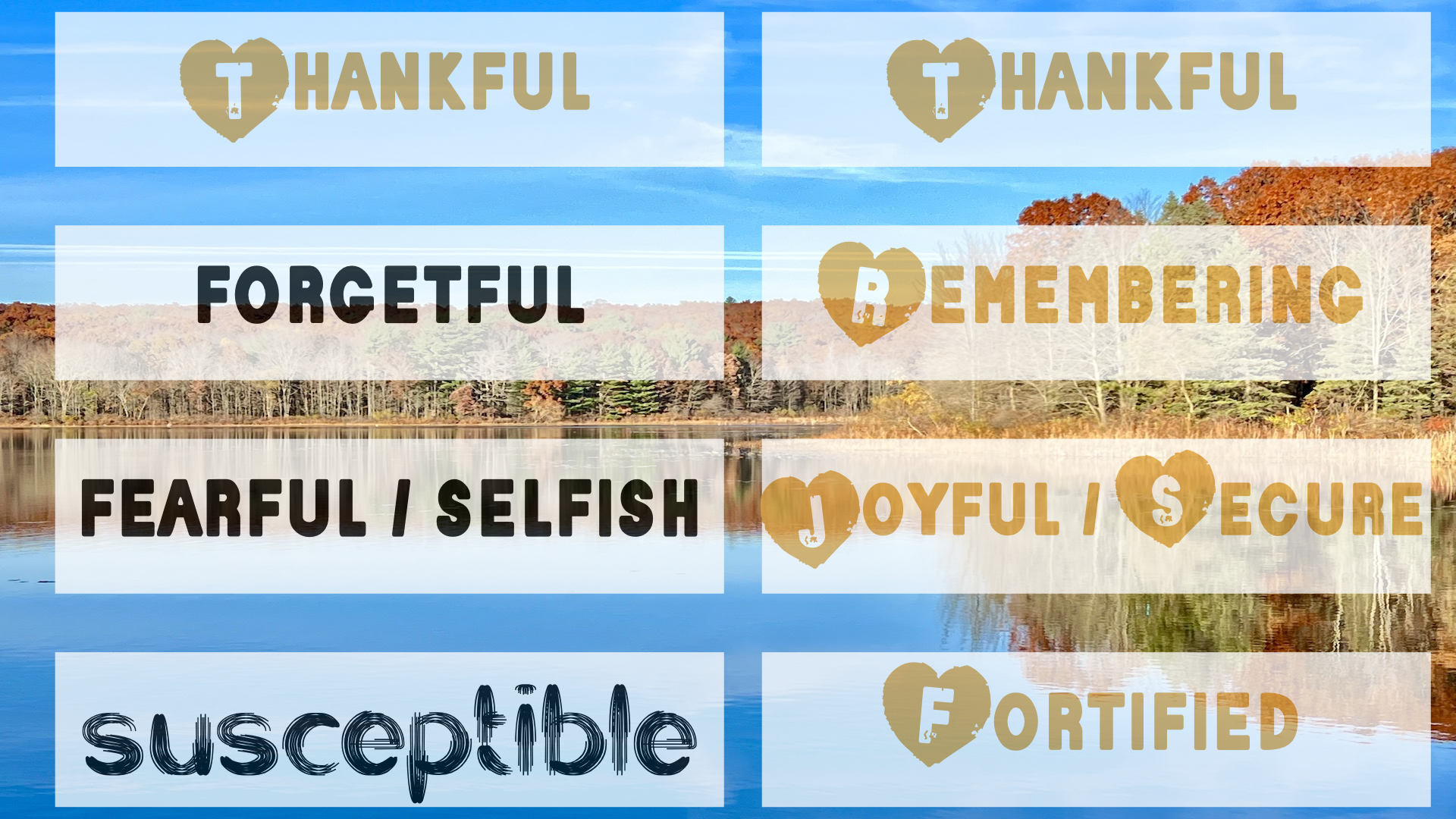
  • Thankfulness → Forgetfulness → Fearful / Selfish attitudes → Susceptible to the temptation to grumble against God 
  • Thankfulness → Remembering → Joyful / Secure attitudes → Fortified against the temptation to grumble against God

Jim Cymbala said, “Ingratitude to God is the first step toward backsliding and departure from God. So, it is to our benefit to have a thankful heart toward God.” 

Let’s put into practice this lesson from King David: “Praise the Lord, O my soul, and forget bot all His benefits” (Psalm 103:2). 

You can check out all of the other messages in our Be Thankful series here. 

►► Would you please prayerfully consider supporting this ministry? My Patreon supporters get behind-the-scenes access to exclusive materials. ◀︎◀︎

Don’t Let Your Gratitude Get Hijacked

Listen to the podcast of this post by clicking on the player below, and you can also subscribe on AppleSpotify, or Audible. 

Last week I mentioned that I was a bit surprised that scientists had done so much research on the benefits of gratitude because science tends to have an over-reliance on the tangible world. But it’s hard to ignore that there are so many intangibles (like gratitude) which make a tangible difference in people’s lives. 

We get ourselves into trouble if we focus exclusively on the tangible or intangible. We also get ourselves into trouble if we don’t use all of the resources God has given us. 

The Bible tells us that we have been created in the image of God, and that one of the things that separates us from the other creatures in the world is our soul (Genesis 2:7). Our soul is compromised of our mind, our will, and our emotions. 

(Check out all of the Scriptures I mention in this post by clicking here.) 

We cannot allow any one of these to lay dormant or even considered less valuable than the others, nor we can allow any one of these to bully the others. 

  • If my emotions dominate (especially emotions like fear or anger) I can give into fight-or-flight—Psalm 106:7 
  • If my mind dominates, I can become dark and confused—Romans 1:21 NLT 
  • If my willpower dominates, I tend to be very selfish—Isaiah 14:13-14 

When my emotions flare up, when my mind is dark, or when I feel selfish, I need to remember to engage the other two parts of my God-breathed soul. This is where gratitude comes into play. 

I love reading the Psalms when I’m battling the negative emotions that seem to rush in during trying times. The psalmists were so honest about what they were feeling. Check out a couple of examples in Psalm 7:17 and 9:1-2 where we see David engaging his mind and his will to make the choice to be grateful to God despite his circumstances. 

In the New Testament, we see a similar response from Paul and Silas when they are falsely imprisoned in Philippi (see Acts 16:22-26). Despite their cruel circumstances, they chose to life thankful worship to God. Luke write that the other inmates were listening, and so was the jailer and his family, who ended up accepting Jesus as their Savior. 

I’ve got three important words for you when dark times threaten to hijack your gratefulness:

TALK TO YOURSELF

We see another psalmist doing this in Psalm 42:1-6. He asks his soul why it is so downcast, and then he says, “I chose to remember God in all His goodness and I chose to praise Him!” These words are repeated again in Psalm 42:11 and 43:5, which tells me that giving thanks to God is not a one-and-done thing, but something that needs to be continually repeated. 

You can get some conversation starters for your self-talk in two simple ways:

  1. Write down your gratitude 
  2. Talk about your gratitude 

Keep a gratitude journal: Write something down at the end of each and every day. Write it down. Re-read it regularly. Tell others about it. And then be ready for others to ask you about Jesus—just like the Philippian jailer—when they notice how thankful you are! 

Use your mind to talk back to your fears and worries, and then engage your willpower. Don’t let your gratitude get hijacked by the circumstances around you, but allow your thankfulness to help you reframe your circumstances into God’s plan. 

Check out the other messages in our Be Thankful series by clicking here. 

►► Would you please prayerfully consider supporting this ministry? My Patreon supporters get behind-the-scenes access to exclusive materials. ◀︎◀︎
Forgetfulness Can Be Fatal

Have you ever noticed the up-and-down track record of the Israelites? We see them worshiping God, enjoying His abundance, with their enemies on the run in one chapter, only to see them worshiping idols, barely scraping by, with their enemies closing in on them.  

What led to the downturn from freedom and abundant blessing to slavery and scarcity? I think it’s summed up in two words: They forgot. 

Asaph captures this idea in the 78th Psalm. And if we’re honest with ourselves, Israel’s history is our history too. 

There is a peril in our forgetfulness!  

“When we have much of God’s providential mercies, it often happens that we have but little of God’s grace, and little gratitude for the bounties we have received. We are full and we forget God: satisfied with earth, we are content to do without Heaven. Rest assured it is harder to know how to be full than it is to know how to be hungry—so desperate is the tendency of human nature to pride and forgetfulness of God.” —Charles Spurgeon (emphasis added)

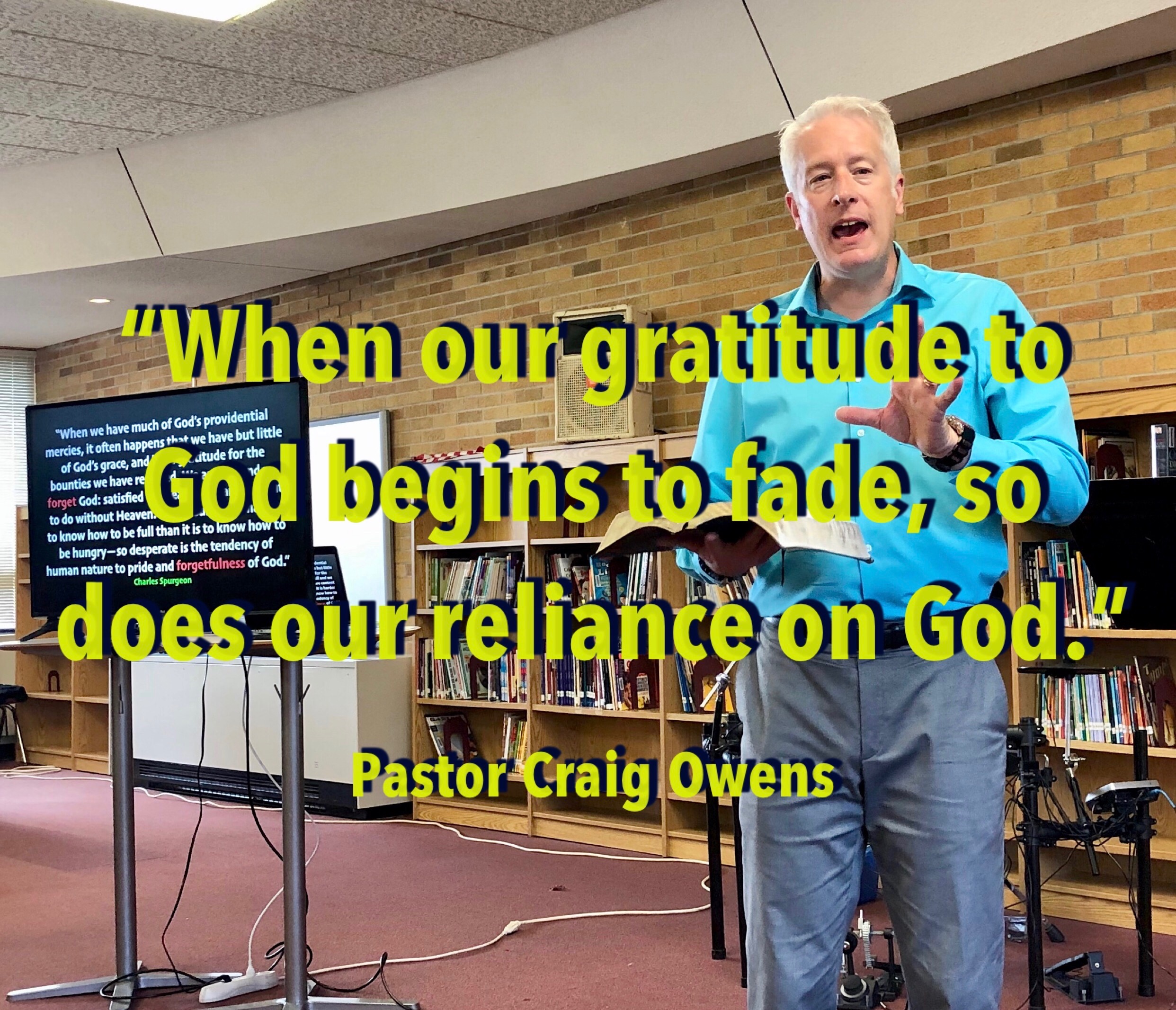
When our thoughts about God begin to fade, so does our gratitude to God. When our gratitude to God begins to fade, so does our reliance on Him. 

The dictionary defines some important terms:

  • Ungratefulness—not giving due return for benefits conferred
  • Unthankfulness—not repaying the blesser with thanks

I don’t think anyone consciously chooses to be ungrateful, but if we don’t choose to actively remember our blessings—and our Blesser—we will become ungrateful. So what if we began to think differently about the definition of gratitude? 

  • Forgetfulness—to cease to think of something
  • Gratitudeto continue to think of Someone (with that Someone being God!) 

When we are continually thankful—when we don’t let our gratitude fade—it keeps God’s blessings at the forefront of our minds. Gratitude—continuing to think of Someone—makes us completely God-reliant. 

Moses had a good idea to help us to continue to think of God’s blessings—

Impress them on your children. Talk about them when you sit at home and when you walk along the road, when you lie down and when you get up. Tie them as symbols on your hands and bind them on your foreheads. Write them on the doorframes of your houses and on your gates. (Deuteronomy 6:7-9) 

What if you posted reminders of God’s blessings all over the place? What if you made it almost impossible to forget God? What if you were constantly thinking of your blessings? 

Join us for our series called Fading Gratitude during the month of November.

Fading Gratitude

Looking back at the history of God’s people in the Bible, there is a distinct up-and-down cycle. The Israelites would be worshiping God and enjoying His blessings, and then we see them turning their back on God and needing Him to rescue them from oppressors. After God rescues them the people praise Him, only to slip right back into the same downward slide again. 

I believe their slipping away from God can be directly linked to their forgetfulness. 

If any of us allows our gratitude for all of God’s blessings to fade, we will experience the same slipping away. 

However, there is good news! If there is a peril in our forgetfulness, there is also a power in our thankfulness! 

If you missed any of the messages in this series, please check them out here:

Be Careful

In the final instructions before the Israelites were going to enter the Promised Land, the book of Deuteronomy uses the phrase be careful fifteen (15) times:

  • Be careful not to forget
  • Be careful to obey
  • Be careful to avoid making idols
  • Be careful to honor your leadership
  • Be careful of your thoughts

In the dictionary careful is defined as being attentive to potential danger, error, or harm. It implies paying special attention to accuracy and being discerning.

God doesn’t ask this of me to cramp my style but to put me in a place where He can bless me. And not just me: being careful leads to generational blessings. Here’s my favorite be careful verse:

Be careful to obey all these regulations I am giving you today, so that it may always go well with you and your children after you, because you will be doing what is good and right in the eyes of the Lord your God.

Sometimes to be careful we have to slow down. We seem to want everything quickly and with as little effort as possible. Remember the cliché “Haste makes waste”?

What if you slowed down a bit today?

What if you took just a little time to be attentive to potential danger?

What if you paused long enough to discern if you were giving your best to God?

What if you took a moment to simply ask God to give you the wisdom needed to make a godly decision?

Being careful so that it may ALWAYS go well with you and your children after you….

Isn’t that worth it?

Scarecrows In The Melon Patch

Think about the imagery: some old clothes stuffed with straw, perhaps a burlap bag with a funny face drawn on it, and maybe a raggedy hat on top. Then hang this creation on a wooden pole, arms all akimbo, in an attempt to scare away birds from a melon patch.

Are you scared? I certainly hope not!

Yet this is exactly the thing God used to describe the fear His people were experiencing

Like a scarecrow in a melon patch, their idols cannot speak; they must be carried because they cannot walk. Do not fear them; they can do no harm nor can they do any good.

The scarecrow doesn’t hurt anyone, but he doesn’t help either. God said His people were afraid of a scarecrow. But here’s the amazing part: they made their scarecrows!

These people had forgotten God—forgotten His goodness, forgotten His blessings, forgotten His mercy, forgotten His strength, forgotten His wisdom, forgotten His power. Since they had forgotten that He was the One in charge, that He was the One who could protect them, they tried to create their own protection. They built their own scarecrows, and then became afraid of what they created!

I think we have done the same thing today.

We have forgotten God’s goodness, forgotten His blessings, forgotten His mercy, forgotten His strength, forgotten got His wisdom, forgotten His power. To protect ourselves we have made scarecrows of economic systems, and governments, and elected officials, and medicines, and insurance companies. And just like scarecrows, they can do no harm nor can they do any good.

That’s why fear is so rampant in our hearts: We are looking to the scarecrows we have created instead of looking to the Creator who gave us life.

Are you fearful? Do you feel panicky? Does your future seem ominous? If so, perhaps there are a few scarecrows you need to dismantle. Rip them apart and scatter the straw to the wind. And then begin to read God’s Word. Jeremiah also records these words from God to us

This is what the LORD says: “Let not the wise man boast of his wisdom or the strong man boast of his strength or the rich man boast of his riches, but let him who boasts boast about this: that he understands and knows Me, that I am the LORD, who exercises kindness, justice and righteousness on earth, for in these I delight,” declares the LORD.

Understanding and knowing God’s kindness, justice, and righteousness will destroy your scarecrows and set you free from fear. Get rid of those scarecrows today!