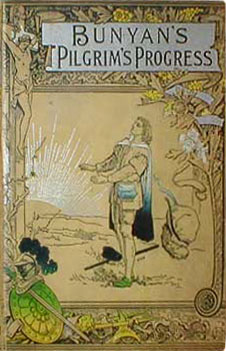
Great-heart & Christiana From “Pilgrim’s Progress”

Pilgrim's ProgressI love Pilgrim’s Progress! You can read my full book review by clicking here. I’m sharing some of my favorite passages from this classic.

This is part of a dialogue between Great-heart and Christiana—

Great-heart: “He [Christ] has more righteousness than you have need of, or than He needeth Himself.”

Christiana: “Pray make that appear.”

Great-heart: “With all my heart: but first I must premise, that He of whom we are now about to speak, is one that has not His fellow. He has two natures in one person, plain to be distinguished, impossible to be divided. Unto each of these natures a righteousness belongeth, and each righteousness is essential to that nature; so that one may as easily cause the nature to be extinct, as to separate its justice or righteousness from it. Of these righteousnesses therefore we are not made partakers, so as that they, or any of them, should be put upon us, that we might be made just, and live thereby. Besides these, there is a righteousness, which this person has, as these two natures are joined in one. And this is not the righteousness of the Godhead, as distinguished from the manhood; nor the righteousness of the manhood, as distinguished from the Godhead; but a righteousness which standeth in the union of both natures, and may properly be called the righteousness that is essential to His being prepared of God to the capacity of the mediatory office, which He was to be intrusted with. If He parts with His first righteousness, He parts with His Godhead; if He parts with His second righteousness, He parts with the purity of His manhood; if He parts with this third, He parts with that perfection which capacitates Him for the office of mediation. He has therefore another righteousness, which standeth in performance, or obedience to a revealed will; and that is it that He puts upon sinners, and that by which their sins are covered. Wherefore He saith, As by one man’s disobedience many were made sinners, so by the obedience of One shall many be made righteous.”

Christiana: “But are the other righteousnesses of no use to us?”

Great-heart: “Yes; for though they are essential to His natures and office, and so cannot be communicated unto another; yet it is by virtue of them that the righteousness that justifies is for that purpose efficacious. The righteousness of His Godhead gives virtue to His obedience; the righteousness of His manhood giveth capability to His obedience to justify; and the righteousness that standeth in the union of these two natures to His office, giveth authority to that righteousness to do the work for which it is ordained.

“So then here is a righteousness that Christ, as God, has no need of; for He is God without it. Here is a righteousness that Christ, as man, has no need of to make Him so; for He is perfect man without it. Again, here is a righteousness that Christ, as God-man, has no need of; for He is perfectly so without it. Here then is a righteousness that Christ, as God, as man, as God-man, has no need of with reference to Himself, and therefore He can spare it; a justifying righteousness, that He for Himself wanteth not, and therefore He giveth it away. Hence ’tis called the gift of righteousness. This righteousness, since Christ Jesus the Lord has made Himself under the law, must be given away; for the law doth not only bind him that is under it, to do justly, but to use charity. Wherefore he must, he ought by the law, if he hath two coats, to give one to him that has none. Now our Lord indeed hath two coats, one for Himself, and one to spare; wherefore He freely bestows one upon those that have none.”

Read a dialogue between Faithful, Christian, and Talkative by clicking here.

And a dialogue between Christian and Hopeful by clicking here.

Do You Smell Like Jesus?

Christ's aromaScientists tell us that the sense of smell contributes to more vivid and clear memory recall than any of the other human senses. Have you ever thought about the things Jesus smelled? Or about the memories others recalled about Jesus because of the way He smelled?

Less than a week before His crucifixion, Mary anointed Jesus with a highly-scented spice called spikenard (see John 12:1-8; Mark 14:3-9; and Matthew 26:6-13). Let me rephrase that: Mary didn’t just “anoint” Jesus as we think about that word today, she doused Him in a lifetime supply of this fragrance. Some people complained, but Jesus told those sour people that it was absolutely beautiful what she had done, as Jesus carried this aroma with Him to the Cross.

After He died on the Cross, Joseph and Nicodemus prepared Jesus for burial with 75 pounds of myrrh and aloes (see John 19:38-40). Think about that: seventy-five pounds! In doing so they actually fulfilled a prophesy from the Old Testament about King Jesus’ triumphal return to life—

Your throne, O God, will last for ever and ever; a scepter of justice will be the scepter of Your kingdom. You love righteousness and hate wickedness; therefore God, Your God, has set You above Your companions by anointing You with the oil of joy. All Your robes are fragrant with myrrh and aloes and cassia… (Psalm 45:6-8).

Jesus carried a powerful aroma with Him all the way to the Cross, into the tomb, and when He burst forth alive from the tomb! 

Without Christ, our lives carry the stench of death. We cannot come into our Heavenly Father’s presence because of that putrid smell clinging to us. But when God forgives us of our sins as we place our faith in Jesus, we are wrapped in the robes of Christ: we smell like Him and are welcomed into the Father’s presence.

Easter is a reminder of how a forgiven Christian should now live—

Live a life filled with love, following the example of Christ. He loved us and offered Himself as a sacrifice for us, a pleasing aroma to God (Ephesians 5:2).

…Now [God] uses us to spread the knowledge of Christ everywhere, like a sweet perfume. Our lives are a Christ-like fragrance rising up to God (2 Corinthians 2:14-15).

How do you smell? Do you smell like Jesus? Are others attracted to the aroma of Christ because of what they smell in you? Smelling good honors the work Jesus did on the Cross and in overcoming the grave.

Poetry Saturday—When I Survey The Wondrous Cross

Isaac WattsWhen I survey the wondrous Cross
On which the Prince of glory died,
My richest gain I count but loss,
And pour contempt on all my pride.

Forbid it, Lord, that I should boast,
Save in the death of Christ my God!
All the vain things that charm me most,
I sacrifice them to His blood.

See from His head, His hands, His feet,
Sorrow and love flow mingled down!
Did e’er such love and sorrow meet,
Or thorns compose so rich a Crown?

Were the whole realm of nature mine,
That were a present far too small;
Love so amazing, so divine,
Demands my soul, my life, my all. —Isaac Watts


The Horrors Of Crucifixion

Good FridayWilliam Barclay, in his commentary on the Gospel of John, wrote graphically about the horrors of crucifixion—

   There was no more terrible death than death by crucifixion. Even the Romans themselves regarded it with a shudder of horror. Cicero declared that it was “the most cruel and horrifying death.” Tacitus said that it was a “despicable death.” It was originally a Persian method of execution. It may have been used because, to the Persians, the earth was sacred, and they wished to avoid defiling it with the body of an evil-doer. So they nailed him to a cross and left him to die there, looking to the vultures and the carrion crows to complete the work. The Carthaginians took over crucifixion from the Persians; and the Romans learned it from the Carthaginians.

   Crucifixion was never used as a method of execution in the homeland, but only in the provinces, and there only in the case of slaves. It was unthinkable that a Roman citizen should die such a death. Cicero says: “It is a crime for a Roman citizen to be bound; it is a worse crime for him to be beaten; it is well nigh parricide for him to be killed; what am I to say if he be killed on a cross? A nefarious action such as that is incapable of description by any word, for there is none fit to describe it.” It was that death, the most dreaded in the ancient world, the death of slaves and criminals, that Jesus died.

   The routine of crucifixion was always the same. When the case had been heard and the criminal condemned, the judge uttered the fateful sentence: Ibis ad crucem, “You will go to the cross.” The verdict was carried out there and then. The condemned man was placed in the centre of a quaternion, a company of four Roman soldiers. His own cross was placed upon his shoulders. Scourging always preceded crucifixion and it is to be remembered how terrible scourging was. Often the criminal had to be lashed and goaded along the road, to keep him on his feet, as he staggered to the place of crucifixion. Before him walked an officer with a placard on which was written the crime for which he was to die and he was led through as many streets as possible on the way to execution. There was a double reason for that. There was the grim reason that as many as possible should see and take warning from his fate. But there was a merciful reason. The placard was carried before the condemned man and the long route was chosen, so that if anyone could still bear witness in his favor, he might come forward and do so. In such a case, the procession was halted and the case retried. (emphasis added)

Always remember that Jesus willingly went through this for you and me.

Surely He took up our pain
    and bore our suffering,
yet we considered Him punished by God,
    stricken by Him, and afflicted.
But He was pierced for our transgressions,
    He was crushed for our iniquities;
the punishment that brought us peace was on Him,
    and by His wounds we are healed. (Isaiah 53:4-5, emphasis added)

Thursdays With Oswald—The Historicity Of The Cross

This is a weekly series with things I’m reading and pondering from Oswald Chambers. You can read the original seed thought here, or type “Thursdays With Oswald” in the search box to read more entries.

The Historicity Of The Cross 

     It is essential to have an historic basis for our Christian faith: our faith must be centered in the Life and Death of the historic Jesus. Why is it that that Life and Death have an importance out of all proportion to every other historic fact? Because there the Redemption is brought to a focus. 

     Jesus Christ was not a Man who twenty centuries ago lived on this earth for thirty-three years and was crucified; He was God Incarnate, manifested at one point of history. All before look forward to that point; all since look back to it. The presentation of this fact produces what no other fact in the whole of history ever could produce, viz.: the miracle of God at work in human souls. The death of Jesus was not the death of a martyr, it was the revelation of the Eternal heart of God. That is why the Cross is God’s last word.

From Conformed To His Image

This is THE Fact of history—

For God loved the world so much that He gave His One and Only Son, so that everyone who believes in Him will not perish but have eternal life. God sent His Son into the world not to judge the world, but to save the world through Him. (John 3:16-17)

Links & Quotes

link quote

Some great reading I came across today.

“If your household is not the better for your Christianity—if men cannot say, ‘This is a better house than others,’ then be not deceived—ye have nothing of the grace of God.” —Charles Spurgeon

The pain of Christ’s crucifixion: A Medical Account Of Jesus’ death.

How do we know Jesus was the Messiah? A Look At Old Testament Prophesies.

“Nothing is too great and nothing is too small to commit into the hands of the Lord.” —Arthur Pink

“God is having a difficult time getting through to us because we are a fast-paced generation. We seem to have no time for contemplation. We have no time to answer God when He calls.” —A.W. Tozer

“Gravity explains the motions of the planets, but it cannot explain who set the planets in motion. God governs all things and knows all that is or can be done.” —Isaac Newton

Did The Resurrection Happen … Really? (book review)

Did The Resurrection HappenJosh McDowell is an amazing apologist! He has a tremendous knack for being able to “put the cookies on the bottom shelf.” By that I mean that he can make complex topics accessible to a wider audience than most authors. In Did The Resurrection Happen … Really? he and Dave Sterrett do just that with some great arguments for and against the death and resurrection of Jesus Christ.

This book is classified as fiction, because fictional characters are having a discussion at a fictional university about the deep subjects of life and death, and life after death. Although the characters are fictional, the questions being discussed are real, and the sources quoted in defense of each side of the argument are all non-fictional.

McDowell and Sterrett (who are Christian apologists) don’t dumb-down the arguments against the claims of an actual physical death and an actual physical resurrection. They quote from some of the most well-known proponents of these arguments, and then thoughtfully and persuasively rebut those claims.

Because this book is written in a conversational style, it bring the reader right into the coffee chats of the characters. It also helps the reader see how he/she could have a similar dialogue with others who question the biblical account of the crucifixion and resurrection of Jesus Christ.

The book is well footnoted, so curious readers can dig deeper and research further. But don’t let this fact lead you to believe that this is a heady, academic book. As I mentioned earlier, McDowell and Sterrett definitely make these concepts accessible to a wide audience.

This would be an excellent book to read if you have friends who are skeptical to the biblical account. It would also be a very good resource for those preparing to attend a university where the faculty might be more antagonistic toward the biblical worldview. In any case, it was a very enjoyable and educational book.

No Conspiracies Here

Listen to the podcast of this post by clicking on the player below, and you can also subscribe on AppleSpotify, or Audible. 

Could it really be this simple? Could it be that Jesus died and rose again just like the Bible says? Or does it need to be more complicated than that? Are there other theories that seem to fit the facts?

At the feast of Pentecost where Jewish people from all over the world convened in Jerusalem just 50 days after the resurrection of Jesus, Peter stood up to address them:

  • He began, “Fellow Jews and all of you who live in Jerusalem…” (Acts 2:14). He addressed both local residents and guests from faraway lands.
  • Peter began by saying, “Jesus of Nazareth was a Man accredited by God to you by miracles, wonders and signs, which God did among you, as you yourselves know” (v. 22). No one shouted Peter down or disputed this claim. Quite possibly because there were those in this audience who had personally seen or experienced one of Jesus’ miracles.
  • The he announced, “God has raised this Jesus to life, and we are all witnesses of the fact” (v. 32). Anyone could have easily refuted this claim because the tomb of Jesus was within walking distance of where they were standing, and yet no one disputed this claim.

(Check out all of the Scripture references in this post by clicking here.)

A short time later, after healing a lame man outside of the temple, Peter and John were hauled before the Sanhedrin (the rulers and elders of the people [Acts 4:8]). This was the very group who had convinced the Roman governor Pontius Pilate to have Jesus crucified.

  • They addresses this group by saying, “It is by the name of Jesus Christ of Nazareth, Whom you crucified but Whom God raised from the dead, that this man stands before you healed” (v. 10). Once again, they didn’t dispute this, but they just told them to stop preaching in this name of Jesus (v. 17).

Paul was a devout member of this Jewish religious leadership until he had a personal encounter with Jesus. It became awfully difficult for Paul to argue that Jesus was dead, when he had personally seen Him and talked with Him!

Paul’s former colleagues had him arrested to stand trial before the Romans. The Roman governor Festus noted that the claims of the Jews against Paul were “about a dead man named Jesus Who Paul claimed was alive” (Acts 25:19). This is nearly 30 years after the resurrection of Jesus occurred. King Agrippa didn’t scoff this off. In fact, Paul said he was glad to talk to the king since “the king is familiar with these things…. I am convinced that none of this has escaped his notice, because it was not done in a corner” (Acts 26:26). Again, Agrippa didn’t dispute the claim of Jesus’ resurrection, but simply accused Paul of trying to convert him to Christianity.

There is something in our hearts that wants the resurrection to be true.

  • We don’t want to work all our lives for nothing.
  • We don’t want to invest in a relationship, only to have that end when the other person dies.
  • We want there to be something more. We want there to be something that makes sense of the world.
  • Only the resurrection of Jesus the Christ helps us make sense of life. Only His resurrection gives us lasting hope. 

An old song by the band Kansas says:

Deep within the hardest heart

There is something there that knows

There’s a hunger life can never fill

Til you face the One Who rose

There were two followers of Jesus who were out for a walk on the evening of the day of the resurrection. They, too, were trying to figure out if the news reports they heard about Jesus’ resurrection was fact or fiction. Jesus met them on the road (although they didn’t recognize Him) and He walked and talked with them. He explained how all of the things in the Bible pointed to these facts: a Savior would come, a Savior would die, and a Savior would be raised to life again. As Jesus sat down to eat with them, they recognized Who He was, and then He disappeared from their sight. As they hurried back to tell the other disciples, they said, “Didn’t our hearts burn within us as He talked” (Luke 24:32).

Does it take faith to believe the biblical resurrection story? Yes!

Does it take faith to believe the conspiracy theories? Yes!

But I believe that not only is the resurrection account more plausible, but it’s more satisfying too. The resurrection of Jesus rings true because IT IS TRUE, and because you were created by God to believe this truth so you could be in a relationship with Him forever.

►► Would you please prayerfully consider supporting this ministry? My Patreon supporters get behind-the-scenes access to exclusive materials. ◀︎◀︎

5 Quotes From “Love To The Uttermost”

Love To The UttermostI suggested last week that John Piper’s book Love To The Uttermost is an excellent resource to help guide you through the Holy Week with some fresh insights (you can read my review of this book by clicking here). Here are a few of the fresh insights that stood out to me.

“Luke 12:32 is a verse about the nature of God. It’s a verse about what kind of heart God has. It’s a verse about what makes God glad—not merely about what God will do or what He has to do, but what He delights to do, what He loves to do, and what He takes pleasure in doing. ‘Fear not, little flock, for it is your Father’s good pleasure to give you the kingdom.’ … This is what the word means: God’s joy, His desire, His want and wish and hope and pleasure and gladness and delight, is to give the kingdom to His flock.”

“Jesus was not accidentally entangled in a web of injustice. The saving benefits of His death for sinners were not an afterthought. God planned it all out of infinite love to sinners like us, and He appointed a time. Jesus, who was the very embodiment of His Father’s love for sinners, saw that the time had come and set His face to fulfill His mission: to die in Jerusalem for our sake. ‘No one takes my life from Me,’ Jesus said, ‘I lay it down of my own accord’ (John 10:18).”

“First, we know the depth of someone’s love for us by what it costs him. Second, we know the depth of someone’s love for us by how little we deserve it. Third, we know the depth of someone’s love for us by the greatness of the benefits we receive in being loved. Fourth, we know the depth of someone’s love for us by the freedom with which they love us.”

“[God] does not need us. If we stay away He is not impoverished. He does not need us in order to be happy in the fellowship of the Trinity. But He magnifies His mercy by giving us free access through His Son, in spite of our sin, to the one Reality that can satisfy us completely and forever, namely, Himself.”

“The resurrection of Jesus is given to us as the confirmation or evidence that He was indeed free in laying down His life. And so the resurrection is Christ’s testimony to the freedom of His love. … Of all the great things that Easter means, it also means this: it is a mighty ‘I meant it!’ behind Christ’s death. I meant it! I was free. You see how free I am? You see how much power and authority I have? I was able to avoid it. I have power to take up My life out of the grave. And could I not, then, have devastated My enemies and escaped the Cross? My resurrection is a shout over My love for My sheep: It was free! It was free! I chose it. I embraced it. I was not caught. I was not cornered. Nothing can constrain Me to do what I do not choose to do. I had power to take My life from death. And I have taken My life from death. How much more, then, could I have kept My life from death! I am alive to show you that I really loved you. I freely loved you. Nobody forced Me to it. And I am now alive to spend eternity loving you with omnipotent resurrection love forever and ever. Come to Me, all you sinners who need a Savior. And I will forgive you and accept you and love you with all My heart forevermore.”

Thursdays With Oswald—Redemption

This is a weekly series with things I’m reading and pondering from Oswald Chambers. You can read the original seed thought here, or type “Thursdays With Oswald” in the search box to read more entries.

Redemption

   Redemption is easy to experience because it cost God everything, and if I am going to be regenerated it is going to cost me something. I have to give up my right to myself. I have deliberately to accept into myself something that will fight for all it is worth, something that will war against the desires of the flesh, and that will ask me to go into identification with the death of Jesus Christ, and these things produce a struggle in me. …

   The result of the Redemption in my life must be that I justify God in forgiving me. …In what way are you different in your life? does the reality of the Redemption at work in you justify God in having forgiven you?

From Baffled To Fight Better and Biblical Ethics

I like to think of the death and resurrection of Jesus this way: It cost Him so much, and He wants everything He paid for.

Jesus didn’t coast through, He wasn’t wishy-washy about His decision to go to the Cross, neither was He forced into such a horrific death by crucifixion.

Jesus willingly and lovingly went “all in” to pay the redemption price for our sins. So I’m challenged by Oswald Chambers’ question: Does the reality of the Redemption at work in you justify God in having forgiven you? Does my life show how grateful I am for the price Jesus paid?