Clearing Up The Confusion

Listen to the podcast of this post by clicking on the player below, and you can also subscribe on AppleSpotify, or Audible. 

The apostle Peter had a very unusual encounter with a vision and with the voice of Jesus. 

It was so unusual that Luke records that Peter was “wondering“ and later on “still thinking“ about what he had seen and heard, and what the implications of the vision were (Acts 10:17, 19). In the KJV, the word for “wondering” is translated “doubted within himself.” The Greek words that Luke uses here mean perplexed and entirely at a loss. In essence, Peter was asking, “What did I just see? What in the world does this even mean?!” 

(Check out all of the Scriptures in this post here.) 

The vision came to Peter as he was praying on the roof of Simon‘s house. Because he was still on the roof when some men from Cornelius the centurion arrived, I believe this means that Peter stayed in an attitude of prayer while he was still wondering. That is an excellent posture for us to remain in as well when we are unclear as to what to do next. 

As I mentioned, Luke says that Peter “was still thinking” about what he had seen and heard (v. 19). This is a different Greek word which means to revolve in mind. In other words, Peter didn’t brush it off or think it was simply too complex for him to grasp, but he continued to look at it, wondering about what it could mean. 

I believe Peter is desirous to obey God, but he just doesn’t know what that obedience is supposed to look like. Instead of shutting down or launching out too quickly, Peter continues to wait for some illumination. 

It was at this point—while still in a prayerful, thoughtful posture—that the Holy Spirit could speak to him. The Holy Spirit simply said, “there are some men here to see you. You must not hesitate to go with them“ (vv. 19-20). 

Although Peter couldn’t see this yet, his obedience would actually be the first step toward understanding and applying the vision. 

It was as Peter talked with his visitors that afternoon, and then as he heard Cornelius‘ story the next day, that the application became clear to him. We can gather this when we hear Peter say, “God has shown me“ (v. 28). As he was retelling this story to some Jewish Christians later, he also said, “then I remembered what the Lord had said” (11:16). 

For Peter and his companions that traveled with him, God’s message in the vision became crystal clear when they all saw “that the gift of the Holy Spirit had been poured out even on Gentiles” (10:45-47). 

Here are some important takeaways for all of us. When God speaks a word to us that seems to be confusing, we must stay in a prayerful, expectant posture. Don’t brush it off, and don’t jump to any conclusions. Like Peter, stay in prayer and wait for a clearer word from the Holy Spirit. When the Holy Spirit reveals something else to you, walk forward in the part that is clear. It is as you are walking in obedience that God‘s full message will become clear to you. 

►► Would you please prayerfully consider supporting this ministry? My Patreon supporters get behind-the-scenes access to exclusive materials. ◀︎◀︎

Secondhand Problems

Peter shared the gospel with a group of Gentiles at Cornelius’ house, and not only did they receive Jesus as their Savior, but they were all baptized in the Holy Spirit as well. 

A group of Jews approached Peter and were angry with him because of a secondhand report they heard. To their credit, they listened respectfully to Peter’s full account of what happened and ended up changing their minds after they heard the firsthand story. 

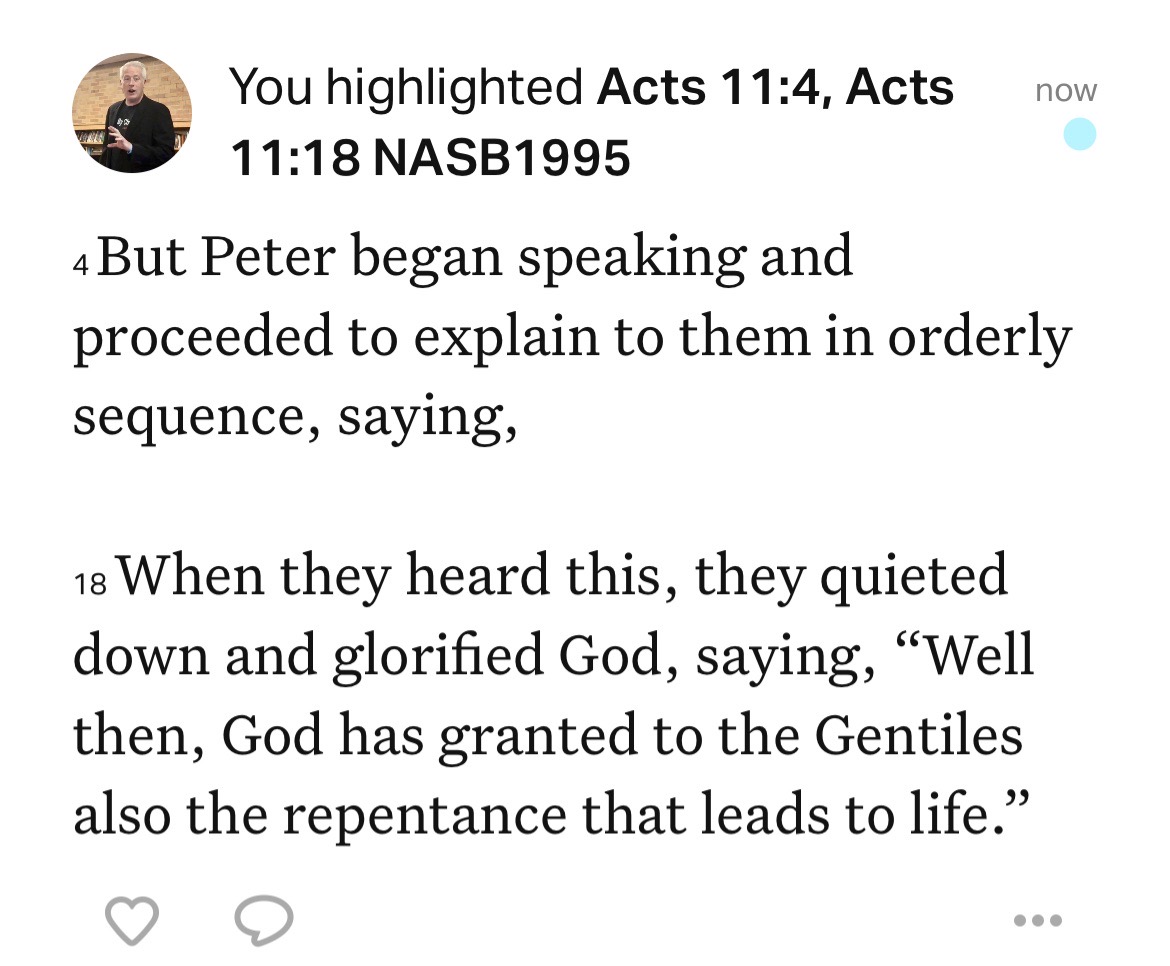
But Peter began speaking and proceeded to explain to them in orderly sequence…. When they heard this, they quieted down and glorified God, saying, “Well then, God has granted to the Gentiles also the repentance that leads to life.” (Acts 11:4, 18) 

There’s a wonderful lesson here for all of us to apply: Verify secondhand reports. 

I unpack this more in my book When Sheep Bite in discussing gossip and slander.

3 Lessons From A Devoted Dad

If you were to pick a man that would have been desperately devoted to Jesus as his Savior, Cornelius wouldn’t make anyone’s “top 10” list! 

Just take a look at all the strikes against this man. He was a… 

  • Gentile—to Jews, Gentiles were just the fuel to stoke the fires of hell. 
  • resident of the city of Caesarea—since this was the headquarters of the Roman government for Palestine, not many Jews would venture there. 
  • Roman—historians say only 10% of Romans in this era were monotheistic. 
  • centurion—not just any centurion, but an extremely powerful centurion from the Italian Regiment (not just a local mercenary who was in it for the money). And he took his name from Cornelius Sulla, a Roman general known both for his mercy and his ruthlessness.

All of this makes Cornelius a fully self-sufficient and a well-to-do man who was not likely to look for help from God. Nor was he the type of person that a Christian missionary might seek out. 

But clearly, something was missing in Cornelius’ life because he was completely countercultural in his pursuit after God. Not just his pursuit of God, but his quick understanding of exactly who Jesus was. 

Luke the historian describes Cornelius as:

  • devout and God-fearing. The Greek word for devout literally means “a right worshipper.” It’s a word Luke only uses three times in Acts, and two of those times are describing Cornelius. 
  • prayerful. The word Luke uses for him means someone who makes prayer personal and ongoing. 
  • generous. Cornelius took care of people who couldn’t take care of themselves. 

All of this got God’s attention (see Psalm 141:2; Revelation 5:8; Proverbs 19:17), and He sent an angel to direct Cornelius to Peter. 

When Peter came to Cornelius’ house, twice he said “as you know” (vv. 36, 37), showing us that Cornelius was aware that there was not only one true God, but that a relationship with Jesus was the only way to be in right relationship with God. As Peter spoke with Cornelius, his family, his relatives, his close friends, and even his fellow soldiers, the Holy Spirit baptized them just as He had done with the disciples of Jesus on the day of Pentecost. 

So here are 3 vital lessons for all men to learn from the life of Cornelius the centurion—

  1. Your devotion to God is influential. People around you do notice your devoted pursuit of God.
  2. Your openness to all that God has puts your family, friends, and coworkers in a place to receive God’s blessings too.
  3. God’s blessings flowing through you have lasting and far-reaching results. The outpouring of the Holy Spirit on Cornelius may have opened the door for Christian evangelism to Gentiles unlike anything that had happened before.

Dads, be devoted to God. Desire all He has for you, and all He has for those around you. Pursue Him no matter how many “strikes” there may be against you. 

If you missed any of the messages in this series, you can access the full list of messages by clicking here.

The Key Decision For Influential Men

Influence like JesusNo matter how you look at it, being a Dad is hard work! Men have this constant balancing act between being tough and being tender. Guys have to have their game face on at work, and their family face on at home. They’ve got to work hard knocking down work competitors, and then work just as hard building up their family members.

But there is one key decision that will determine how successful a man will be at work, at home, in his social circles, and even in his relationship with God. 

In Acts 10 we meet a centurion named Cornelius. Centurions were professional military officers in charge of a centuria (usually 100 soldiers). Centurions were always “on the clock,” never letting down their guard nor their professionalism.

All of the centurions mentioned in the New Testament have noble characteristics associated with them. Whereas someone might be uncertain how a typical Roman soldier would behave, people felt more assured when the centurion was on the scene. Even Roman governors like Pilate, and Jewish kings like Herod, all seemed to fully trust the judgement, honesty, and resourcefulness of centurions.

Centurions worked hard to get where they were, and had some well-earned perks:

  • Good pay (one built a temple, Luke 7:1-5).
  • “Men of authority” with soldiers and servants reporting to them (Matthew 8:8-9).
  • Opportunity for advancement (Rome was the dominate world force).
  • A certain degree of autonomy (they had their own residences (Matthew 8; Acts 10).

In order to keep this position, they would have to buy into kurios Caesar (Caesar is lord). To do otherwise was to put their position and future advancement at risk.

Yet Cornelius was different. 

He was a trusted centurion, but something unusual stood out about his life. Luke the historian describes him as devout and God-fearing, mentioning his pious activities of prayer and giving to the poor. Cornelius’ own soldiers referred to him as righteous and respected by notable people in the community.

But probably most telling of all: God noticed how committed Cornelius was (see Acts 10:3-4)!

Cornelius had a lot to lose by rejecting kurios Caesar for, as the Christians said, kurios Iesous (Jesus is Lord). Yet after carefully weighing his options, he saw that trusting God was the best thing he could do for his family. His view of the eternal outweighed anything that he could gain in the temporal.

This one decision changed everything! 

Because Cornelius trusted God, look at the expansiveness of his influence, not only at home, but at work, and among his friends and extended family, and throughout his community:

  • His family—ALL his family were devout and God-fearing (v. 2)
  • His employees—a devout soldier (v. 7)
  • His community—respected by ALL the Jewish people (v. 22)
  • His relatives and friends—his relatives and close friends (v. 24)
  • In fact everyone around him—we are ALL here in the presence of God (v. 33)
  • And most importantly, with God—your prayers and gifts have come up as a memorial offering before God (v. 4)

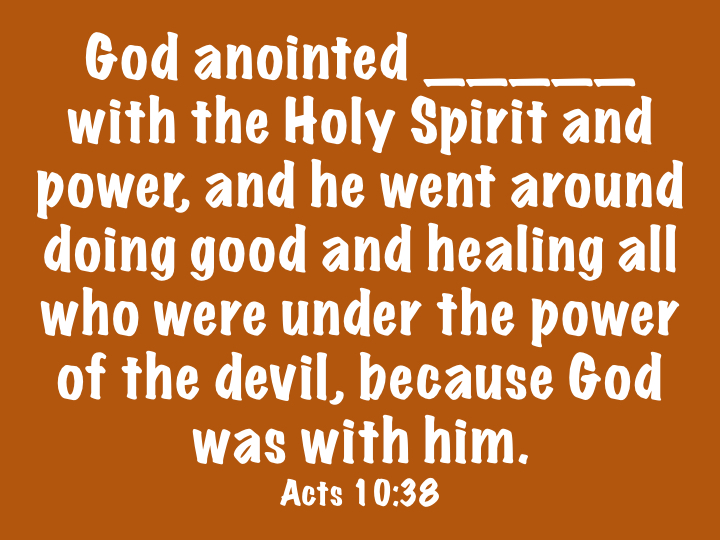
Fellas, you can have this same level of influence if you, too, will decide to live karios Iesous: Jesus is Lord. If you will do that, you can have said about your life what was said about Cornelius and Jesus: “God anointed ___________ with the Holy Spirit and power, and he went around doing good and healing all who were under the power of the devil, because God was with him!” (see Acts 10:38).