No Limits (book review)

I always get excited when I get to read a John Maxwell book because I know right upfront that I’m going to be getting life-changing insights. As usual, No Limits lived up to my expectations!

The premise of this book is simple: Most of our limitations are self-imposed, but if we could see a way to blow the cap off those limitations there is no limit to the level of success we can achieve.

The book is built around John Maxwell’s capacity challenge, which says, “If you grow in your awareness, develop your abilities, and make the right choices, you can reach your capacity. In other words: Awareness + Ability + Choices = Capacity.”

No Limits is built around the three components in this capacity equation. First, you will learn how to become aware of what may be limiting you; then, you will learn how you have the ability to develop the capacities that you already have; and finally, you will learn how to make the daily choices that will maximize your capacity.

The book contains a link to a “Capacity Quiz,” which is a great help to identify the areas in which you especially need growth. It’s a good idea to take this quiz before diving into the material in the book so that you can pay special attention to the weakest areas as you are reading.

John Maxwell continues to stretch and mentor me in leadership growth like few other people have. I believe he will do the same thing for you, too, if you are willing to roll up your sleeves and go to work on blowing the cap off all your limits!

I am a Center Street book reviewer.

Thursdays With Oswald—Are You Self-Made Or God-Made?

Oswald ChambersThis is a weekly series with things I’m reading and pondering from Oswald Chambers. You can read the original seed thought here, or type “Thursdays With Oswald” in the search box to read more entries.

Are You Self-Made Or God-Made?

     It is possible to be perfectly real to ourselves but not real to God; that is not reality. It is possible to be perfectly real to ourselves and real to other people, but not real in our relationship to God; that is not reality. The only reality is being in harmony with ourselves and other people and God. That is the one great reality towards which God is working, and towards which we are working as we obey Him. … 

     The critical moment in a man or woman’s life is when they realize they are individually separate from other people. When I realize I am separate from everyone else, the danger is that I think I am different from everyone else. Immediately I think that, I become a law to myself; that means I excuse everything I do, but nothing anyone else does. ‘My temptations are peculiar,’ I say; ‘my setting is very strange; no one knows but myself the peculiar forces that are in me.’ … This sense that I know what other people do not know, that I have a special intuition that tells me things, is even more dangerous than the sense of individualism because it leads to spiritual deception in a religious nature and to hard intellectual conceit in a natural nature. … 

     Self-realization naturally cares nothing about God, it does not care whether Jesus lived or died or did anything at all. For ourselves we live and for ourselves we die; that is self-realization that leads to death and despair; it is absolutely and radically opposed to Christ-realization. True self-realization is exhibited in the life of Our Lord, perfect harmony with God and a perfect understanding of man; and He prays “that they may be one, even as We are one.” … 

     God’s purpose is to make us real, that is, to make us perfectly at one with all our own powers and perfectly at one with God, no longer children but understanding in our heads as well as in our hearts the meaning of the Redemption, and slowly maturing until we are a recommendation to the redeeming grace of our Lord Jesus Christ.

From The Philosophy Of Sin

Oswald Chambers says we have a choice: Will we try to be a self-made man or woman, OR will we allow the Holy Spirit to make us a God-made man or woman? Only the second option puts us in touch with ourselves, others, and God.

4 Blessings From Trusting God + 1 Curse For Not

Choose lifeWhen you have a decision to make, isn’t it nice when you know the outcome of each option ahead of time? I mean, it makes it way easier to decide when you know what you’re going to get with each decision.

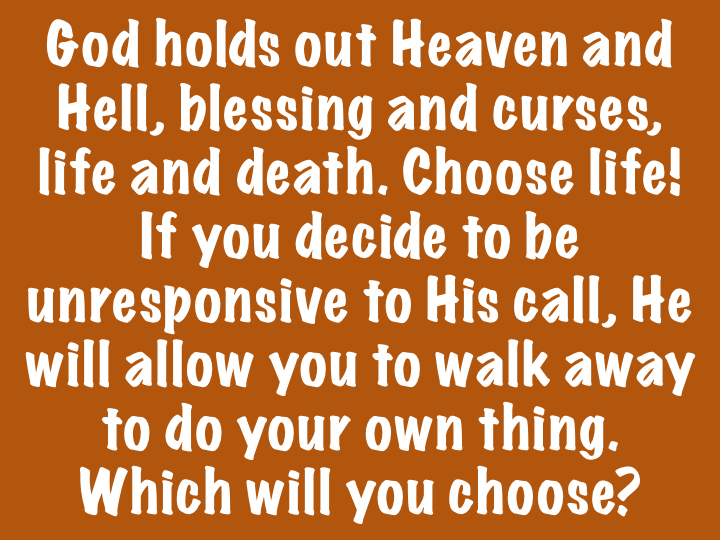
Like just before the Israelites head into the Promised Land, God says, “You can choose Me and have a whole lot of blessings, or you can choose another god and miss out on all My blessings” (Deuteronomy 30:11-20).

Easy choice, right?

I think the songwriter of Psalm 125 had that Deuteronomy passage in mind when he wrote his song of ascent. Basically, he says, you can trust God (v. 1) or you can walk on crooked paths (v. 5). What does it mean to trust God? Literally it means to have a confident expectation that He is Who He says He is, and He does what He says He’s going to do.

To help make the decision easier, the songwriter lists four blessings that come when we trust God—

  1. We become as secure and unshakeable as Heaven is (v. 1).
  2. We experience God’s “surroundedness” over, around, above and beneath us (v. 2).
  3. We escape evil’s clutches (v. 3).
  4. We experience God doing good for us (v. 4).

Of course, we can also choose not to trust God. We can try another path on our own. The curse for doing that is pretty sad—God will allow those who aren’t responsive to His voice to walk away from Him (v. 5).

Just like the story of the prodigal son (in Luke 15), the Father will allow you to walk away, but He will continue to long after you. And hopefully like that wayward son you will “come to your senses” and return to your Father. When you do, He will run to you, wrap you in His love, restore you to His family, and allow you to experience all of His blessings again!

The choice is up to you. I pray you will choose life and blessing and surroundedness, and God’s goodness toward you.

If you’ve missed any of the messages in this series, you can access the complete list by clicking here

It’s Your Choice

ChoicesIn just seven verses, Jesus tells us how to experience God’s blessing or be prepared to say, “Woe is me!” What a contrast! Check out Luke 6:20-26.

The four blessed promises are in verses 20-22, and the four woe warnings are in verses 24-26. Connecting them (v. 23) is Jesus essentially saying, “You can have blessing, or you can have woe. Your choice.”

There is a secure reward and eternal blessing for those who—

  • are Earth-poor and Heaven-rich
  • are dissatisfied with anything but the things of God
  • weep over the present sinful state of humanity
  • are persecuted, excluded, insulted or rejected by the world because they identify with Christ

But woe to those who—

  • want riches and comfort now
  • are satisfied with what the world can give
  • laugh at the smutty things of Earth
  • desire worldly popularity above hearing God say, “Well done, good and faithful servant”

Choices must be made every day. These choices lead to either blessing or woe

Choose the blessings!

What Are You Looking At?

Blue eyeI read a fascinating article on some recent research on how eye movement can effect moral decision-making.

The researchers found that, “people asked to choose between two written moral statements tend to glance more often towards the option they favour.” And also that a decision can be influenced by asking for an answer immediately after the person looks at what you want them to choose.

The Bible has much to say about where our eyes are fixed, and how that impacts our life decisions―

I have a message from God in my heart concerning the sinfulness of the wicked: There is no fear of God before their eyes. (Psalm 36:1)

So we fix our eyes not on what is seen, but on what is unseen, since what is seen is temporary, but what is unseen is eternal. (2 Corinthians 4:18)

With eyes full of adultery, they never stop sinning…. (2 Peter 2:14)

Your eye is the lamp of your body; when your eye (your conscience) is sound and fulfilling its office, your whole body is full of light; but when it is not sound and is not fulfilling its office, your body is full of darkness. (Luke 11:34, Amplified)

I made a covenant with my eyes not to look lustfully at a young woman. (Job 31:1)

Keep your eyes straight ahead; ignore all sideshow distractions. (Proverbs 4:25, Message)

So … what are you looking at?

11 Quotes From “How High Will You Climb?”

How High Will You Climb?How High Will You Climb? is an abridgment of Dr. John Maxwell’s amazing book The Winning Attitude. Truly, attitude will determine your success in life. I highly recommend either of these books (you can check out my review by clicking here). Below are some attitude quotes I highlighted and one helpful infographic.

“The attitude is an inward feeling expressed by behavior. That is why an attitude can be seen without a word being said.” 

“It is impossible to perform consistently in a manner that is inconsistent with the way we see ourselves. In other words, we usually act in direct response to our self-image. … We should also remember God’s unconditional love and acceptance. He thinks more of us than we do of ourselves. … This principle works in reverse too. How we see ourselves reflects how others see us. If we like ourselves, it increases the odds that others will like us.”

“Others can stop you temporarily, but you are the only one who can do it permanently.”

“Usually wrong decisions are made at the wrong time, and right decisions are made at the right time. The reason? We let our environment control our thinking, which controls our decisions. Therefore, the more decisions that are made in the calm of life, the fewer times storms can bring us down.”

“Failure—we hide it, deny it, fear it, ignore it, and hate it. We do everything but accept it. By acceptance, I don’t mean resignation and apathy. I mean understanding that failure is a necessary step to success. The person who never makes a mistake never does anything.”

“Fear of failure grips those who take themselves too seriously.”

“First, discouragement hurts our self-image. … Discouragement causes us to see ourselves as less than we really are. This fact becomes even more important when we realize that we cannot consistently perform in a manner that is inconsistent with the way we see ourselves. Second, discouragement causes us to evade our responsibilities. … Third, discouragement causes us to blame others for our predicaments. … Fourth, discouragement causes us to blur the facts.”

“When our attitude crashes, we have two alternatives. We can either alter the difficulty or alter ourselves. What can be changed for the best, we must change. When that is impossible, we must adjust to the circumstances in a positive way.”

“We are either the masters or the victims of our attitudes. It is a matter of personal choice. Who we are today is the result of choices we made yesterday. Tomorrow we will become what we choose today.” 

“It is a sad day for any person when he becomes so satisfied with his life, his thoughts, and his deeds that he ceases to be challenged to do greater things in life.”

“When an opportunity for growth is open to you, what do you tell yourself? Will you grasp the chance with a tingle of excitement and say, ‘I can make it work!’ or do you smother it by saying, ‘That’s impractical… too difficult… I don’t think it can be done’? In that moment, you choose between success and failure. You helped to form a habit of either positive or negative thinking by what you tell yourself. So give your ‘better’ self a chance to grow. Form the habit of positive reaction followed by positive action.”
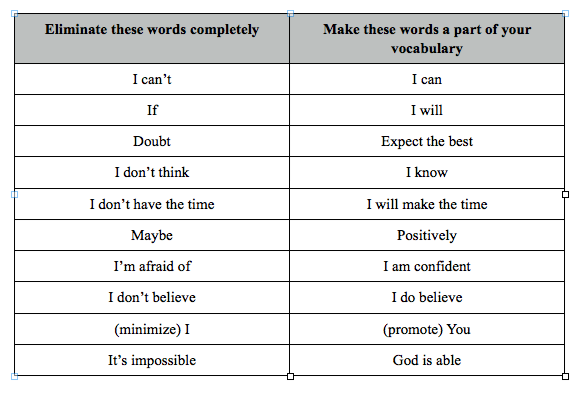
Change your vocabulary


Barney’s Choice

Barney FritcherYesterday I had the privilege of speaking at the funeral of my good friend Barney Fritcher. Barney was an amazing man who lived as much like Jesus as anyone else I have ever met.

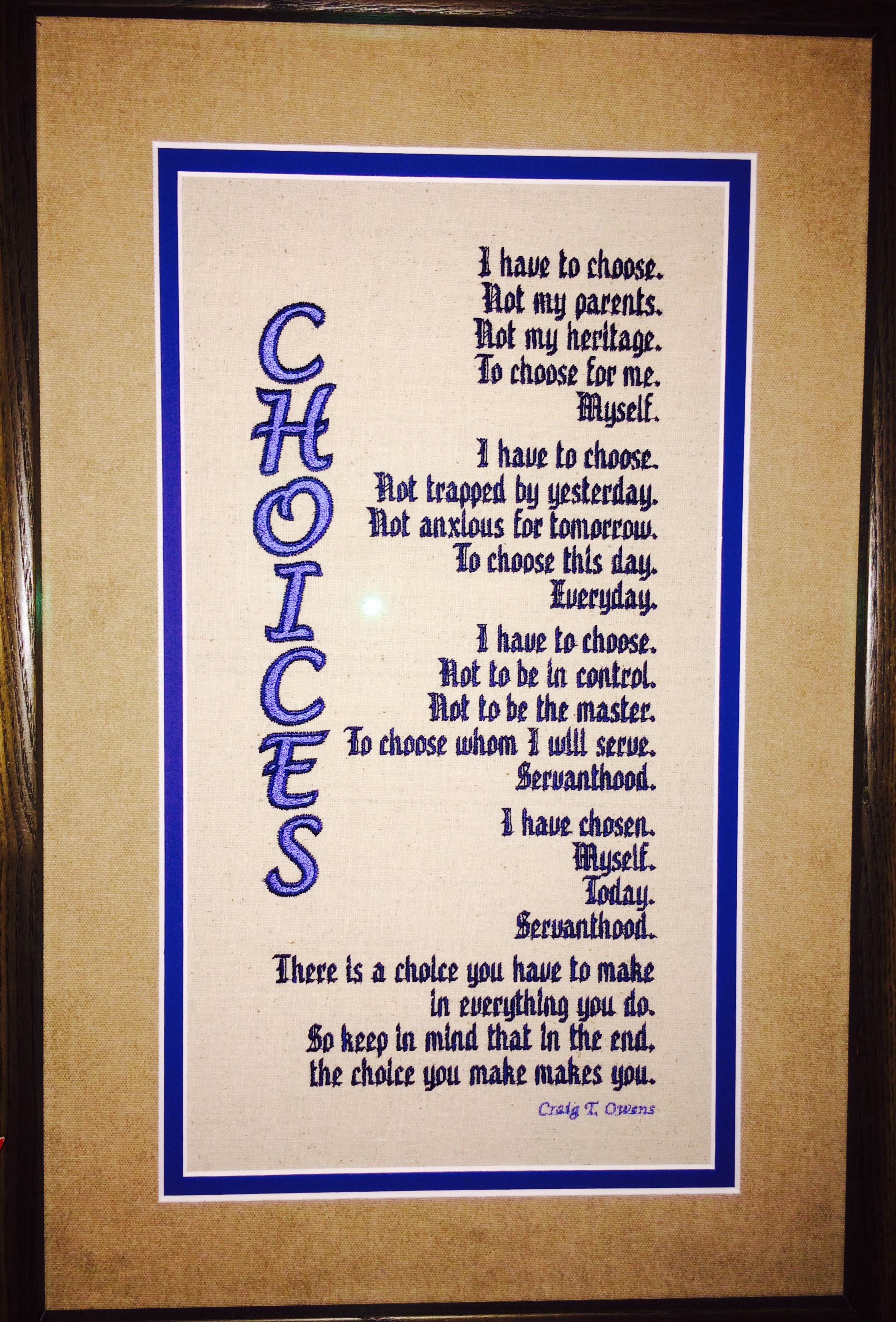
In December 2008 I tried my hand at a little poetry, which I posted on my blog with the title Choices. It was a humble attempt at expressing myself. But Barney, who truly had a God-given gift for poetry, wrote a poem in response that left my eyes filled with tears. I read his poem at his memorial service yesterday, and found out that no one else had heard this poem before then. Since many have been asking for a copy of it, and since it is such an amazing piece, I thought I would share it here for everyone to enjoy.

There have been times
when choices I’ve made
if given the chance
I would gladly trade. 
 
The path that I took
was rocky and rough
and things all around me
seemed to be tough. 
 
I could have asked Jesus
to lend me a hand
to reach down and pull me
from the sinking sand. 
 
He could have helped me
to a road that was paved
but I walked on my own
before I was saved. 
 
I climbed over 
the brush and the briar
thinking I could help myself
from that fire. 
 
When trees fell down
and blocked my way
I could have gotten down
on my knees to pray.
 
I could have said,
“Lord, it’s You that I choose
please save my life 
before life I lose.” 
 
But I was stubborn
fighting for my goal
now to the Lord
I have given my soul. 
 
The path I now travel
is clear to me
and any obstruction
is plain to see. 
 
When I look ahead
and problems arise
I pray to the Lord
and He hears my cries. 
 
He helps me to choose
a safe way to go 
making my sins
as white as snow. 
 
Of all of the choices
that I have made
I’m glad I made one
I’m glad I’ve been saved.
 

May we all make the choice that Barney made to invite Jesus into our lives!

Thursdays With Oswald—Moral Choices

This is a weekly series with things I’m reading and pondering from Oswald Chambers. You can read the original seed thought here, or type “Thursdays With Oswald” in the search box to read more entries.

Oswald Chambers

Moral Choices 

     Jesus Christ revealed what a normal man should be and in so doing showed how we may become all that God wants us to be. … But Jesus did not come to show us what a holy life was like: He came to make us holy by means of His death

     … When we partake of His life through the experience of regeneration we are put into a state of innocence towards God, and we then have to do what Jesus did, that is, transform that innocence into holy character by a series of moral choices. 

From Bringing Sons Unto Glory

There’s a song that says, “Now that we’ve found love, what are we going to do with it?” The Holy Spirit asks regenerated Christians the same thing: “Now that you’ve been declared innocent in God Almighty’s sight, how are you going to live?”

Every day you and I are faced with moral choices. Will we try to find the loopholes or the easy way out? Will we justify our ungodly choices? Or will we do what Jesus did and obey God fully?

Now that you’ve been declared innocent, what are you going to do with it?

Are You Content?

The dictionary defines contentment as—

Satisfied with what one is or has; not wanting more or anything else.

Does that describe you? Sadly, it’s describing fewer and fewer of us today. But saddest of all: Very few Christians describe themselves as being content!

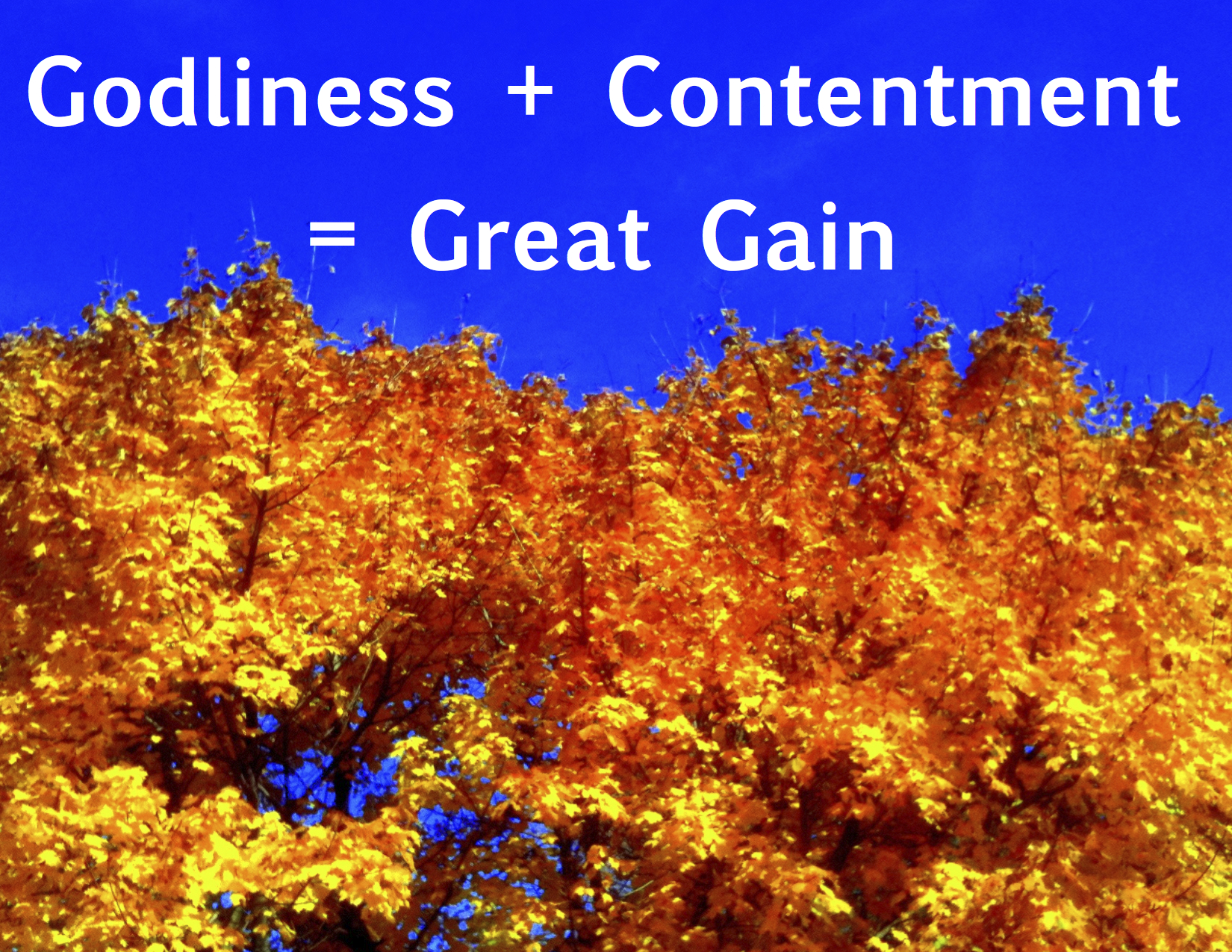
The Bible says, “But godliness with contentment is great gain. … If we have food and clothing, we will be content with that.” (1 Timothy 6:6, 8)

Godliness + Contentment = Great Gain

Both godliness and contentment are choices we must make.

I choose to be godly, and I choose to be content.

The default—the natural course for us—is selfishness. The pull toward my gain and my pleasure is strong. So I must exert great energy to pursue godliness; I must make the conscious decision to be content.

Give us this day our daily bread should be the prayer request in the morning (Matthew 6:11).

Thank You, God, for providing food and clothing for today should be the prayer of thanks in the evening.

Today if you have more than food and clothing, how much more blessed you are!

Choose godliness. Choose contentment. And watch and see how God provides great gain for you!

Making Choices

The unusual or out-of-the-ordinary always seems to grab my attention. So when I was reading through a long, long (long!) list of names in 1 Chronicles, I stopped when I read, “Their sister was named Hazzelelponi.”

My first thought: What parent names their little girl Hazzelelponi?!?

My second thought: Why does the biblical writer mention her? First off, there are scarcely any other women mentioned in these genealogies. And then to mention such an unusual name without any other commentary seems weird.

Her name is a compound of two words: to turn toward + shadows.

The Hebrew word for shadows can have two meanings: (1) The cool, protected place; or (2) Something which is transitory or short-lived. One positive definition, and one negative definition. Since all the other times this word is used in the Bible the second definition is used, we can assume that the negative usage is meant here too.

Since I doubt that anyone makes a decision to turn to the shadowy “dark side” all at once, Hazzelelponi made small choices day after day after day.

Small choices every day to rely in things that would not last. And now her history is nothing but a single line: “Their sister was named Hazzelelponi.” No descendants, no heritage, no legacy; just a footnote because of the small choices she made.

“There is a choice you have to make in everything you do. So keep in mind that in the end, the choice you make, makes you.” – John Wooden

What choices are you making today?