14 Quotes From “Unfinished”

UnfinishedI found Unfinished by Richard Stearns to be both confrontational and motivating. You can read my full book review by clicking here. These are some of the quotes I especially appreciated from this book. Unless otherwise marked, they are quotes from Stearns—

“God created you intentionally to play a very specific role in His unfolding story. God didn’t create any extras meant to stand on the sidelines and watch the story unfold; He created players meant to be on center stage. And you will feel fully complete only when you discover the role you were born to play.”

“You don’t have to go to the Congo or to Uzbekistan to change the world. You don’t have to be brilliant to change the world—or wealthy or a spiritual giant. But you do have to say yes to the invitation. You do have to be available and willing to be used, and you may have to pay the price that comes with following Jesus because changing the world and following Jesus isn’t easy, and it doesn’t come cheap.”

“Prosperity knits a man to the World. He feel that he is ‘finding his place in it,’ while really it is finding its place in him.” —C.S. Lewis

“Yet that is exactly how many Christians view the gospel of Christ. I do a deal with God, buy the fire insurance policy, put it in my drawer, and then I can go back to the party. Sure, it wouldn’t be a bad idea to go to church now and then to dip my feet into spiritual waters, and it wouldn’t hurt to pray from time to time, but, basically, with my salvation secured I can now get on with my life. This is what Dallas Willard refers to as the ‘gospel of sin-management.’”

“So we need to dispense with any notion that we can take this Jesus on our own terms, that we can simply add Him to the structure of our lives, fit Him into our plans, worship Him once a week for an hour or so, and offer Him a prayer when we find ourselves needing something. No, Jesus demands the total commitment of our lives in His service. We are called to enlist in His army and lay down every other priority in our lives at His feet. Our ambitions, our careers, our relationships, our possessions, even our families must be laid at His feet to do with as He wishes.”

“Authentic churches truly living together… offer a radically different and beguiling attractive alternative to every other model of human community.”

“God’s deepest desire is not that we would help the poor. God’s deepest desire is that we would love the poor; for if we love them, we will surely help them.”

“Love always requires tangible expression. It needs hands and feet. As followers of Christ we can too easily become overwhelmed by the complexity and depth of our Christian faith, and we can become confused by doctrine and theology. But the beautiful simplicity of our faith is that it distills down to the exact same bottom line for both the brilliant theologian and the five-year-old child: love God and love each other—period. Everything else derives from that.”

“Now, here is a really important thing to understand. If you lay down all of these things in the service of Christ and His kingdom, He won’t necessarily take them away from you. He doesn’t ask us all to quit our jobs, leave our homes, and have an estate sale to liquidate all our earthly possessions. No, He only asks that we turn all of those decisions over to Him. If you have built a business that can generate great wealth, He may leave you right there so that the business can be used to His glory and to accomplish His purposes. If you are an investment banker at Goldman Sachs, He may want you to stay put and become a kingdom builder right where you are stationed by letting your light shine in a place where a shining light may be desperately needed. If you love your community, He may use you to help transform it and reclaim it for His kingdom. He might even use your addiction as a powerful tool of His restorative power to transform human lives. But he does require that the certificates of title be signed over to Him. He becomes the owner, and we become the stewards, not of our possessions but of the Master’s possessions.”

“I am only one, but I am one;
I cannot do everything,
But I can do something.
What I can do I ought to do,
And what I ought to do
By God’s grace I will do.” —Edward Everett Hale

“Think of it this way: If we all worked for Boeing, our general calling would be to engage in the building of airplanes. But our specific calling might be to assemble the landing gear, wire and install the instruments, assemble the wings, or design the roomy and comfortable coach seats. And which of those specific tasks we were called to would be determined by the boss’s best judgment, taking into consideration our unique skills and abilities. … The same is true in building the kingdom of God. We all have the same general assignment but our specific roles within it will be unique to us as individuals and will take into account our gifts and talents but also our experience, our assets, our physical location, and our connections and associations.”

“The chief purpose of the church is to bring glory to God by accomplishing the Great Commission pronounced by Jesus. Everything else—worship, preaching, teaching, discipling, congregational care, the sacraments, feeding the hungry, caring for the poor, and so on—while valuable for us and pleasing to God in and of themselves, are ultimately means to the end of faithfully completing the assignment given to the church by Jesus just before He left.”

“Jesus envisioned these communities of believers would transform the world in which we live, much as springtime melts the cold and snow of winter and releases the exuberance of new life bursting forth. We would be drawn to the cold places, the broken places, the ragged edges of our world. We would be drawn to the open sores upon our societies: poverty, disease, hunger, injustice, and exploitation, becoming a healing balm to those who feel marginalized, excluded, and discarded. … Our generosity would astound, our determination amaze, and our love be irresistible.”

“The most important thing to remember is this: to be ready at any moment to give up what you are for what you might become.” —W.E.B. DuBois


867-5309

MeditatingI know I’m showing my age with this example: But how many of you remember the song by Tommy Tutone that contained Jenny’s phone number. That song hit #4 on the charts in 1982, and yet after all of these years if you start singing the song, people can tell you that Jenny’s number is 867-5309.

Why do we remember such trivial things?!

The way God designed the human brain is absolutely astounding! Electrical impulses from our five senses filter into the brain and are saved as short-term memories, with the emphasis on short. Short-term memories usually last 20-30 seconds. But we can reset the timer by repeating the information again and again.

If we repeat it enough or think about it more, our brain realizes that it has some significance to us, and begins to “solidify” the information in our intermediate memory banks. These intermediary memories last 5-8 hours.

But in order for the intermediary memories to be stored away in our long-term memory—where they can be stored indefinitely—there needs to be an added component from us. That component is emotion.

The more important the information is to us, the greater the likelihood it will be filed in the “do not delete” section of our brain.

People tell me all the time how difficult it is for them to memorize Scripture, but the keys to memorization are built into the Scripture itself.

First, you have to approach it with a passion. Oh, how I love your law! … Therefore I hate every wrong path (Psalm 119:97, 104). The “bookends” of this section show passionate emotion.

Second, you need to sing the Word. Twice the psalmist said he mediated on God’s Word all day long (vv. 97, 99). At the root of this word is to hum. Singing God’s Word attaches emotion to it, and the emotion tells your brain to move it to long-term storage.

Third, you need to realize just how important it is to have the Scripture stored away in your memory banks. In one section of the 119th Psalm we see benefits like: makes me wiser, gives me more insight, I have greater understanding, I can avoid evil paths (vv. 98-102).

C.S. Lewis commented, “All that is not eternal is eternally useless.” Jenny’s phone number won’t keep us out of trouble, or draw us closer to God, or even give us insight into helping a friend. But God’s Word will do all of those things … and so much more!

These steps will help you store and retrieve eternally useful truths, and not just fictional phone numbers! Try it and let me know how it works for you.

If you have missed any of the messages in our P119 series, you can access them all by clicking here.

10 Quotes From “Alive To Wonder”

Alive To WonderIn this collection of essays John Piper shares how C.S. Lewis impacted his thinking about God. You can read my book review (and get the link to download the free ebook version of this book) by clicking here.

I could have highlighted and underlined nearly the entire book, but here are some of my favorite quotes—

“I shall not demean my own uniqueness by envy of others. I shall stop boring into myself to discover what psychological or social categories I might belong to. Mostly I shall simply forget about myself and do my work.” —Clyde Kilby

“Although Lewis owned a huge library, he possessed few of his own works. His phenomenal memory recorded almost everything he had read except his own writings—an appealing fault. Often when I quoted lines from his own poems he would ask who the author was. He was a very great scholar, but no expert in the field of C.S. Lewis.” —Walter Hooper

“The work of a charwoman and the work of a poet become spiritual in the same way and on the same condition.” —C.S. Lewis 

“God is not worshipped where He is not treasured and enjoyed. Praise is not an alternative to joy, but the expression of joy. Not to enjoy God is to dishonor Him. To say to Him that something else satisfies you more is the opposite of worship. It is sacrilege.” —John Piper

“How sweet all at once it was for me to be rid of those fruitless joys which I had once feared to lose…! You drove them from me, You who are true, the sovereign joy. You drove them from me and took their place, You who are sweeter than all pleasure, though not to flesh and blood, You who outshine all light, yet are hidden deeper than any secret in our hearts, You who surpass all honor, though not in the eyes of men who see all honor in themselves. … O Lord my God, my Light, my Wealth, and my Salvation.” —Augustine

“Would it not be an encouragement to a subject, to hear his prince say to him, ‘You will honor and please me very much, if you will go to yonder mine of gold, and dig as much gold for yourself as you can carry away’? So, for God to say, ‘Go to the ordinance, get as much grace as you can, dig out as much salvation as you can; and the more happiness you have, the more I shall count Myself glorified.’” —Thomas Watson

“Consider this question: In view of God’s infinite power and wisdom and beauty, what would His love for a human being involve? Or to put it another way: What could God give us to enjoy that would prove Him the most loving? There is only one possible answer: Himself.” —John Piper 

“We praise what we enjoy because the delight is incomplete until it is expressed in praise.” —John Piper

“You cannot hope and also think about hoping at the same moment; for in hope we look to hope’s object and we interrupt this by (so to speak) turning round to look at the hope itself. … The surest means of disarming an anger or a lust is to turn your attention from the girl or the insult and start examining the passion itself.” —C.S. Lewis 

“God is glorified in His people by the way we experience Him, not merely by the way we think about Him. Indeed the devil thinks more true thoughts about God in one day than a saint does in a lifetime, and God is not honored by it. The problem with the devil is not his theology, but his desires. Our chief end is to glorify God, the great Object. We do so most fully when we treasure Him, desire Him, and delight in Him so supremely that we let goods and kindred go and display His love to the poor and the lost.” —John Piper

Alive To Wonder (book review)

Alive To WonderC.S. Lewis has had an amazing impact on my thinking, helping me see things in the spiritual world I might have otherwise missed. So when I saw that John Piper—another man who has opened my spiritual eyes—was similarly impacted by C.S. Lewis, I was intrigued. Alive To Wonder is a free ebook in which John Piper shares his thoughts about C.S. Lewis.

This book is really a collection of essays from John Piper on the various areas his thoughts were challenged or sharpened by the works of C.S. Lewis. It is a fascinating insight into two great minds. Because both of these men are intellectual giants, reading this short book is a mentally-stretching exercise (no light, cotton candy reading here!), but well worth the effort!

You can download the free ebook from the Desiring God website by clicking here.

C.S. Lewis In His Own Voice

Mere ChristianityThis address from C.S. Lewis was broadcast on the BBC in 1944. Sadly, this is the only one of his radio talks that have survived. But the good news is these talks form the bulk of C.S. Lewis’ amazing book Mere Christianity.

Gods And Goddesses

When I saw this video, I thought of the words of C.S. Lewis—

“It is a serious thing to live in a society of possible gods and goddesses, to remember that the dullest and most uninteresting person you talk to may one day be a creature which, if you saw it now, you would be strongly tempted to worship, or else a horror and a corruption such as you now meet, if at all, only in a nightmare. All day long we are, in some degree, helping each other to one of these destinations.”

What are you doing to help others see themselves as God sees them?

I Am Jehovah

Listen to the podcast of this post by clicking on the player below, and you can also subscribe on AppleSpotify, or Audible.

One of the misconceptions about Jesus is that He first appears on the scene in a manger in Bethlehem. Nothing could be further from the truth! Jesus appears in the opening words of the BibleIn the beginning God created—and in the last words of the BibleYes, I am coming soon. And He appears in every word in between!

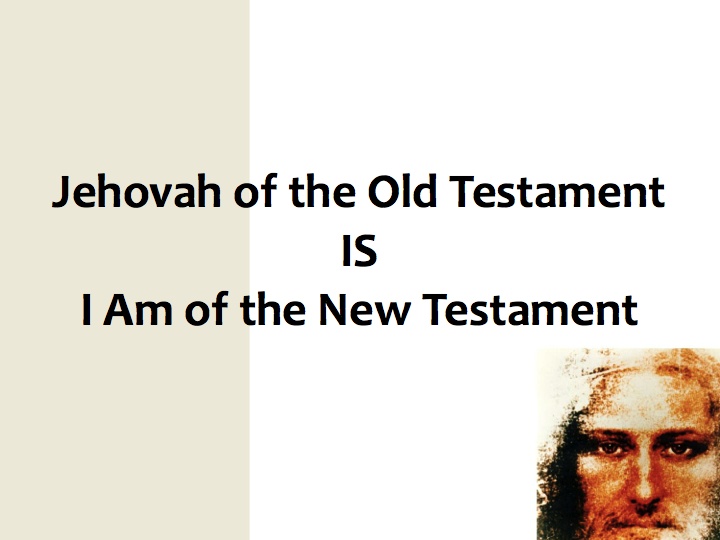
It was Christ’s claims of being one with the Father that enraged the Jewish religious leadership. When He proclaimed His “I Am” statements in the New Testament, they knew He was tying Himself to the “Jehovah” titles of the Old Testament.

B.B. Warfield has a great picture of the Old Testament being a mansion with richly-decorated, beautifully-ornate rooms, but which are dimly lit. So with just the Old Testament by itself, it is hard to appreciate the magnificent beauty that’s there. In Jesus, the light is turned on, and we can now appreciate the glory and majesty that was always there!

So notice how the “I Am” statements shine a bright light on the titles of “Jehovah”

  • Jehovah Jireh (I Am Your Provider) → I am the Bread of Life (John 6:35)
  • Jehovah Rapha (I Am Your Healing) → I am the Resurrection and the Life (John 11:25-26)
  • Jehovah Nissi (I Am Your Source) → I am the Vine (John 15:5)
  • Jehovah Shalom (I Am Your Peace) → I am the Light of the world (John 8:12)
  • Jehovah Raah (I Am Your Shepherd) → I am the Good Shepherd (John 10:11)
  • Jehovah Sabaoth (I Am Your Wall Of Protection) → I am the Gate (John 10:9)
  • Jehovah Tsid-kenu (I Am Your Righteousness) → I am the Way, Truth, and Life (John 14:6)
  • Jehovah Shammah (I Am Here) → I am the Alpha and Omega (Revelation 1:8; 22:13).

(Check out all of the above Scriptural references here.)

In essence Jesus is saying “I Am Jehovah in all His fullness.” So what are we to make of that? What are we to make of Jesus Christ? Here’s how C.S. Lewis addressed that very question:

   “This is a question which has, in a sense, a frantically comic side. For the real question is not what are we to make of Christ, but what is He to make of us? The picture of a fly sitting deciding what it is going to make of an elephant has comic elements about it. But perhaps the questioner meant what are we to make of Him in the sense of ‘How are we to solve the historical problem set us by the recorded sayings of this Man?’ 

  “The problem is to reconcile two things. On the one hand you have got the almost generally admitted depth of sanity of His moral teaching, which is not very seriously questioned, even by those who are opposed to Christianity. In fact, I find when I am arguing with very anti-God people that they rather make a point of saying, ‘I am entirely in favor of the moral teaching of Christianity….’ 

  “On the one side clear, definite moral teaching. On the other, claims which, if not true, are those of a megalomaniac, compared with whom Hitler was the most sane and humble of men. There is no halfway house and there is no parallel in other religions. If you had gone to Buddha and asked him, ‘Are you the son of Bramah?’ he would have said, ‘My son, you are still in the vale of illusion.’ If you had gone to Socrates and asked, ‘Are you Zeus?’ he would have laughed at you. If you had gone to Mohammed and asked, ‘Are you Allah?’ he would first have rent his clothes and then cut your head off. If you had asked Confucius, ‘Are you Heaven?’ I think he would have probably replied, ‘Remarks which are not in accordance with Nature are in bad taste.’ 

  “The idea of a great moral teacher saying what Christ said is out of the question. In my opinion, the only person who can say that sort of thing is either God or a complete lunatic suffering from that form of delusion which undermines the whole mind of man.” (emphasis mine)

In this quote, C.S. Lewis gives us three choices about Jesus. We can either say (1) He is a liar, (2) He is a lunatic, or (3) He is who He says He is.

What do you say about Him?

(You may also be interested in my post and sermon about the divinity and humanity of Jesus.)

If you have missed any of the messages in this series called Who Is Jesus?, you can find them all here.

►► Would you please prayerfully consider supporting this ministry? My Patreon supporters get behind-the-scenes access to exclusive materials. ◀︎◀︎

Thursdays With Oswald—Two Ways To Handle A Crisis

Listen to the podcast of this post by clicking on the player below, and you can also subscribe on AppleSpotify, or Audible. 

This is a weekly series with things I’m reading and pondering from Oswald Chambers. You can read the original seed thought here, or type “Thursdays With Oswald” in the search box to read more entries.

Two Ways To Handle A Crisis

     A man must decide whether he will be identified with the death of the Lord Jesus Christ, which will mean the turning out not only of the “old man,” but of the old responsible intelligence, the old bondage, the old legalism, the things which used to guide the life before, and the forming of a totally new mind. 

     It works out this way: in your practical life you come to a crisis where there are two distinct ways before you, one the way of ordinary, strong, moral, common sense and the other the way of waiting on God until the mind is formed which can understand His will. 

     Any amount of backing will be given you for the first line, the backing of worldly people and of semi-Christian people, but you will feel the warning, the drawing back of the Spirit of God, and if you wait on God, study His Word, and watch Him at work in your circumstances, you will be brought to a decision along God’s line, and your worldly “backers” and your semi-Christian “backers” will fall away from you with disgust and say, “It is absurd, you are getting fanatical.” 

From Biblical Psychology 

When you have to deal with a crisis, there are two options:

  1. Use your common sense and the good ideas of others
  2. Do it God’s way

God’s ways usually defy the world’s common sense.

“As the heavens are higher than the earth, so are My ways higher than your ways and My thoughts than your thoughts,” says God. (Isaiah 55:9)

For the foolishness of God is wiser than man’s wisdom, and…the wisdom of this world is foolishness in God’s sight. (1 Corinthians 1:25; 3:19)

If you want to try to do it the “common sense” way, go ahead. God will let you try it, and a lot of people will encourage you to keep at it. But I think you will quickly find that the “God sense” way is so much better! Although very quickly your former “backers” and “cheerleaders” will look at you as a fanatic.

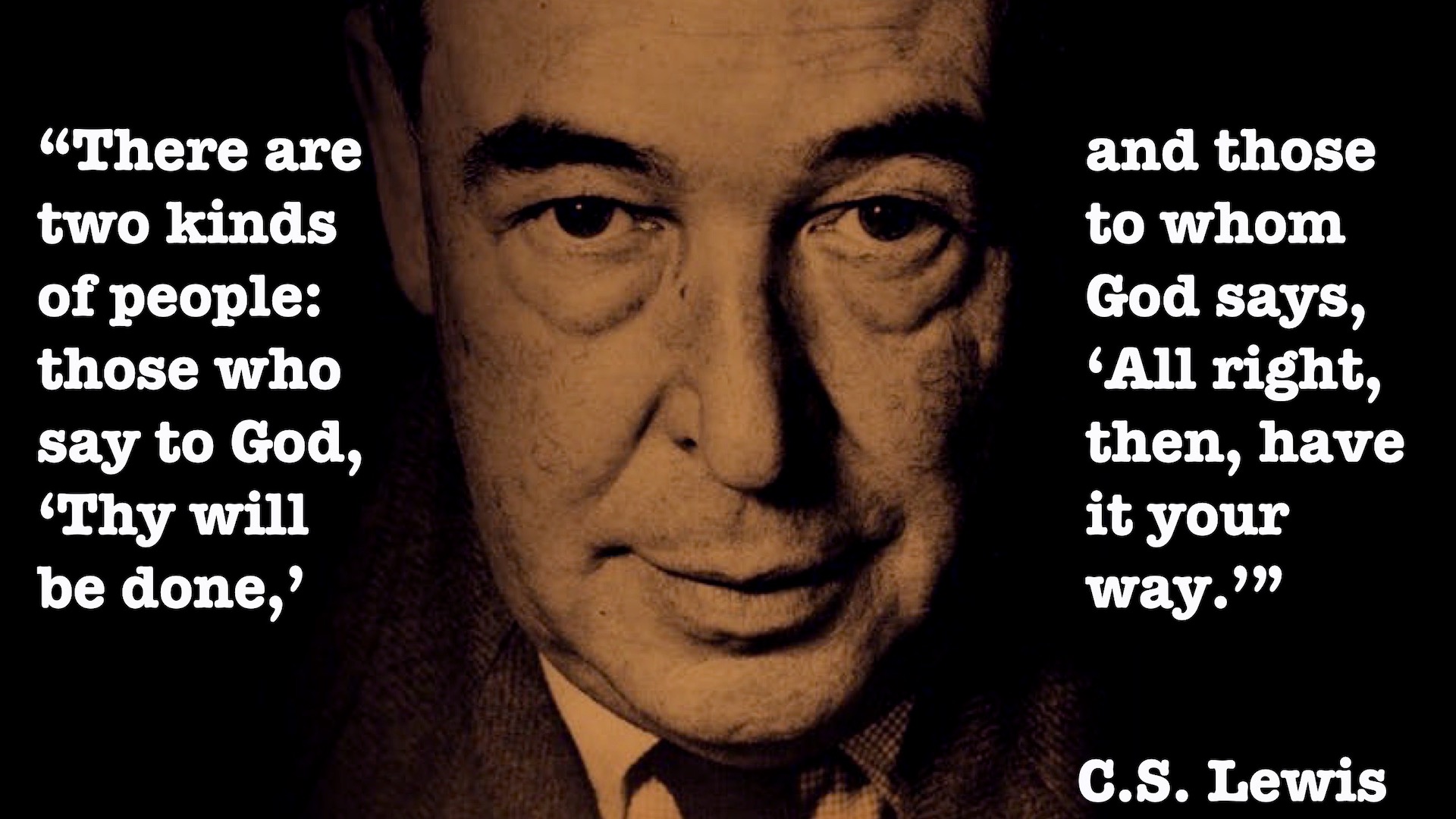
“There are two kinds of people: those who say to God ‘Thy will be done’ and those to whom God says, ‘All right then, have it your way.’” —C.S. Lewis

You must decide how you will respond in a crisis.

►► Would you please prayerfully consider supporting this ministry? My Patreon supporters get behind-the-scenes access to exclusive materials. ◀︎◀︎

Don’t Settle

C.S. Lewis at his deskI shared this quote with Calvary Assembly of God this morning to remind us that we shouldn’t settle. God wants us to pray BIG and to pray LONG. He wants us to claim His promises. He wants to be glorified by answering our prayers.

“If we consider the unblushing promises of reward and the staggering nature of the rewards promised in the Gospels, it would seem that our Lord finds our desires, not too strong, but too weak. We are half-hearted creatures…like an ignorant child who wants to go on making mud pies in a slum because he cannot imagine what is meant by the offer of a holiday at the sea. We are far too easily pleased.” —C.S. Lewis

Watch Out For Pride

Listen to the podcast of this post by clicking on the player below, and you can also subscribe on AppleSpotify, or Audible.

This post is especially for my fellow pastors, but it would be thoughtful reading for anyone in a leadership position.

Let me state it simply: Pastor, you need to watch out for pride.

Listen to the words of A.W. Tozer—

“A clergyman is a man, and often he has a proud little kingdom of his own, a kingdom of position and often of pride and sometimes with power.”

Pride is so insidious that it can creep into the hearts of leaders at anytime.

  • When things are going well. We think to ourselves, “Look what I’ve done” or we even spiritualize it a bit to say, “Look what God’s done through me.”
  • When things are going poorly. Pride causes us to look out the window at others, instead of looking in the mirror at ourselves.
  • When we’ve successfully handled a situation. We think, “Wow, I’ve really got it!”
  • When we’ve dropped the ball and we make excuses instead of asking for forgiveness.
  • And on and on it goes….

One of the things that has helped me immensely is the thoughts Kenneth Blanchard and Phil Hodges shared in their book Lead Like Jesus. They point out that every leader has an ego. The issue is what kind of ego is it?

It can be negative: E.G.O. = Edging God Out 

It can be positive: E.G.O. = Exalting God Only

So what do we do to make sure we have the God-honoring E.G.O.?

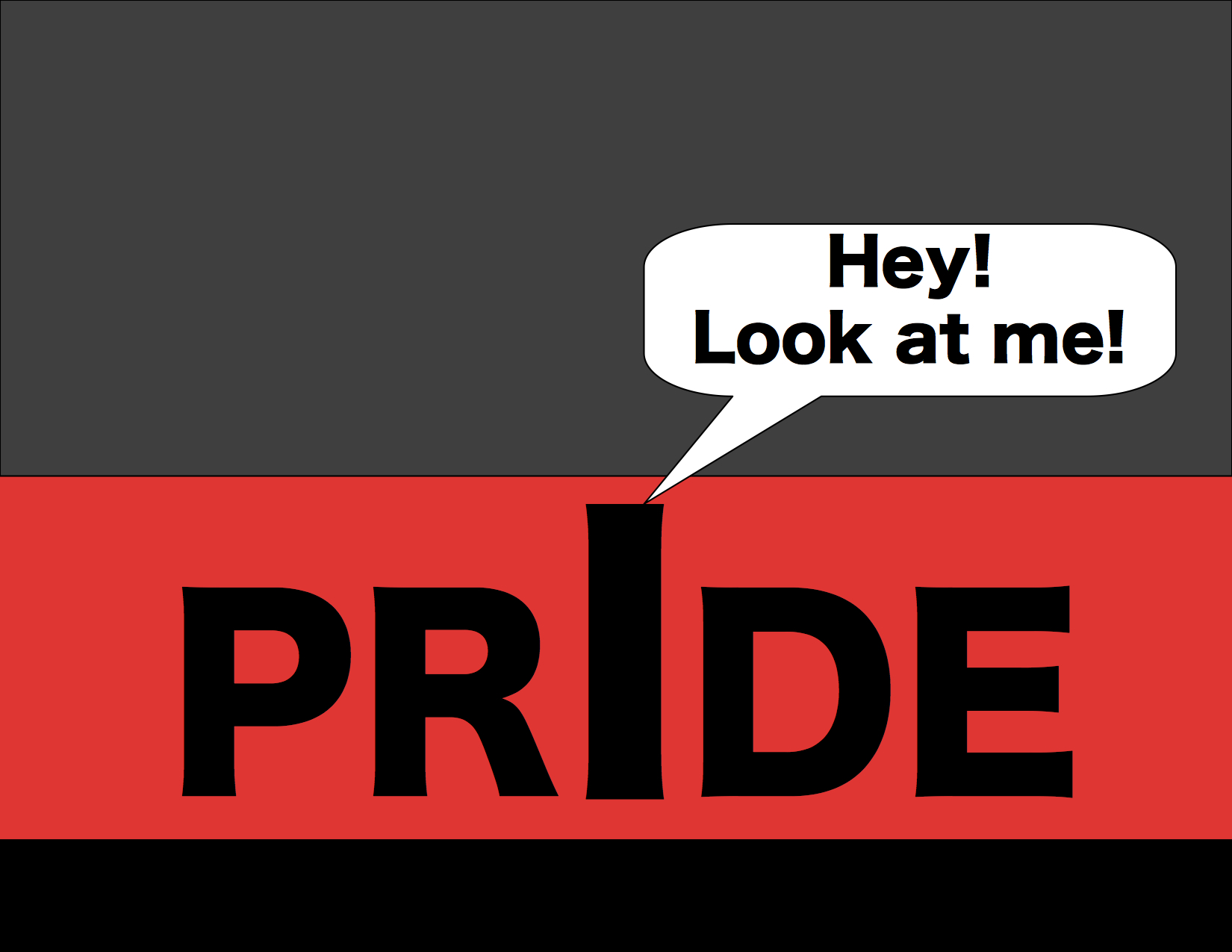
  • Look in the mirror. James says the Bible is the perfect mirror. So how does your life line up with the Scripture? Don’t sugarcoat it … Don’t make excuses … Say the words “Look at me” or “Wow, I’ve got it” out loud. Do you find those in God’s Word? If not, root it out!
  • Get some tough guys around you. You need some loving people around you that aren’t the ones writing your press releases. You need people around you that can boldly say, “Ahem! You appear to be getting off track.”
  • Monitor your gut-level responses. If you feel defensive, or if you feel the need to justify or make excuses, watch out because that’s pride’s signature.
  • Stay on your knees. Not only in prayer, but in service too. It’s awfully hard to get full of yourself when you’re washing feet, or scrubbing toilets. If you ever think any job is beneath you, watch out because you may have been infected by pride.

“Depth under depth of self-love and self-admiration. Pride! It was through Pride that the devil became the devil; it is the complete anti-God state of mind. Pride is essentially competitive in a way the other vices are not. Pride is a spiritual cancer. —C.S. Lewis

I have two companion chapters in my book Shepherd Leadership: The Metrics That Really Matter that dive deeper into this topic: “A confident leader’s attitude adjustment” and “A humble leader’s attitude adjustment.” I hope you will pick up a copy.

►► Would you please prayerfully consider supporting this ministry? My Patreon supporters get behind-the-scenes access to exclusive materials. ◀︎◀︎