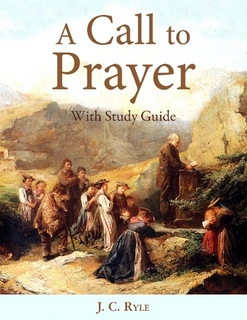
A Call To Payer (book review)

A Call To PayerJ.C. Ryle asks a pretty simple question over and over in the first few chapters of his book A Call To Prayer: Do you pray?

On the face of it, this seems like a pretty naive question to ask. After all, if his readership is a Christian, wouldn’t he be praying already? But Ryle says quite simply, “It is one thing to say your prayers and another to pray.” So in chapter after chapter he reinforces the vital need for real praying.

This isn’t a finger-in-your-face, pulpit-pounding message, but J.C. Ryle delivers his impassioned plea for prayer with great humility. In fact, in the closing pages of the book he says, “I offer these points for your private consideration. I do it in all humility. I know no one who needs to be reminded of them more than I do myself. But I believe them to be God’s own truth, and I desire myself and all I love to feel them more. … I want the times we live in to be praying times. I want the Christians of our day to be praying Christians. I want the church to be a praying church.”

The chapters are short, but power-packed. The Chapel Library version of the book includes several thought-provoking questions and calls to action at the end of each chapter.

We must pray. We must really pray, and pray more earnestly than ever before. This book may be just the nudge to help you do that.

7 Quotes From “Discipleship In Crisis”

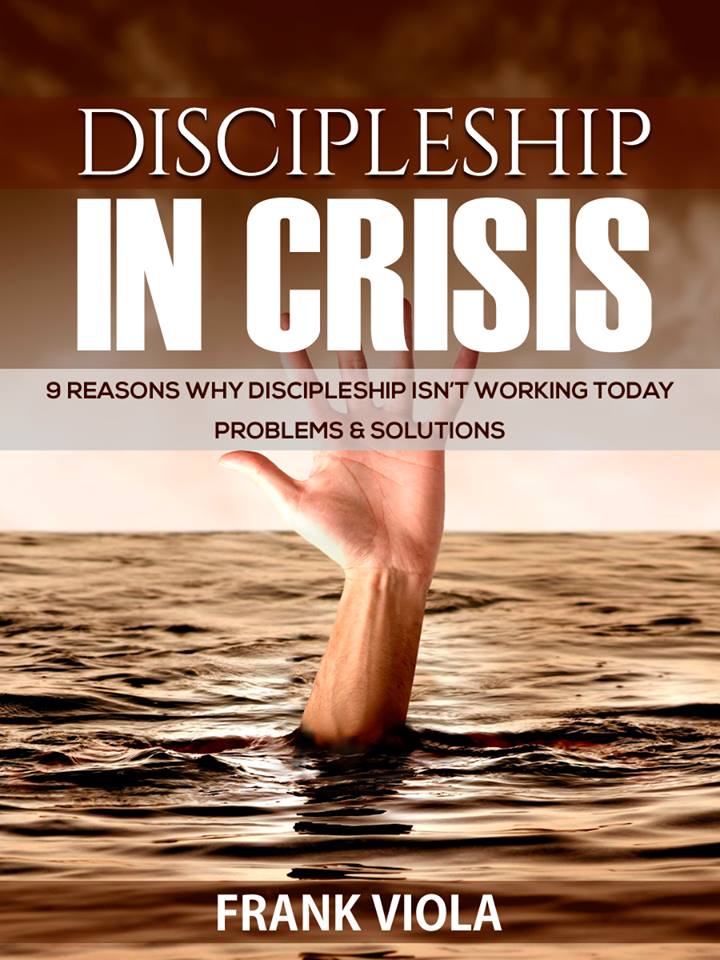
Discipleship In CrisisCheck out my review of Discipleship In Crisis by Frank Viola by clicking here. Below are a few quotes which I found especially highlighter worthy.

“The presupposition that sits underneath virtually every sermon heralded today and most of the Christian books that fill bookstores is that we can live the Christian life if we just try hard enough. If we study our Bible more, pray more, witness more, tithe more, hear more sermons… then we can be like Jesus. But that’s not the gospel. The gospel teaches that just as Jesus couldn’t do anything of Himself, we can’t do anything of ourselves. Listen to the Lord again: ‘Without Me you can do nothing.’ The Christian life is impossible. It’s only Him-possible.” 

“The goal of the gospel is not to get you out of hell and into Heaven, but to get God out of Heaven and into you.”

“A person who is living by the tree of life doesn’t sit back and say, ‘Let me try to do good and avoid evil.’ Instead, he allows the life of God to flow with in and through him. He yields to the instincts, promptings, and energy of that God-life. … You see, ‘good’ is a form of life. And only God is good. Here are the two choices before you today: (1) The choice to intellectually know good from evil and to try to do good = the tree of the knowledge of good and evil; (2) Living by the life of God, which is goodness itself = the tree of life.”

“The only way you and I can truly imitate Jesus’ external lifestyle is to imitate His internal relationship with His Father.”

“What history teaches us is that men have never learned anything from it.” —G.W.F. Hegel

“In a word, you cannot raise the bar on discipleship without raising the bar on the ekklesia—the living experience of the body of Christ—the native habitat in which true disciple-making and transformation take place.”

“The New Testament talks about spiritual seeing, spiritual touching, spiritual tasting, spiritual handling, and spiritual healing. These are the faculties of your Spirit-regenerated human spirit. Jesus was very much in touch with His spiritual instincts, and hence, He ‘perceived’ things ‘in His spirit’ that were outside natural means. He did this as a man anointed by the Holy Spirit, not because He was God.”

Discipleship In Crisis (book review)

Discipleship In CrisisI am a recent “convert” to the writings of Frank Viola, but this man’s heartbeat is so biblically-tuned that his words resonant with godly authority. I recently read Discipleship In Crisis which is a timely message for the church.

For a limited time you can get Discipleship In Crisis as a free ebook by clicking here.

This book is short and to the point. You can easily read through it in one sitting, but the issues which Frank will cause you to re-think in the way we are currently “doing church” might take you quite awhile to process. If you are involved in a larger church, implementing these ideas might really throw a monkey-wrench in the gears!

But this is a message that needs to be heard, as the way we are doing “discipleship” now isn’t working … because it’s not biblical.

Download the ebook, read it, and then get together with others to discuss it.

Absolute Fact

C.S. LewisI recently re-read C.S. Lewis’ book Miracles (you can read my full book review by clicking here). As you may have noticed, after reading and reviewing books on this blog, I also like to share some quotes that caught my attention. Doing this with Lewis is difficult, because in order to get the context of a particular quote, I think I would have to cite almost a full page or more. So over the next few weeks I plan to share some quotes from Miracles that require not as much context, or I will provide a bit of background to set the stage.

Lewis took head-on the idea that God is everywhere or can be in everything, that all paths will ultimately lead to Him. This, Lewis firmly states, is not the case. God is definite and so there is a definite way to come to Him.

“We say that God is ‘infinite.’ In the sense that His knowledge and power extended not to some things but to all, this is true. But if by using the word ‘infinite’ we encourage ourselves to think of Him as a formless ‘everything’ about whom nothing in particular and everything in general is true, then it would be better to drop that word altogether. Let us dare to say that God is a particular thing. Once He was the only Thing: but He is creative, He made other things to be. He is not those other things. He is not ‘universal being’: if He were there would be no creatures, for a generality can make nothing. He is absolute being—or rather the Absolute Being—in the sense that He alone exists in His own right. But there are things which God is not. In that sense He has a determinate character. Thus He is righteous, not amoral; creative, not inert. The Hebrew writings here observe an admirable balance. Once God says simply I AM, proclaiming the mystery of self-existence. But times without number He says, ‘I am the Lord’—I, the ultimate Fact, have this determinant character, and not that. And men are exhorted to ‘know the Lord,’ to discover and experience this particular character. …

“God is basic Fact or Actuality, the source of all other facthood. At all costs therefore He must not be thought of as a featureless generality. If He exists at all, He is the most concrete thing there is, the most individual, ‘organized and minutely articulated.’ He is unspeakable not by being indefinite but by being too definite for the unavoidable vagueness of language. … An impersonal God—well and good. A subjective God of beauty, truth and goodness, inside our own heads—better still. A formless life-force surging through us, a vast power which we can tap—best of all. But God Himself, alive, pulling at the other end of the cord, perhaps approaching at an infinite speed, the hunter, king, husband—that is quite another matter.”

I posted other passages from Miracles under Miracle Or “Cheating”?Miracles And Nature, and Correcting The Pantheist.

The Ministry Of God’s Word (book review)

The Ministry Of God's Word

As a pastor I am frequently in awe that God would use me to share His Word with His people. At times it can feel almost overwhelming. Reading Watchman Nee’s teaching to pastors in The Ministry Of God’s Word I feel equal parts heaviness and encouragement.

The heaviness comes from the even deeper realization that Nee brings to pastors of their awesome responsibility before God to be the messengers of His Word. Nee makes it clear that if a pastor’s heart or mind is not as tuned in as possible, the message will be diminished in its delivery.

The encouragement comes from the realization of how much the Holy Spirit wants to help a preacher get his heart, mind, spirit, memory, and even vocabulary in a place that can be used greatly by God.

Pastors, this is not an easy-to-read book. Not because of the vocabulary, but because of the deepness of the subject matter. You will find yourself confronted at every page. But as you persevere through Nee’s challenging message, you will feel God’s Spirit moving to equip you for even great ministry of God’s Word.

And I would be remiss if I didn’t say thank you to my son Harrison for giving this book to me as a gift. Thank you, son!

7 Quotes From “The Greatest Words Ever Spoken”

The Grestest Words Ever SpokenObviously the best quotes from The Greatest Words Ever Spoken are from Jesus Himself. But Steven K. Scott, who complied the words of Christ into this unique format (you may read my book review by clicking here) had some good things to say too.

“No occurrence in history or physical science has been verified with a higher degree of statistical certainty than the fact that Jesus is exactly who He claimed to be—the Messiah, the Son of the living God.” 

“We cannot worship the Father in spirit or in truth unless we see Him for who He really is and understand His relationship with the Son.”

“Agnostics hold the position that they simply do not know if God exists. Atheists, on the other hand, claim intellectual superiority over all others, saying they know there is no God.”

“If you want to know what God thinks and feels, how He acts and works, what grieves Him and what pleases Him, all you have to do is read the words and observe the behavior of Jesus Christ.”

“Several years ago a string of four letters took the Christian community by storm. It seemed like WWJD, which stands for ‘What would Jesus do?’ was everywhere—and why not? When a choice has to be made, is any other question more important to ask? The answer is ‘Yes, one question is more important. One question Christians should ask before choosing any course of action, making any spiritual decision, or adopting any value or belief.’ That question is ‘WDJS: what did Jesus say?’ This is the question Christians need to ask because in many situations we simply can’t know for sure what Jesus would do, so we are left to figure it out for ourselves. And figuring it out may require more wisdom, revelation, insight, and spiritual maturity than we possess at the time. … Jesus made more statements about how His followers should live and what they should believe than about any other group of topics.”

“By nature, we evaluate nearly every situation according to its immediate impact on our desires, and we make our choices accordingly. Consequently, we often sacrifice that which would bring infinite eternal benefit in exchange for temporary gratification.”

“Jesus shows us that blaming others for our failures is not only offensive to God; it is detrimental to our relationships. While we all want healthier relationships, most of us have a hard time breaking free from our natural inclinations. The words of Christ… can bring about extraordinary change in every relationship in your life, for the rest of your life. … We can have better relationships with anyone who crosses our path, but it doesn’t happen naturally. Jesus provides both the revelation and the power that frees us from our human nature.”

The Greatest Words Ever Spoken (book review)

The Grestest Words Ever SpokenThe greatest Man to ever walk the earth had His words recorded for us. The Bible contains the words of Jesus, intermingled with the descriptions of the things He was doing and the reactions of those who heard and saw Him. In The Greatest Words Ever Spoken, Steven K. Scott has given us the words of Jesus gathered together in easy-to-search categories.

Many Bibles print the words of Christ in red to distinguish them from the rest of the text. In The Greatest Words Ever Spoken almost all you will read are red letter words. With only minimal chapter and category headings, and a few brief introductions to each chapter, Steven Scott steps aside and lets Jesus speak for Himself for over 500 pages.

I don’t think I’ve said this about another book before, but one of the most helpful things in this book is the table of contents. Seriously! It is so cool to be able to find a topic on which I want to absorb the perfect wisdom of Jesus Christ, and turn to that collection of His words on a specific topic. And with so many red letters greeting me on each page, I can let my guard down and drink it all in.

I quickly scanned through this entire book to be able to give you my thoughts, but now I am right back into it, reading slowly and hungrily. It’s so good! The full Bible cannot be beat for giving you the context and setting for Christ’s remarks, but when you want to get right down to the bare essence of what the Master said, you can’t beat The Greatest Words Ever Spoken.

I am a Waterbrook Multnomah book reviewer.

Correcting The Pantheist

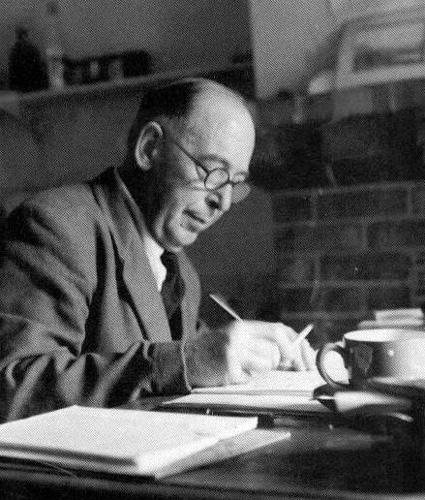
C.S. Lewis at his deskI recently re-read C.S. Lewis’ book Miracles (you can read my full book review by clicking here). As you may have noticed, after reading and reviewing books on this blog, I also like to share some quotes that caught my attention. Doing this with Lewis is difficult, because in order to get the context of a particular quote, I think I would have to cite almost a full page or more. So over the next few weeks I plan to share some quotes from Miracles that require not as much context, or I will provide a bit of background to set the stage.

Democritus was a Greek philosopher who proposed the universe was made up of invisible atoms and empty space. The atoms perpetually bounced around and sometimes connected with other atoms to form our tangible universe. Erwin Schrödinger put a ‘concreteness’ or ‘definiteness’ to the atomic theories previous held. In other words, Democritus saw an almost pantheistic, indescribable vagueness about Nature, whereas Schrödinger gave it definition. Lewis says that Christians need to put Monotheistic definitions on Nature and Supernature. 

“At every point Christianity has to correct the natural expectations of the Pantheist and offer something more difficult, just as Schrödinger has to correct Democritus. At every moment he has to multiply distinctions and rule out false analogies. He has to substitute the mappings of something that has a positive, concrete, and highly articulated character for the formless generalities in which Pantheism is at home.” 

 “If God is the ultimate source of all concrete, individual things and events, then God Himself must be concrete, and individual in the highest degree. Unless the origin of all other things were itself concrete and individual, nothing else could be so; for there is no conceivable means whereby what is abstract or general could itself produce concrete reality. Bookkeeping, continued to all eternity, could never produce one farthing. Metre, of itself, could never produce a poem. Bookkeeping needs something else (namely, real money put into the account) and metre needs something else (real words, fed into it by a poet) before any income or any poem can exist. If anything is to exist at all, then the Original Thing must be, not a principal nor a generality, much less an ‘ideal’ or a ‘value,’ but an utterly concrete fact.”

For more quotes from this book, check out Miracle Or “Cheating”? and Miracles And Nature.

8 Quotes From “The Facts On World Religions”

The Fact On World ReligionsThe Facts On World Religions is a broad overview of the four major religions of the world—Christianity, Islam, Buddhism and Hinduism. You can read my full book review by clicking here. These are some of the passages I found noteworthy….

“Positive criticism: Being critical of other people’s beliefs is necessary for the sake of what is true and what is good. Every idea in the world is not true, regardless of what relativists claim. And some ideas are harmful, including religious ideas. We have also been critical of our own faith when needed, so when we ask adherents of other religions to analyze their own perspectives, we are not requesting that they do something we ourselves have neglected.” 

“The Bible’s uniqueness in some 20 different areas—including many specific predictions of the future (especially as to the Messiah), theology and content, textual preservation against all odds, the physical resurrection from the dead of its central character, scientific and medical prevision, the miraculous existence of Israel, historic and archaeological accuracy, victory over all criticism, and massive influence in human history—is virtual proof that the Bible comprises God’s revelation to humanity. Because it alone is evidentially and independently verified, at points of conflict all other scriptures are, by definition, false. … The manuscript evidence proving the New Testament’s accuracy is about a thousand times better than for ancient manuscripts that scholars everywhere concede are reliable.”

“Historical facts confirm that the Qur’an has experienced significant corruption through various means. Texts such as The Origins of the Qur’an (edited by Ibn Warraq), though sometimes displaying a rationalistic bias, nevertheless prove beyond doubt that the Qur’an is not a pure text. … Dr. William Miller reveals that for some years after the death of Muhammad there was great confusion as to what material of all that had been preserved should be included in the Qur’an. Finally, in the caliphate of Uthman (644-656 AD) one text was given official approval, and all other material was destroyed.” 

“Buddha did not even claim that his teachings were a unique and original source of wisdom. Buddha always said, ‘Don’t take what I’m saying [that is, on my own authority], just try to analyze as far as possible and see whether what I’m saying makes sense or not. If it doesn’t make sense, discard it. If it does make sense, then pick it up.’” —Clive Erricker

“Internal contradictions in Buddhism make it impossible to know what is true and what is false, leading to an emphasis on subjectivism and experientialism to discover ‘truth,’ rather than upon objective data.” 

“Consider the Wall Street Journal/Heritage Foundation’s ‘Index of Economic Freedom Report.’ From 1995 to 2008, the ‘mostly free’ categories of nations include only some Muslim states, while the ‘mostly unfree’ and ‘repressed’ categories include the large majority of Muslim nations; no Muslim nation exists in the ‘free’ category. Some 600 million souls live in dismal poverty. And it’s not difficult to see why: The average man, woman or child living in a repressed or mostly unfree economy lives a life of poverty on only about $2,800 a year. Compare this with the prosperous residents of the world’s free economies, where the average per-capita income is $21,200, or nearly eight times greater. Put simply, the difference between poverty and prosperity is freedom.”

“Islam may be called a ‘religion of peace,’ but history paints a different picture, no matter how many individual Muslims are peace-loving. The book that most regulates Islam, the Qur’an, is mixed at best in this regard. Entirely different religions, both logically justified, can be extracted from its pages. There are verses about peace and tolerance, but also verses about intolerance, Holy War against non-Muslims, and subjugating the world to the will of Allah. … Evils done in the name of Christian faith have been committed either by nominal Christians who are unbelievers or by deceived believers. In both cases the people are acting inconsistently with Christian faith and the clear teachings of Christian Scripture.” 

“Too few appreciate how critically unique biblical Christianity is when compared to other religions—or the implications. For example, Christianity is the only religion based on the death of its founder, a death that forever altered the course of human history. No other religion has the literal physical resurrection of its founder. Biblical Christianity is the only religion having solid evidence to prove it true. It’s the only religion offering eternal life as a free gift through grace, and the only religion demonstrating beyond the shadow of a doubt that God truly loves us—as demonstrated at the Cross. Biblical Christianity is the only religion to dramatically improve the welfare of humanity in a score of areas.”

The Facts On World Religions (book review)

The Fact On World ReligionsAs a Christian, I have always taken seriously the admonition of the Apostle Peter to, “Always be prepared to give an answer to anyone who asks you the reason for the hope you have. Do this with gentleness and respect” (1 Peter 3:15). Not being able to answer is unacceptable, and so I want to diligently study. The Facts On World Religions by John Ankerberg, John Weldon & Dillion Burroughs is just the book to help me in this pursuit.

The Facts On is a well-researched, well-footnoted, helpful guide to learn the basic information on four of the world’s predominate religions: Christianity, Islam, Hinduism, and Buddhism. For all four religions the authors give a broad overview in the categories of:

  • What are this religion’s central beliefs?
  • How did this religion originate?
  • Is the founder of this religion who he claimed to be?
  • Are this religion’s scriptures reliable?

Having each religion covered in the same four categories make a side-by-side comparison much easier. Although this book is not an in-depth study, every chapter is heavily notated to make it easy to find additional study materials on each religion. The last section of the book is a summation of the findings and addresses the questions: Is all religion good? Is only one religion fully true? Are Christians intolerant to say Christ is the only way? What are the consequences for believing the way these religions teach?

All in all this book is a very handy guide for any student who wants to be prepared to give an answer.

Check out this video from Greg Koukl on why Christians should defend their faith…