Did Jesus Rise From The Dead? (book review)

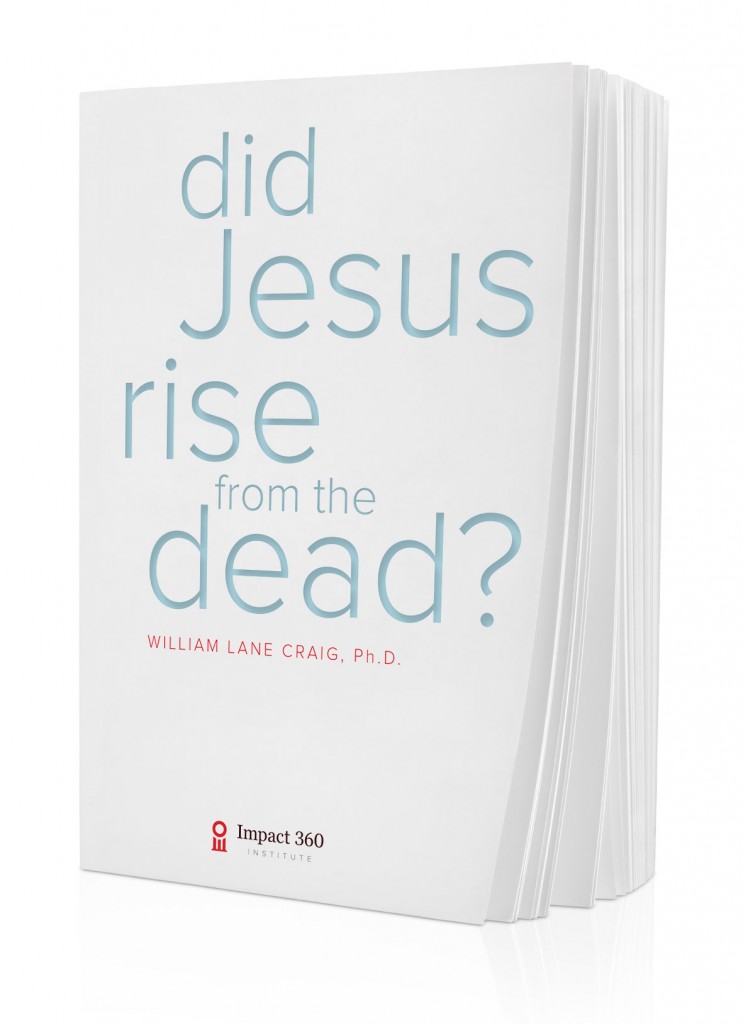
Did Jesus Rise From The DeadDr. William Lane Craig is a brilliant Christian apologist. Part of his brilliance is in the way he can make complex subject matters so accessible for everyone. This is fully on display in his book Did Jesus Rise From The Dead?

This book is a fairly quick read, but it is packed with powerful information. Point-by-point Dr. Craig leads us through the evidence for the empty tomb of Jesus, laying out all of the independently-corroborated evidence for Christ’s resurrection, and dismantling the arguments against His resurrection.

Next he lists several hypotheses—including the conspiracy hypothesis, the apparent death hypothesis, the displaced body hypothesis and the hallucination hypothesis—and gives us the criteria to analyze each of these hypotheses on our own. These criteria include the explanatory scope, the explanatory power, plausibility, less contrived theories, and the disconfirmation factors. Quite fascinating!

The book is well footnoted to give the reader ample sources to dig deeper on any of the points Dr. Craig covers. I could see this being an ideal book for those skeptical of the biblical claims of Christ’s resurrection, as well as a good study tool for Christians to prepare themselves to answer the objections others may have about the good news of Jesus being raised from the dead.

4 Quotes By And About Abraham Lincoln In “Humility”

HumilityI thoroughly enjoyed Dr. David Bobb’s book Humility (you can read my full book review by clicking here). The book was partially a challenge for us to cultivate this virtue in our individual lives and in the fabric of our nation. So Dr. Bobb uses several biographies of notable Americans to illustrate the power of humility. These are some quotes by and about Abraham Lincoln.

“Towering genius disdains a beaten path. It seeks regions hitherto unexplored.” —Abraham Lincoln

“Nowhere in the world is presented a government of so much liberty and equality. To the humblest and poorest amongst us are extended the highest privileges and positions. The present moment finds me at the White House, yet there is as good a chance for your children as there was for my father’s.” —Abraham Lincoln

“[Abraham] Lincoln’s navigation of these almost impossible waters was not without mistakes. What distinguished him from many others, however, were his ability to shift his course without ever losing sight of his destination and his willingness to admit when he steered awry.” —David Bobb

“With our limited understanding we may not be able to comprehend it, yet we cannot but believe, that He who made the world still governs it.” —Abraham Lincoln

5 Quotes By James Madison In “Humility”

HumilityI thoroughly enjoyed Dr. David Bobb’s book Humility (you can read my full book review by clicking here). The book was partially a challenge for us to cultivate this virtue in our individual lives and in the fabric of our nation. So Dr. Bobb uses several biographies of notable Americans to illustrate the power of humility. These are some quotes by James Madison.

“Had every Athenian citizen been a Socrates, every of Athenian assembly would still have been a mob.” —James Madison

“The aim of every political constitution is, or ought to be, first to obtain for rulers men who possess most wisdom to discern, and most virtue to pursue, the common good of the society, and in the next place, to take the most effectual precautions for keeping them virtuous whilst they continue to hold their public trust.” —James Madison

“As there is a degree of depravity in mankind which requires a certain degree of circumspection and distrust, so there are other qualities in human nature which justify a certain portion of esteem and confidence. Republican government presupposes the existence of these qualities in a higher degree than any other form.” —James Madison

“Before any man can be considered as a member of a Civil Society, he must be considered as a subject of the Governor of the Universe.” —James Madison

“Is there no virtue among us? If there be not, we are in a wretched situation. No theoretical checks—no form of government can render us secure. To suppose that any form of government will secure liberty or happiness without any virtue in the people, is a chimerical idea.” —James Madison

4 Quotes By & About George Washington In “Humility”

HumilityI thoroughly enjoyed Dr. David Bobb’s book Humility (you can read my full book review by clicking here). The book was partially a challenge for us to cultivate this virtue in our individual lives and in the fabric of our nation. So Dr. Bobb uses several biographies of notable Americans to illustrate the power of humility. These are some quotes by and about George Washington.

“In [George] Washington’s early haste to achieve greatness, he sometimes let his ambition outpace virtue. He gradually realized this, and he calibrated his actions accordingly. Rather than just cloaking his ambition, Washington recognized that the more he served others and the cause of justice, the more his success would matter. The less his ambition was about his own fame, the more he would deserve the honors he received. Virtue in this sense, he discovered, can be its own reward.” —David Bobb

“I consider it an indispensable duty to close this last solemn act of my official life, by commending the interests of our dearest country to the protection of Almighty God, and those who have the superintendence of them, to His holy keeping.” —George Washington’s resignation speech

“I hope I shall always possess firmness and virtue enough to maintain (what I consider the most enviable of all titles) the character of an honest man, as well as prove (what I desire to be considered in reality) that I am.” —George Washington 

“Of all the dispositions and habits which lead to political prosperity, religion and morality are indispensable supports.” —George Washington’s farewell address

6 Quotes From Profound Thinkers From “Humility”

HumilityI thoroughly enjoyed Dr. David Bobb’s book Humility (you can read my full book review by clicking here). The book was partially a challenge for us to cultivate this virtue in our individual lives and in the fabric of our nation. These are some noteworthy quotes from some noteworthy thinkers that Dr. Bobb referenced.

“This way is first humility, second humility, third humility … if humility does not precede and accompany and follow every good work we do, and if it is not set before us to look upon, and beside us to lean upon, and behind us to fence us in, pride will wrest from our hand any good deed we do while we are in the very act of taking pleasure in it.” —Augustine 

“But devout humility makes the mind subject to what is superior. Nothing is superior to God; and that is why humility exalts the mind by making it subject to God.” —Augustine

“Real wisdom is never pretending to seem to know what one does not know.” —Plato

“The Christian virtues are not natural and reasonable virtues of a golden mean but radical virtues of grace.” —Karl Löwith

“Nothing more certainly makes a man ridiculous than an over-forwardness to display his excellencies.” —John Witherspoon

“Smoke has no weight.” —Augustine

Impertinent Poems (book review)

Impertinent PoemsImpertinent Poems is a lovely collection of poetry from Edmund Vance Cooke. In case you left your dictionary at home, “impertinent” implies someone is a bit brash and out of line, so you might almost think that these poems are a bit cheeky.

And they are. Sort of.

Cooke does poke and prod his readers to take a good, long, honest look in the mirror in a way that’s almost too pointed. But then you realize that his finger is pointed squarely at his own reflection in the mirror, and we are almost listening in as he talks to himself.

Some of the poems are fun, some make you laugh, some seem a bit out of date (remember: these poems were written nearly 100 years ago), but all of them will make you think. And that is the beauty of well-written poetry.

10 Quotes On Humility From “Humility”

HumilityI thoroughly enjoyed Dr. David Bobb’s book Humility (you can read my full book review by clicking here). The book was partially a challenge for us to cultivate this virtue in our individual lives and in the fabric of our nation. So Dr. Bobb uses several biographies of notable Americans to illustrate the power of humility. These are some of the best quotes in the book on humility.

“Healthy pride is tied to truth, and pride devoid of merit is arrogance. Humility’s opposite that is arrogance, not pride. … The personal significance of this idea is radical: to be truly great, one has to be humble. The political significance of this idea is profound: to be truly and enduringly great, a nation’s hallmark must be humility.” 

“In reality, humility is strength, not weakness. It is the crown of the virtues. Humility enables courage and points wisdom in the right direction. It is the backbone of temperance, and it makes love possible.”

“Humility offers the promise of excellence, but it does not guarantee power when power is the proud domination of human beings. The power promised by humility is power over oneself in self-government. It is much harder to achieve. Humility’s strength is hidden, obscured by our blindness in the age of arrogance in which we live.” 

“Instead of responding to God’s love and drawing closer to Him, the first human beings retreated into the recesses of their hearts. In so doing they became less themselves—less like God created them to be. They departed from their nature, which was perfect until they turned from God. Unhealthy pride pushes man away from God; it destroys his ability to cling to his Creator as he should, not in miserable self-debasement, but in worshipful humility.”

“True humility enables true compassion.” 

“The key was not creating a government in which a leader could feign goodness and get away with it, but rather in creating one in which goodness could not be counted on, but was nevertheless sought. … America’s Founders knew the importance of humility and desired to be humble, but they also wished to make their mark. They were ambitious. They wanted to be great, but only if greatness came not at the expense of goodness.”

“The truly great person will be a servant. No less committed to excellence in everything, and still as dedicated to the highest achievements, the magnanimous man as servant can accomplish even more than when he tries to do it alone. Service is not servility. Meekness is not weakness. Humility is an essential part of true greatness of soul.”

“Contrary to popular misconceptions, modesty is not the underestimation of one’s worth. Rather, it acts as a restraint against the inordinate desire for recognition. While everyone desires recognition, a modest person quells the longing for fleeting fame. Modesty checks the impulse to claim credit and crave praise. It is the anti-vanity.”

“As a virtue, humility has an ordering quality to it. Arrogance has the opposite effect, as it loosens the grip of self-control and throws a human soul into disorder. … Ambition is not evil itself, but when an individual lets ambition run wild, it has the tendency to take over his soul. When this happens, a person loses sight of limitations. He is deluded into thinking himself unbeatable. Arrogance gives rise to unchecked ambition and begins a vicious cycle. Unchecked ambition leads to make those in its thrall more and more arrogant. And the arrogant continue to grow in misdirected ambition. This cycle—arrogance feeding ambition, and ambition giving way to more arrogance—can produce a tyrant. … Ambition is like pride in one decisive respect. Held in check, it is immensely important to the accomplishment of high and difficult tasks. Left unchecked, it is a debilitating force. Pride in check can be balanced with humility. One can be properly proud of some accomplishment and at the same time humble. … Like healthy pride, there is also worthy ambition.”

“Humility is a virtue prerequisite to prudence. If one lacks humility, the advancement of self or the substitution of an immoral end can overwhelm the pursuit of a just end. … Prudence allows the statesman to consider all alternatives and to make a decision not based upon who garners glory but upon the proper demands of the situation at hand. Prudence requires the submersion of one’s ego.”

Humility (book review)

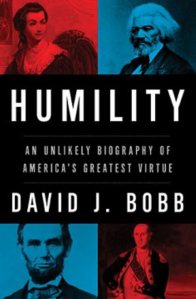
HumilityDavid J. Bobb has a title/subtitle combination that almost sounds paradoxical—Humility: An Unlikely Biography Of America’s Greatest Virtue. After all, when many think of America they are more likely to use the terms “confidant” or even “brash,” but not usually “humble.” But in this seeming paradox is a great truth.

The Greek philosophers often described a virtue as the golden mean between two extremes. Indeed, David Bobb uses such philosophers as Socrates and Aristotle, alongside Augustine and even more modern thinkers like Benjamin Franklin, to explore how America could be virtuous because of its humility.

Or more precisely, how America could be virtuous because of humble Americans. Dr. Bobb explores the biographies of notable Americans like George Washington, James Madison, Abigail Adams, Abraham Lincoln and Frederick Douglass to give us an intriguing description of what true humility looks like. Although in their time many thought of these people as proud or even glory-seekers, Dr. Bobb shows us how it was their profound, often hard-won humility that made them examples worth emulating.

And we do need these examples. In the epilogue, Dr. Bobb quotes Oliver Wendell Holmes, “Humility is the first of the virtues for other people.” How true! The question is: Will Americans re-learn the virtuous power and strength of humility, or will humility continue to erode, mistaken by many as a weakness?

For both history enthusiasts, leaders, leaders-in-training, and those who love a good biography, Humility is a very enjoyable and educational book.

I am a Thomas Nelson book reviewer.

11 Quotes From “A Call To Prayer”

A Call To PayerJ.C. Ryle makes the case for more prayer in his book A Call To Prayer. You can read my book review by clicking here. These are a few of the quotes I thought were thought provoking.

“But this I do say, that not praying is a clear proof that a man is not yet a true Christian. He cannot really feel his sins. He cannot love God. He cannot feel himself a debtor to Christ. He cannot long after holiness. He cannot desire heaven. He has yet to be born again. He has yet to be made a new creature. He may boast confidently of election, grace, faith, hope, and knowledge, and deceive ignorant people. But you may rest assured it is all vain talk if he does not pray.”

“We live in days of abounding religious profession. There are more places of public worship now than there ever were before. There are more persons attending them than there ever were before. And yet in spite of all this public religion, I believe there is a vast neglect of private prayer.”

“Diligence in prayer is the secret of eminent holiness.”

“Bibles read without prayer; sermons heard without prayer; marriages contracted without prayer; journeys undertaken without prayer; residences chosen without prayer; friendships formed without prayer; the daily act of private prayer itself hurried over, or gone through without heart: these are the kind of downward steps by which many a Christian descends to a condition of spiritual palsy, or reaches the point where God allows him to have a tremendous fall. This is the process which forms the lingering Lots, the unstable Samsons, the wife-idolizing Solomons, the inconsistent Asas, the pliable Jehoshaphats, the over-careful Marthas, of whom so many are to be found in the church of Christ.”

“You may be very sure men fall in private long before they fall in public. They are backsliders on their knees long before they backslide openly in the eyes of the world. Like Peter, they first disregard the Lord’s warning to watch and pray, and then like Peter, their strength is gone, and in the hour of temptation they deny their Lord.”

“Prayer can lighten crosses for us, however heavy. It can bring down to our side One who will help us to bear them. Prayer can open a door for us when our way seems hedged up. It can bring down One who will say, ‘This is the way, walk in it.’ Prayer can let in a ray of hope when all our earthly prospects seem darkened. It can bring down One who will say, ‘I will never leave thee, nor forsake thee.’ Prayer can obtain relief for us when those we love most are taken away, and the world feels empty. It can bring down One who can fill the gap in our hearts with Himself, and say to the waves within, ‘Peace; be still.’ Oh that men were not so like Hagar in the wilderness, blind to the well of living waters close beside them.”

“There is not a single good reason that you can show for living without prayer.”

“Wait not because you feel unworthy. Wait for nothing. Wait for nobody. Waiting comes from the devil. Just as you are, go to Christ. The worse you are, the more need you have to apply to Him. You will never mend yourself by staying away.”

“Fear not because your prayer is stammering, your words feeble, and your language poor. Jesus can understand you.”

“It should not be enough to confess we are sinners: we should name the sins of which our conscience tells us we are most guilty. It should not be enough to ask for holiness; we should name the graces in which we feel most deficient. It should not be enough to tell the Lord we are in trouble; we should describe our trouble and all its peculiarities.”

“Sermons and books and tracts, and committee meetings and the company of good men, are all good in their way, but they will never make up for the neglect of private prayer.”

The Central Miracle

C.S. Lewis at his deskI recently re-read C.S. Lewis’ book Miracles (you can read my full book review by clicking here). As you may have noticed, after reading and reviewing books on this blog, I also like to share some quotes that caught my attention. Doing this with Lewis is difficult, because in order to get the context of a particular quote, I think I would have to cite almost a full page or more. So over the next few weeks I plan to share some quotes from Miracles that require not as much context, or I will provide a bit of background to set the stage.

Lewis talks a great deal about the Creator entering His creation, quoting from passages in the Bible that talk about Christ’s pre-existence before Time, and His choice to descend into Nature.

“The central miracle asserted by Christians is the Incarnation. They say that God became Man. Every other miracle prepares for this, or exhibits this, or results from this. … Everywhere the great enters the little—its power to do so is almost a test of its greatness. In the Christian story God descends to re-ascend. He comes down; down from the heights of absolute being into time and space, down into humanity; down further still, if embryologists are right, to recapitulate in the womb ancient and pre-human phases of life; down to the very roots and seabed of the Nature He has created. But He goes down to come up again and bring the whole ruined world up with Him. One has the picture of a strongman stooping lower and lower to get himself underneath some great complicated burden.”

For other quotes from this book see Miracle Or “Cheating”?Miracles And NatureChristianity And PantheismCorrecting The Pantheist, and Absolute Fact.