7 More Quotes From “The Ministry Of God’s Word”

The Ministry Of God's WordWhat a fascinating book Watchman Nee wrote in The Ministry Of God’s Word. In fact, it’s one of the rare books that I called a must read for pastors (you can read my book review by clicking here). To whet your appetite I’ve been sharing some quotes from this book.

“This is an enormous task, a task which far surpasses human ability. Every servant of God must realize his incompetency. He should prostrate himself before God, knowing how incompetent he is in supplying Christ, even though he may be well able to speak on the doctrines or teachings of the Bible. Let us look to God’s mercy today. We need to reevaluate everything. We must see how absolutely useless we are. We are utterly helpless without His mercy. To be a minister of the Word is too serious a matter to be taken lightly. It is not an easy task which can be fulfilled just by reading the Bible so many times. A minister of the Word must be able to supply Christ and help people to touch Christ by his words.”

“To obtain a pure minister of the Word God has to so work in a person that his outward man is broken. Hence it is necessary for a minister of the Word to accept the discipline and control of God; otherwise he will surely destroy God’s Word by the mingling in of his own undealt flesh. … The Holy Spirit has been able to work to such a depth that when that man stands to speak, people hear the Lord speaking.”

“Ministry requires our seeing something before God and in freshness presenting this thing to the church. … Each time I minister I need to receive special revelation for the occasion. … Continuous revelation begets continual ministry.” 

“The same message with the same delivery may not produce the same result; only the same anointing will.”

“God never intends to give us small revelations. If He grants revelation, His revelation is big; its scope and content is rich. How can anything inglorious come forth from the God of glory? The normal portion God gives man is a cup running over. God is forever rich, great, and all-inclusive.” 

“Man’s mental strength acts like his physical strength. If his arm can only lift fifty pounds of weight, then he cannot handle anything heavier, not even one additional pound. So is our mental strength limited. If we exhaust its energy on other things we will have nothing left with which to spend on the things of God; and hence we will not be able to translate God’s light into thought.”

“In the things spiritual, natural eloquence is useless. God must give words. … Hence we must wait on God and read the Bible, asking Him to grant us the words. When the words do come, we are instantly assured of what we should speak today. … The greater the lack of revealed words the longer should be the waiting before God. Pray, commune, wait, and lay the Bible before God. This is not an ordinary waiting, nor ordinary prayer and communion. This is waiting before God with the Bible, praying to God with the Bible, and communing with God over the Bible.” 

You can read the other quotes I’ve posted by clicking here, here, here, and here.
10 More Quotes From “The Ministry Of God’s Word”

The Ministry Of God's WordPastor, if you haven’t read The Ministry Of God’s Word by Watchman Nee yet, you need to put this on your To Do list. It’s one of the very few books I have labeled a must read for pastors (you can read all about it in my book review by clicking here). Here are a few more quotes from this fascinating book.

“There is no assurance that the Word previously anointed by the Holy Spirit will again be anointed each time it is spoken. Let us remember that the Word of revelation we earlier received is not guaranteed to always be such a word whenever it is uttered. The Word remains, but revelation does not linger. You may repeat the Word, yet you cannot repeat the revelation or the anointing. Revelation and anointing are in God’s hand. You can only repeat the words, you cannot recall revelation.” 

“A minister is one in whom there is light, revelation, and the anointing of the Holy Spirit. When he arises and speaks on the Bible, God is willing to speak through the Bible. This is how a minister supplies the church with God’s Word.”

“One reason for the prevailing impotency of the church is that our Lord does not find a way through us.”

“Do not be a professional preacher. Once you turn professional you speak not because you have something to say from God but because you are obliged to utter something.”

“Serving the church with God’s Word is ministering the Son of God. … If the Bible is divorced from the Person of Christ it becomes a dead book.” 

“The task is not simply presenting a book to men, rather is it presenting the Son of God in the Book.”

“What you preach must be what you truly know.” 

“The Word of God is not something people hear by just being present. Physical presence does not insure the hearing of the Word.”

“You are sure that the Lord wants you to minister this Word and He will providentially arrange the time and opportunity for you to deliver it. And thus the Word you preach shall become Christ in others. This is the ministry of the Word in us.

“One cannot minister the Christ one does not know, nor can one serve with only a fragmentary knowledge of Christ. Ministry cannot be based on fragmentary knowledge. … For God to reveal His Son in us is not the result of research or searching; it is entirely a matter of mercy and revelation. It is an inward seeing, an inner knowing. And thereafter the Bible becomes a new and living Book.”

You can read other quotes from this book by clicking here, here, and here.

12 Quotes From “Create”

CreateCreate by Stephen Altrogge is a quick motivating read to help you: (1) realize that God created you to be creative, (2) remove the excuses for not exercising your creativity, and (3) encourage you to get something started! You can read my full book review by clicking here. Below are some quotes I highlighted in Create.

“Everyone was created to create. It’s hardwired into us by our Maker. … We are created in the image of God we all have an irresistible impulse to create and to establish order. When a painter brings forth beauty from the chaos of his paint palette, he is reflecting the image of God. When an accountant massages an unruly mass of data into an intelligent sales report, she is reflecting the image of God. When a writer assembles letters into words and words into sentences and sentences into paragraphs and paragraphs into pages and pages into a book, he is reflecting the image of God. When a wife tastefully decorates her house with paint colors and throw pillows, she is reflecting the image of God. When a chef mixes flower and sugar and eggs to create a cake, she is reflecting the image of God.”

“If we’re constantly dependent on the approval of other people we’ll always be afraid of failure. If we’re constantly needing the affirmation and praise of those around us then we’ll never take any creative risks. … Our identity is not rooted in what we create it’s rooted in Christ. Our identity is wrapped up in the One who created us, not the things that we create. Our acceptance doesn’t come from our friends or coworkers or fellow artists, it comes from Christ.”

“Be at peace with being lousy for a while. Chesterton once said that anything worth doing was worth doing badly. He was right. Only an insufferable egoist expects to be brilliant first time out.” —Douglas Wilson

“Trying to be perfect all the time takes the fun out of creativity.”

“When you start a creative project don’t look at the end, look at the next step in front of you.”

“A journey of a thousand miles is begun with a step.  Beware of despising small beginnings.  Some men never arrive at usefulness because they are not satisfied to begin in a small way, and proceed by a step at a time.” —Charles Spurgeon

“Most creative works are the result of faithful effort, not massive creative outbursts.”

“I believe in plodding. Productivity is more a matter of diligent, long-distance hiking than it is one-hundred-yard dashing. Doing a little bit now is far better than hoping to do a lot on the morrow. So redeem the fifteen minute spaces.” —Douglas Wilson

“Being a successful creator requires making a habit out of creativity. The most consistently creative people are the ones who have made creativity a habit. They sit down at their desk every single day and do the work. They may not work for long periods of time, but they do work consistently. They don’t wait for the creative muse to descend upon them. They sit down, grab the muse by the ear, and start putting words on paper or numbers in a spreadsheet or paint on a canvas. The muse does not descend upon those who wait. The creative muse descends upon those who grab hold of it, put it in a headlock, and force it into submission.” 

“If our creative work truly is for the honor of God, we should be willing to see it through to the end. … If we give up easily on a project that we believe will honor the Lord, we’re not being faithful. We’re being lazy, and we’re actually being selfish. We’re not allowing others to benefit from the creative gifts that God has given us.”

“If we’re truly seeking to glorify God through creativity, then we should be open to all manner of advice, suggestions, and even criticisms. God created us to be dependent on other people, and this is true in the creative field as well. … If we don’t pursue feedback there’s a pretty good chance that our creative work isn’t going to be very good.” 

“Psalm 24:1 says, ‘The earth is the Lord’s and the fullness thereof, the world and those who dwell therein….’ God created the world. Everything in the world belongs to Him and everything in the world is infused with His creativity. The world is literally busting at the seams with the creativity of God. There are ideas lurking around every corner! Creativity is everywhere. We just need to be on the lookout for it.”

Links & Quotes

link quote

Pay attention, guys: 3 Ways A Man Should Lead His Home. I love this quote from this post: “A husband and father can’t impart what he doesn’t possess. So the best strategy for the everyday preacher is to first preach the gospel to himself. Then, through his own repentance, he is able to lead his family to the very place where he himself has been.” —Dave Bruskas

This is a fun quiz: 100 Bible Knowledge Questions from Kevin DeYoung.

A brand new book from John Piper which he calls “the one most different from all the others.” Read more about Seeing Beauty And Saying Beautifully, and download a free PDF version.

A beautiful reminder from Chilly Chilton that God wants to bless us: The Search.

Create (book review)

Create“I believe that God has given every single person creative gifts. … This book is intended to help you use those gifts. It’s intended to help you stop making excuses and start making stuff for the glory of God.” That’s how Stephen Altrogge begins his book Create.

This is not a book for budding artists, nor struggling authors, nor promising young musicians. It is a book for all of those folks and for everyone who wants to unlock the creative potential the Creator has implanted in them.

Stephen writes about what he’s learned about creativity, and bolsters each of his points with personal examples, biblical references, and quotes from others who have tapped into their creative potential. Along the way Stephen gives us encouragement to be creative and demolishes all of the excuses we typically use to try to convince ourselves that we’re not creative.

This is a short but very informative and liberating book. Get it today!

Faith’s Checkbook (book review)

Faith's CheckbookWhen you pull out your checkbook, it’s nice to have money in the account so your check will be honored. The same concept holds true for your “spiritual bank account.” Charles Spurgeon has a collection of daily biblical promises called Faith’s Checkbook which will help you realize how fully-funded God has made your spiritual account.

Each day the Spurgeon, called the Prince of Preachers, highlights a promise in God’s Word and unpacks all the riches that promise delivers. Each thought only takes a page, but Spurgeon gives you enough “cash” to provide for you for that day.

What a fantastic year-long journey of faith-building I had with Faith’s Checkbook!

5 More Quotes From “The Ministry Of God’s Word”

The Ministry Of God's WordThere was simply too many passages I highlighted in The Ministry Of God’s Word by Watchman Nee to share in just one post. Pastor, you must read this book! You can read my full book review by clicking here.

“Each man’s special characteristic is brought out only when he is subject to the Holy Spirit.” 

“No one today can have God’s Word extraneous to the Bible; even the New Testament cannot exist alone, nor can the words of Paul. You cannot cut the Old Testament away and retain much of the New Testament; neither can you excise the four Gospels and keep the letters of Paul. … All the ministries in the Bible are interdependent; none possesses an unconnected revelation totally unrelated to the others and entirely disconnected.”

“How does God interpreted the Bible? How does He explain the words of the Old Testament to the New Testament minister? There are at least three distinct ways of interpretation in the New Testament: (1) prophetic interpretation, (2) historical interpretation, and (3) comprehensive interpretation. When New Testament ministers study the Old Testament words, they will approach the Scriptures from these different angles: they look to the Holy Spirit for interpretation of prophetic words, historical records, or comprehensive messages.” 

“Let us remember that ministry of the Word in our day ought to be richer than that of those who wrote the New Testament. … How, then, do we say that today’s ministry of the Word should be richer? Because Paul had in his hand only the Old Testament as the basis of his speaking, but we have in our hand the writings of Paul and Peter and others in addition to the Old Testament. Paul had only 39 books in his hand, but we have 66 books. Hence our ministry should be richer in Word. We have more materials at the disposal of the Spirit of God, more opportunities for God’s Spirit to explain. Our ministry therefore ought not be poorer but richer.”

“One should never deceive himself by thinking he can be a minister of God’s Word if he simply reads the Bible. The question is not whether he has read the Bible: it is instead, how has he read it?”

You can read other quotes from this book by clicking here and here.

A Few More “Generation iY” Thoughts

Generation iYIn a recently-released last chapter to his ground-breaking book Generation iY, Tim Elmore added material that made me realize more than ever that this book is a must read for anyone who works with youth. You can read my book review by clicking here, and you can read some other quotes I shared from this chapter by clicking here.

Just a few additional thoughts Dr. Elmore shared in this chapter that I wanted to pass along to you—

“We did a better job preventing, presuming and protecting then we did preparing.” 

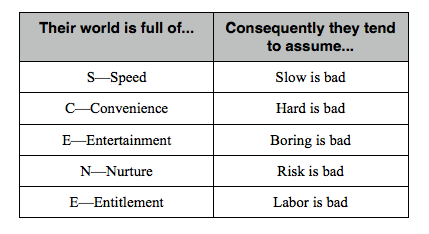
Gen iY assumptions

“Examine the right-hand column for a moment. Notice the words slow, hard, boring, risk and labor. Are those not the very ingredients that build a mature adult? When a task is hard and it moves slowly, it builds patience and work ethic in me. When things are boring, it forces my mind to be creative on its own. When I have to take risks, I learn that failure is not final or fatal, and that it’s only when I risk failure that I feel the satisfaction of true success. And when I learn to embrace labor, using my strengths to add value to others, I learned the value of service.”

“Wherever you see a lacking virtue, there’s likely an activity you can do to build it, just as one would lift weights to improve physical muscle strength. … We can no longer assume those emotional muscles will develop naturally in kids. We must initiate a plan to build them. Will likely need to discuss this issue over with them, and agree to balance the virtual with the genuine; the screen with the real. In short: 

  • More time interacting with the real people. 
  • More time outside in active movement. 
  • More time working and waiting on answers. 
  • More time initiating and less time reacting.” 

“It’s important to strike a balance between utilizing the conveniences of modern technology and building the life skills that require no technology.”


Generation iY (one more chapter)

Generation iYThree years ago I posted this—

I’m going to make a statement about Dr. Tim Elmore’s book Generation iY that I rarely make: This book is a MUST READ for parents and anyone who works with youth!

Yes, a must read. The subtitle of this book is not over-dramatized, but really is an understated truth: Our last chance to save their future.

Recently Tim Elmore released in ebook format a final chapter to Generation iY. After reading this I was just as convinced that anyone who works with our youth must read this book (read my full book review by clicking here). Here are a few quotes from this chapter.

“Historical trends suggest that every time there is a population explosion among the youth (between 15-29 years old), violence follows. Sociologist Gunnar Heinson reported that countries are vulnerable when the youth population is 30 percent or higher.” 

“Our assessment of 8,500 high school and college students clearly reveals a drop in:

  • Resilience—we removed the ability to bounce back after a failure.
  • Empathy—we have pushed them toward self-expansion.
  • Work ethic—their short attention spans make the daily grind a turn-off.
  • Stamina—sticking with the task when the novelty’s going is difficult.
  • Ambition—the internal drive to succeed is replaced by external stimuli.
  • Self-awareness—few adults have been honest about their blind spots.”

“Condoleezza Rice and Joel Klein released a report recently saying that the state of our youth is now an issue of national security. Seventy-five percent of America’s youth are not even fit for the military due to obesity, criminal records or failure to graduate high school.”

  1. As technology goes up, empathy goes down. We can find a direct parallel between screen time and the lack of empathy in adolescence. It makes sense, doesn’t it? A text that says ‘I am having a bad day’ doesn’t elicit the same empathy as being face to face with a person in tears, in the midst of a crisis. It seems virtual, so our empathy is virtual. Kids often laugh at what they cried about a decade ago.
  2. As information expands, attention spans diminish. Resilience, patience, and attention spans have dropped thanks to today’s quick, convenient, and saturated world. When overwhelmed, we surrender readily. Herbert Simon said it best: “A wealth of information creates a poverty of attention.”
  3. As options broaden, long-term commitment shrinks.
  4. As life speeds up, patience and personal discipline drop.
  5. As external stimulation increases, internal motivation decreases. Experiments among students show that external rewards actually reduce internal drive and ambition. Kids work for the reward, not the satisfaction of the work. The external (and possibly artificial and superficial) reduces incentive and, consequently, self-sufficiency.
  6. As consequences for failure diminish, so does the value of success.
  7. As virtual connections climb, emotional intelligence declines.
  8. As free content swells, so does our sense of entitlement.


High Adventure In Tibet (book review)

High Adventure In TibetA book about dedication, perseverance, adventure, near misses and escapes, intrigue, triumphs and tragedies. Yep, High Adventure In Tibet by David Plymire has all of that. But this isn’t a novel; it’s a true story!

High Adventure recounts the life of Victor Plymire (David’s father) who was a pioneer missionary in taking the message of Jesus Christ into the interior of Tibet in the early 1900s. Persevering through language barriers, religious strongholds, political intrigues, civil wars, the advance of Communism, and the difficulty of travel through mountainous regions and deserts, Victor would not rest until all Tibetans had an opportunity to hear the biblical account of Jesus.

David spent his childhood in Tibet, so he knows both the man, the terrain, and the people about which he writes. He also includes direct quotations from his father’s diary to give a real-time feel to the events in the book. One of the most amazing recurring themes for me was the miraculous way God provided for Victor time and time again, usually at a moment in which it appeared all was lost.

For young and old alike, High Adventure is a book that will keep you interested from the opening pages. For you, as it did for me, I pray this book (re)awakens the importance of praying for and financially supporting missionaries. And perhaps God will even use this book to call some readers to a mission field. I know that response would please God, and Victor Plymire.