Pleasure & Profit In Bible Study (book review)

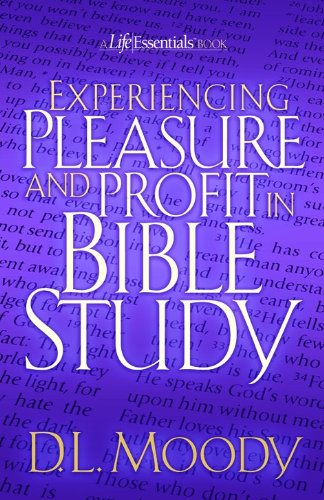
Pleasure & ProfitNear the beginning of Pleasure & Profit In Bible Study, Dwight Moody states the purpose of his book: “We cannot overestimate the importance of a thorough familiarity with the Bible. I try to lose no opportunity of urging people by every means in my power to the constant study of this wonderful Book. If through the pages that follow, I can reach still others and rouse them to read their Bibles, not at random but with a plan and purpose, I shall be indeed thankful.”

I am thankful that D.L. Moody took the time to pen this book for us. Though over a century old, his words are bringing a renewed excitement to studying my all-time favorite book: The Bible.

Moody devoured God’s Word, and had amazing recall of all he read. He reminds us that anything we are full of will be much easier to recall and apply. He then allows us a glimpse into his personal study time, showing us how he reads his Bible, what he looks for, how he marks certain passages, and other ways to engage Scripture.

If anyone ever felt like their Bible reading or studying was in a rut, this book will be a welcome rejuvenator. Even for those who already appreciate their time studying God’s Word, Pleasure & Profit will bring new insights for your study time.

I highly recommend this book!

C.S. Lewis In A Time Of War (book review)

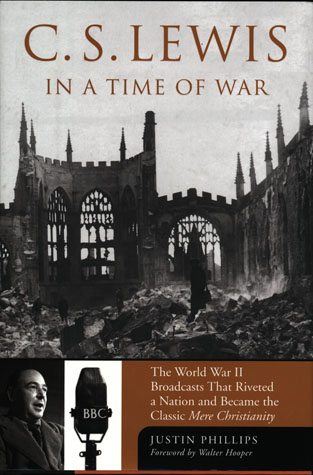
In A Time Of WarC.S. Lewis In A Time Of War by Justin Phillips combined several favorite things for me: World War II history, an inside look at old-time radio, a biography on one of my favorite authors, and a fascinating look at the repercussions of one man’s life.

The BBC Radio was just coming into its own during the lead up to World War II. England again was to play a major part on the world stage, and the radio became not only the primary means of communicating inside Great Britain, but also to the world as well. Radio was used to inform, to pass along vital information, to entertain, and to boost morale.

After having already endured The Great War (what we now call World War I), the English populace was largely dismayed at being forced into another bloody conflict. As anyone might imagine, morale was at an all-time low and questioning God’s role in these cataclysmic events was at an all-time high. The BBC felt duty-bound to try to raise morale and answer these questions.

Looking back on history, C.S. Lewis seems the perfect choice to be the voice of encouragement and reason that the BBC would use, but at the time Lewis was a little-known don at Magdalen College who had never written a script to be read over the airways (something far different than writing for someone else to read themselves in essay or book form). So not only did the BBC take a huge leap of faith, but so did Lewis, as a failure in this venture could have seriously damaged his reputation and future.

As it turned out, Lewis’ talks were immensely popular, and the text of those talks ended up being published in the book form we now know as Mere Christianity. C.S. Lewis also experienced one of the most productive times of his life, cranking out many other of his most popular books, sermons, and talks given to the Royal Air Force and other military personnel.

If you are a fan of C.S. Lewis, World War II history or old-time radio, there is much to enjoy in this well told story by Justin Phillips. Definitely a great read!

NOTE: Focus on the Family produced an excellent audio drama using this book as the source. Check out my review of that production by clicking here. 

A Mathematical Quote From Gerald Schroeder In “There Is A God”

There Is A GodAs I said in my book review of Anthony Flew’s There Is A God, the real value of this book is in the arguments which contributed to Flew’s shift from atheism to theism. You can read my full book review by clicking here.

Frankly, it’s hard to share a lot of the quotes because the context of the full argument would be lacking, but I’ve been sharing a few of them over several posts. To continue, here is an extensive quote from mathematician Gerald Schroeder, which is set up by a quote from Anthony Flew.

“Schroeder first referred to an experiment conducted by the British National Council of Arts. A computer was placed in a cage with six monkeys. After one month of hammering away at it (as well as using it as a bathroom!), The monkeys produced fifty typed pages—but not a single word. Schroeder noted that this was the case even though the shortest word in the English language is one letter (a or I). A is a word only if there is a space on either side of it. If we take it that the keyboard has thirty characters (the twenty-six letters and other symbols), then the likelihood of getting a one-letter word is 30 times 30 times 30, which is 27,000. The likelihood of getting a one-letter word is one chance out of 27,000. Schroeder then applied the probabilities to the sonnet analogy. ‘What’s the chance of getting a Shakespearean sonnet?’ he asked. He continued:

‘All the sonnets are the same length. They are by definition fourteen lines long. I picked the one I knew the opening line for, “Shall I compare thee to a summer’s day?” I counted the number of letters; there are 488 letters in that sonnet. What’s the likelihood of hammering away and getting 488 letters in the exact sequence as in “Shall I Compare Thee to a Summer’s Day?” What you end up with is 26 multiplied by itself 488 times—or 26 to the 488th power. Or, in other words, in base 10, 10 to the 690th. 

‘Now the number of particles in the universe—not grains of sand, I am talking about protons, electrons, and neutrons—is 10 to the 80th. Ten to the 80th is one with 80 zeros after it. Ten to the 690 is one with 690 zeros after it. There are not enough particles in the universe to write down the trials; you’d be off by a factor of 10 to the 600th. 

‘If you took the entire universe and converted it to computer chips—forget the monkeys—each one weighing a millionth of a gram and had each computer chip able to spin out 488 trials at, say, one million times a second; if you turn the entire universe into these microcomputer chips and these chips were spinning a million times a second producing random letters, the number of trials you would get since the beginning of time would be 10 to the 90th trials. It would be off again by a factor of 10 to the 600th. You will never get a sonnet by chance. The universe would have to be 10 to the 600 times larger. Yet the world just thinks the monkeys can do it every time.’”

  • More quotes are forthcoming.
  • You can read some direct quotes from Anthony Flew by clicking here.
  • Some Albert Einstein quotes can be found by clicking here.

5 Quotes From Albert Einstein In “There Is A God”

There Is A GodAs I said in my book review of Anthony Flew’s There Is A God, the real value of this book is in the arguments which contributed to Flew’s shift from atheism to theism. You can read my full book review by clicking here.

Frankly, it’s hard to share a lot of the quotes because the context of the full argument would be lacking, but I’ve begun sharing some of them over several posts. To continue, below are some quotes from Albert Einstein.

“I am not a positivist. Positivism states that what cannot be observed does not exist. This conception is scientifically indefensible, for it is impossible to make valid affirmations of what people ‘can’ or ‘cannot’ observe. One would have to say ‘only what we observe exists,’ which is obviously false.” —Albert Einstein

“The man of science is a poor philosopher.” —Albert Einstein

“I want to know how God created this world. … I want to know His thoughts, the rest are details.” —Albert Einstein

“I’m not an atheist, and I don’t think I can call myself a pantheist. We are in the position of a little child entering a huge library filled with books in many languages. The child knows someone must have written those books. It does not know how. It does not understand the languages in which they are written. The child dimly suspects a mysterious order in the arrangement of the books but doesn’t know what it is. That, it seems to me, is the attitude of even the most intelligent human being toward God. We see the universe marvelously arranged and obeying certain laws but only dimly understand these laws. Our limited minds grasp the mysterious force that moves the constellations.” —Albert Einstein

“Every one who is seriously engaged in the pursuit of science becomes convinced the laws of nature manifest the existence of a spirit vastly superior to that of men, and one in the face of which we with our modest powers must feel humble.” —Albert Einstein

More quotes are forthcoming. You can read some direct quotes from Anthony Flew by clicking here.

9 Quotes From “Sidelined”

SidelinedSidelined was a book I could hardly put down: such a compelling story of love, and family, and overcoming adversity! You can read my full book review by clicking here. Below are some quotes I highlighted in this book, unless otherwise noted all of the quotes are from Coach Pagano.

“We can! We will! We must! By any means necessary—we have no choice—we will win.”

“We were determined to create a culture where guys couldn’t wait to come to work. We wanted people who would be excited about getting up in the morning and being here. … We wanted a workplace where people are honest and forthright with each other. We wanted open communication to be practiced daily. We wanted every person in the building to be treated with the dignity that every human being deserves. Sure, we’re tough guys, and we like to joke and trash talk sometimes as part of our fun. But there has to be a limit to that kind of behavior, and we wanted everyone to respect each other more than anything else. A joke’s only funny if we all share in it together at no person’s expense. And when we make mistakes or do something wrong, we don’t deny it. We want a place that if we are going to eat crow, we are going to eat it while it’s hot!”

“…My condition will not determine my position. I understand the condition, but choose to focus on my position. That is to stay positive and serve….” (part of a letter to his team before the Green Bay Packers game)

“Endurance is not just the ability to bear a hard thing, but to turn it into glory.” —William Barclay

“You brought the spiritual plane. That’s why your leadership goes beyond coaching. You set an example as a spiritual leader, and that’s what inspires people.” —Kevin Elko

“Coaching is a profession of love. You can’t coach people unless you love them.” —Eddie Robinson

“People sometimes ask me what we look for in a player—how we know he’ll be a good fit for our program. It’s a hard question to answer because there are so many variables. … We also go beyond all the facts and stats and determine if these are what we like to call ‘horseshoe guys.’ The horseshoe emblem of the Colts shows seven nails or studs. Each one represents a quality we want in a player/leader for our team—smart, tough, dynamic, physical, character, integrity, and respect. … Players who want to be a part of something bigger. Something great.”

“Part of the reason I couldn’t remain disappointed after our lost to the Ravens [in the playoffs] was that I knew we had built our foundation on solid rock. We had established something that wasn’t going to dry up and blow away in a matter of weeks or months. Our team was committed to building a program for sustained success. We called it ‘building the monster.’ We wanted to take our building blocks of athleticism, talent, and skill and bring them to life with our commitment, character, and determination.”

“Cancer can take away a lot—your hair, your appetite, your energy, and, yes, sometimes your very life. But cancer cannot take away the love that passes between you and the special people in your life. It can’t take away the support and encouragement, the creativity and beauty, the connections and relationships to others who are fighting alongside you. No matter how hard it tries, cancer can never contain the human spirit or diminish the power of faith.”

5 Quotes From Anthony Flew In “There Is A God”

There Is A GodAs I said in my book review of Anthony Flew’s There Is A God, the real value of this book is in the arguments which contributed to Flew’s shift from atheism to theism. You can read my full book review by clicking here.

Frankly, it’s hard to share a lot of the quotes because the context of the full argument would be lacking, but I’m going to attempt to share some of them in multiple posts. To start with, below are some of the direct quotes from Anthony Flew.

“I have said in some of my later atheist writings that I reached the conclusion about the nonexistence of God much too quickly, much too easily, and for what later seemed to me the wrong reasons. I reconsidered this negative conclusion at length and often, but for nearly seventy years thereafter I never found the grounds sufficient to warrant any fundamental reversal. One of those early reasons for my conversion to atheism was the problem of evil.” 

“The presumption of atheism can be justified by the inescapable demand for grounds. To believe there is a God, we have to have good grounds for the belief. But if no such grounds are provided, there exists no sufficient reason for believing in God, and the only reasonable position is to be a negative atheist or an agnostic (by negative atheist, I meant ‘a-theist,’ parallel to such words as atypical and amoral). … This argument garnered many and varied responses. Writing as an agnostic, the English philosopher Anthony Kenny maintained that there may be a presumption for agnosticism, but not for positive or negative atheism. He suggested that it takes more effort to show that you know something than that you do not (this includes even the claim that the concept of God is not coherent). But he said this does not let agnostics off the hook; a candidate for an examination may be able to justify the claim that he or she does not know the answer to one of the questions, but this does not enable the person to pass the examination. … By far, the heaviest challenge to the argument came from America. The modal logician Alvin Plantinga introduced the idea that theism is a properly basic belief. He asserted that belief in God is similar to belief in other basic truths, such as belief in other minds or perception (seeing a tree) or memory (belief in the past). In all these instances, you trust your cognitive faculties, although you cannot prove the truth of the belief in question. Similarly, people take certain propositions (e.g., the existence of the world) as basic and others as derivative from these basic propositions. Believers, it is argued, take the existence of God as a basic proposition.”

“If there is an infinite series of books about geometry that owe their pattern to copying from earlier books, we still do not have an adequate answer as to why the book is the way it is (e.g., it is about geometry) or why there is a book at all. The entire series needs an explanation.” 

“Science qua science cannot furnish an argument for God’s existence. But the three items of evidence we have considered in this volume—the laws of nature, life with its teleological organization, and the existence of the universe—can only be explained in the light of an Intelligence that explains both its own existence and that of the world.”

“My discovery of the Divine has been a pilgrimage of reason and not of faith.”

Check back soon for some additional quotes from this thought-provoking book.

Sidelined (book review)

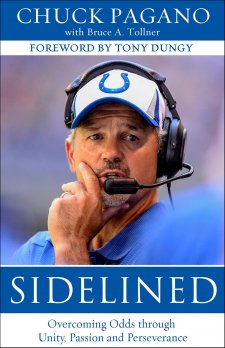
SidelinedEvery once in awhile I come across a book that is hard to put down. Sidelined by Chuck Pagano, the head coach of the NFL’s Indianapolis Colts, is just such a book.

Before I lose anyone who says, “Football? Not interested,” let me assure you that this is not a football book. This is a great story of near-tragedy and triumph that happens to have a football coach as its main character. This is a book about family, and faith, and teamwork, and pulling together, and overcoming. It’s a love story with a happy ending. It’s a great book!

In a nutshell, Chuck Pagano is hired as the head coach of the Colts, the first time in his career he has gotten a shot at being a head coach. Just a couple of games into his very first season, he is diagnosed with leukemia and sees his coaching responsibilities immediately halted. He enters into a life-and-death struggle with cancer, and ultimately beats it. But the real triumph of the story is the way his diagnosis pulled together a whole city, and even other NFL cities, to raise awareness of this dreaded disease.

Sidelined doesn’t really have an ending, because Coach Pagano’s career is still ongoing, and so is the fight against leukemia. After reading this book, I’m not only cheering for Coach, but I’m also cheering on those in the fight of their lives against cancer as well as those searching for a cure for this disease.

I am a Thomas Nelson book reviewer.

There Is A God (book review)

There Is A GodIt’s a mark of a strong, confident person that can admit, “I was wrong. I made a mistake.” Anthony Flew is just such a strong man. His book is called There Is A God: How the world’s most notorious atheist changed his mind.

The one sentence summary of this book could be: Anthony Flew was a noted philosopher who concluded there was no God, but then was persuaded to rethink his position and came to a complete reversal. But that would sell his story short.

The real meat-and-potatoes of the book are the arguments which helped change Anthony Flew’s mind. This, I must warn you, is no easy reading. The arguments are so nuanced and metaphysical at times, that it really requires a careful reading. This was not a book I could speed read, because the chain of logic in the arguments was simply too good to miss anything.

I throughly appreciated the candor with which Flew shared his metamorphosis from atheist to Theist. The book also includes two appendices which address the current state of modern atheism, and an interview with N.T. Wright on Jesus being God Incarnate.

If you are ready to study some of the atheistic and theistic arguments that the brightest apologists for both viewpoints are presenting today, then this is the book for you! I thought the journey of discovery was fantastic and mind-expanding!

12 Quotes From “Tactics

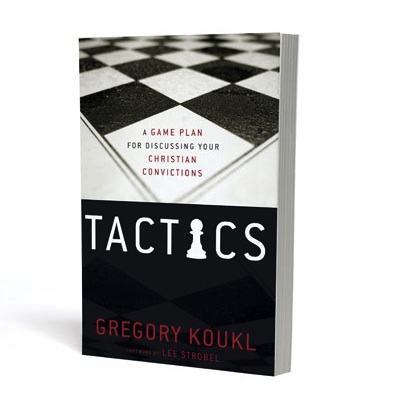
TacticsIn Tactics Greg Koukl gives Christians more how than what/why in defending the Biblical faith. It is an outstanding read that I recommend to all Christians (young or old). You can read my full book review by clicking here. Below are just a few of the quotes I highlighted in this empowering book.

“First, Christ’s ambassadors need the basic knowledge necessary for the task. They must know the central message of God’s kingdom and something about how to respond to the obstacles they’ll encounter on their diplomatic mission. … However, it is not enough for followers of Jesus to have an accurately informed mind. Our knowledge must be tempered with the kind of wisdom that makes our message clear and persuasive. This requires the tools of a diplomat, not the weapons of a warrior, tactical skill rather than brute force. Finally, our character can make or break our mission. Knowledge and wisdom are packaged in a person, so to speak. If that person does not embody the virtues of the kingdom he serves, he will undermine his message and handicap his efforts.” 

“The tactical approach requires as much careful listening as thoughtful response.”

“It is not the Christian life to wound, embarrass, or play one-upmanship with colleagues, friends, or even opponents, but it’s a common vice that anyone can easily fall into.” — Hugh Hewitt 

“Always make it a goal to keep your conversations cordial. Sometimes that will not be possible. If a principled, charitable expression of your ideas makes someone mad, there’s little you can do about it. Jesus’ teaching made some people furious. Just make sure it’s your ideas that offend and not you, that your beliefs cause the dispute and not your behavior.”

“The ability to argue well is vital for clear thinking. That’s why arguments are good things. Arguing is a virtue because it helps us determine what is true and discard what is false. … Paul warns against wrangling about words and quarreling about foolish speculations (2 Timothy 2:14, 23). But he also commands us to be diligent workmen, handling the word of truth accurately (2 Timothy 2:15). And, because some disputes are vitally important, Paul solemnly charges us to reprove, rebuke, and exhort when necessary (2 Timothy 4:112). This cannot be done without some confrontation, but disagreement need not threaten genuine unity.”

“If you want skeptics to believe in the Bible, don’t get into a tug-of-war with them about inspiration. Instead, invite them to listen—to engage Jesus’ words firsthand—then let the Spirit do the heavy lifting for you.”

“You have to know why Jesus is the only way before it is helpful to tell people that He is the only way.” 

“There are three specific things you can do to ‘ready’ yourself to respond. You can anticipate beforehand what might come up. You can reflect afterward on what took place. And in both cases you can practice the responses you think of during these reflective moments so you will be prepared for the next opportunity.”

“Knowing when to step back requires the ability to separate the hogs and the dogs from the lost sheep looking for a shepherd. But how do you know when someone has crossed the line? When do we have an obligation to speak, and when should we save our pearls for another time? Part of the answer can be found in Jesus’ next words in Matthew 7:6: ‘…lest they trample [the pearls] under their feet, and turn and tear you to pieces.’ Be generous with the truth except with someone who shows utter contempt for the precious gift being offered him. He will simply trample it in the mud and then viciously turn on you. … There is an exception to this principle, however. I have learned from my radio show that sometimes my real audience is not the person I’m talking to, but the people who are listening in, eavesdropping on the conversation. … Lee Strobel calls this ‘ricochet evangelism.’” 

“When I face an aggressive challenger, I often give him the last word. Not only is this gracious, it’s also powerful, conveying a deep sense of confidence in one’s own view. Instead of fighting for the final say-so, give it away. Make your concluding point clearly and succinctly, and then say, “I’ll let you have the last word.” But don’t break this promise. Grant him his parting shot, and then let it rest.”

“Know the truth. Know your Bible well enough to give an accurate answer. Tactics are not a substitute for knowledge. Cleverness without truth is manipulation.”

“Culture is most profoundly changed not by the efforts of huge institutions, but by individual people.” —Chuck Colson


Tactics (book review)

TacticsI am a big fan of Christian apologetics: defending what I believe as a Christian. But until reading Tactics by Greg Koukl, I have found very few books which discuss how to present what I believe.

Tactics isn’t about parlor tricks, or playing games with words. It is truly a mindset to keep a conversation going with someone who wants to know (or challenge) what you believe. When we make a statement, the conversation comes to a screeching halt or explodes into an intense argument. But if we continue to ask questions, a dialogue can continue.

Greg Koukl uses some insights from TV detective Columbo to give Christians some strategies for productive conversations. Peter Falk’s character was an intuitive detective who got his information by asking people to clarify what they were saying, and getting them to open up and talk more. In similar fashion, Greg gives us some ideas of how to find out not only what the other person believes, but why they believe it, by asking some strategic questions.

From the moment I began reading this book, I have been able to immediately use the tactics Greg outlines. I have recommended this book to a couple of other people, and they are also reporting back to me that they are experiencing similar results. So I wholeheartedly recommend this book to any Christian who wants to have more meaningful conversations with others about their faith.