Accountability To Saints

Listen to the podcast of this post by clicking on the player below, and you can also subscribe on AppleSpotify, or Audible. 

Sanctification (saint-ification) is an ongoing process that brings out fruitfulness, joy-fullness, and enhances our testimony to others. And an essential part of this process involves other saints. Notice that this word “saints” it plural. That’s because it is a plural word every place it appears in the Bible. 

Saints have gotten themselves into trouble when they tried to go solo. Like David’s sin with Bathsheba, Elijah’s slide into depression, or Peter’s denial of Jesus. But we also see saints thriving through difficult situations when they have a fellow saint alongside. Like how Barnabas gave Saul his start, Paul and Silas could sing together in prison, Silas and Timothy helped Paul minister, and how Jesus sent out His ambassadors by twos (Luke 10:1).  

(Check out all of the Scriptures in this post by clicking here.) 

I love the names of traveling companions John Bunyan uses in Pilgrim’s Progress: Christian travels with Faithful and Hopeful; Christiana travels with Mercy and Mr. Great-heart. And we get to travel along with some really great people as well (Proverbs 27:17; Ecclesiastes 4:9-12). 

How does accountability to other saints work? Since we see togetherness so much in the early Church (look for the phrases like “each other” or “one another”), think A.C.T.S.—

(1) Admit my need for accountability. James tells us that we all stumble and that even my so-called little slip-ups are major in God’s eyes (James 3:2, 2:10). So I need help. 

John Maxwell said, “Every person is undisciplined in some area of their life; in the area that I am undisciplined, that is the area where I need greatest accountability. I will not do well in my areas of weakness unless I am held accountable for better results.” We all have blind spots, we all have weak areas, and we must be humble enough to admit to those things. 

(2) Choose my accountability partners prayerfully and carefully (Proverbs 12:26; 2 Corinthians 6:14). These should be trustworthy people who have the emotional and spiritual capacity to be able to come alongside me (Proverbs 17:9; Galatians 6:2). 

(3) Trust my friend. Trust their counsel even when it stings a bit (Proverbs 27:6), and trust the effectiveness of their prayers for me (James 5:16). 

(4) Stick with them through thick and thin. Be your brother’s keeper and let them be your keeper (Hebrews 3:12-14). We need to keep at it especially in difficult times. Notice the phrase “let us” that appears five times in Hebrews 10:19-25.  

If we are living with a biblical worldview, we realize that the saints here on earth are those we will also be with for eternity. Our biblical worldview should form our understanding of both being accountable to another saint and holding other saints accountable as well. 

As Jack Hayford so wisely noted, “The believer’s best defense against self-deception is through mutual accountability to one another.” 

If you would like to check out the other messages in our series B.A.S.I.C. Christianity, you can click here. 

►► Would you please prayerfully consider supporting this ministry? My Patreon supporters get behind-the-scenes access to exclusive materials. ◀︎◀︎

Links & Quotes

You cannot get Scripture from the Bible into your heart and mind by osmosis! To develop a biblical worldview, we have to put the Word in so the Holy Spirit can help us work it out.

I have a lot of new video content on my YouTube channel every week. Please check it out and subscribe so you don’t miss anything.

“Without goals, training has no direction.” —Natalie Coughlin 

John Piper saures 12 resolves for Christians to fortify them against viewing pornography. In the post called The High Price of Watching Nudity, Piper says, “I want to invite, frankly, all Christians to join me in this pursuit of greater purity of heart and mind. In our day, when entertainment media is virtually the lingua franca of the world, this is an invitation to be an alien. And I believe with all my heart that what the world needs is radically bold, sacrificially loving, God-besotted freaks, aliens.”

“Accountability closes the gap between intentions and actions.” —Craig Groeschel

T.M. Moore wrote, “Who are your ten most admired pastors? Probably we could all make a list. Why do we admire them? Because their churches are growing? Would they want you to say of them that they really know how to grow a church? We make two mistakes here. First, we mistake big numbers with real growth. The Bible’s view of growth is much more qualitative than quantitative. Second, we think we can get ‘growth’—in numbers—by simple mechanics: Find the right combination of programs, the latest in worship music, and a nice refreshment area. That won’t get the growth Jesus is seeking.”

Staggering Seduction

Listen to the podcast of this post by clicking on the player below, and you can also subscribe on AppleSpotify, or Audible. 

The northern tribes of Israel had been defeat by the Assyrians and gone into exile because of their persistent and unrelenting sins against God. You would think that this would be a vivid enough warning to get the attention of the people of Judah, but sadly it wasn’t. 

King Manasseh sinned and then doubled-down on his sinning. The prophets thundered their warnings, and Manasseh not only kept his sins going but he kept pulling more and more people down into sin with him. 

Isaiah pointed to the example of Israel’s sin—

     Woe to Samaria the crown of pride of the drunkards of Ephraim [the ten tribes], and to the fading flower of its glorious beauty, which is on the head of the rich valley of those overcome and smitten down with wine! … But even these reel from wine and stagger from strong drink: the priest and the prophet reel from strong drink; they are confused from wine, they stagger and are gone astray through strong drink; they err in vision, they stumble when pronouncing judgment. (Isaiah 28:1, 7 AMPC) 

Notice the words like reel and stagger, as though intoxicated by alcohol. 

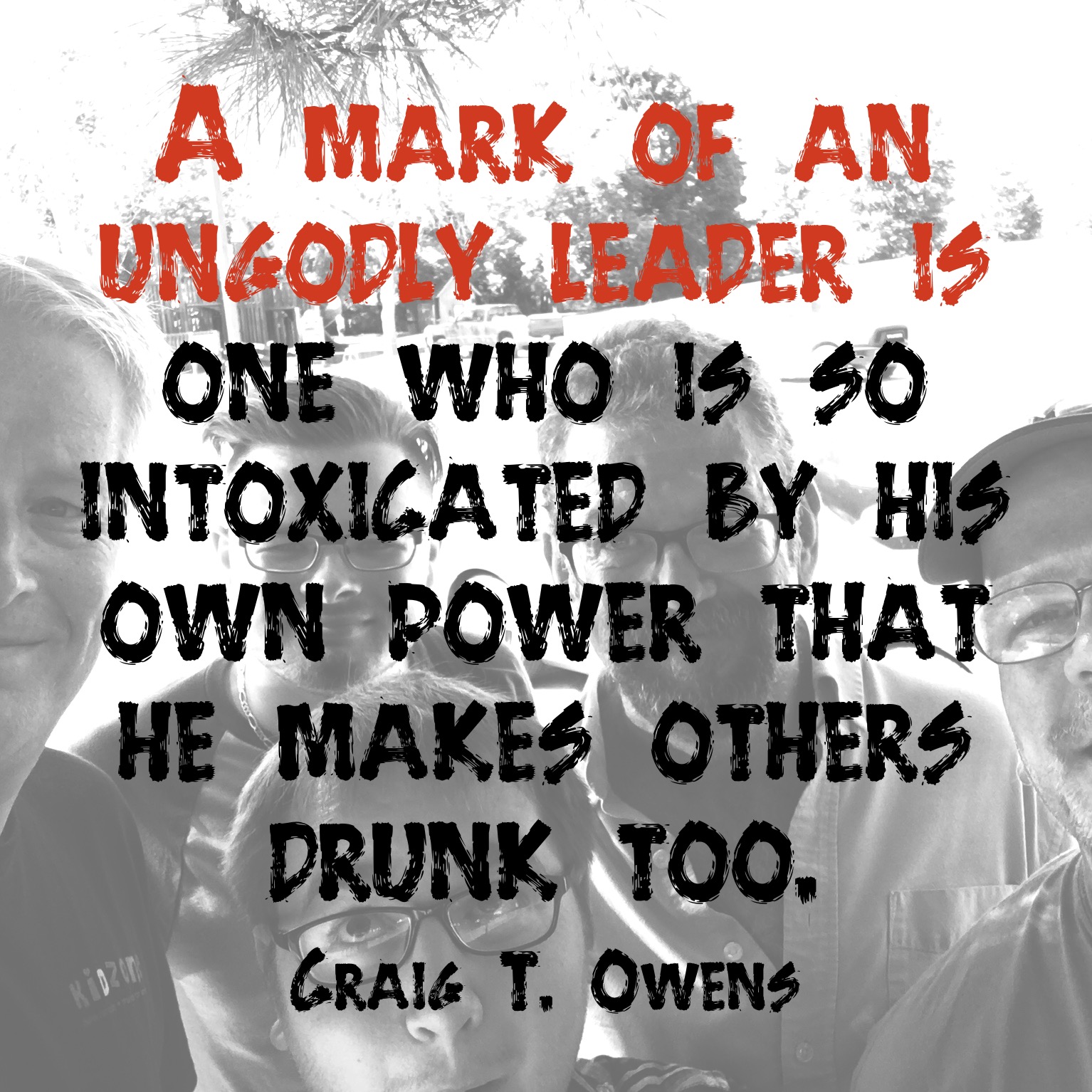
A mark of an ungodly leader is one who is so intoxicated by his own power that he makes others drunk too. 

Look at this description of Manasseh: “But the people [of Judah] would not listen; and Manasseh seduced them to do more evil than the nations did whom the Lord destroyed before the Israelites!” (2 Kings 21:9). 

The Hebrew word translated “seduced” is the same Hebrew word that Isaiah used for the staggering and going astray of a drunkard. 

This is the power that leaders have for both good and evil. A sober-minded, godly leader can encourage people toward righteousness, but an ungodly leader who is intoxicated by his power seduces people to join him in his unrighteousness. Manasseh was described as “making Judah sin, by doing evil in the sight of the Lord” (v. 16).

Certainly there are people who choose a sinful lifestyle during the tenure of a godly leader, and there are people who steadfastly choose righteousness during the tenure of an ungodly leader. But the Bible issues strong warnings to those leaders who misuse their God-appointed positions of leadership to lead people astray (see Ezekiel 3:17-21, 33:1-9). 

Leaders, be on guard that a position of leadership doesn’t seduce you to stray from righteousness. Don’t forget that God chose you for this role, so to Him you will have to stand to give an accounting of your leadership. I pray you can say that you soberly and sincerely pursued righteousness and led your people in that pursuit as well. I want you to hear, “Well done, good and faithful servant” and not, “Depart from Me.” 

This is part 86 in my series on godly leadership. You can check out all of my posts in this series by clicking here.

►► Would you please prayerfully consider supporting this ministry? My Patreon supporters get behind-the-scenes access to exclusive materials. ◀︎◀︎
Know, Go, Show

Listen to the podcast of this post by clicking on the player below, and you can also subscribe on AppleSpotify, or Audible. 

There is a recurring theme throughout the Book of Judges and then later is repeated in the years leading up to Israel’s exile: A godly leader passes off the scene and the people return to their old selfish, godless lifestyle. This sinful life brings God’s punishment, which causes the people to cry out to God for help. God raises up a leader who leads the people in repentance and a return to God. As a result, God’s blessings again flow to His people. Then that leader passes off the scene and the cycle repeats. 

This recurring thought is in the middle of a particularly dark time for Israel: “In those days there was no king in Israel; every man did what was right in his own eyes” (Judges 17:6; see also 18:1). 

The entire 17th and 18th chapters of Judges is a sickening story of the Israelites utterly turning their back on God so they could go do whatever they want. And worst of all, we see godless leaders taking advantage of the situation to line their pockets with worldly riches. 

Just because there is a God-fearing leader on the scene doesn’t guarantee that the people will follow his or her lead and devote themselves to God. But a godless leader almost always results in people debasing themselves by thumbing their nose at God’s laws. 

God raises up leaders and holds them accountable for their actions. He told Ezekiel that there would be consequences for both boldly speaking God’s message or for keeping silent (see Ezekiel 3:16-21). 

God calls His leaders to know His ways, to walk in integrity in that way, and then to call others to walk in that way too. 

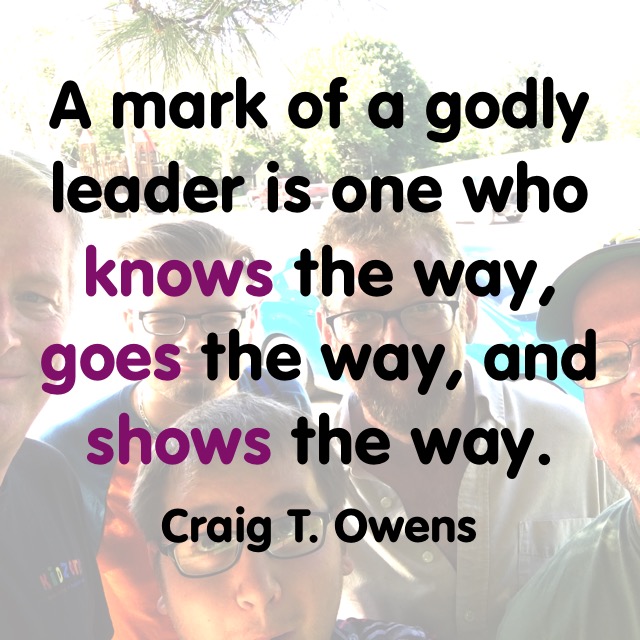
A mark of a godly leader is one who knows the way, goes the way, and shows the way.

This is part 84 in my series on godly leadership. You can check out all of my posts in this series by clicking here.

►► Would you please prayerfully consider supporting this ministry? My Patreon supporters get behind-the-scenes access to exclusive materials. ◀︎◀︎
A Little Is Still Enough

Listen to the podcast of this post by clicking on the player below, and you can also subscribe on AppleSpotify, or Audible. 

“No one will even notice.” 

“It really doesn’t matter what I do.” 

“There’s not much that I’m good at.” 

Sadly, these statements are far too common for a lot of people. Even sadder is how frequently Christians say them. Of all people, Christians should be assured that God has created them on purpose and for a purpose. To fulfill that purpose, God has given each of us the right talents in the right proportions. 

Jesus illustrated it with a story in Matthew 25, but I want to especially highlight what the master said to his stewards when they were giving an account for what had been entrusted to their care. 

     His master said to [the steward entrusted with five talents], “Well done, you upright (honorable, admirable) and faithful servant! You have been faithful and trustworthy over a little; I will put you in charge of much. Enter into and share the joy (the delight, the blessedness) which your master enjoys.” … His master said to [the steward entrusted with two talents], “Well done, you upright (honorable, admirable) and faithful servant! You have been faithful and trustworthy over a little; I will put you in charge of much. Enter into and share the joy (the delight, the blessedness) which your master enjoys.” … [The steward entrusted with one talent said], “So I was afraid, and I went and hid your talent in the ground. Here you have what is your own.” (Matthew 25:21, 23, 25 AMPC)

The two wise stewards were both told they had been faithful in a little, even though one started out with more than the other. 

The lazy steward didn’t consider what he had been given to be worth the bother. 

But all three of them were given only what they could handle—

     To one he gave five talents [probably about $5,000], to another two, to another one—to each in proportion to his own personal ability. Then he departed and left the country. (Matthew 25:15 AMPC) 

In other words, God gives us our talents or gifts on purpose. He knows exactly what gift to give us and in what proportion to be an effective steward for Him. Don’t ever discount what God has given you, and don’t ever envy what He has given to another servant. What you consider “a little” is still enough to accomplish the purpose God has for your life. 

Do your very best with what you have, and then know that you will hear your Master say, “Well done. Come share My eternal joy!” 

►► Would you please prayerfully consider supporting this ministry? My Patreon supporters get behind-the-scenes access to exclusive materials. ◀︎◀︎

The Maturing Steward

Listen to the podcast of this post by clicking on the player below, and you can also subscribe on AppleSpotify, or Audible.

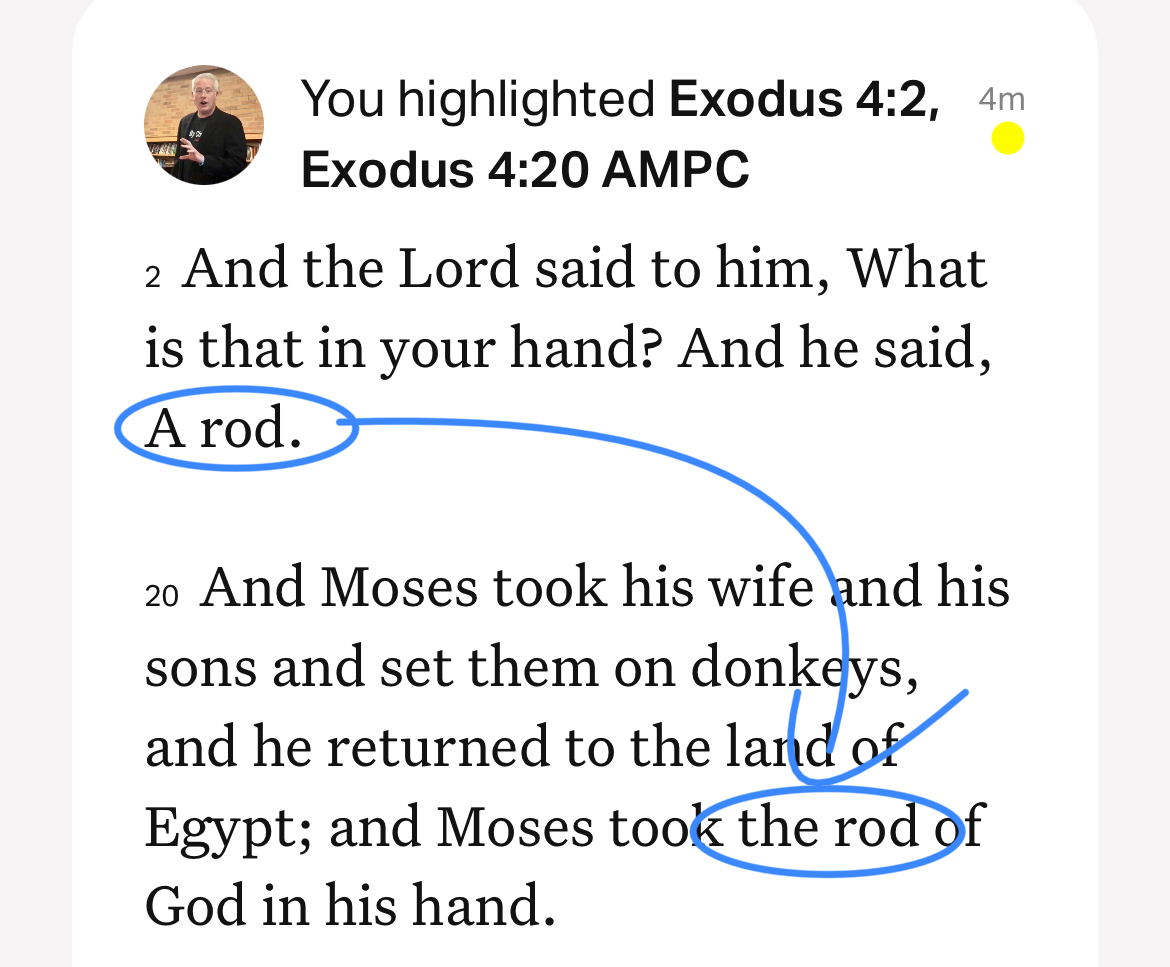
And the Lord said to [Moses], “What is that in your hand?” And he said, “A rod.” … And Moses took his wife and his sons and set them on donkeys, and he returned to the land of Egypt; and Moses took the rod of God in his hand. (Exodus 4:2, 20 AMPC) 

What Moses originally called merely “a rod” he later called “the rod of God.” He recognized that what he thought was his was in actuality what God had given him to use. 

When we recognize that what’s in our hands isn’t our creation, but a God-given talent, it marks a defining moment in both our maturity and our humility. Or to borrow a phrase I elaborate on in my book Shepherd Leadership, this helps us view our God-given talents or positions with confident humility (or, if you like, humble confidence). 

With this shift in Moses’ understanding and language in mind, this is how we should treat every strength God has given us:

• It’s not mine, but God’s 

• I am only a steward of this talent 

I must use this God-given strength only for God’s glory 

• I will have to give an account to God for how I invested or squandered what He entrusted to me

When we realize that we are not self-made men or women, but that any talents, abilities, or opportunities we have are God-appointed, we show a marked maturity in our understanding of our stewardship of God’s gifts. As our maturity grows, our confidence and our humility will grow proportionately. And as we become more confidently humbled in the way we steward God’s gifts, our leadership cannot help but exhibit more of God’s blessing on it. 

All of this growth starts with just the simple recognition that what’s in my hands is there only because God placed it there. 

►► Would you please prayerfully consider supporting this ministry? My Patreon supporters get behind-the-scenes access to exclusive materials. ◀︎◀︎
Grumbling People

Listen to the podcast of this post by clicking on the player below, and you can also subscribe on AppleSpotify, or Audible

The Israelites were barely out of Egypt, freed from 400 years of captivity, and they begin grumbling against Moses, their God-appointed leader—

     Now when the people saw that Moses delayed to come down from the mountain, the people assembled around Aaron and said to him, “Come, make us a god who will go before us; for this Moses, the man who brought us up from the land of Egypt—we do not know what happened to him.” (Exodus 32:1)

Then later, on the borders of their promised land, they were again doubtful that Moses truly had heard from God. “So they said to one another, ‘Let’s appoint a leader and return to Egypt!’” (Numbers 14:4). 

Have you ever wondered why these disgruntled people didn’t just leave on their own? If they truly thought that going to their Promised Land was impossible, why not just pack up their possessions and leave? 

Instead, they said, “We need a leader to help us leave.” In reality, they are really saying, “We need a leader that will help us do what we want to do.” 

Human nature is always looking for someone to validate their evil desires—to assure them that they are okay. 

Except they’re not okay. They are rebelling against God!

⛔️ There is a warning here for all of us. When we are looking for a leader to validate our feelings instead of looking to God for an unchangeable, objective standard to obey, we are in a dangerous place! 

Paul warned his friend Timothy, ”For the time will come when they will not tolerate sound doctrine; but wanting to have their ears tickled, they will accumulate for themselves teachers in accordance with their own desires” (2 Timothy 4:3). 

⛔️ There is also a warning here for leaders. Watch out when people come to you, asking you to lead or teach in a way that sanctions the way they want to live. You are in a dangerous place if you give in to the rabble’s demands! 

Paul also warned Timothy, “Be diligent to present yourself approved to God as a worker who does not need to be ashamed, accurately handling the word of truth” (2 Timothy 2:15). 

Leaders, always remember that it doesn’t matter how many people follow you or tell you how wonderful you are. The only thing that matters is hearing the Judge say to you either, “Depart from Me, I never knew you” or “Well done, good and faithful servant!” (see Matthew 7:21-23; 25:14-23). 

Godly leaders don’t live for the momentary approval of fickle people, but they live focused on the eternal pleasure that only comes when they stay singularly attuned to our unchangeable God. 

If you are a leader, you may also want to check out these two related posts: 

►► Would you please prayerfully consider supporting this ministry? My Patreon supporters get behind-the-scenes access to exclusive materials. ◀︎◀︎

Links & Quotes

Leaders need to give others confidence to try something new. We need to help people get moving so that we can coach what they are doing. For more great leadership insights, check out The Craig and Greg Show.

I have lots of new content every week, which you can check out on my YouTube channel.

A couple of thought-worthy quotes for pastors. First from David Mathis: “Pastors, observe that in and of itself, mocking is no clear reflection of the faithfulness or fruitfulness of preaching Christ. Wise preachers do not take mocking as an indicator of failure, nor as an indicator of success. Twice in Athens some mock Paul, which may seem like a failure compared to his homiletic triumphs elsewhere. However, others say, ‘We will hear you again.’ And then, in the end: ‘some men joined him and believed’ [Acts 17:32-34]. … How foolish it would be to distract ourselves with the mockers. Or to call special attention to the mocking as some great badge of our own faithfulness. Rather, we have the example of Paul at Mars Hill, who, so far as we can tell, wholly overlooks, with a holy disregard, these mockers and concerns himself instead with those asking honest questions.”

…and then one from John Piper: “Preaching is a happy business. Because even if the text is a hard word that devastates the hearers, the preacher connects the hard word with the gracious word and the hopeful word, and he catches them as they fall. So, in the end, all preaching is a happy business.

“A people that values its privileges above its principles soon loses both.” —Dwight D. Eisenhower

“For condemnation to work, we must say to God what the devil has said to us and believe it. If I want to stand before God with excuses that make what He said to me void, I’ll have to quote the devil to God. Does that sound like a good thing to do? God’s will for me is not to condemn me, but to liberate me from everything that holds me back from being what He created me to be through an ongoing relationship. To accomplish that, I need to do the opposite of what I used to do when I walked in condemnation. Instead of quoting to God what the devil is saying, I quote to the devil what God has said.” —Jim Wiegand, in Recruiting To Releasing 

Thinking about “how Martin Luther, a professor at Wittenberg University, helped to spark the 16th century Protestant Reformation,” J. Calvin Holsinger conceived the idea of preparing missionaries to US colleges and universities—a ministry called Chi Alpha.

Another great story from the “Here We Stand” series of biographies of notable people during the Reformation. “An attendant asked [King Henry VIII] whom he wished to have at his bedside. The king asked for Thomas [Cranmer]. By the time Cranmer arrived, King Henry was unable to speak. Foxe tells the story. ‘Then the archbishop, exhorting him to put his trust in Christ, and to call upon His mercy, desired him though he could not speak, yet to give some token with his eyes or with his hand, that he trusted in the Lord. Then the king, holding him with his hand, did wring his hand in his as hard as he could (Foxe’s Book of Martyrs, 748).’ The scene sweetly punctuates the most important friendship in the English Reformation. Whatever King Henry believed when he squeezed Cranmer’s hand that day, God used the bond between them to break England free from Roman Catholicism and to recover the one true gospel.”

The ICR reports, “Genesis claims that people in the pre-Flood world routinely attained 900-year lifespans. The best-known example is Methuselah, who had the longest recorded lifespan of 969 years (Genesis 5:27). Skeptics dismiss these great ages as fanciful legends, but recent fossil data are providing unexpected, albeit indirect, corroboration of the Bible’s testimony.” Check out this full report.

“In my experience, each failure contains the seeds of your next success—if you are willing to learn from it.” —Paul Allen, cofounder of Microsoft

A Leader Even Without The Title

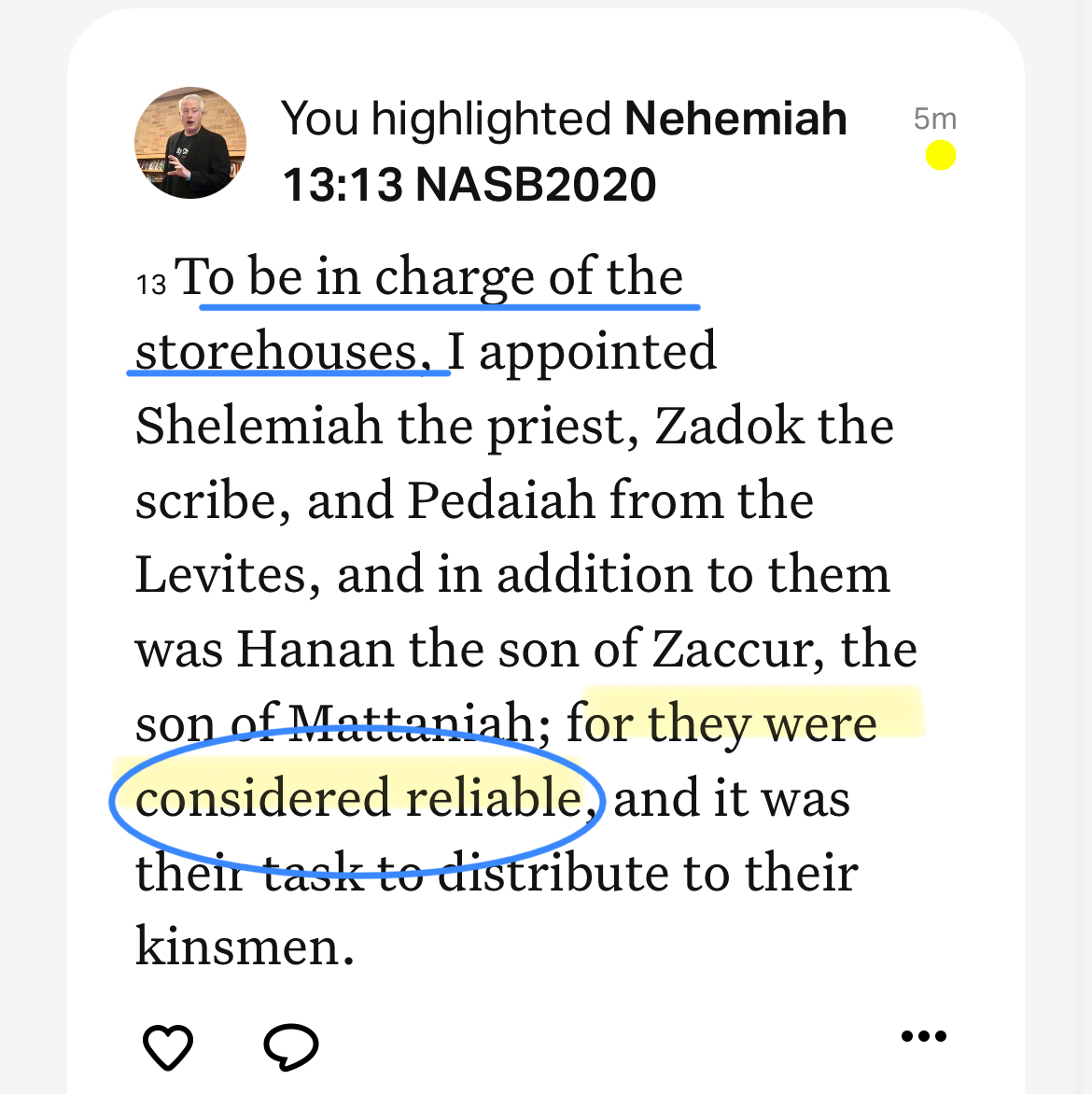
I also discovered that the portions of the Levites had not been given to them, so the Levites and the singers who performed the service had gone away, each to his own field. So I reprimanded the officials and said, “Why has the house of God been neglected?” Then I gathered them together and stationed them at their posts. All Judah then brought the tithe of the grain, wine, and oil into the storehouses. To be in charge of the storehouses, I appointed Shelemiah the priest, Zadok the scribe, and Pedaiah from the Levites, and in addition to them was Hanan the son of Zaccur, the son of Mattaniah; for they were considered reliable, and it was their task to distribute to their kinsmen. (Nehemiah 13:10-13)

According to the Hebrew definitions:

  • “considered” = accountable 
  • “reliable” = trustworthy 

Both words mean someone who has passed the test and someone who is still passing the test. These men were faithful leaders before they were given this important job, and then they continued to prove themselves faithful even as their work was carefully scrutinized. 

A title doesn’t make you a leader, and a title doesn’t sustain you as a leader. Your faithful, God-honoring, trustworthy accountability makes you a leader—even if you never get the title, God sees you and He will reward you. 

Check out my whole series on godly leadership.

The Craig And Greg Show: The Responsibility Of Power

Listen to the audio-only version of this podcast by clicking on the player below, or scroll down to watch the video.

It goes without saying, but leadership positions confer a level of power to the people who occupy them. This power is necessary for us as leaders to do our job effectively, but if we’re not very careful it can begin to corrupt us and poison our leadership. Tune in as Greg and I tackle this tricky issue.

  • [0:22] Leaders need both enough power to get things done, but not too much that they crush people. 
  • [1:44] Power can corrupt us if we are unaccountable in the use of our power.
  • [3:12] We should always be thinking in terms of how our use of power can empower others.
  • [5:16] A leader’s power should always be linked to responsibility.
  • [6:27] We earn our power—we don’t grab it form others—to better serve.
  • [9:32] Greg says, “Leadership should be dangerous!”
  • [12:40] Sometimes we must use our power to protect those around us.
  • [16:00] Greg steps into “you know what”!
  • [16:27] Are power and serving compatible?
  • [18:25] What do powerful leaders not want to do?
  • [20:26] When it comes right down to it, the use of leadership really comes down to influence.
  • [22:02] Our coaching services can help you use your power more effectively.

Check out this episode and subscribe on YouTube so you can watch all of the upcoming episodes. You can also listen to our podcast on Spotify and Apple.