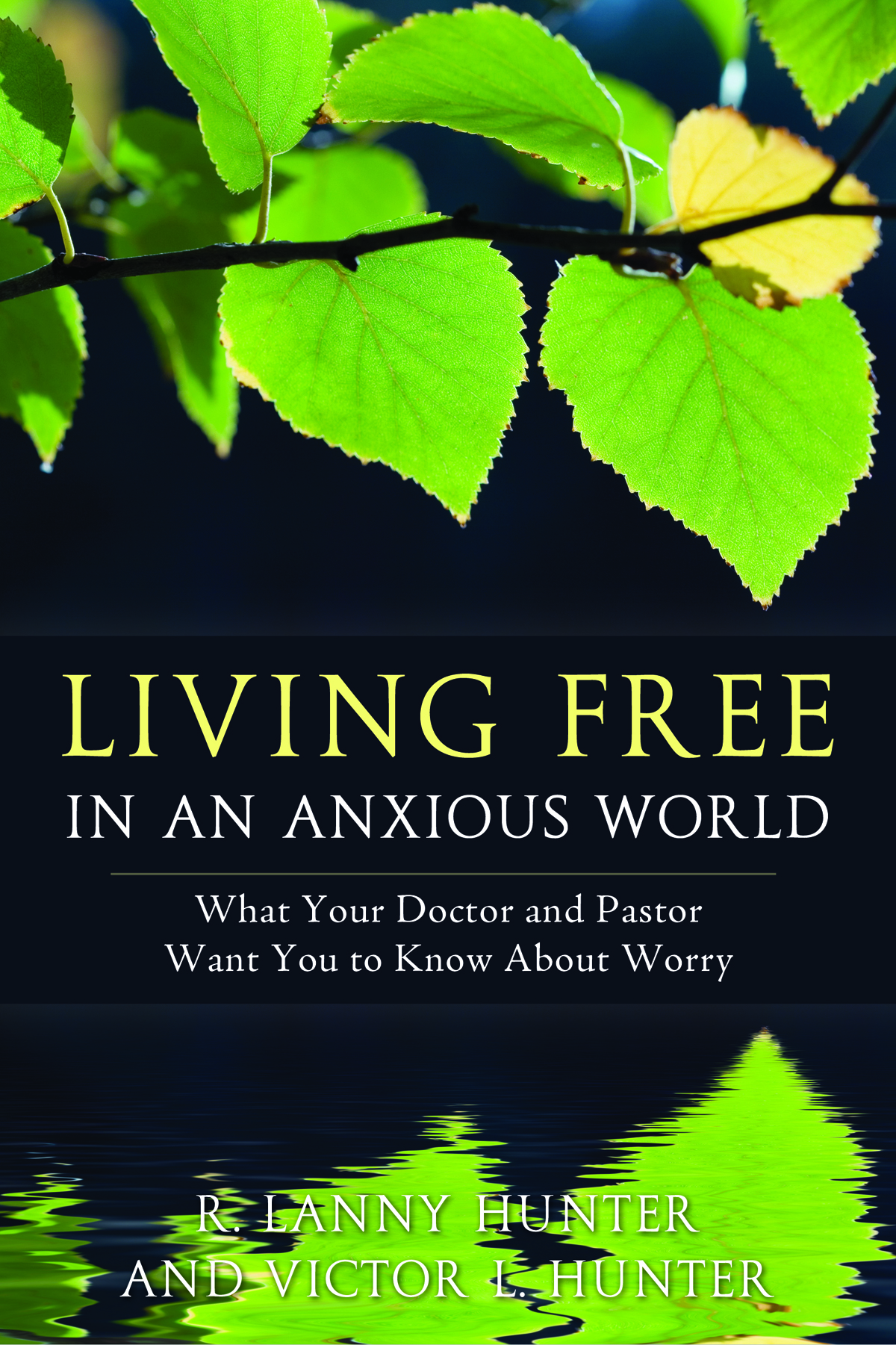
Living Free In An Anxious World (book review)

When I say that more people today are worried, or stressed-out, or suffering from anxiety attacks, I’m not saying anything that you don’t already know. But in Living Free In An Anxious World authors R. Lanny Hunter and Victor L. Hunter give us a whole new way of looking at worry and anxiety.

Many times I’m frustrated by some author’s one-size-fits-all approach to dealing with worry and anxiety. The fact is, we are complicated and we are individuals. But more than that, many authors tend to focus on just one part of the human, when in fact we are a three-part being. There is a physical component, an emotional/mental component, and a spiritual component.

The Hunter brothers are well trained to address the effects of worry in all its forms, as one brother is a medical doctor and the other is a pastor who received specialized training in both religion and psychiatry. They both bring their specialties to this book in a way that I found both informative and comforting.

One of the first concepts they address is that the key is to not eliminate worry from our lives. That, they say, is impossible. The goal is to not worry in a self-destructive way. Right from the first chapter, I found myself buying into their insights which were so real and applicable.

The Hunter brothers explore the biblical, scientific, and even philosophic origins of worry, and provide very real solutions for even a layman like me. This book wasn’t “over my head” nor did it over-simply the very real and challenging task of dealing with worry the right way.

Since 6.5 million Americans suffer from general anxiety disorder every year, chances are good that you are going to have to confront worry in your life or in the life of a loved one. So I highly recommend this book to you.

I am an Abilene Christian University Press book reviewer.
I’m Just Not Feelin’ It

Ever been here?

My job is boring…

My finances are barely making ends meet…

My relationships seem stagnant…

I’m bored…

Church just doesn’t thrill me anymore…

My devotions are lackluster…

My prayer life is sporadic…

I just don’t feel like praising God…

What do you do? You certainly can’t listen to your feelings because they will betray you as many times as they help you. My experience has been that you cannot wait until you feel like doing something to start doing something. But if you just do the right thing, then the good feelings will usually follow.

King David was in a similar position—no job, no prospects, no income, strained relationships, no chance to even go to church. Psalm 34 has this introduction, “When he pretended to be insane before Abimelech, who drove him out, and he went away.” In other words, David was not having a good day. He certainly wasn’t feelin’ it! How did he get out of this funk?

STEP 1: Use your will to praise God.

I will praise the Lord at all times. I will constantly speak His praises. I will boast only in the Lord.

David said, “I’m not really feelin’ it, but I’m gonna praise God anyhow!”

STEP 2: Be prepared for your emotions to engage.

My soul will boast in the LORD.

The soul is the seat of the emotions. It started off as an act of David’s will, but then it got down into his soul and he started feelin’ it.

STEP 3: Become an encouragement to others.

Let all who are helpless take heart. Come, let us tell of the Lord’s greatness; let us exalt His name together.

When David used his will to praise God, other helpless, hurting people began to join in. Soon it was a choir of praise!

You may not be feelin’ it, but if you’ll just use your will to praise God, you will begin to feel better, and you’ll help others to feel it as well.

Worry Unlearned

We started a new series yesterday called The Stranglehold Of Worry. The word worry originated with shepherds. When a wild dog or a wolf had killed a sheep by grabbing it by its throat and choking it to death, the shepherds said that sheep had been worried to death.

In modern times, researchers at Purdue University found that worrying can chop 16 years off of someone’s life. Not only does worry rob your life of years, but it can also rob your years of life.

What exactly is worry? Fear is our natural response to real threats, like a car heading toward you in your lane of traffic. Worry is our response to perceived threats (to unseen things), like the car that may head toward your kids’ car when they are driving.

Get this clear: worry is being fearful of the unseen.

Compare that to the Bible’s definition of faithNow faith is being sure of what we hope for and certain of what we do not see. Worry and faith both operate in the unseen dimension.

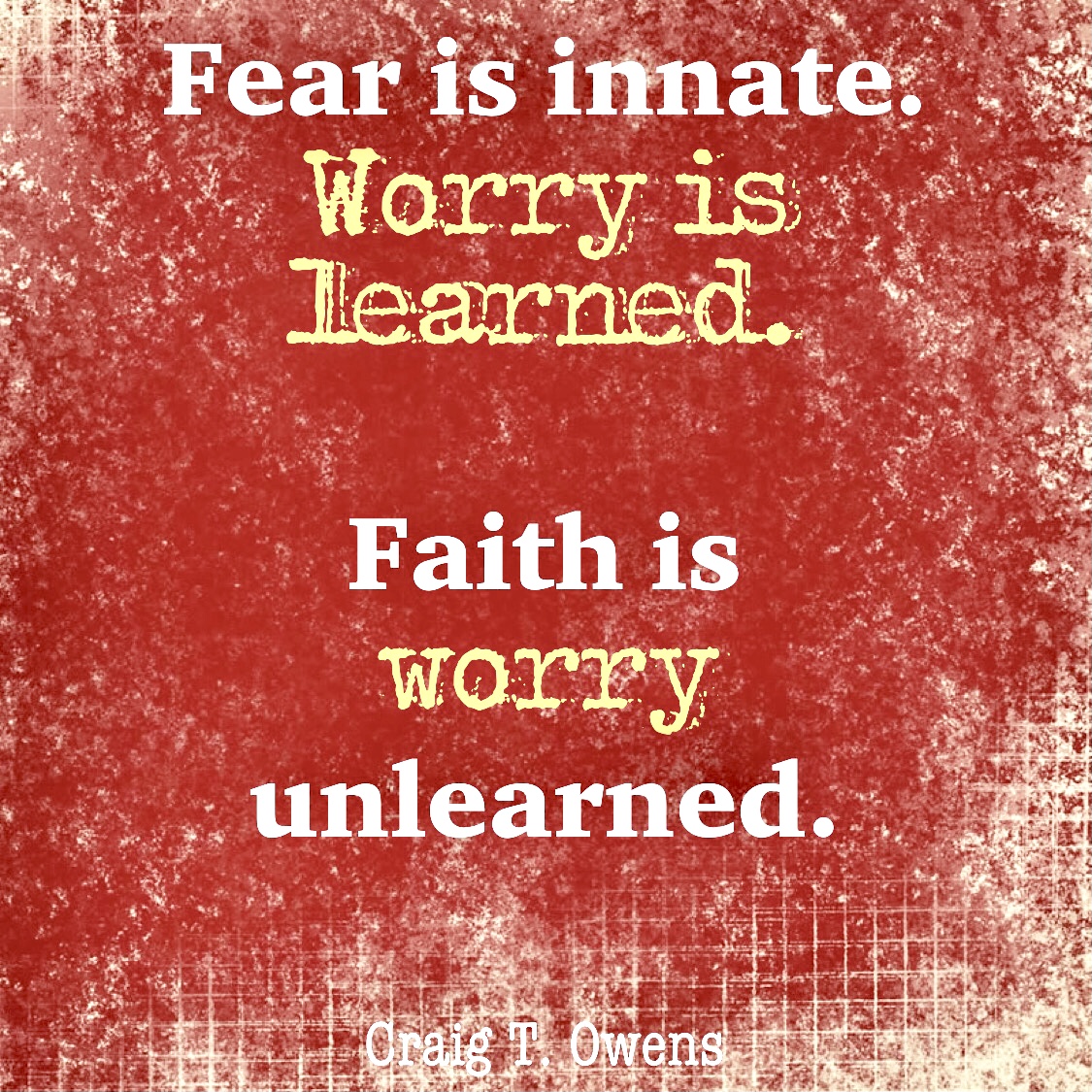
Fear is innate, but worry is learned.

Faith is worry unlearned.

Worry tells your brain a story about bad things that may happen.

Faith tells your brain a story about good things that should happen. Based on what you’ve already experienced of God’s power, what you’ve already seen in God’s provision, or what you already know of God’s promises, your faith in God can help you unlearn your worry.

The prophet Jeremiah tended to be a worrywart. Maybe that’s why he’s been called the “weeping prophet.” But in the middle of his worrying, he unlearns his worry by using his faith to tell a different story about God’s provision, power, and promises:

I well remember [the bad things], and my soul is downcast within me. Yet this I call to mind and therefore I have hope: Because of the LORD’s great love we are not consumed, for His compassions never fail. They are new every morning; great is Your faithfulness. I say to myself, “The LORD is my portion; therefore I will wait for Him.”

Did you notice that Jeremiah talked to himself? He wrote, “I say to myself.” If you have a tendency to worry, it’s time to start talking to yourself and telling yourself a different story. Instead of being fearful of the bad things you cannot see, why not be hopeful of the good things of God you can see?

Let your faith in God help you unlearn your worry. You can overcome worry and anxiety by telling yourself a new faith-filled, hope-oriented story. You can recall God’s faithfulness in the past, and apply it to your current circumstance.

What stories are you telling yourself today? Share with others how you overcame, or are in the process of overcoming worry now. Your faith story will help others overcome and unlearn their worry too.

Anger That Crosses The Line

Last night in our Bible study we looked at some words that David penned when he was angry. He was on the run from his son Absalom, and it seemed like everywhere he turned people were after him, or slandering him, or just doing their best to make him miserable. Yet in two back-to-back Psalms David says, “I lay down every evening and get a great night of rest.”

His sweet sleep comes from a moment of reflection before dozing off. He says:

In your anger do not sin; when you are on your beds, search your hearts and be silent. Selah.

  • Did my anger today cross the line into sin?
  • Am I allowing the time for the Holy Spirit to search my heart?
  • When the Holy Spirit points out where my anger crossed the line, do I justify my anger, or am I silent?

How do we know if our anger has not crossed that line and become sin?

Aristotle wrote, “Anybody can become angry—that is easy; but to be angry with the right person, and to the right degree, and at the right time, and for the right purpose, and in the right way—that is not within everybody’s power and is not easy.”

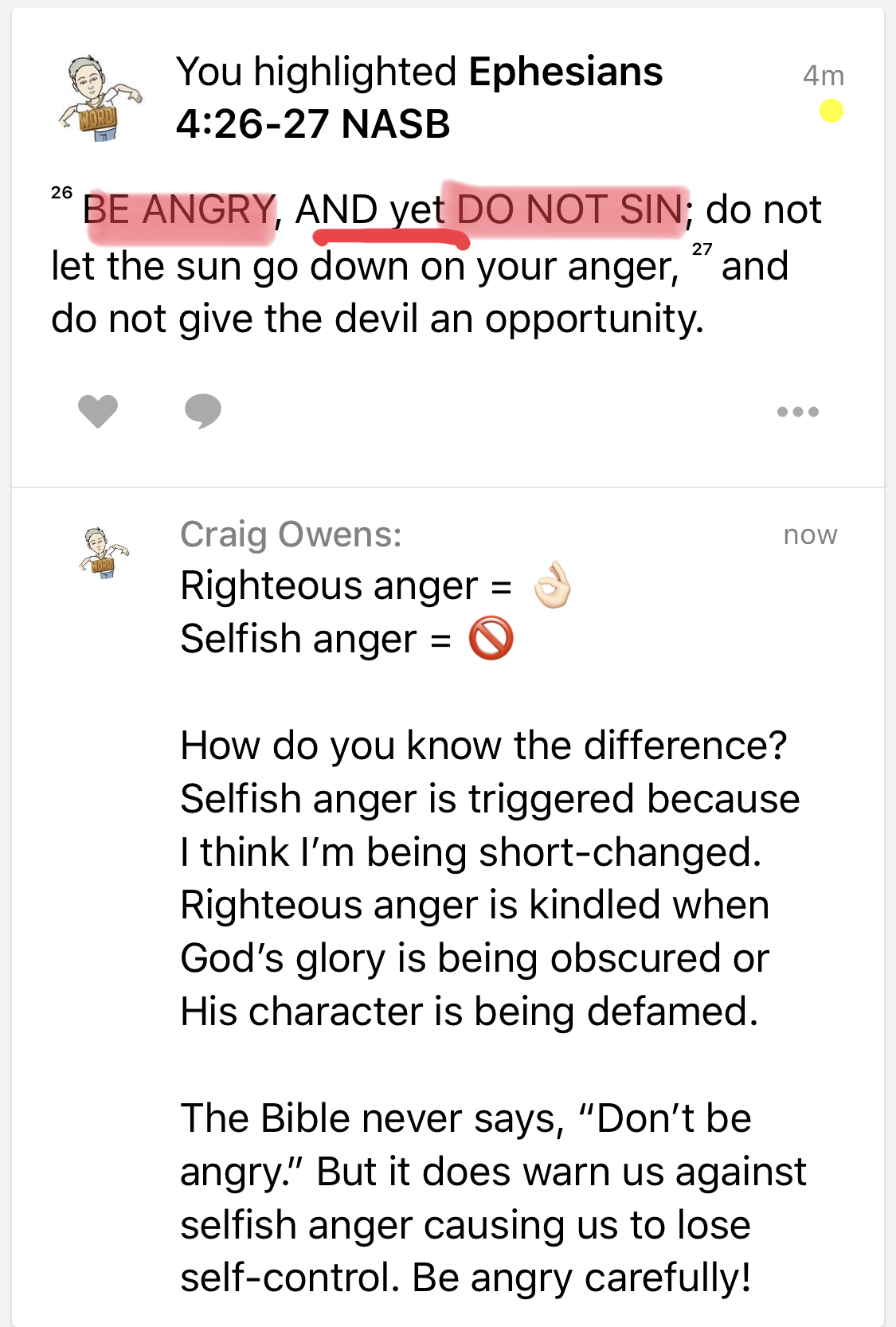
Being angry is not the issue. David said it (and Paul quoted it in Ephesians 4:26): “Be angry; just don’t sin.” God gets angry, but He does not sin. Jesus, in His public ministry, got angry, but He did not sin. We need to search our hearts to make sure our anger has not crossed the line to sin. We have to be angry in a godly way.

I see at least four ways to become angry without crossing the line into sin:

1.  Selfless Anger = anger at sin, but not angry at the sinner.

Love is not rude, it is not self-seeking, it is not easily angered, it keeps no record of wrongs. Love does not delight in evil but rejoices with the truth. (1 Corinthians 13:5, 6)

2.  Slow Anger = lengthen your fuse a bit.

Do not be quickly provoked in your spirit, for anger resides in the lap of fools. (Ecclesiastes 7:9)

My dear brothers, take note of this: Everyone should be quick to listen, slow to speak and slow to become angry, for man’s anger does not bring about the righteous life that God desires. (James 1:19, 20)

Good advice from Thomas Jefferson: “When angry, count to ten before you speak; if very angry, a hundred.”

3.  Protective Anger = when sinners entice others to join them in their sin. God is sad when people leave Him; He is angry at them when they take others with them.

But they put God to the test and rebelled against the Most High; they did not keep His statutes. Like their fathers they were disloyal and faithless, as unreliable as a faulty bow. They angered Him with their high places; they aroused His jealousy with their idols. When God heard them, He was very angry; He rejected Israel completely. (Psalm 78:56-59)

4.  Righteous Anger = against those who are keeping others from coming closer to God.

For I endure scorn for Your sake, and shame covers my face. I am a stranger to my brothers, an alien to my own mother’s sons; for zeal for Your house consumes me, and the insults of those who insult You fall on me. (Psalm 69:7-9)

This verse was recalled by Jesus’ disciples when they saw Him get angry and clear out the Temple in Jerusalem. Jesus was angry because of the religious clutter that was keeping God’s house from being a house of prayer for all nations.

I think everyone is familiar with the acrostic WWJD = What Would Jesus Do?

I’d like to propose something similar: WGGA = Would God Get Angry?

This is a great question to ask to make sure our anger does not cross that line into sin. Get angry—in a godly way—and do not sin.

Help! I’m Being Strangled!

I’m kicking off a new series at Calvary Assembly of God on Sunday about breaking the stranglehold of worry. The origin of worry comes from a word that means choking, strangling, hard to breathe. And isn’t that exactly what worry feels like?

I’m sure that none of you ever struggle with worry (he wrote sarcastically!). But if you know any “friends” who may benefit from an honest look at both the origins of worry and how to gain freedom from worry, please send them our way over the next few Sundays.

They will be so glad that you did!

The Immunization Of Tears

The Israelites had such a predictable pattern —

Loving God

Slipping away from Him

Sin

Oppressed by an enemy

Remorse & repentance

God’s deliverance

Return to loving God

Repeat


In the book of Judges there is a repeated phrase: But when they cried out to the Lord, He raised up for them a deliverer.

Perhaps is they cried in God’s presence more often, they cycle could have been broken.

It’s the same for us — instead of using tears as a cure, how about using them as an immunization? How about crying in God’s presence before sin has cruelly oppressed us?

I think if I shed tears over my “little” sins more frequently, it would keep me from much deeper hurts.

The Bible says, “A broken and contrite heart, O Lord, You will not ignore.” Holy Spirit, break my heart over the smallest of sins so I may quickly repent and return before I am enslaved by my sins.

I believe tears call God to our help, but how much better if they are used to immunize us against sin!

Final Words

I’m working on a message for a funeral that I will speak at tomorrow. It’s very humbling to think that a family has chosen me to say the final words about their loved one. How do I accurately sum up someone’s life in just a few minutes?

This process always gets me thinking about what final words I would want to have said about my life. I have three passages in the Bible that I would love to have said about me:

He had no great joy than knowing his family all walks in the truth. (3 John 4)

He always took the spiritual truths that he heard and taught and entrusted them to reliable people who were also qualified to teach others. (2 Timothy 2:2)

He fought the good fight, he finished the race, he kept the faith. (2 Timothy 4:7)

What about you? What final words do you want people to say at the end of your life?

Stephen Covey wisely advises us to begin with the end in mind. See your goal—your final words—clearly fixed in your mind now, then live to fulfill it.

A Slight Case Of The “Ites”

As the Israelites were attempting to settle in the Promised Land, there is a repeated phrase, “They could not drive out the ites.” (The “ites” are people like Canaanites, Hivites, Jebusites, etc.) God told them that they should completely clear the land of the ites, but they didn’t. Instead, they just subjected them to forced labor.

Oops! These small ites eventually became the downfall of Israel. The ites continued to practice their pagan worship observances, and eventually enticed the people of Israel to join them. As a result, Israel was humiliated, defeated, and carried off into captivity.

Can I make a parallel to our lives?

The Promised Land is a Christ-follower’s life in Christ. The ites are our sinful tendencies.

I know the ites are there, but it seems so difficult to remove them: the Bible uses the phrase they were determined to live in that land. So the ites are allowed to coexist, and I determine to use my willpower to make sure they stay contained.

After awhile the ites have behaved themselves. They seem harmless enough. In fact, I’ve gotten so strong, so mature, in my Christian faith, I know I’ll never give in to the pull of the ites again. I can relax a little bit now.

But the ites wait. They bide their time. They find just a crack to slowly worm their way in. Then when I am at a vulnerable time, they strike. The slave becomes the master. The ites retake possession of my life.

Willpower will not work. Only complete elimination will work.

God will help you if you will let Him.

  • What ites are you trying to hold down by sheer willpower?
  • What ites do you tolerate now that you didn’t tolerate earlier in your faith walk?
  • Do you think you are immune to some ites now that you are more mature?

The Bible’s warning is loud and clear:

These are all warning markers—danger!—in our history books, written down so that we don’t repeat their mistakes. Our positions in the story are parallel—they at the beginning, we at the end—and we are just as capable of messing it up as they were. Don’t be so naive and self-confident. You’re not exempt. You could fall flat on your face as easily as anyone else. Forget about [willpower]; it’s useless. Cultivate [God-power].

A slight case of the ites is a serious thing! Don’t let it continue!

Appropriate Language

Just wondering:

If the Bible says this…

Let no foul or polluting language, nor evil word nor unwholesome or worthless talk ever come out of your mouth, but only such speech as is good and beneficial to the spiritual progress of others, as is fitting to the need and the occasion, that it may be a blessing and give grace (God’s favor) to those who hear it. (Ephesians 4:29 AMP)

…does my texting, blogging, Facebooking, and Tweeting line up?

Does yours?

Wow!

Standing On A Promise

Just before Joshua’s farewell address to the Israelites, he makes one final comment to sum up the whole campaign that secured Israel’s borders—

Not one of all the Lord’s good promises to the house of Israel failed; every one was fulfilled.

Every one.

You can trust God! You can stand on His promises. They will not fail; they will all be fulfilled.

Dr. Robert Lockyear estimates that there are 7,457 promises of God in the Bible!

Which one are you standing on today? Get into God’s Word, and let His promises get into you. Write them down. Memorize them. Repeat them again and again. Believe that not one of all the Lord’s good promises will fail.

Here are a few you can stand on:

  • He forgets your forgiven sins.
  • He will give you abundant life now, and eternal life later.
  • Nothing can separate you from His love.
  • All things are working together for the good for those who love God.
  • He will never leave or forsake you.
  • He will continue to develop the best in you.
  • He will never place you in a situation where you cannot stand.

(check out all of the biblical references for these promises by clicking here)

“We take away from this most precious promise, and, by refusing to take it in its fullness lose the fullness of its application and power. Then we limit God’s power to keep: we look at our frailty more than His omnipotence. Where is the line to be drawn, beyond which He is not ‘able’? Why should we pare down the promises of God to the level of what we have hitherto experienced of what God is ‘able to do,’ or even what we have thought He might be able to do for us? Why not receive God’s promises, nothing doubting, just as they stand?” —Frances Ridley Havergal

What promise are you standing on today?