Isaac Newton said, “This most beautiful system of the sun, planets, and comets, could only proceed from the counsel and dominion of an intelligent and powerful Being.” Isaac Newton and Johannes Kepler are two gigantic figures in the world of science. These men were both devout Christians. Check out these mini-biographies from the ICR.
“What made David’s heart remarkable wasn’t the absence of sin but his unrelenting pursuit of restoration with God.” —YouVersion reading plan Men of God: Ancient Virtues for Modern Warriors
It’s always fascinating to read about archeological discoveries that overlap with the historical accounts of the Bible.
Whether you are a pastor, a Sunday School teacher, or just a Christian sharing your testimony with your friend, we need to handle God’s Word correctly. John Piper’s lesson on 2 Timothy 2:14-15 is spot-on.
Listen to the podcast of this post by clicking on the player below, and you can also subscribe on Apple, Spotify, or Audible.
Everyone knows that we all make mistakes. Good leaders know more than this: They know that it is their responsibility to help those around them recover from those mistakes.
Listen to the podcast of this post by clicking on the player below, and you can also subscribe on Apple, Spotify, or Audible.
God called Gideon to lead Israel to victory over the oppressive Midianites. He told Gideon, “Go in the strength you have and save Israel” (Judges 6:14). When Gideon hesitated because he didn’t think he had much strength nor influence to raise an army, God assured him of two things: “I am sending you” and “I will be with you” (vv. 14, 16).
Gideon’s initial recruitment netted him 32,000 soldiers from four tribes: “And he sent messengers throughout all Manasseh, and the Manassites were called to follow him; and he sent messengers to Asher, to Zebulun, and to Naphtali, and they came up to meet them” (v. 35).
God said this large army would be tempted to take the credit for themselves for defeating the Midianites, so God pared down the army to 10,000 men and then to 300 men (7:3, 6).
When God said He would deliver Midian into Gideon’s hands (v. 7), He meant it! HE would do the delivering, with Gideon’s 300 men merely being the instruments He would use. These men would defeat the invaders simply with trumpets and torches.
When these 300 men surrounded the Midianite forces during the night, I want you to notice the bracketed phrase in the AMPC:
And the three companies blew the trumpets and shattered the pitchers, holding the torches in their left hands, and in their right hands the trumpets to blow [leaving no chance to use swords], and they cried, “The sword for the Lord and Gideon!” (v. 20 AMPC)
The Israelites had to leave their swords hanging on their belts to fully obey God!
It was only this posture of full obedience that brought the victory. “They stood every man in his place round about the camp, and all the Midianite army ran—they cried out and fled. When Gideon’s men blew the 300 trumpets, the Lord set every Midianite’s sword against his comrade and against all the army” (vv. 21-22).
Those who weren’t in the 300 were still needed to finalize the pursuit, as they were called up to complete the victory (v. 23).
Perhaps only the 300 had enough faith to not drop their torch and their trumpet and grab their sword.
If it seems like God has stripped you of what you considered your source of security—like the swords that hung unused on the belts of Gideon’s 300—perhaps that is because He is getting ready to do something that only He can do! Whether you feel well armed or simply left holding something as simple as a trumpet and a torch, trust God’s strength. He can deliver you far better than you can deliver yourself.
Listen to the podcast of this post by clicking on the player below, and you can also subscribe on Apple, Spotify, or Audible.
Did you know that’s possible for your greatest strength could become your most limiting weakness? Let’s learn how to spot and avoid this pitfall on this episode of The Podcast.
As leaders, we need to continually work on the “unconscious” areas of our lives. Here are some additional resources to help you.
Listen to the podcast of this post by clicking on the player below, and you can also subscribe on Apple, Spotify, or Audible.
Sanctification (saint-ification) is an ongoing process that brings out fruitfulness, joy-fullness, and enhances our testimony to others. And an essential part of this process involves other saints. Notice that this word “saints” it plural. That’s because it is a plural word every place it appears in the Bible.
Saints have gotten themselves into trouble when they tried to go solo. Like David’s sin with Bathsheba, Elijah’s slide into depression, or Peter’s denial of Jesus. But we also see saints thriving through difficult situations when they have a fellow saint alongside. Like how Barnabas gave Saul his start, Paul and Silas could sing together in prison, Silas and Timothy helped Paul minister, and how Jesus sent out His ambassadors by twos (Luke 10:1).
How does accountability to other saints work? Since we see togetherness so much in the early Church (look for the phrases like “each other” or “one another”), think A.C.T.S.—
(1)Admit my need for accountability. James tells us that we all stumble and that even my so-called little slip-ups are major in God’s eyes (James 3:2, 2:10). So I need help.
John Maxwell said, “Every person is undisciplined in some area of their life; in the area that I am undisciplined, that is the area where I need greatest accountability. I will not do well in my areas of weakness unless I am held accountable for better results.” We all have blind spots, we all have weak areas, and we must be humble enough to admit to those things.
(2)Choose my accountability partners prayerfully and carefully (Proverbs 12:26; 2 Corinthians 6:14). These should be trustworthy people who have the emotional and spiritual capacity to be able to come alongside me (Proverbs 17:9; Galatians 6:2).
(3)Trust my friend. Trust their counsel even when it stings a bit (Proverbs 27:6), and trust the effectiveness of their prayers for me (James 5:16).
(4)Stick with them through thick and thin. Be your brother’s keeper and let them be your keeper (Hebrews 3:12-14). We need to keep at it especially in difficult times. Notice the phrase “let us” that appears five times in Hebrews 10:19-25.
If we are living with a biblical worldview, we realize that the saints here on earth are those we will also be with for eternity. Our biblical worldview should form our understanding of both being accountable to another saint and holding other saints accountable as well.
As Jack Hayford so wisely noted, “The believer’s best defense against self-deception is through mutual accountability to one another.”
If you would like to check out the other messages in our series B.A.S.I.C. Christianity, you can click here.
You cannot get Scripture from the Bible into your heart and mind by osmosis! To develop a biblical worldview, we have to put the Word in so the Holy Spirit can help us work it out.
“Without goals, training has no direction.” —Natalie Coughlin
John Piper saures 12 resolves for Christians to fortify them against viewing pornography. In the post called The High Price of Watching Nudity, Piper says, “I want to invite, frankly, all Christians to join me in this pursuit of greater purity of heart and mind. In our day, when entertainment media is virtually the lingua franca of the world, this is an invitation to be an alien. And I believe with all my heart that what the world needs is radically bold, sacrificially loving, God-besotted freaks, aliens.”
“Accountability closes the gap between intentions and actions.” —Craig Groeschel
T.M. Moore wrote, “Who are your ten most admired pastors? Probably we could all make a list. Why do we admire them? Because their churches are growing? Would they want you to say of them that they really know how to grow a church? We make two mistakes here. First, we mistake big numbers with real growth. The Bible’s view of growth is much more qualitative than quantitative. Second, we think we can get ‘growth’—in numbers—by simple mechanics: Find the right combination of programs, the latest in worship music, and a nice refreshment area. That won’t get the growth Jesus is seeking.”
Listen to the podcast of this post by clicking on the player below, and you can also subscribe on Apple, Spotify, or Audible.
I am so excited to announce that my co-host Greg has written a new book called Sales Armageddon. As anyone in the profession knows, sales can be a battlefield. Through fables and insightful teaching Greg’s book will equip you with new strategies you can implement right away to keep yourself and your team in the fight.
[0:30] Greg’s new book is out.
[1:40] The book contains a business fable based on real people.
[3:39] Salespeople can learn from this book how to work well and grow because of others.
[5:52] This is a very entertaining book that helps us learn.
[7:16] All salespeople need o learn to work with their peers.
[8:40] Sales Armageddon is not just a soft story but it shares the science of sales as well.
[9:35] Here is a teaser of a key chapter on developing a robust sales pipeline.
[12:46] This book has both the emotion and the hard skills of excelling in sales.
[14:47] Greg says that each chapter is going to remind you of someone you’ve worked with before, or it may even remind you or yourself!
[16:37] This is not a “heavy” read, but this is something that you are going to be able to immediately apply to your sales work.
Listen to the podcast of this post by clicking on the player below, and you can also subscribe on Apple, Spotify, or Audible.
When you’ve been hurt, you probably want someone to tell you that it was all the other person’s fault. That’s what you may want, but a true friend will tell you what you need to hear.
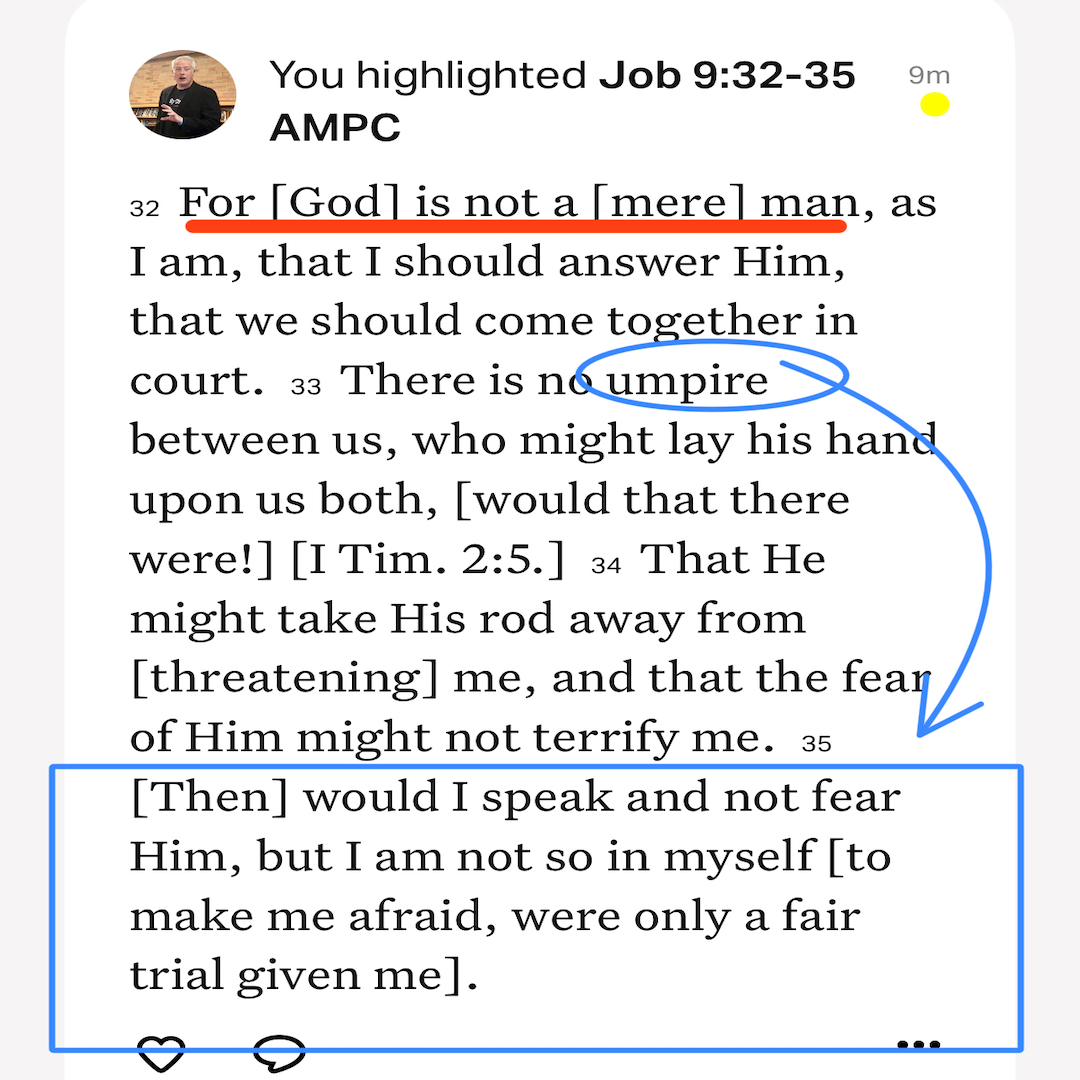
For God is not a mere man, as I am, that I should answer Him, that we should come together in court. There is no umpire between us, who might lay his hand upon us both—would that there were! That He might take His rod away from threatening me, and that the fear of Him might not terrify me. Then would I speak and not fear Him, but I am not so in myself to make me afraid, were only a fair trial given me. (Job 9:32-35 AMPC)
The “umpire” or mediator for whom Job was longing is Jesus.
Both Paul (Galatians 3:19-20; 1 Timothy 2:5) and the writer of Hebrews (8:6, 9:15, 12:24) make it clear that what Job said was true: Man cannot come before God on his own, let alone attempt to argue his case.



 Whether we see the world through a naturalistic lens or a biblical lens makes all the difference!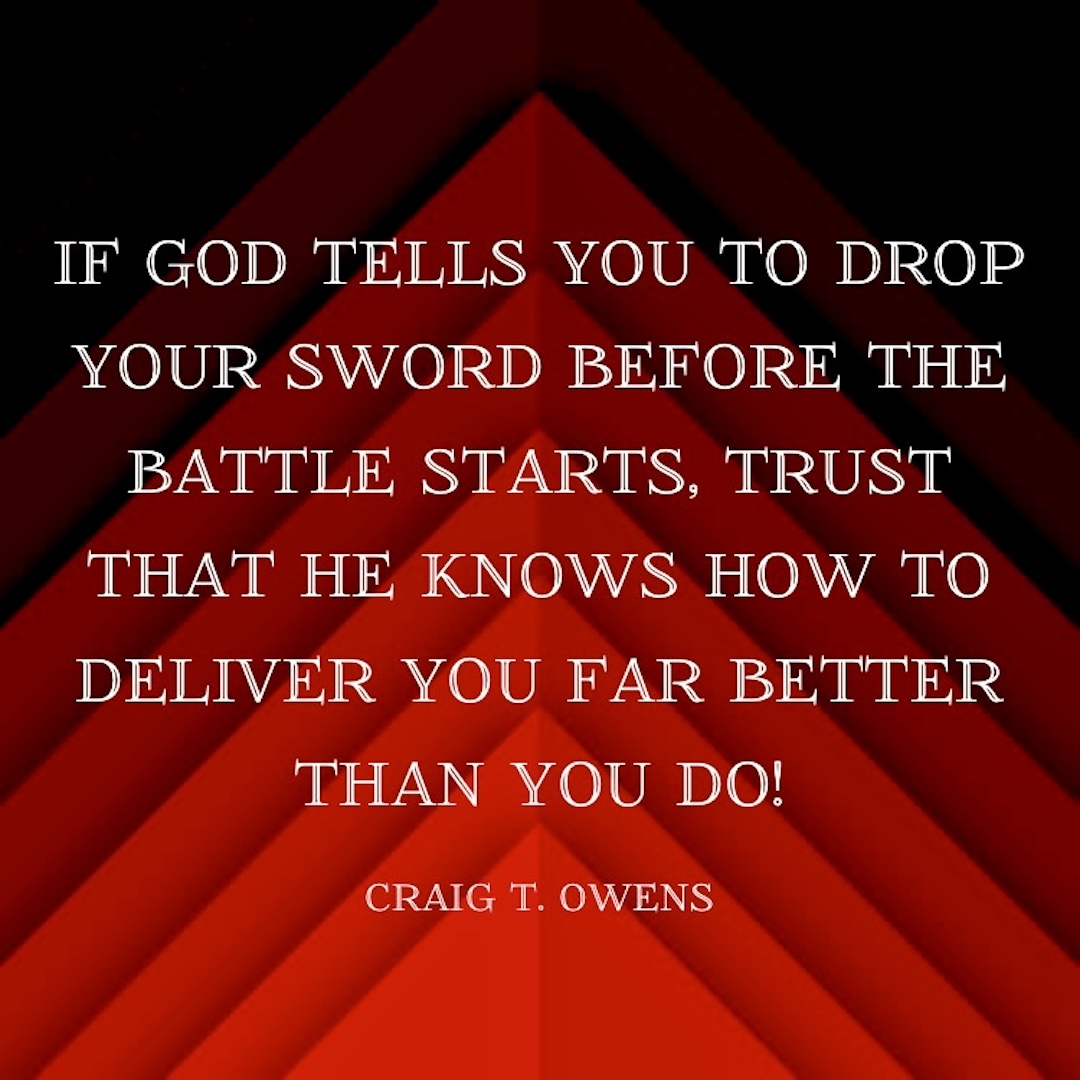









 Craig T. Owens