This is a weekly series with things I’m reading and pondering from Charles Spurgeon. You can read the original seed thought here, or type “Thursdays With Spurgeon” in the search box to read more entries.
Are You Gazing Or Going?
The resurrection of Christ is the morning star of our future glory! Equally delightful is the remembrance of His ascension. …
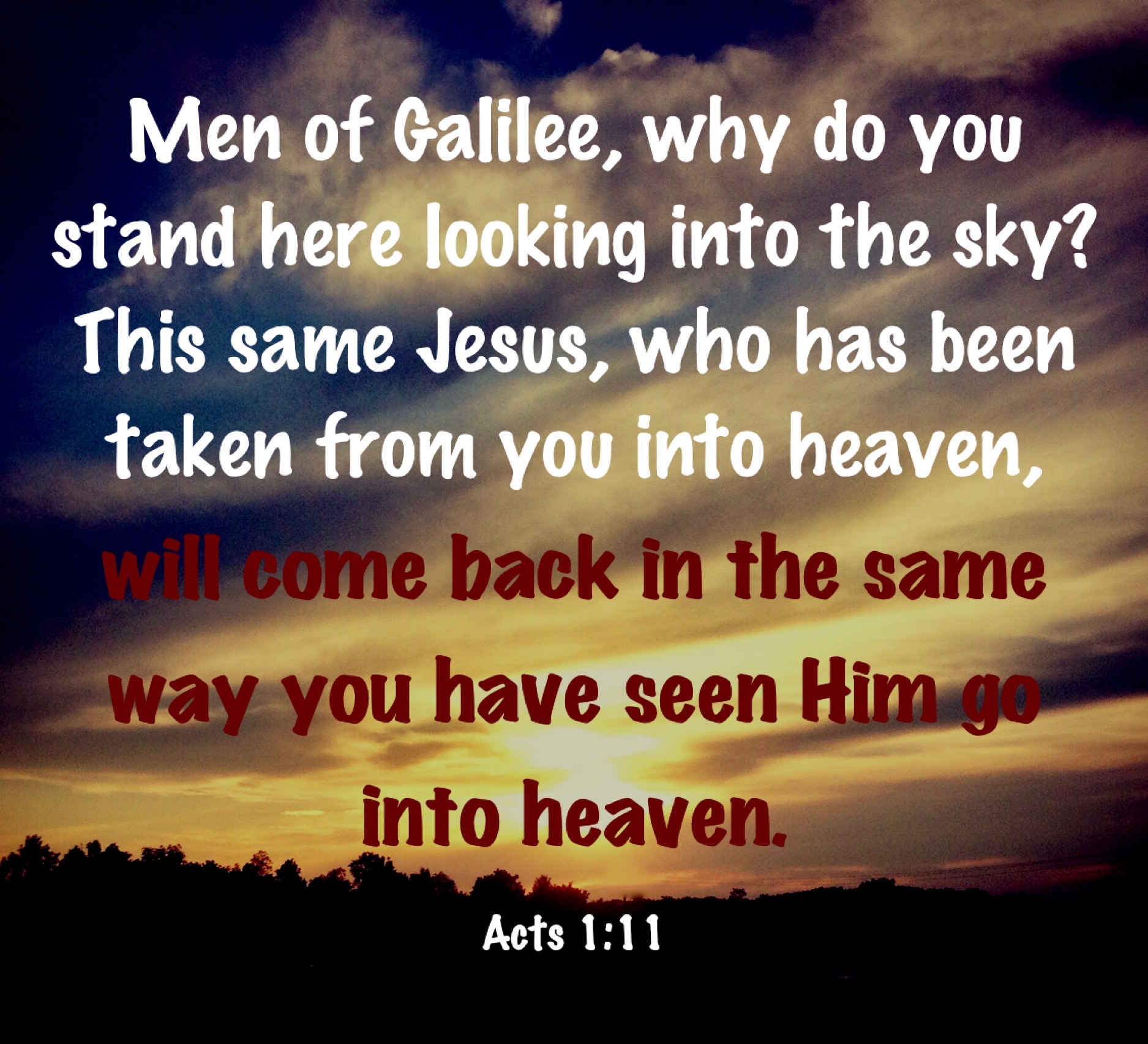
They were looking intently up into the sky as he was going, when suddenly two men dressed in white stood beside them. “Men of Galilee,” they said, “why do you stand here looking into the sky? This same Jesus, who has been taken from you into heaven, will come back in the same way you have seen Him go into heaven.” (Acts 1:10-11)
It is not the Lord’s will that [His disciples] should long remain inactive—the reverie is interrupted. They might have stood there till wonder saddened into fear. As it was, they remained long enough, for the angel’s words may be accurately rendered, ‘Why do you stand gazing up into heaven’? …
As they had once said to the women, ‘Why do you seek the living among the dead? He is not here, but is risen!’ (Luke 24:5-6), so did they now say, ‘Men of Galilee, why do you stand gazing up into heaven? This same Jesus who is taken up from you into heaven, will so come in like manner as you saw Him go into heaven.’ …
They do not need twice telling, but hasten to Jerusalem. The vision of angels has singularly enough brought them back into the world of actual life again, and they obey the command, ‘Tarry in the city of Jerusalem’ (Luke 24:49). They seem to say, ‘The taking up of our Master is not a thing to weep about. He has gone to His throne and to His glory, and He said it was expedient for us that He should go away. He will now send us the promise of the Father….
From The Ascension And The Second Advent Practically Considered
Jesus was incarnated in human flesh so that we could know the way to Heaven.
Jesus died on a Cross so that we could have our sins forgiven and go to Heaven.
Jesus ascended into Heaven so that He could go to prepare a place for us.
Jesus wants us to be empowered by the Holy Spirit so that we can take others to Heaven with us.
Let us not imitate the disciples’ first reaction and simply gaze into Heaven hopefully and longingly after the ascended Jesus. Instead, let us imitate their next reactions: Waiting for the empowerment of the Holy Spirit on the Day of Pentecost so that we can take the Good News of salvation everywhere we can!
…Joshua, son of Nun, the servant of the Lord… (Joshua 24:29).
There are not many people in the Bible called “the servant of the Lord”:
In Joshua’s final address to the Israelites, I believe he shares some common themes for anyone who wants to be called a servant of the Lord:
All of these principles were fulfilled in the Ultimate Servant of the Lord: Jesus of Nazareth. And that Servant told us that His Spirit would empower us to live like He lived. It’s not impossible to live like this, but the Holy Spirit wants to empower us to live this out. The question is: will we let Him?
Sadly, the were no other leaders that came immediately after Joshua who were called “servant of the Lord.” Israel failed primarily because they violated the the very first principle—they had no first-hand, personal experience of God’s miracles. They lived off the miracles of their parents’ age: it was for them “the Lord your God” and never “the Lord my God” (see Joshua 24:31; Judges 21:25).
May our prayer today be: Heavenly Father, I want to be a legacy leader. Jesus, I want to be a servant of God just like You were. Holy Spirit, I invite you into my life to empower me to live this servant lifestyle every single day.
Much of the Bible is given to us in a conversational format, and many of those conversations are between humans and God.
My desire is that we wouldn’t just read through the Bible, but we would learn to pray through the Bible. The Scripture is full of prayers people have already prayed. We have the benefit of seeing the setting that led to the prayer, the prayer itself, and then the outcome of the prayer.
The Holy Spirit can help us make each prayer in the Bible our own prayer. They can become personalized to the situations we face.
In this 5-minute video, I demonstrate how I turned Psalm 27 into a prayer. Below the video is the text of this psalm so you can see how I began the prayer. After watching this video, I encourage you to begin to use God’s Word as a launching point for your prayers for your situations.
The Lord is my light and my salvation—whom shall I fear? The Lord is the stronghold of my life—of whom shall I be afraid?
When the wicked advance against me to devour me, it is my enemies and my foes who will stumble and fall.
Though an army besiege me, my heart will not fear; though war break out against me, even then I will be confident.
One thing I ask from the Lord, this only do I seek: that I may dwell in the house of the Lord all the days of my life, to gaze on the beauty of the Lord and to seek Him in His temple.
For in the day of trouble He will keep me safe in His dwelling; He will hide me in the shelter of His sacred tent and set me high upon a rock.
Then my head will be exalted above the enemies who surround me; at His sacred tent I will sacrifice with shouts of joy; I will sing and make music to the Lord.
Hear my voice when I call, Lord; be merciful to me and answer me.
My heart says of You, “Seek His face!” Your face, Lord, I will seek.
Do not hide Your face from me, do not turn Your servant away in anger; You have been my helper. Do not reject me or forsake me, God my Savior.
Though my father and mother forsake me, the Lord will receive me.
Teach me Your way, Lord; lead me in a straight path because of my oppressors.
Do not turn me over to the desire of my foes, for false witnesses rise up against me, spouting malicious accusations.
I remain confident of this: I will see the goodness of the Lord in the land of the living.
Wait for the Lord; be strong and take heart and wait for the Lord.
In the Sermon on the Mount, Jesus outlined a “game plan” for His followers. He showed us how to correctly apply the Scripture to our daily lives with this repeated pattern: “You have heard it said [God’s Word], but I tell you [real-life application].” Smack-dab in the middle of this sermon Jesus drops this on us, “Be perfect, therefore, as your heavenly Father is perfect” (Matthew 5:48).
You might say, “But ‘perfect’ doesn’t really mean perfect, does it?”
Actually, it does. The Greek word telios means the end goal of being complete in various applications of labor, growth, mental and moral character. In other words: complete in body, soul, mind, spirit—just like Jesus.
Think about it: Jesus never misspoke, He never waited too long to act, He never acted too quickly, He never overstepped God’s boundaries, He never needed to apologize.
Again, you might push back with, “Yes, but He is Jesus. He is God!”
You are absolutely correct, but—miracle of miracles!—Jesus chose not to use His deity while He was on earth (Hebrews 2:17; Philippians 2:6-7). He lived a perfect life as a human, not playing His “God card,” to show us that it was possible. Jesus demonstrated that He needed to rely on the Holy Spirit (Luke 3:21-22, 4:1, 14; John 5:19-20, 12:49-50).
This is what Jesus wants for us as well, which is why He told His disciples to wait for the empowerment that came with the baptism in the Holy Spirit. On our own, perfection is impossible. But when we baptized in the Holy Spirit, we are empowered to live perfectly.
Remember the definition I gave for perfect (telios): complete in body, soul, mind, spirit. That’s exactly how Dr. Luke described Jesus, and it’s also how Jesus described our perfect love of God (Luke 2:52, 10:27).
Don’t stop at salvation—press on to be baptized in the Holy Spirit. If Jesus was so reliant on the Holy Spirit, what would make us think we could live with anything less?!
If you missed any of the other posts in this series, you can find them all listed here.
This is a weekly series with things I’m reading and pondering from Charles Spurgeon. You can read the original seed thought here, or type “Thursdays With Spurgeon” in the search box to read more entries.
Sweeter And Sweeter
Therefore, to you who believe, [Jesus] is precious. (1 Peter 2:7)
The preciousness of Christ is connected in the Scriptures with a believing people. The Bible never expects that without faith men will glorify Christ. For, dear brothers and sisters, it is by faith that the value of Christ is perceived. You cannot see Christ by mere reason, for the natural man is blind to the things of the Spirit. You may study the evangelists themselves, but you will never get to see the real Christ who is precious to believers except by a personal act of faith in Him. … An ounce of faith is better than a ton of learning! …
By faith the Lord Jesus is more and more tasted and proved and becomes more and more precious. In proportion as we taste our Lord, He will rise in our esteem. … The more afflictions a believer endures, the more he discovers the sustaining power of Christ, and therefore the more precious Christ becomes to him. …
Every time you give way to skepticism and critical questioning, you lose a sip of sweetness.
From Christ Precious To Believers
Oh, how sweet Jesus is!
Have you tasted and discovered this for yourself?
“The proclamation that Jesus died for our sins so that we could be forgiven and have eternal life is not, in fact, what C.S. Lewis referred to as mere Christianity—Christianity at its most basic. Rather, I would say that this message, which offers as its primary hope forgiveness and eternal life, and which offers these to all who merely profess belief in Jesus—this gospel which is roundly proclaimed in perhaps the vast majority of churches throughout the land—should be referred to as near Christianity.
“The Good News that Jesus and the Apostles proclaimed is a message so comprehensive, so altogether new and radical, that it requires deep-seated, heart-felt repentance, complete surrender to the risen Christ, and whole-hearted belief leading to obedience in every area of life. It is the message of the Kingdom of God.
“Anything other than the Gospel of the Kingdom is not the Gospel at all, but a form of near Christianity that holds out promises germane to the Kingdom, prescribes means related to the Kingdom, but holds back on making the full vision and demands of the Kingdom clear to those who would enjoy the conditions of blessedness.
“Such a message obscures the magnitude of God’s grace, minimizes the scope of Christ’s achievement, fails to nurture believers in the full obligations of Kingdom citizenship, and holds out a lesser hope—mere forgiveness and eternal life, rather than the glory of the living God.
“Near Christianity, therefore, produces little in the way of Kingdom evidence in the lives and churches of those who embrace it.” —T.M. Moore, in The Gospel of the Kingdom
(Check out some other quotes from The Gospel of the Kingdom by clicking here.)
Last week I shared how in a span of a month and a half Peter went from a man who crumbled before a little servant girl, to one who boldly stood up for Jesus before a huge crowd. Don’t you think that some of the other disciples that had spent the previous 3-plus years with Peter were thinking, “Who is this guy?! He’s preaching this amazing sermon that he didn’t even prepare for ahead of time!”
That’s what the Holy Spirit does for us: He opens up God’s Word like we’ve never seen it before! It wasn’t just for Peter, or the original 12 disciples, or the first-century Church. This is still available to you and me today!
Please note that it’s not just a relationship with Jesus that opens up the Scriptures to us. No one spent more time in the presence of Jesus than His disciples. And yet even after Jesus explicitly shared truth with them, we read, “His disciples didn’t understand at the time that this was a fulfillment of prophecy. But after Jesus entered into His glory, they remembered what had happened and realized that these things had been written about Him” (John 12:16).
Notice those words “after…they remembered…and realized.”
After what? After they were baptized in the Holy Spirit on Pentecost (see Acts 2:1-16). In every setting after that we see their new understanding and correct application of the Scriptures (check out Acts 2:16, 25, 34; 2:42; 4:25-26; 8:35; 2 Timothy 3:16-17; Hebrews 4:12; 2 Peter 1:21).
This is still available to you and me today! Jesus told us that He had more to say to us, and that’s why the Holy Spirit would come. The same Holy Spirit that inspired the Word of God is available today to illuminate it to us!
R.T. Kendall made this observation about the teachings of Jesus, “[His teachings] cannot be truly understood until you see that it is our Lord’s doctrine of the Holy Spirit. It means we must embrace His interpretation of the Law and how it is fulfilled in us.”
This is what God foretold through Ezekiel—I will give them an undivided heart and put a new spirit in them; I will remove from them their heart of stone and give them a heart of flesh. Then they will follow My decrees and be careful to keep My laws… (Ezekiel 11:19-20). In other words, God is saying, “When the Holy Spirit is in you, you will know how to apply My laws to your every-day life. You will become skilled in the correct and timely biblical application.”
ALL Scripture is for ALL servants of God. ALL Scripture is applicable to ALL the circumstances we will ever face in life. But we need the illumination of the Holy Spirit in order to make the connection from the written Word to the real-life application.
So don’t stop at salvation—press on to be baptized in the Holy Spirit.
If you have missed any of the other lessons in this series, you may access them by clicking here.