You Are An Empowered Peacemaker

My new attitude“The whole world—with one minor exception—is made up of others,” says John Maxwell. The ‘one minor exception’ is that person who’s looking back at you from the mirror every morning, so if you want to be successful in life, you better learn to get along with ‘the others.’

I believe this is especially important for those who call themselves Christians. Here are three reasons why—

  1. Our interaction with other Christians is a testimony to outsiders—John 13:34-35.
  2. Our positive interaction with outsiders can draw others to Christ—Colossians 4:5.
  3. Our negative interaction with outsiders can repel others from Christ—1 Peter 2:12.

So although it can be very (sometimes very, very!) challenging, we are called to find ways to get along with others. The Apostle Paul said:

Be careful to do what is right in the eyes of everybody. If it is possible, as far as it depends on you, live at peace with everyone (Romans 12:17-18, emphasis added).

When you see the phrase “if it is possible” you may think that Paul has given us an “out.” We could say, “I tried really hard to get along with that guy, but it just hasn’t worked, so I’m off the hook!”

But consider how another translation of the Bible states this phrase: Do all that you can to live in peace with everyone.

Jesus was asked to do something that had never been done before: heal two men born blind. Jesus asked these men, “Do you believe I am able to do this?” (Matthew 9:28). The men answered an emphatic, “Yes!” On another occasion a father asked Jesus to heal his son by saying, “If You can, please help us.” Jesus said, “‘If I can? All things are possible to those who believe.” The father immediately replied, “I do believe; please help my unbelief” (Mark 9:22-24).

If you are Christian, the Spirit of Jesus lives in you. So the question Jesus asks us about our difficult relationships is, “Do you believe I am able to help you?” Or perhaps more accurately He asks us, “Will you let Me help you?”

So the part of the verse which says, “if it is possible, as far at it depends on you” is really saying, “If you really believe Jesus is stronger than this strained relationship, will you let Him do something in you to bring about peace?”

We aren’t asking Jesus to change the other person; we’re asking Him to change us. We aren’t asking someone else to get on our page, or to see the world from our perspective; we’re asking the Holy Spirit to help us get on their page, to help us see the world they way they see it.

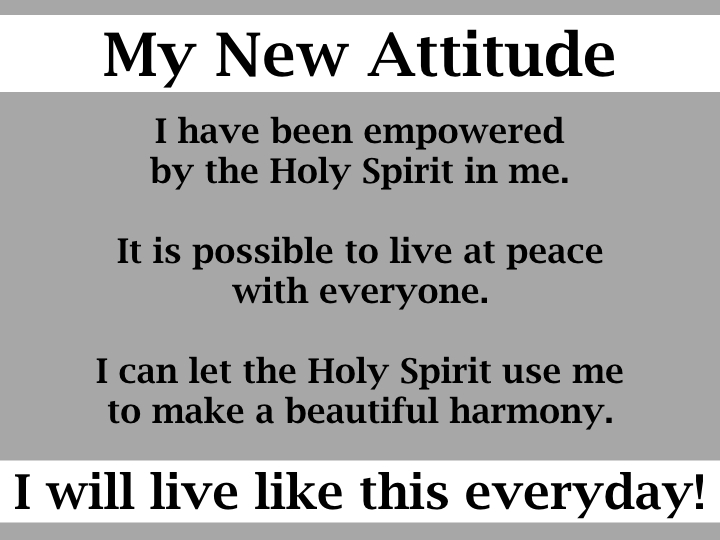
We need to have a new attitude. And I believe that attitude comes from a prayer like this—

I have been empowered by the Spirit of Christ in me. 
It is now possible for me to live at peace with everyone. 
I can let the Holy Spirit use to me make a beautiful harmony. 
I will keep on living like this every day.

Next Sunday we will be looking at some practical techniques and more biblical insights to help us excel in getting along with all ‘the others’ that make up the world. Please join us in person or on Periscope.

9 Quotes On Socialism From “Churchill’s Trial”

Churchill's TrialWinston Churchill waged a lifelong battle against Socialism creeping into a democratic government. He felt it would ultimately undermine the freedoms of individual citizens. In Churchill’s Trial by Larry Arnn, significant space was given to this topic. Here are a few of the most noteworthy quotes on the evils of socialism.

“Human relations are not a contest in which the advantage of some requires the disadvantage of others. That means in turn that government need not have the authority to allocate resources, at least not comprehensively. A government with such power would be in one sense at war with any citizens who have more than others, effectively with all citizens but the few poorest.” —Larry Arnn

“I declare to you, from the bottom of my heart, that no Socialist system can be established without a political police. Many of those who are advocating Socialism or voting Socialist today will be horrified at this idea. That is because they are short-sighted, that is because they do not see where their theories are leading them. No Socialist Government conducting the entire life and industry of the country could afford to allow free, sharp, or violently-worded expressions of public discontent. They would have to fall back on some form of Gestapo, no doubt very humanely directed in the first instance.” —Winston Churchill

“The inherent vice of capitalism is the unequal sharing of blessings. The inherent virtue of socialism is the equal sharing of miseries.” —Winston Churchill

“Churchill’s differences with socialism proceed from this fundamental difference about nature. He thought that the equality for which socialism aimed was unnatural. He thought that it could not be achieved except by suppressing nature, including human nature, which would require the suppression of humans. He thought that because of this fundamental difference, socialism would result in impoverishment in economics, corruption in personal character, and despotism in politics. He thought that by nationalizing these areas of private life in which most human beings do their most urgent and fulfilling tasks, socialism would truncate the lives of ordinary people. For that reason he regarded socialism as dehumanizing.” —Larry Arnn

“A state that attempts to equalize things that are not inherently equal will be at war with human excellence. Some people are in fact wiser, braver, more generous, more skillful, more beautiful, stronger, and more active than others. This does not make them different in their rights, if those rights are defined as the right to employ their ability and gain or lose by their efforts. Both the equality of rights and the differences of human makeup are natural phenomena, and they must be accorded their sway. The attempt to equalize unequal things would, Churchill argued, produce resistance, which in turn would call forth from socialism more vigorous laws. This cycle will continue until all the rights of the people were gone.” —Larry Arnn

“Socialism knows that it can only operate through an agency of bureaucracy under the direction of an autocratic sect.” —Winston Churchill

“If you make 10,000 regulations you destroy all respect for the law.” —Winston Churchill 

“Property [means] every thing to which a man may attach a value and have a right; and which leaves to everyone else the like advantage.” —James Madison (emphasis in original)

“If evil systems corrupt good men, it is no less true that base men will dishonor any system, and while no bond of duty more exacting than that of material recompense regulates the relations of man and man, while no motion more lofty and that of self-interest animates the exertions of every class, and no hope beyond the limits of this fleeting world lights the struggle of humanity, the most admirable systems will merely succeed in transferring, under different forms and pretexts, the burden of toil, misery, and injustice from one set of human shoulders to another.” —Winston Churchill 

You can read my review of Churchill’s Trial by clicking here.

My first set of quotes from this book can be found by clicking here.

Thursdays With Oswald—Don’t Rush God’s Timing

Oswald ChambersThis is a weekly series with things I’m reading and pondering from Oswald Chambers. You can read the original seed thought here, or type “Thursdays With Oswald” in the search box to read more entries.

Don’t Rush God’s Timing 

     Moses was learned in all the wisdom of the Egyptians, he was a mighty man and a great statesman, and when he saw the oppression of his people he felt that God had called him out to deliver them, and in the righteous indignation of his own spirit he started to right their wrongs. God is never in a hurry. After the first big strike for God and for the right things, God allowed Moses, the only man who could deliver his own people, to be driven into the desert to feed sheep—forty years of blank discouragement. 

     Then when God appeared and told him to go and bring forth the people, Moses said—“Who am I, that I should go?” … At first, Moses was certain he was the man, and so he was, but he was not fit yet. He set out to deliver the people in a way that had nothing of the stride of God about it. Moses was right in the individual aspect, but he was not the man for the work until he had learned communion with God, and it took forty years in the desert while God worked through him in ways of terrific personal enlargement before he recognized this.

     We have to learn that our individual effort for God is an impertinence, our individuality must be rendered incandescent by a personal relationship to God, and that is not learned easily. 

From The Place Of Help (emphasis added)

Do you feel like God has called you to do something great for Him? You’re right, He has! But don’t rush His timing. Listen to the counsel of wise people in your life, pray about it, count the cost, and let God prepare you for it. He has perfect timing … don’t rush Him!

12 Quotes From “Churchill’s Trial”

Churchill's TrialIn Churchill’s Trial, Larry Arnn has given us a fascinating look at Winston Churchill’s battle to keep freedom alive, both in the moment of crisis and after the crisis has passed. You can read my full book review by clicking here. Below are a few of the quotes I highlighted as I read.

“Mankind has never been in this position before. Without having improved appreciably in virtue or enjoying wiser guidance, it has got into its hands for the first time the tools by which it can unfailingly accomplish its own extermination. That is the point in human destinies to which all the glories and toils of men have at last lead them. They would do well to pause and ponder upon their new responsibilities. Death stands at attention, obedient, expectant, ready to serve, ready to shear away the peoples en masse; ready, if called upon, to pulverize, without hope of repair, what is left of civilization. He awaits only the word of command. He awaits it from a frail, bewildered being, long his victim, now—for one occasion only—his master.” —Winston Churchill 

“Science is necessary, and also science is a master. As the human ability to make grows, the human ability to control the engines by which we make diminishes. The logical problem is relentless: we may stay as we are and lead shorter lives of pain and trouble, or we may use our capacity to make our lives easier and safer. If we do that we will gain power, and we can use that power against ourselves.” —Larry Arnn

“No material progress, even though it takes shapes we cannot now conceive, or however it may expand the faculties of man, can bring comfort to his soul.” —Winston Churchill 

“We must never cease to proclaim in fearless tones the great principles of freedom and the rights of man which are the joint inheritance of the English-speaking world and which through Magna Carta, the Bill of Rights, the Habeas Corpus, trial by jury, and the English common law find their most famous expression in the American Declaration of Independence. …

“All this means that the people of any country have the right, and should have the power by constitutional action, by free unfettered elections, with secret ballot, to choose or change the character or form of government under which they dwell; that freedom of speech and thought should reign; that courts of justice, independent of the executive, unbiased by any party, should administer laws which have received the broad ascent of large majorities or are consecrated by time and custom. Here are the title deeds of freedom what should lie in every cottage home. Here is the message of the British and American peoples to mankind. Let us preach what we practice—let us practice what we preach.” —Winston Churchill

“There is enough for all. The earth is a generous mother; she will provide in plentiful abundance food for all her children if they will but cultivate her soil in justice and in peace.” —Bourke Cockran

“Human relations are not a contest in which the advantage of some requires the disadvantage of others. That means in turn that government need not have the authority to allocate resources, at least not comprehensively. A government with such power would be in one sense at war with any citizens who have more than others, effectively with all citizens but the few poorest.” —Larry Arnn

“In republics, the greater danger is that the majority may not sufficiently respect the rights of the minority.” —James Madison

“He who molds public sentiment goes deeper than he who enacts statutes or pronounces decisions.” —Abraham Lincoln

“Democracy properly understood means the association of all through the leadership of the best.” —Winston Churchill

“Our hearts will ache…if we have not a vision above material things.” —Winston Churchill

“If men were angels, no government would be necessary. If angels were to govern men, neither external nor internal controls on government would be necessary.” —James Madison

“We now watch the workings of a written Constitution enforced by a Supreme Court according to the letter of the law, under which anyone may bring a test case challenging not merely the interpretation of the law, but the law itself, and if the Court decides for the appellant, be he only an owner of a few chickens, the whole action of the Legislature and the Executive becomes to that extent null and void.” —Winston Churchill 

More quotes coming soon…

How To Get Along With Others

How To Get Along With OthersJohn Maxwell famously said, “The entire world—with one minor exception—is made up of other people.” That “one minor exception”? It’s the person staring at you in the mirror every morning! Obviously learning how to get along with all the “others” in the world is hugely important.

It’s even more important for those who call themselves Christians.

The Bible makes it quite clear that people watch how Christians treat one another to see if the message they preach is one worth living. And Jesus told one of His most well-known stories to make the point that all of the Bible is fulfilled in just two things: (1) Loving God and (2) Loving others.


To live above with the God that we love,
Oh, wouldn’t that be glory!
But to live below with the saints that we know,
Well, that’s a different story!

The Bible says a lot about “one another.” In fact, that phrase is used nearly 60 times in the New Testament! Not only is there much that the Scripture has to say to us about getting along with one another, but most of what was written has been confirmed by modern psychology.

Join me this Sunday at Calvary Assembly of God as we begin a new series called How To Get Along With Others. We’ll be learning some practical training along with biblical insights to help us excel at this vitally important life skill.

You can find directions to our church here, and if you can’t join us in person, be sure to tune in to our Periscope broadcast (follow me @craigtowens to be notified when the broadcast starts).

Churchill’s Trial (book review)

Churchill's TrialI have read so much written by and about Winston Churchill, that it’s hard to imagine learning something new about this remarkable man. And yet, I was amazed at how much more I learned in reading Churchill’s Trial by Larry Arnn.

It’s easy to take for granted the freedoms people have in countries like England and the United States because of the foresight of the framers of our Constitutions. But there are trials which put these freedoms in a precarious place, and if it were not for strong and insightful men—like Winston Churchill—those freedoms could have disappeared.

Churchill played key roles in his country, and in world politics, through two world wars, a global depression, the coming of age of new military super-powers, the dawn of the era of atomic warfare, and the rise of Communism. In all of these intense events, the temptation was there to make radical changes to meet the challenge of the moment. Churchill had the wisdom and foresight to leverage the strength of his country’s Constitution, without undermining it nor setting a precedent which would erode future freedoms.

In what Churchill did for England, he also helped strength the resolve of key leaders in the United States, who faced similar challenges in a shifting geopolitical climate. Churchill not only saved the world from the spread of fascism and communism, but he did so in a way that would guarantee freedom for millions of people in generations to follow. The question before us now is: Will we learn from Churchill’s example, or will we fail the trial we now face?

For history buffs, political junkies, and fans of Winston Churchill, Churchill’s Trial is an excellent read.

I am a Thomas Nelson book reviewer.

Life Or Death?

Life or deathSince Jesus predicted His death on a Cross, and His resurrection from the dead three days later, and since that really happened(!), I think that it would be wise to consider the other words Jesus said!

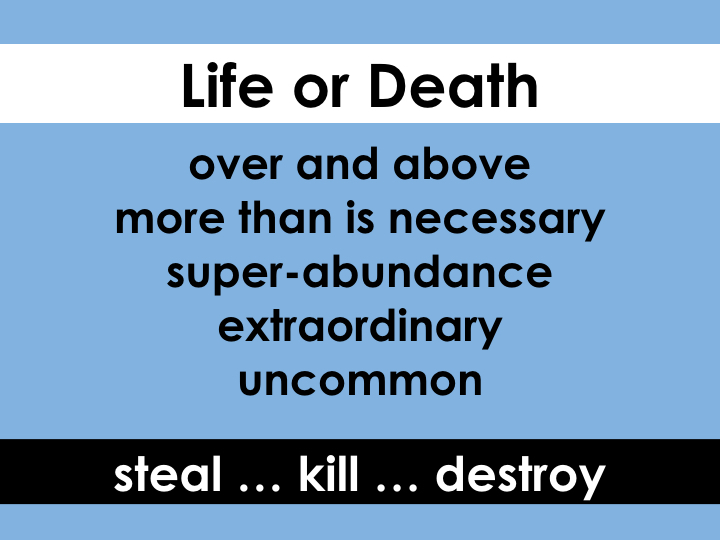
Here’s an important one—The thief cometh not, but for to steal, and to kill, and to destroy: I am come that they might have life, and that they might have it more abundantly (John 10:10).

It’s a pretty clear distinction: One way brings death and the other way brings life. But not just any kind of life.

The Greeks had three words for “life”—

  1. Bios from which we get our word biology. We can see when something is alive because of its biological growth.
  2. Psuche from which we get our word psychology. Plants might be biologically alive, but they don’t have the psychological life of a human.
  3. Zoe. This is the word Jesus used in John 10:10. It’s the word that means “life force” or better stated it’s God’s life.

God is a Triune God: Father, Son, and Spirit. When God created humans, we were created in His “trinity” image—Let Us make man in Our image (Genesis 1:26). Adam was created with bios, psuche, and zoe life. God told Adam and Eve that if they sinned, they would die (Genesis 2:17). When they did eat that forbidden fruit, they remained biologically and psychologically alive, but the zoe life force was cut off.

Jesus came to restore that! He came to bring us back to the state God originally intended for us, which meant He had to go to the Cross to become our sin, so that we could be forgiven and brought back to life.

Placing your faith in Jesus Christ’s work on the Cross means a complete about-face. The devil wants to steal from you, kill you, and destroy your soul for eternity. But Jesus came that you could have zoe in a way that was above-and-beyond, super-abundant, extraordinary and uncommon!

To get this life, Jesus asks us to do something that He did—If anyone would come after Me, he must deny himself and take up his cross and follow Me (Matthew 16:24).

Jesus isn’t calling for our hands and feet to be nailed to a wooden Cross. But He is calling for our selfish thoughts to be crucified (Matthew 16:23), and for us to give no more attention to our old sinful life.

I think this passage in Romans captures that thought so well—

Could it be any clearer? Our old way of life was nailed to the Cross with Christ, a decisive end to that sin-miserable life—no longer at sin’s every beck and call! What we believe is this: If we get included in Christ’s sin-conquering death, we also get included in His life-saving resurrection. We know that when Jesus was raised from the dead it was a signal of the end of death-as-the-end. Never again will death have the last word. When Jesus died, He took sin down with Him, but alive He brings God down to us. From now on, think of it this way: Sin speaks a dead language that means nothing to you; God speaks your mother tongue, and you hang on every word. You are dead to sin and alive to God. That’s what Jesus did. That means you must not give sin a vote in the way you conduct your lives. Don’t give it the time of day. Don’t even run little errands that are connected with that old way of life. Throw yourselves wholeheartedly and full-time—remember, you’ve been raised from the dead!—into God’s way of doing things. Sin can’t tell you how to live. After all, you’re not living under that old tyranny any longer. You’re living in the freedom of God. (Romans 6:6-14)

The choice is yours: the rip-off, destruction, and death the devil offers OR the abundant, overflowing, extraordinary, more-than-is-needed, zoe life that Jesus offers.

Life or death. Your choice.

Is Christ Real To Me?

John WesleyJohn Wesley was deeply introspective about his faith in Jesus Christ. He once wrote—

“I did go thus far for many years…using diligence to eschew all evil, and to have a conscience void of offense; redeeming the time; buying up every opportunity of doing all good to all men; constantly and carefully using all the public and all the private means of grace; endeavoring after a steady seriousness of behavior, at all times, and in all places; and, God is my record, before Whom I stand, doing all this in sincerity; having a real design to serve God; a hearty desire to do His will in all things; to please Him who had called me to ‘fight the good fight,’ and to ‘lay hold of eternal life.’ Yet my own conscience beareth me witness in the Holy Ghost, that all this time I was but almost a Christian.”

To help keep himself on the right path, Wesley came up with this list of questions he regularly asked himself. This is a list any Christian would do well to read through regularly—

  1. Am I consciously or unconsciously creating the impression that I am better than I am? In other words, am I a hypocrite?
  2. Am I honest in all my acts and words, or do I exaggerate?
  3. Do I confidentially pass onto another what was told me in confidence?
  4. Am I a slave to dress, friends, work, or habits?
  5. Am I self-conscious, self-pitying, or self-justifying?
  6. Did the Bible live in me today?
  7. Do I give it time to speak to me everyday?
  8. Am I enjoying prayer?
  9. When did I last speak to someone about my faith?
  10. Do I pray about the money I spend?
  11. Do I get to bed on time and get up on time?
  12. Do I disobey God in anything?
  13. Do I insist upon doing something about which my conscience is uneasy?
  14. Am I defeated in any part of my life?
  15. Am I jealous, impure, critical, irritable, touchy or distrustful?
  16. How do I spend my spare time?
  17. Am I proud?
  18. Do I thank God that I am not as other people, especially as the Pharisee who despised the publican?
  19. Is there anyone whom I fear, dislike, disown, criticize, hold resentment toward or disregard? If so, what am I going to do about it?
  20. Do I grumble and complain constantly?
  21. Is Christ real to me?

Encampment Of Blessings

I am so proud of our Sunday School class! They don’t just talk about being disciples of Jesus Christ, they live it out daily.

33-Scott & HungarianOn New Year’s Day, they braved the frigid temperatures to minister to needy people in the inner city of Grand Rapids. They are going back again on Saturday, April 23.

You can help in several ways:

  1. Go with them on April 23. They will be leaving 1:00pm.
  2. Donate some items that they will be passing out. You can find a complete list here → Encampment of Blessings
  3. Make a financial donation. If you cannot purchase these items, you may make a financial donation via PayPal on the church’s website. Please write “Encampment” on the memo line.
  4. Help with the organization of all the donated items on Sunday, April 17, right after church.
  5. Pray that God will use this outreach to open doors for these folks to hear and see the love of Jesus.

Jesus said, “For I was hungry and you gave Me something to eat, I was thirsty and you gave Me something to drink, I was a stranger and you invited Me in, I needed clothes and you clothed Me, I was sick and you looked after Me, I was in prison and you came to visit Me. Then the righteous will answer, ‘Lord, when did we see You hungry and feed You, or thirsty and give You something to drink? When did we see You a stranger and invite You in, or needing clothes and clothe you? When did we see You sick or in prison and go to visit You?’ The King will reply, ‘Truly I tell you, whatever you did for one of the least of these brothers and sisters of mine, you did for Me.’” (Matthew 25:35-40)

Thursdays With Oswald—What Does Your Religion Mean?

Oswald ChambersThis is a weekly series with things I’m reading and pondering from Oswald Chambers. You can read the original seed thought here, or type “Thursdays With Oswald” in the search box to read more entries.

What Does Your Religion Mean? 

     To believe is literally to commit. Belief is a moral act, and Jesus makes an enormous demand of a man when He asks him to believe in Him. To be “a believer in Jesus” means to bank our confidence in Him, to stake our soul upon His honor. …

     Many of us use religious jargon, we talk about believing in God, but our actual life proves that we do not really believe one tithe of what we profess. … “The unsearchable riches of Christ”—yet we often live as if our Heavenly Father had cut us off with a shilling! We think it is a sign of real modesty to say at the end of a day—“Oh well, I have just got through, but it has been a severe tussle.” We carry our religion as if it were a headache, there is neither joy nor power nor inspiration in it, none of the grandeur of the unsearchable riches of Christ about it, none of the passion of hilarious confidence in God. …

     Christianity is the vital realization of the unsearchable riches of Christ. …

     We have made Christianity to mean the saving of our skins. Christianity means staking ourselves on the honor of Jesus; His honor means that He will see us through time, death and eternity. … 

     Why do you pray? Why are you religious? Because of a consuming passion for a particular set of your beliefs to be enthroned and proved right, or because of a consuming passion for Jesus Christ? 

From The Place Of Help

Wow, those are excellent questions to consider—What do I think Christianity really is? Do I really believe what Jesus did for me, or is it just jargon I use? Am I consumed in my passion for Christ, or is it only something I profess when things are going my way?