Do You Know Your Community?

Jesus called His followers to be salt and light. It’s pretty easy to figure out that the salt cannot season the food if it stays in the saltshaker, and the light cannot illuminate the darkness if it stays covered up. In order to season and shine in your community, you have to know your community.

And, pastor, that starts with you.

What you do is a much more effective sermon that what you say. Pastor, you need to know your community, so that you can be involved in your community, so that you and your church can season and shine in your community together.

So let me ask a couple of questions:

  • Do you know your Mayor / City Manager / Township Supervisor? If you don’t know them, how can you affirm their leadership (Romans 13:1-7)?
  • Do you attend City / Township Council meetings? If you don’t, how will you know what issues they’re wrestling with? If you don’t know those issues, how can you pray effectively for them (1 Timothy 2:1-2)?
  • Are you involved in your community? Don’t just assume people in your community will come to your church to sit among stranger to hear a stranger speak; instead, be so involved in your community that they will come to church to fellowship with friends and hear a friend speak (John 2:1-2).

I opened with the question, “Do you know your community?” But maybe a better way to ask this is, “Does your community know you?”

Does the community come to you to ask for help? This may be the best barometer of your involvement in your community: how often they seek your help or assistance in addressing issues within your community.

If you’re not as involved as you should be, the good news is that it’s never too late to start! Go get involved—go season and shine!

Thursdays With Oswald—How To Think About Sin

This is a weekly series with things I’m reading and pondering from Oswald Chambers. You can read the original seed thought here, or type “Thursdays With Oswald” in the search box to read more entries.

How To Think About Sin

     We have to face the problem that our hearts may be right with God while our heads have a startling affinity with a great deal that is antagonistic to the Bible teaching. What we need, and what we get if we go on with God, is an intellectual re-birth as well as a heart re-birth.

     The trouble with the modern statements regarding sin is that they make sin far too slight. Sin according to the modern view simply means selfishness, and preachers and teachers are as dead against selfishness as the New Testament is. Immediately we come to the Bible we find that sin is much deeper than that. According to the Bible, sin in its final analysis is not a defect but a defiance, a defiance that means death to the life of God in us. …

     According to the Bible, sin is doing without God. Sin is not wrong doing, it is wrong being, deliberate and emphatic independence of God.

From Biblical Ethics

Sometimes I just have to read Oswald Chambers, let it soak in, read it again, and then sit back and exhale deeply. His profound insights into how a Christian should live always seem to hit me right between the eyes.

Here’s what I’m pondering: “The trouble with the modern statements regarding sin is that they make sin far too slight.” Do I make excuses for sin? Do I say, “It’s not that big of a deal”?

And this: “Sin is not wrong doing, it is wrong being, deliberate and emphatic independence of God.” Am I living each and every moment totally dependent on God? It’s when I think I can do it on my own that I am the most vulnerable to sinning.

The Treasure Principle (book review)

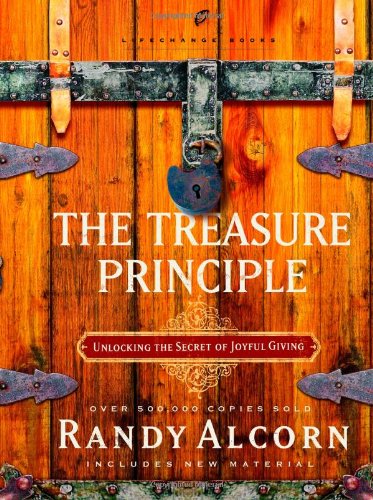
One of the knocks I often hear about the church is that we talk too much about money. I don’t feel that’s an accurate assessment, especially considering that Jesus talked about money and possessions more than He did about Heaven and Hell. In The Treasure Principle: Unlocking The Secret Of Joyful Giving, Randy Alcorn shares the keys that Jesus taught about this important topic.

In just the first few pages, Randy sets the stage for this book by stating:

“Why did Jesus put such an emphasis on money and possessions? Because there’s a fundamental connection between our spiritual lives and how we think about and handle money. We may try to divorce our faith and our finances, but God sees them as inseparable.”

The Treasure Principle mixes biblical instruction on handling our money, Randy’s insights into those scriptures, as well as Randy’s own personal experiences with finances. These are all used to support six treasure principle keys.

One of my favorite parts of the book comes at the very end. Randy shares “31 Radical, Liberating Questions To Ask God About Your Giving.” This is where the rubber meets the road (or the principles meet the pocketbook!). This is setup for you to read one question daily for a month, to really allow God to speak to you through His Word and through this book about your financial perspectives and practices. I thoroughly enjoyed the book, and I’m looking forward to continuing my month-long journey through these radical questions.

I am a Multnomah book reviewer.

Church-In-A-Box

Did you ever play with a Jack-in-a-box? You turned the crank, listened to the song, and waited for the funny-looking Jack to pop out of the box. Then you stuffed Jack back in the box and did it again.

And again, and again!

It was predictable.

It happened like clockwork. After awhile, though, the predictability became boring, and the Jack-in-a-box ended up collecting dust on the shelf.

Sometimes I’m concerned that our churches are becoming like a church-in-a-box. Like the predictable Jack-in-a-box, we turn the crank of showing up on Sunday, going through the same routine, waiting for God to show up, and then stuffing it all back into the box, only to repeat it all again the next Sunday.

And the next Sunday, and the next Sunday!

It’s predictable. It happens like clockwork. After awhile, though, the predictability can become boring, and our church-in-a-box ends up collecting dust on the shelf.

Here’s what I’m pondering:

  • Why do we meet on Sunday mornings?

There are as many mentions in the Bible about Christians meeting on other days as there are mentions about the first day of the week.

  • Why do we get so hung up on the “order of service”?

None of the New Testament writers taught about that. Yet if you want to anger some folks, just change up the Sunday routine.

  • Why do we dress a certain way to go to church?

Jesus had only one set of clothes, which means He wore the same thing to the synagogue as He wore the rest of the week. Yet we expect people to “dress correctly” for church.

  • Why do we call what happens on Sunday “worship,” and what happens the rest of the week “work”?

Shouldn’t everything we do bring glory to God? Shouldn’t all of our lives be worship?

  • Why do we complain about a church service not “moving us,” when we don’t feel the Holy Spirit moving the other six days of the week?

I’m not trying to pick a fight. Really.

I’m just wondering if perhaps we’ve gotten used to church-in-a-box. And if we have, perhaps we’ve also put God in a box too. Maybe we’ve become so accustomed to showing up on Sunday, dressing a certain way, following a certain routine, singing certain songs, and then expecting God to pop out and thrill us.

And then we put it all away until the next Sunday.

Wouldn’t God be more glorified if we didn’t put Him in a box? If we worshiped Him every day, not just Sunday? If we felt His Spirit animating us in everything we do, not just in the churchy things we do? If He popped up all throughout the week, in all sorts of places (like work, school, the grocery store, home)?

What do you think? Have we put church (and God) in a box? If so, how should we change?

What Are You Exchanging?

Listen to the podcast of this post by clicking on the player below, and you can also subscribe on AppleSpotify, or Audible.

In Romans 1, the word exchanged shows up three times in just one passage (Romans 1:22-32). Quite simply, this means every encounter with God’s presence requires me to make a choice, to exchange something.

I cannot remain neutral. The interaction with God is not static, but dynamic.

There are two forces at work in my life: sin and the Holy Spirit.

Sin wants me to exchange…

  • …the creation for the Creator (Romans 1:23)
  • …lies for truth (v. 25)
  • …pleasure for purity (v. 26)
  • …depravity for holiness (v. 28)

One exchange toward sin makes the next one that much easier. Soon the downward spiral can be pulling me faster and faster until: it’s not as if they don’t know better. They know perfectly well they’re spitting in God’s face. And they don’t care—worse, they hand out prizes to those who do the worst things best! (v. 32, The Message)

C.S. Lewis said it this way:

Good and evil both increase at compound interest. That is why the little decisions you and I make every day are of such infinite importance. The smallest good act today is the capture of a strategic point from which, a few months later, you may be able to go on to victories you never dreamed of. An apparently trivial indulgence in lust or anger today is the loss of a ridge or railway line or bridgehead from which the enemy may launch an attack otherwise impossible.”

The Holy Spirit also asks for an exchange. He wants me to exchange…

  • …the momentary for the eternal
  • …self-gratification for God’s glory
  • …my desire for God’s will

You will encounter God today. The choice is yours: What exchange will you make?

►► Would you please prayerfully consider supporting this ministry? My Patreon supporters get behind-the-scenes access to exclusive materials. ◀︎◀︎

Earth Day 2012

One of the first commands that God gave to Adam and Eve was to work in the Garden of Eden and take care of it (Genesis 2:15). The earth is God’s, but He put mankind here to be stewards of His creation.

That’s why I am pleased that Calvary Assembly of God is going to participate in the Earth Day 2012 cleanup in Cedar Springs. This is a great way for us to show, in a tangible way, that we love our community, and that we want to take care of the environment where we live, work and worship.

If you live in Cedar Springs, please join with us on Saturday, April 28, at 10am. If you live in another community, please consider partnering with a similar cleanup effort in your hometown, or start one of your own.

I believe those who call themselves Christians should be the most environmentally-aware people in the community.

How Much Do I Have To Do?

I had a couple of questions along the line of “How much do I have to do” in The Q Series yesterday morning. We all have a tendency to want to know how to fill in the blanks of questions like:

  • How much time do I have to spend with God to make Him happy?
  • How holy do I have to be for God to accept me?
  • What do I have to do for God to love me more?
  • How much do I have to do to make it to Heaven?

But all of these questions start with a wrong premise. These questions all assume I can do something. If the history of mankind shows us anything, it’s that all of our attempts to build a bridge up to God always falls short.

So—wonder of wonders!—God reached down to us! Jesus gave all so that we could be restored to a relationship with God. And what does He want in return? He wants you! I love this thought from C.S. Lewis:

“For it is not so much of our time and so much of our attention that God demands; it is not even all our time and all our attention; it is ourselves.”

Sometimes we look at ourselves and think, “God wants this?! God wants me?!” In fact, I received another question yesterday that simply asked, “Why does God love us?”

God wants you because He made you to be in relationship with Him. He loves you as if you were the only person on earth to love. Again, consider these wise words from C.S. Lewis—

“We were made not primarily that we may love God (though we were made for that too) but that God may love us, that we may become objects in which the Divine love may rest ‘well pleased.’ …Because He already loves us He must labor to make us lovable.”

How much do you have to do to receive that love? Just believe that fact that God loves you, that He sent Jesus to pay the price for your forgiveness, and that the Holy Spirit is right now working to draw you into that ‘Divine love’ relationship.

Let me state it simply: God loves you. Will you let His love fill your life?

Check out other questions in our Q Series by clicking here.

Harmless

When a story from the past is so well known, we can easily insert ourselves into it with a certain bias. When we do this, we read things into the story because of the facts we know now.

For instance, we know Judas betrays Jesus. So when we see his name in any story in the Bible, we immediately associate the word traitor with him, and we can only view him through that lens. Therefore, it’s easy for us to put ourselves in the place of one of the other eleven disciples of Jesus, and assume that they too knew Judas was a traitor.

Except they didn’t.

Look at this verse after Jesus says, “One of you will betray Me”—

His disciples stared at one another, at a loss to know which of them He meant. (John 13:22)

The Eleven were not suspicious of Judas. They didn’t say, “Well, I just knew it was him,” or “I kinda expected that from Judas.”

One of the things Jesus taught His followers was for them to be gentle as doves. I like how the King James Version says it: harmless as doves (Matthew 10:16).

Pastor, I know you especially have been hurt by people in your church. They have betrayed you, gossiped about you, turned on you. If people did that to Jesus, why would you expect anything less? And yet we are still to remain harmless as doves.

The Eleven never suspected a traitor. They were innocent. I think they were so focused on Jesus, they didn’t have time to be cynical about others. We view Judas cynically; they didn’t.

What a testimony to others when we are harmless:

That ye may be blameless and harmless, the sons of God, without rebuke, in the midst of a crooked and depraved nation, among whom ye shine as lights in the world. (Philippians 2:15)

You may have been hurt many (many, many, many…) times in the past. But being harmless means that, like the disciples, we are “at a loss” as to whom it could be when someone tells us there is a traitor in our midst.

  • Stay focused on Jesus, so you may love others as He loves them.
  • Allow God to heal the wounds others have inflicted on you.
  • Ask the Holy Spirit to reveal any cynicism in your heart.
  • Repent of your suspicion of people.
  • Be harmless toward everyone.
  • Grieve over the traitor.
  • Then stay focused on Jesus, not the traitor and not your wound.

Thursdays With Oswald—The Realness Of The Holy Spirit

This is a weekly series with things I’m reading and pondering from Oswald Chambers. You can read the original seed thought here, or type “Thursdays With Oswald” in the search box to read more entries.

The Realness Of The Holy Spirit

     The Holy Spirit makes Jesus Christ both present and real. He is the most real Being on earth, ‘closer is He than breathing, and nearer than hands and feet.’ Simply receive the Holy Spirit, rely upon Him and obey Him and He will bring the realization of Christ….

     The Holy Spirit is seeking to awaken men out of lethargy; He is pleading, yearning, blessing, pouring benedictions on men, convicting and drawing them nearer, for one purpose only, that they may receive Him so that He may make them holy men and women exhibiting the life of Jesus Christ. How the devil does rob Christians who are not thinking on Pentecostal lines of the tremendous power of the Presence of Jesus made real by the Holy Spirit!

From Biblical Ethics

When Jesus said He would never leave us, He fulfilled this promise by sending the Holy Spirit. The Holy Spirit is our constant Guide, our wisest Counselor, our kindest Teacher, and the illuminating Spirit of Truth.

Think about this: The same Holy Spirit who inspired the writing of the Scriptures, is the same Holy Spirit Who will illuminate those Scriptures to you. How the devil does rob Christians who are not thinking on Pentecostal lines!

Holy Spirit, I willingly yield to Your illuminating and transforming presence in my life today!

My High Wire Act

“Ladies and gentleman, high above you, balanced precariously on the tightrope high over your heads—and performing it all without a net—is your pastor!”

Well, that’s sorta what it feels like to me!

Last year, I took a couple of Sundays to field questions from our congregation. My hope was that lots of people would turn in their questions early, to give me a little time to prepare (that’s like performing with a net). But instead, most of the questions came as I was standing at the front of the church with the microphone in my hand. That’s definitely performing without a net!

But it was very well received, so we’re trying this high wire act again. Beginning next Sunday The Q Series allows anyone in attendance to ask their questions about the Bible, God, or anything else that’s on their mind about spiritual matters. People can either ask their question verbally, or they can text their question anonymously to the techs in our sound booth.

Of course, if you’d like to help me perform with a net, please ask a question or two (or three, or four…) in the comments below. If you’d like to see me perform without a net, join us at 10:30am this Sunday morning.

Here are some of the questions we have addressed: