Thursdays With Oswald—An Aroma From God’s Garden

Oswald ChambersThis is a weekly series with things I’m reading and pondering from Oswald Chambers. You can read the original seed thought here, or type “Thursdays With Oswald” in the search box to read more entries.

An Aroma From God’s Garden

     [Oswald Chambers is speaking about how the prodigal son returned home.] 

     Did the father send any message to the far country after the younger boy? There is no record of any message being sent. What did the younger boy have to do? He had to do exactly what is recorded in Hosea long before that picture was painted by Our Lord—he had to return. Drawn by God? It does not say so. Read the fourteenth chapter of Hosea: “I will heal their backsliding” [Hosea 14:4]; but the backslider has to get up first, leave the pigs and what pigs eat, and go back to where he came from. Help granted him? None whatever. Messages from the home country? Not one. Tender touches of God’s grace on his life? No. Can you picture that prodigal son returning, a degraded, sunken, sin-stained man, going back in all the cruel, bald daylight? Oh, it is a hard way to go back out of the backslider’s hell; a hard, hard way! Every step of it is cruel, every moment is torture. But what happened? Before that younger son had gotten very far, the father saw him “and ran to his son, threw his arms around him and kissed him”!

     Worker for God among backslidden souls, remember God’s way, put the sting, if you can, into the backslider’s soul that he may get up and come back to God, and what has he to do? Take with him words and say, “Forgive all my sins and receive me graciously” [Hosea 14:2]. Did the prodigal son take with him words? He did, he rehearsed them over and over again where he was amongst the pigs—“I will say to my father this and that,” he had it all by heart. Does Hosea say the same? He does: “My sins have been my downfall” [Hosea 14:1]. … 

     I just said now that no message was sent to the far country; God sends none, but, worker for God, will you be a message from the Father? Will you so bathe your life in the atmosphere of prayer that when you come in contact with a backslidden soul, it will awaken a remembrance of the Father, awaken a remembrance of what that soul once was? Will you let your life be like a bunch of flowers from the Father’s home garden, just awakening for one moment a remembrance of what life once was, and then pass on, and pray and watch, and you will be mightily rewarded by God when you see that poor backslidden soul get up and go back to God, taking with him words and saying, “My sins have been my downfall.” 

From Workmen Of God

What about you, my friend? Do you love the prodigals enough to be the Father’s message from home to them?
7 Quotes From “The Pastor In Prayer”

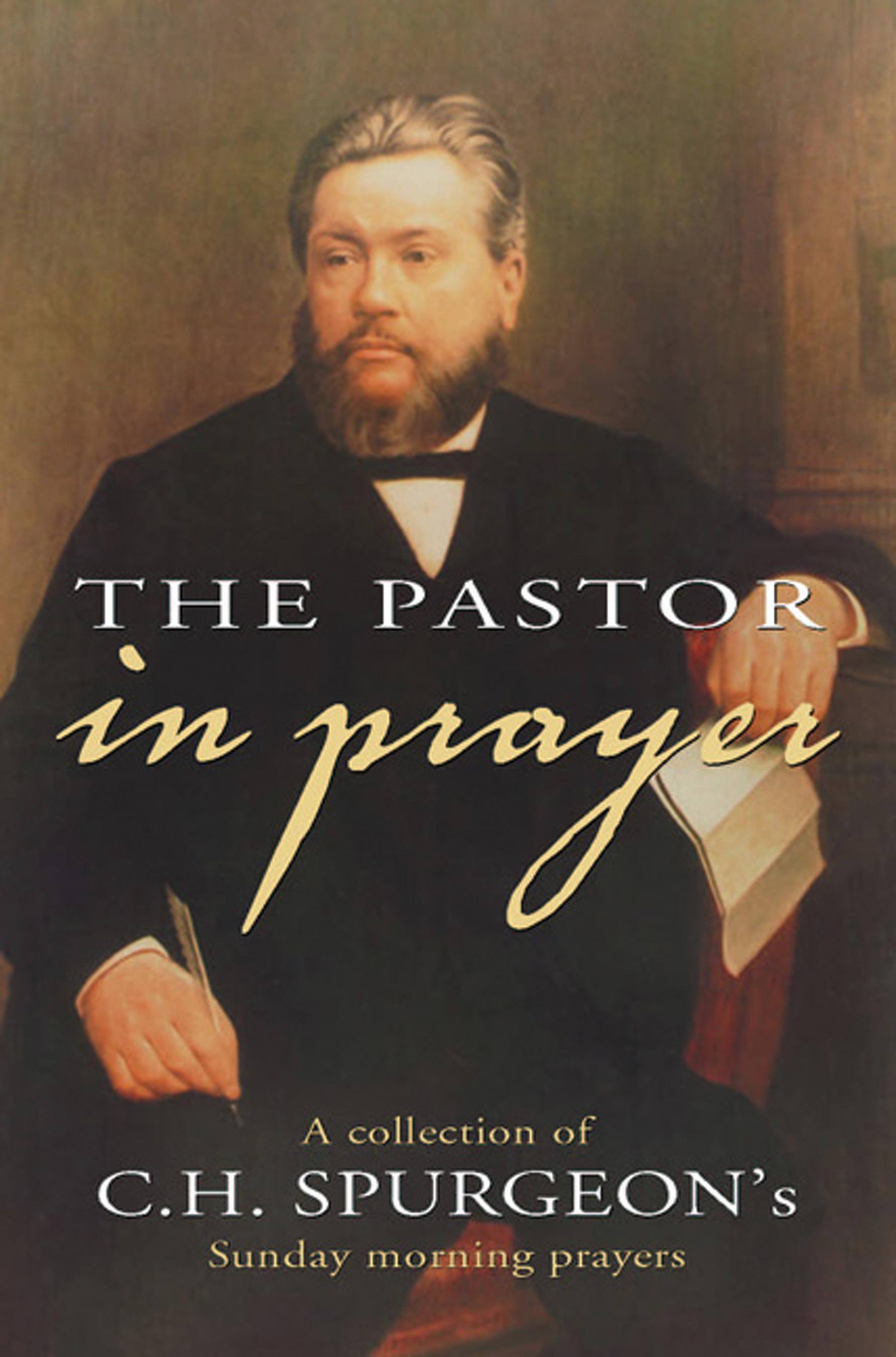
In The Pastor In Prayer we discover that Charles Spurgeon is not only the prince of preachers, but the prince of pray-ers as well. Check out my review of this fabulous book by clicking here.

“Thy grace must give us even to know our need of grace. We are not willing to confess our own sinfulness until Thou dost show it to us. Though it stares us in the face our pride denies it, and our own inability is unperceived by us. We steal Thy power and call it our own till Thou dost compel us to say that we have no strength in ourselves.”

“Thy grace has almost out-graced itself, Thy love has reached its height love to rebels; so to love that even Thy Son could not be spared. O God, we are afflicted in our hearts to think we do not love Thee more after such love as this.”

“O God, we beseech Thee bring men away from all their false trusts to rest in the great sacrifice of Thy dear Son.”

“Oh that we might live so near to the great Shepherd as to be familiar with His voice, to know its tones, that so a stranger we may not follow, for we know not the voice of strangers.”

“Thou art good when Thou givest, and Thou art good when Thou takest away. Thou art good when the night gathers heavy about us. Thou art good when the sun shineth and gladdeneth our pathway. Thou art always good and doest good, and blessed be the name of the Lord from the rising of the sun unto the going down thereof, and through the night watches let His praise be still celebrated.”

“And truly since we have received so many mercies at Thy hand, we do feel that Thou wilt never forsake us in any darkness which may be in our path in the future. Thou hast done too much for us to desert us now. We have cost Thee so much—Oh wondrous price that Thou hast paid for us—and Thou hast spent so much of wise thought, and gracious act upon us, that we are persuaded Thou wilt go through with the work which Thy wisdom has undertaken. But give us faith to believe this when the stormy times come, let us not doubt.”

“Lord, while we work for Thee, always keep us sitting at the feet of Jesus. Let our faith never wander away from the simplicity of its confidence in Him. Let our motive never be anything but His glory; may our hearts be taken up with His love, and our thoughts perpetually engaged about His person.”

The Pastor In Prayer (book review)

Charles Spurgeon was called (and rightly so!) “the prince of preachers.” I think in large part this was because Spurgeon’s sermons were so steeped in God’s Word. But Spurgeon was also renown for his moving prayers, and again I think this is due to the biblical content that was used to weave these prayers. We get a small sample of these prayers in The Pastor In Prayer.

In D.L. Moody’s first sermon at his church in Chicago, he recounted his time visiting Spurgeon’s church. The editor of The Pastor In Prayer summarizes Moody’s words this way: “What impressed him most was not the praise, though he thought he had never heard such grand congregational singing; it was not Mr. Spurgeon’s exposition, fine though it was, nor even his sermon; it was his prayer. He seemed to have such access to God that he could bring down the power from heaven; that was the great secret of his influence and his success.”

Truly prayer is the fuel for any meaningful church activity. We are blessed to have access to these moving, fueling prayers which Spurgeon prayed over his congregation every week. We can hear echoes of his sermon, challenges to draw closer to God, calls to repentance, pleas for revival, blessings on his congregation and on his country.

Truly Spurgeon’s prayers are as memorable and moving as are his sermons!

Pastor, I urge you to read this book and follow Spurgeon’s monumental example in praying for your congregation and in calling them to bolster their own prayer life. But even if you are not in the pastorate, all Christians can be inspired to greater depth in prayer by Mr. Spurgeon’s moving, passionate prayers.

A Christian Should Be Neither Boasting Nor Belittling

“Boasting is an evidence that we are pleased with self; belittling, that we are disappointed in it. Either way we reveal that we have a high opinion of ourselves.

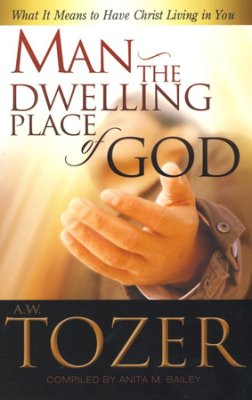
The victorious Christian neither exalts nor downgrades himself. His interests have shifted from self to Christ. What he is or is not no longer concerns him. He believes that he has been crucified with Christ and he is not willing either to praise or deprecate such a man.” —A.W. Tozer, in Man—The Dwelling Place Of God (emphasis mine)

Rediscovering Some Mighty Precious Values

“The trouble isn’t so much that we don’t know enough, but it’s as if we aren’t good enough. The trouble isn’t so much that our scientific genius lags behind, but our moral genius lags behind. The great problem facing modern man is that, that the means by which we live have outdistanced the spiritual ends for which we live. So we find ourselves caught in a messed-up world. The problem is with man himself and man’s soul. …

“The great danger facing us today is not so much the atomic bomb that was created by physical science. Not so much that atomic bomb that you can put in an aeroplane and drop on the heads of hundreds and thousands of people—as dangerous as that is. But the real danger confronting civilization today is that atomic bomb which lies in the hearts and souls of men, capable of exploding into the vilest of hate and into the most damaging selfishness—that’s the atomic bomb that we’ve got to fear today. …

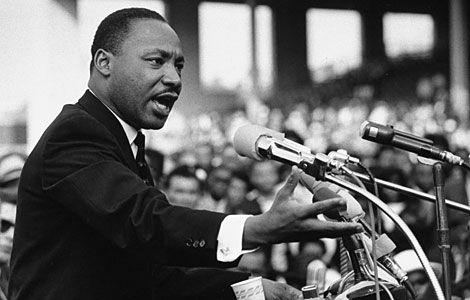
“My friends, all I’m trying to say is that if we are to go forward today, we’ve got to go back and rediscover some mighty precious values that we’ve left behind.” —Martin Luther King, Jr. (February 28, 1954)

Saturday In The Psalms—Sing A New Song

Oh, sing to the Lord a new song! (Psalm 96:1).

God is so great—His worth is infinite—that He deserves a new song every time we sing to Him. There is no need to copy or duplicate something done before, but we should continually find new ways to praise Him.

Look at the angels encircling God’s throne. They continually sing out, “Holy! Holy! Holy!” as they perceive new dimensions of God’s grace, love, faithfulness, beauty, and majesty.

“Oh! Did you see that? Holy!” 

“Look at that! Amazing!” 

“Wow, I just saw something else breathtaking” Worthy!”

Our praise of God should follow that example: “Holy! Holy! Holy!” This is what Psalm 96 tells us…

Sing!
Bless His name!
Tell how good He is!
Declare His glory everywhere!
He is great!
He is greatly to be praised!
Look at His majesty!
Stand in awe of His beauty!
Give Him the glory due His name!
Worship! 
Thrill at the beauty of His holiness!
Bow before His majesty!
Rejoice!
Be glad!
Listen to creation praising their Creator!
Join creation in their song!
He is coming soon!
Maranatha!
Oh, sing to the Lord a new song!
Sing it now and forever and ever!

A.W. Tozer On How To Try The Spirits

“I make available here a little secret by which I have tested my own spiritual experiences and religious impulses for many years. Briefly stated the test is this: This new doctrine, this new religious habit, this new view of truth, this new spiritual experience—how has it affected my attitude toward and my relationship to God, Christ, the Holy Scriptures, self, other Christians, the world and sin.

“Christless Christianity sounds contradictory but it exists as a real phenomenon in our day. Much that is being done in Christ’s name is false to Christ in that it is conceived by the flesh, incorporates fleshly methods, and seeks fleshly ends. Christ is mentioned from time to time in the same way and for the same reason that a self-seeking politician mentions Lincoln and the flag, to provide a sacred front for carnal activities and to deceive the simplehearted listeners. This giveaway is that Christ is not central: He is not all and in all. …

“Whatever originates outside the Scriptures should for that very reason be suspect until it can be shown to be in accord with them. … However high the emotional content, no experience can be proved to be genuine unless we can find chapter and verse authority for it in the Scriptures. …

“The Bible does not teach that there will be new light and advanced spiritual experiences in the latter days; it teaches the exact opposite.

“A growing acquaintance with the Holy Spirit will always mean an increasing love for the Bible. The Scriptures are in print what Christ is in Person.” —A.W. Tozer, in Man—The Dwelling Place Of God

Thursdays With Oswald—The Hardy Annuals

Oswald ChambersThis is a weekly series with things I’m reading and pondering from Oswald Chambers. You can read the original seed thought here, or type “Thursdays With Oswald” in the search box to read more entries.

The Hardy Annuals

     By “hardy annuals” I mean the healthy-minded sinners. … How are we to get these irreligious people who are quite happy and healthy-minded to the place where they want Jesus? … 

     I want us to look at three types of pagans—Gallio, Herod and Pilate. …. 

     “And Gallio cared for none of those things” [Acts 18:12-15]. He said in effect, “I have nothing whatever to do with your religious quarrels, I am not here to decide questions of your law for you.” The opponents of Christianity are not weak, they are opponents who are able to ignore us; so the first thing to do is to examine and see what kind of Gospel we are preaching. … Have I a pet doctrine I am lifting up? If I have, then these healthy-minded folk will simply heap ridicule on me; but immediately I preach Christ, something happens—the Spirit of God begins to work where I cannot. …

     Herod is a rare type of pagan, he is obscene; he was bad, unmentionably bad, and you will find that when he saw Jesus Christ face to face he was not the slightest bit troubled. Why? He had heard the voice of God before through John the Baptist, and he had ordered that voice to be silent [Mark 6:17-18]. Herod is the presentation of the awful possibility of a fixed character, absolutely fixed in immorality. Jesus Christ did not awaken one tremor of conscience in him….  Did you ever notice what is recorded? “Now when Herod saw Jesus, he was exceeding glad” [Luke 23:8-9]—why? For the same reason that people go to a picture show, they want to see things. We read that Herod questioned Jesus in many words; “but He answered him nothing.” … 

     Pilate represents the type of pagan who always seeks his own interests; that type is known to us all today. People belong to certain churches because it is better for their business; or they shift their membership to other churches because it is more convenient for business. A once-born man, who acts from this point of view is an opportunist. “If it is Jesus Christ’s Gospel that is in the ascendancy, then I will use it to serve my own ends.” You have to bring that man face to face with Christ, not with your experience, but with Jesus Christ Himself. … 

     Rely on the Holy Ghost as the most practical Being you ever knew, and live among the facts of God’s Word and among human facts, and people will recognize Jesus Christ through you. … The next time you come across a ‘hardy annual,’ see that you lay hold of God for that one until Jesus Christ is presented by the power of the Holy Ghost, and then you will see the altered face, the altered attitude, and the altered life. 

From Workmen Of God

Well said!