At Calvary Assembly of God, we have been going through a series on how to study our Bibles. I love this insight from John Piper on how to read Bible stories—
Pastor Bobby Conway from the One Minute Apologist has a great series of videos that give us an oversight of each book of the Bible. In this video, he talks about the different genres of Scripture (much like Piper did in the above video)—
“Are you expecting the Lord? Are you living in this expectation? Is it a deep-seated, abiding, cherished hope? Is it a hope that tells upon your character, your life, your daily actings in public or private, your opinions, your whole man? Does it quicken you? Does it purify you? Does it keep you separate from the world? Does it keep you calm in the midst of earth’s most exciting events, or most untoward changes? Does it give you a new view of history as well as prophecy? …
“Let your expectation of the Lord’s coming be a calm and healthy one; not one that excites, but one that tranquilizes; not one that unfits for duty, but one that nerves you more firmly for it; not one that paralyzes exertion, but one that invigorates you for it; not one that makes you indifferent to present duty, but one that makes you doubly in earnest about everything that your hand findeth to do; not one that stops liberality, and prayer, and work, but one that increases all these a hundred fold; not one that dwells exclusively on the future’s dark side—the judgments that are at hand—but one that realizes the glory and the joy of Messiah’s approaching victory and triumphant reign.” —Horatius Bonar
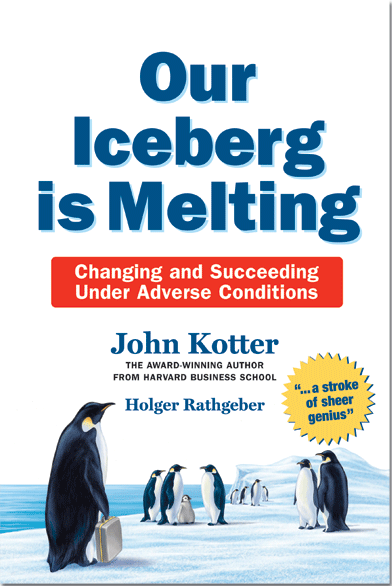
I have gleaned so much wisdom from John Kotter’s scholarly writing over the years, and I also enjoy when someone can tell a compelling fable. In Our Iceberg Is Melting, I got the best of both of these!
John Kotter has written and taught extensively from Harvard Business School. His work on corporate culture, especially the area of changing corporate culture, is always spot-on. But sometimes people find academics a bit too “dry” to even read their work. So Dr. Kotter collaborated with Holger Rathgeber to create a fable that anyone can read.
In Our Iceberg Is Melting, we meet some penguins living on an iceberg that is about to break apart. Only one penguin recognizes the imminent danger at first, but this begins a series of conversations about the changes the penguin colony must confront. As you might imagine, there are some naysayers, some go-getters without a lot of information, some academics with a lot of information but not much drive, and a bunch of penguins who are totally apathetic. All in all, this accurately describes for too many organizations!
Buried in this fable is a treasure-trove of helpful ideas for how to successfully navigate change in whatever organization you may be involved. If you are a part of a leadership team, reading this book together will, I am certain, open the door for some meaningful and productive conversations. It’s a book that can be read in just an afternoon, but the conversations and treasure mining will take weeks!
I highly recommend this book for anyone wanting to stay ahead of needed corporate changes.
Last week I spoke and wrote about some tools you might use to study your Bible. Now I’d like to share some Bible study projects you might try with those new tools. As always, I recommend that beginning Bible studies go verse by verse through the Bible. I believe you will lay a strong foundation for your faith when you systematically put God’s Word into your heart.
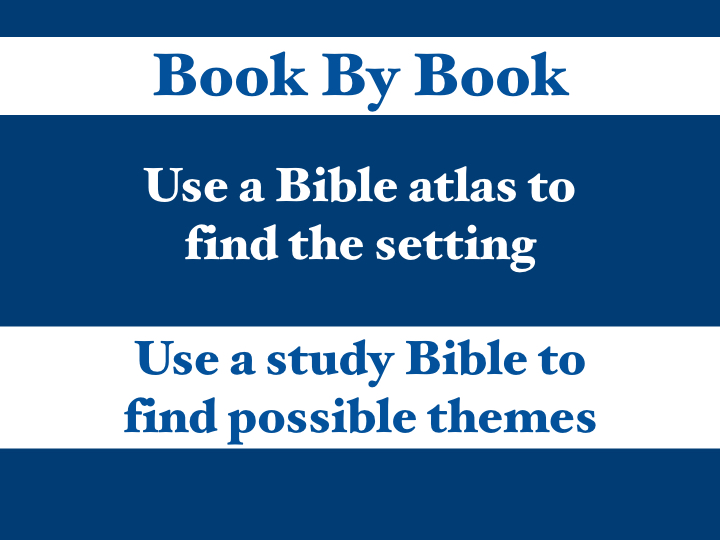
Book By Book
I’ll use the book of Ephesians as an example. Using my Bible atlas I find that the city of Ephesus is located along an important trade route, and it is the Roman capital of the province of Asia. My Full Life Study Bible tells me that because so much trade passed through this city, this letter was probably intended to be a circular letter for all of the communities near Ephesus. As a result, Paul is not addressing any specific problems in this church, but writes theological ideas for a broad spectrum of people.
As I begin reading, I paused in the first verse when I came to the phrase “the faithful in Christ.” I asked myself, “What does it mean to be faithful IN Christ? Can I be faithful outside of Him?” By the time I got to verse 3, I saw a similar phrase: “every spiritual blessing in Christ.” Now I went back and used a blue highlighter (there’s nothing special about blue, it just happened to be the first highlighter I grabbed), and marked those two “in Christ” phrases. I see two more in verse 4: “He chose us in Him” and “holy and blameless in His sight.” Going through the whole book I discovered 36 times the phrases “in Christ” or “in Him.” This is helpful to me to know the kind of security I have in Jesus.
Another thing that stood out to me were Paul’s prayers for the church. I see His very moving prayers in passages like 1:15-19 and in 3:14-21. I also see in 6:18 that he tells us to pray all kinds of prayers for ourselves and for others. And I see in 6:19 that Paul asked the church to pray for him too.
And always look for “therefore” phrases. For example in 4:24-25 or 4:32-5:1. The “therefore” phrases tell us how to live or think in light of the ideas that were just shared.
Chapter By Chapter
A good place to do this is in the Psalms or Proverbs. These are usually stand-alone chapters. When reading the chapters in these two books, I love reading them in parallel with other translations. For example, check out this from Psalm 1.
In Psalm 59, notice the superscript (or introduction). This gives us some background information to the psalm. Using my concordance, I found that this psalm was written this time in David’s life.
There is usually a theme to each chapter of the Proverbs, so try to discover that. In Proverbs 2, I noticed the “if … then” statements. In the first four verses I see things like “IF you will seek wisdom like this,” and then in verses 5-22 I see a whole bunch of blessings that follow the “then” that starts verse 5.
Word By Word
Sometimes I like to go really deep in a passage, so I slow down and look at it word by word. Here you need to use a Strong’s Concordance of the Bible. I like the one available on Blue Letter Bible. For example, next to 2 Peter 1:5, you can hover over the word “Tools” and select “Interlinear.” Clicking on “Interlinear” you will see all of the Greek words that make up this verse. By clicking on the Strong’s number, you can see the definition of that Greek word. Scrolling down a bit, you can see all of the other verses where that Greek word is used in the New Testament.
In this video I go into more detail on how I undertake all of these Bible studies. And be sure to join us next week as we take another look at different types of Bible studies.
This is a weekly series with things I’m reading and pondering from Oswald Chambers. You can read the original seed thought here, or type “Thursdays With Oswald” in the search box to read more entries.
The People God Can Do Nothing With
We say, “It seems out of all proportion that God should choose me—I am of no value”; the reason He chooses us is that we are not of any value. It is folly to think that because a man has natural ability, he must make a good Christian. People with the best natural equipment may make the worst disciples because they will “boss” themselves. It is not a question of our equipment, but of our poverty; not what we bring with us, but what He puts in us; not our natural virtues, our strength of character, our knowledge, our experience; all of that is of no avail in this matter; the only thing that is of avail is that we are taken up into the big compelling of God (1 Corinthians 1:26-28). His comradeship is made out of men who know their poverty. God can do nothing with the men who think they will be of use to Him.
From The Place Of Help
God cannot impart wisdom to a know-it-all, but He can impart it to someone hungry to learn.
God cannot use someone who believes the world revolves around them, but He can use someone who believes the world revolves around Him.
“‘Put out into deep water’ (Luke 5:4). The Lord did not say how deep. The depth of the water into which we sail depends upon how completely we have cut our ties to the shore, the greatness of our need, and our anxieties about the future. …
Our needs are to be met in the deep things of God. We are to sail into the deep of God’s Word, which the Holy Spirit will open to us with profound yet crystal-clear meaning. And the words we knew in the past will have an ocean of new meaning, which will render their original message very shallow. …
The Holy Spirit desires that our self become completely submerged—not merely ankle-deep, knee-deep, waist-deep, but self-deep. He wants us hidden and bathed under this life-giving stream. Let loose the lines holding you to the shore and sail into the deep. And never forget, the Man who does the measuring is with us today.” —J. Gresham Machen
A former abortionist shares the unvarnished truth about how second-trimester babies are aborted. This is gut-wrenching to watch, but please look closely. How is this legal?! How can someone argue that this should be allowed to happen?!
In our elections, I am becoming more and more a single-issue voter: Which candidate is the most pro-life. As Sen. Ted Cruz recently noted, if an elected official won’t stand up for the rights of the most vulnerable of human beings, how can we expect him/her to stand up for anyone else’s rights?
Yesterday I shared 7 must-have Bible study tools. Here are three powerful quotes on how and why we should make studying our Bibles an ongoing, lifelong pursuit.
“Search the Scriptures. Do not merely read them—search them; look up the parallel passages; collate them; try to get the meaning of the Spirit upon any one truth by looking to all the texts which refer to it. Read the Bible consecutively: do not merely read a verse here and there—that is not fair.” —Charles Spurgeon
“One cannot simply read the Bible, like other books. One must be prepared really to enquire of it. Only thus will it reveal itself. Only if we expect from it the ultimate answer, shall we receive it.” —Dietrich Bonhoeffer
“Let us resolve to read the Bible more and more every year we live. Let us try to get it rooted in our memories, and engraved into our hearts. … Let us resolve to be more watchful over our Bible reading every year that we live. Let us be jealously careful about the time we give to it, and the manner that time is spent. Let us be aware of omitting our daily reading without sufficient cause. Let us not be gaping, and yawning and dozing over our book, while we read. … Let us be very careful that we never exalt any minister, or sermon, or book, or tract, or friend above the Word. Cursed be that book, or tract, or human counsel, which creeps in between us and the Bible, and hides the Bible from our eyes! … Let us resolve to talk more to believers about the Bible when we meet them. Sorry to say, the conversation of Christians, when they do meet, is often sadly unprofitable! How many frivolous, and trifling, and uncharitable things are said! Let us bring out the Bible more, and it will help to drive the devil away, and keep our hearts in tune.” —J.C. Ryle



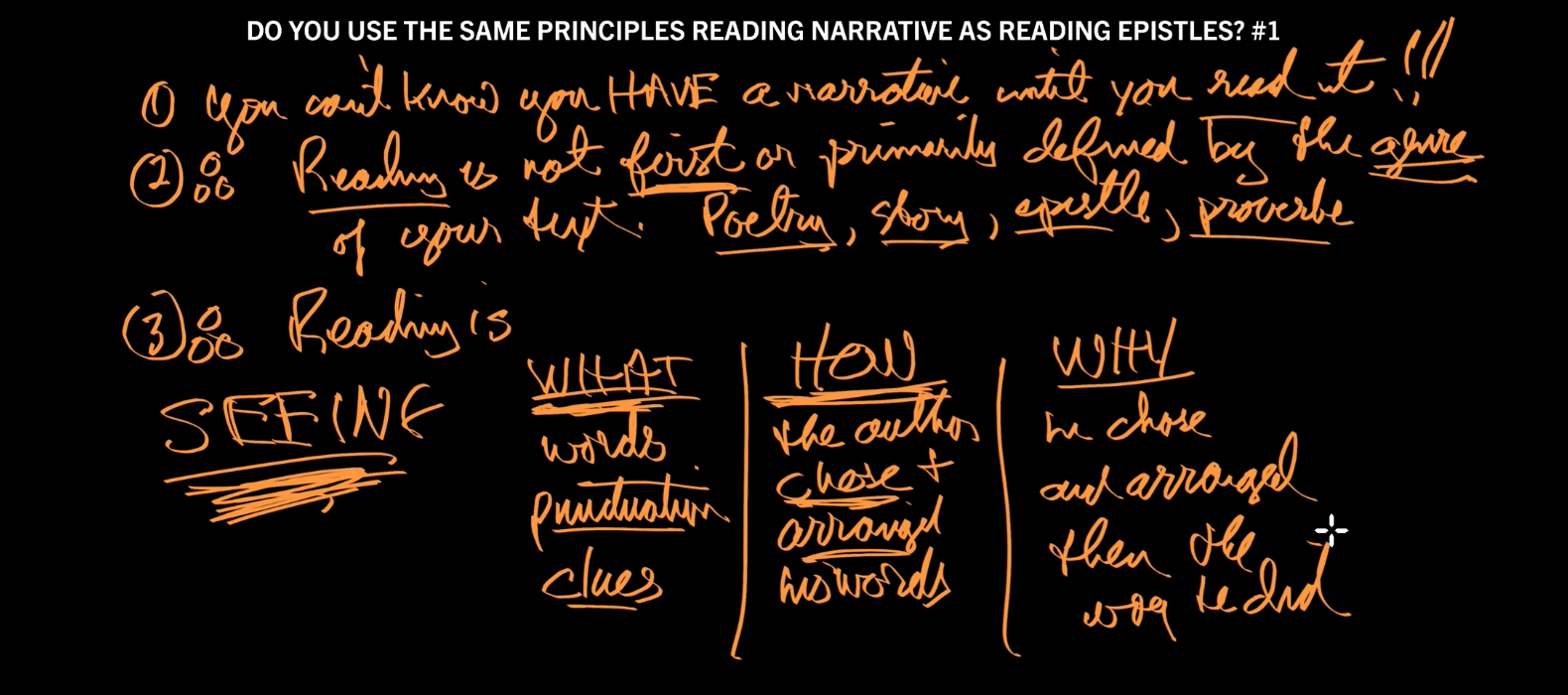 At Calvary Assembly of God, we have been going through a series on how to study our Bibles. I love this insight from John Piper on how to read Bible stories—





 Craig T. Owens