Who Are You?

This is another post especially for pastors (but I think others will find this helpful too).

John the Baptizer had no credentials, and yet people flocked to hear him speak.

He had no formal training, and yet people hung on his every word.

He had no authority from a sanctioning body, and yet he spoke with such power.

This perplexed the religious leadership. After all, they had credentials, training, and authority. So they came to John asking, “Who are you? What do you have to say about yourself?” (John 1:21-22).

If God has called you to the pastorate, He will equip you.

There’s nothing wrong with credentials, training, or sanctioning, per se. But when you think your call to preach has authority because of your title, your training, or your denominational appointment, you have missed the point! John had none of these, and yet Jesus said, “There’s never been a greater prophetic voice!”

So, pastor, who are you?

Are you the one who is credentialed, or trained, or sanctioned?

Or are you the one who has been called and equipped by God?

There’s a huge difference!

Who are you? I hope you can answer, “I am only a servant of the Most High, equipped by the Holy Spirit to make Jesus known in my city.”

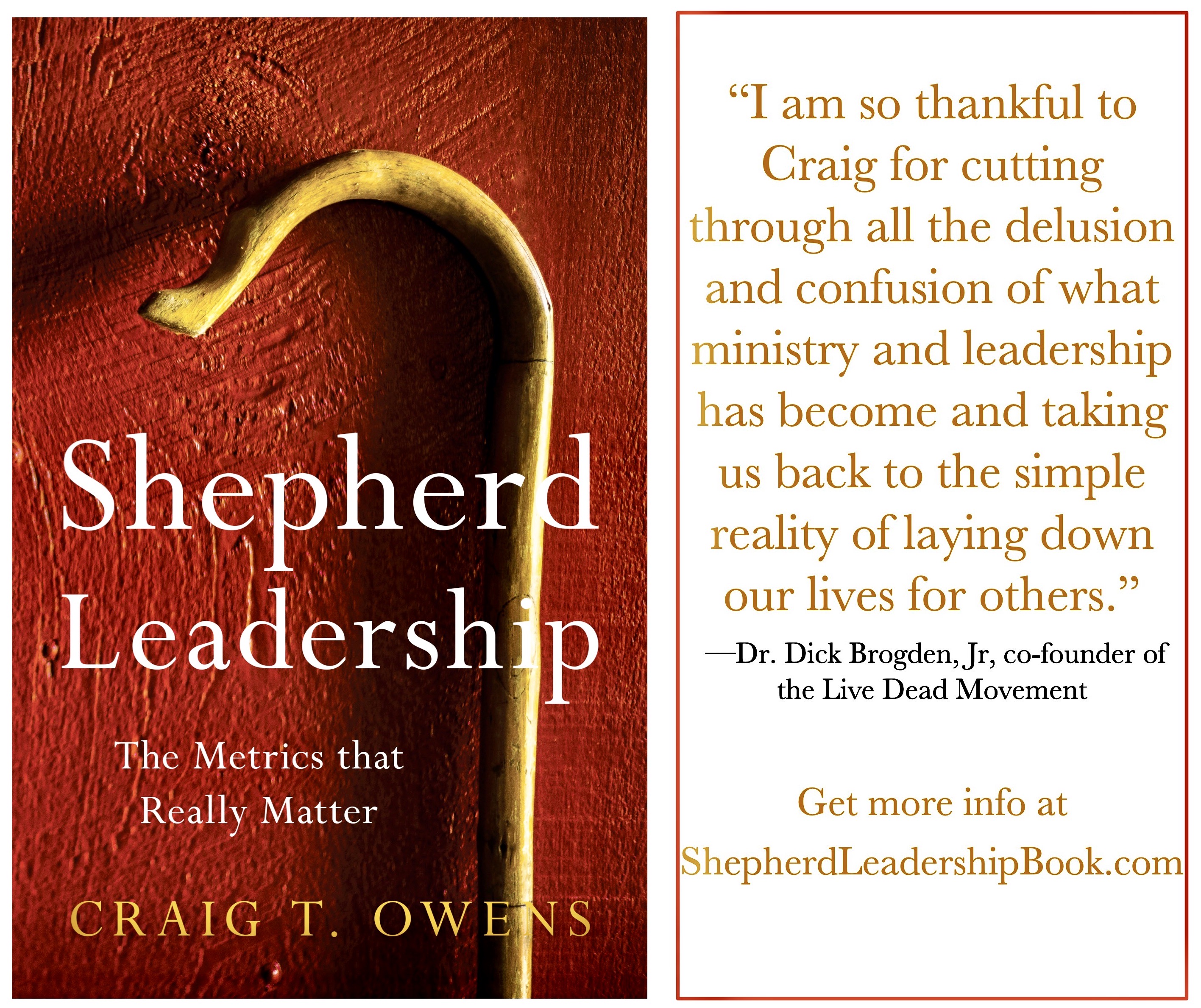
UPDATE: I use John the Baptist as a prominent example in my book Shepherd Leadership: The Metrics That Really Matter.

Thursdays With Oswald—Seeing Sin As Sin

This is a weekly series with things I’m reading and pondering from Oswald Chambers. You can read the original seed thought here, or type “Thursdays With Oswald” in the search box to read more entries.

Seeing Sin As Sin

     Knowledge of what sin is is in inverse ratio to its presence; only as sin goes do you realize what it is; when it is present you do not realize what it is because the nature of sin is that it destroys the capacity to know you sin. …

     To ‘crucify’ means to put to death, not counteract, not sit on, not whitewash, but kill. If I do not put to death the things in me which are not of God, they will put to death the things that are of God.

From Biblical Ethics

Romans 7 tells me that there are two forces at work in my life: God and sin. This is a battle to the death! So, if I think I am standing firm, that’s the exact time to watch out (see 1 Corinthians 10:12).

God never turns away the one who prays to Him, “Be merciful to me, a sinner.” But He turns a deaf ear to the one that claims, “I’m alright.”

May I always be VERY sensitive to even the hint of sin in my heart.

Always Be The Majority

In Acts 27, Paul is on his way to Rome to stand trial before Caesar. The weather has hindered them, so they are currently behind schedule. As they are docked at a town called Lasea, Paul advises the ship’s crew that they should stay right where they are.

But then comes this key phrase: “The majority decided that we should sail on” (Acts 27:12).

The majority in this case includes the sailing experts: the sailors, the ship captain, and even the ship’s owner. Julius, the centurion in charge of Paul, even sided with the majority.

But the majority was wrong.

As the ship is being ripped apart and driven way off course by a fierce storm, this majority even begins to give up on living through this nightmare.

But one man—Paul—with a word from God and “faith in God that it will happen just as He told me” (v. 25), became the most influential voice. From this point on, everyone listened to Paul: the sailors, the captain, the centurion.

One man + Faith in God’s Word = A Majority

Are you in a storm?

Is the majority telling you what you should do?

What has God said to you? Have you heard His Word?

Once you hear from God, cling to that Word in faith, and you will be the influential majority.

Where’s God?

It is one of the most painful, gut-wrenching cries in all of history. Hanging on the Cross, suspended between Heaven and earth, Jesus Christ cries out, “My God! My God! Why have You forsaken Me?!”

Ever been there?

Ever been in such a dark, painful place that you wonder if God has abandoned you?

You are not alone.

We’ve all been there. And best of all, Jesus Himself has been there. The Bible tells us that because Jesus has been there—where your pain is so intense, and the darkness is pitch-black—that He is the best One to help you.

Next Sunday we are kicking off a brand new series called Where’s God? In the darkest moments of our lives, where is God? what is He doing? how can anything good come from this? Please come join us.

If you’ve missed any of the messages in this series, check them our here:

Praying, Praying, And Praying Some More

I start each new year teaching a series on prayer at my church. This year I also began by reading Mark Batterson’s excellent new book on prayer called The Circle Maker.

So 2012 has been a more prayerful year for me so far. As a result, I am hearing about and seeing miracles take place in my life, and throughout our church. You know what this is doing in me? Increasing my desire to pray more!

Charles Spurgeon wrote,

“We may be certain that whatever God has made prominent in His Word, He intended to be conspicuous in our lives. If He has said much about prayer, it is because He knows we have much need of it. The motto for this year must be, Continue in prayer.”

But some of the things I am praying for have been on my prayer list for a long time. It appears that an answer hasn’t come… yet. You know what this is doing in me? Increasing my desire to pray more!

Here’s what Mark Batterson said,

“Some prayers go unanswered because they aren’t what’s best for us. Some prayers go unanswered because they don’t glorify God. Some prayers go unanswered because they aren’t part of God’s will. But while God doesn’t always ANSWER our prayers the way we want, we can be confident that He HEARS our prayers! And our Father knows best.”

Have you seen answers to your prayers? Keep on praying!

Are you waiting for answers to your prayers? Keep on praying!

And then pray some more!!

Mammon

It’s a funny-sounding word, but it has deadly consequences!

Jesus said we cannot serve both God and mammon (Luke 16:13 KJV). That word mammon had no direct translation in the English language, so the translators of the King James Version of the Bible simply did a transliteration: they took the Greek word and carried the same word into English. The translators of the New International Version did something different with this word: they made it Money, with a capital M.

The idea behind this word is placing our trust or reliance in anything except God. For us, the means of our security and basic living needs seems to be money, so Money (with a capital M) seems like an appropriate way to translate mammon.

Jesus recommended giving an offering—above and beyond our tithe—as a way to defeat the Mammon Monster. Giving our tithe is simply obedience to God’s commands. But giving our offering shows our trust in God’s provision.

Giving an offering to God is counterintuitive.

After all, less money is less than more money! If I receive money, I tend to hang on to it. I tell myself, “This might come in handy if the economy nosedives, or if something unexpected comes up.” When I start thinking this way, I start to make money Mammon, because I see money as my provider, instead of God.

What an appropriate way to wrap up our Live Dead series yesterday, as we made faith promises to God. We said, “God, I believe You will provide the amount of money I should give as an offering. And when You do provide, I promise to give it.” Placing my trust in God not only helps me to live dead to the pull of Mammon, but also Jesus promised—

Give, and it will be given to you. A good measure, pressed down, shaken together and running over, will be poured into your lap. For with the measure you use, it will be measured to you. (Luke 6:38)

I don’t give to get. I give because I trust God to provide.

P.S. By the way, all of the offerings that come in as a result of these faith promises will be going directly to missions. Calvary Assembly of God will not be keeping one cent of these faith promise offerings.

If you’ve missed any messages in our series called Live Dead, you can find them all by clicking here.

Preparing The Preacher

A friend of mine was preparing to preach his first sermon at a new church, and he was (as anyone might understand) nervous. He had all sorts of concerns: Is this the right word for this congregation? Will my thoughts make sense to them? Have I prepared enough for this message?

It was that last question that jogged my memory of a quote I had read from Oswald Chambers in his book Approved Unto God. The title of that book comes from a passage a Scripture in which preachers are told to correctly handle the Word of God as a worker that is approved unto God (2 Timothy 2:15).

Check out this pearl of wisdom:

“Keep yourself full to the brim in reading; but remember that the first great Resource is the Holy Spirit Who lays at your disposal the Word of God. The thing to prepare is not the sermon, but the preacher.” —Oswald Chambers (my emphasis)

God doesn’t need His Word prepared—it’s already perfect. But He does need to prepare me to deliver the message. He needs to remove my opinions, my preconceived ideas, my hang-ups with that particular passage, my hesitation to share it.

The Holy Spirit of God needs to prepare me. And I need to let Him do it.

It’s a heavy, awesome responsibility to be “the one” sharing God’s Word to a group of precious people. I dare not even attempt it unless I have let the Spirit prepare me first.

A Story About Choice

What an amazing story about Ryan Bomberger!

And don’t forget about October Baby opening in theaters on March 23 (you can read my review of the film here).

Thursdays With Oswald—Serving Like Christ

This is a weekly series with things I’m reading and pondering from Oswald Chambers. You can read the original seed thought here, or type “Thursdays With Oswald” in the search box to read more entries.

Am I Serving Like Christ?

The Son of Man did not come to be served, but to serve… (Matthew 20:28)

     Jesus also said, ‘Yet I am among you as the One who serves’ (Luke 22:27). Paul’s idea of service was the same as our Lord’s—‘…ourselves your bondservants for Jesus’ sake’ (2 Corinthians 4:5). We somehow have the idea that a person called to the ministry is called to be different and above other people. But according to Jesus Christ, he is called to be a ‘doormat’ for others—called to be their spiritual leader, but never their superior. Paul said, ‘I know how to be abased…’ (Philippians 4:12). Paul’s idea of service was to pour his life out to the last drop for others. And whether he received praise or blame made no difference. As long as there was one human being who did not know Jesus, Paul felt a debt of service to that person until he did come to know Him. But the chief motivation behind Paul’s service was not love for others but love for his Lord.

     …The institutional church’s idea of a servant of God is not at all like Jesus Christ’s idea. His idea is that we serve Him by being the servants of others. Jesus Christ actually ‘out-socialized’ the socialists. He said that in His kingdom the greatest one would be the servant of all (see Matthew 23:11). The real test of a saint is not one’s willingness to preach the gospel, but one’s willingness to do something like washing the disciples’ feet—that is, being willing to do those things that seem unimportant in human estimation but count as everything to God.

From My Utmost For His Highest

I cannot add anything to this brilliant observation. But I can tell you the parts that the Holy Spirit is really working in my heart:

  • “…called to be a ‘doormat’ for others—called to be their spiritual leader, but never their superior.” God, help me to keep my pride in check.
  • “The real test of a saint is not one’s willingness to preach the gospel, but one’s willingness to do something like washing the disciples’ feet.” May I never shrink back from willingly serving at the lowest level of society.

UPDATE: This idea of servant-leaders plays prominently in my book Shepherd Leadership: The Metrics That Really Matter.