Satisfied Service

I started a conversation last week about being a servant (you can catch up here).

Serving should be a two-way street. Contrary to the way that some people look at servanthood, being a servant is not the same thing as being a doormat. Consider two key verses:

  • Each of you should look not only to your own interests, but also to the interests of others. (Philippians 2:4)
  • Submit to one another out of reverence for Christ. (Ephesians 5:21)

We should look equally to others’ needs as well as our own needs. Zig Ziglar says it this way, “You can have everything in life you want, if you will just help other people get what they want.”

This can be manipulation if you’re simply looking to someone else’s interests as a form of flattery or as a quid pro quo. But if you are truly serving—if you truly have the other person’s best interests in mind—if you are willing to submit to them out of reverence for Christ, serving can be liberating.

Last week Rick Warren tweeted, “The more self-centered I am, the more unsatisfied I’ll be.” I retweeted with this addition, “So the more I serve, the more satisfied I’ll be.” I believe that.

Try it for yourself—it works!

Loving Servanthood

Over the past couple of days I’ve been thinking a lot about something: What does it mean to serve? Or more specifically, what does God say about how we should serve?

The typical image that comes to mind when someone says “servant” is a person of lower status—someone who is at the lower end of the organizational chart, someone who is expected to do more with less, someone who doesn’t have many opportunities for advancement (or even a day off), or maybe someone who is expected to be tuned into everyone else’s needs but seldom has his own needs met.

Is being a servant the same thing as being a doormat?

Consider Jesus:

He now showed them the full extent of His love…. Jesus knew that the Father had put all things under His power, and that He had come from God and was returning to God; so He got up from the meal, took off His outer clothing, and wrapped a towel around His waist. After that, He poured water into a basin and began to wash His disciples’ feet, drying them with the towel that was wrapped around Him.

Jesus was the most important person in the room: Jesus KNEW that the Father had put all things under His power. He was also the most love-filled person in the room. What did He do with all of His love and power? He served others.

When He finished, John writes that He returned to His place, and asked His disciples a question, “Do you understand what I just did?” Then in the only instance of Scripture where Jesus Himself said this, “I have set you an example that you should do as I have done.”

Servants are people who use the power they have to lovingly serve others.

Servants don’t serve because someone else forces them to serve. Servants serve because the love of God empowers them to serve.

Do you love your spouse enough to serve him/her? Do you love your family enough to serve them? Do you love your coworkers enough to serve them? The greater the love we have for others, the greater the empowerment to serve. Love empowers us for service.

Oh, So That’s How It Works

Sometimes we make connecting with God way too complicated. If I’m reading my Bible accurately, I think He just wants us to approach Him in the way we are naturally wired to connect. Not every husband interacts with his wife the same way, nor every wife with her husband. We connect with different friends in different ways. But somehow we in the church have come up with a set of “rules” about the right way we should be worshipping God.

So here’s a fun and “informative” video on the rules of worship.

Enjoy!

Surprise!

Last night I went to a surprise party for a great guy in our church. His sons initiated the idea on Sunday evening, and we all went into action to figure out when, where, and (most importantly) what food we were going to bring. After just a few minutes of discussion, everything was in place, and it all came together pretty smoothly.

I think the birthday boy was genuinely surprised. And pleased. And everyone had a fun evening.

But I got to thinking, “Should it really be a surprise that we want to express our appreciation, love, and respect to someone?” Hmmm.

Perhaps today—and every day—we could find a way to “surprise” someone we love or appreciate. You know, just find an unexpected way to let someone know they’re special.

  • A surprise note/text/email
  • A surprise gift
  • A surprise hug
  • A surprise phone call
  • A surprise lunch invitation
  • A surprise cup of coffee or favorite treat

It’s amazing what happens inside people’s hearts when we go out of our way to express our love. Try it, and see what happens.

Make today a surprise day for the people you love and appreciate.

Do It

Here’s what God said to His people through the prophet Ezekiel, “I will judge you according to your conduct.” God says the same thing in the New Testament too.

It’s not what I believe. It’s not what I discuss. It’s not what I intend to do. It’s not what I know is right and wrong. It’s what I do.

I have to give an account of my conduct. I have to answer to God for how I lived out my beliefs. I have to show God what I did with what I believe about Him. I have to put into practice what’s in my heart.

Do I believe God is God? Do I have idols?

Do I believe God is holy? Do I sin?

Do I believe God forgives? Do I repent?

Do I believe God looks after orphans and widows? Do I?

Do I believe God is my Provider? Do I steal?

Do I believe He is Lord? Do I give Him control of everything?

Do I believe I should do something for the hungry, thirsty, naked, sick, and imprisoned? Do I do something?

This is what God judges: belief put into action. Not just beliefs, but godly actions motivated by those godly beliefs.

Faith without works is just wishful dreaming. Works without faith is just religious posturing. Works with faith is God-glorifying!

Don’t just believe it… do it.

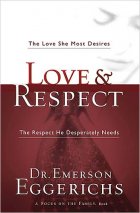
Love & Respect (book review)

Love & Respect

My Grandma used to say this poem, “Good, better, best, never let it rest until your good is better and your better is best.” I thought of this again while reading Emerson Eggerichs’ book Love & Respect. If your marriage is bad, this book can help it get good; if your marriage is already good, this book can help it getter even better; if your marriage is already better, you can use this book to “best it.”

Many of the principles in this book generated an initial push-back from me. I found myself thinking, “I’m not so sure that would work.” But as I read on, I found almost all of those initial hesitancies dissolving.

The book is divided into three overarching sections that cover the three cycles in which your marriage could be: the Crazy Cycle (a bad marriage), the Energizing Cycle (a good marriage), and the Rewarded Cycle (the best marriage). Throughout all of the sections, there is sound, biblically-based counsel for husbands and wives. The title of the book—and most of the underlying principles—come from Ephesians 5:33 where the Apostle Paul tells women to respect their husbands, while husbands are to love their wives.

Be forewarned: the first part of this book felt a little like a commercial for Dr. Eggerichs’ Love & Respect seminar. And oftentimes I felt he was “plugging” his seminar throughout the book. But if you don’t mind the occasional sales-pitch feel, you will uncover some great truths to help your marriage go from bad to better to best.

I am a book review blogger for Thomas Nelson Publishers.

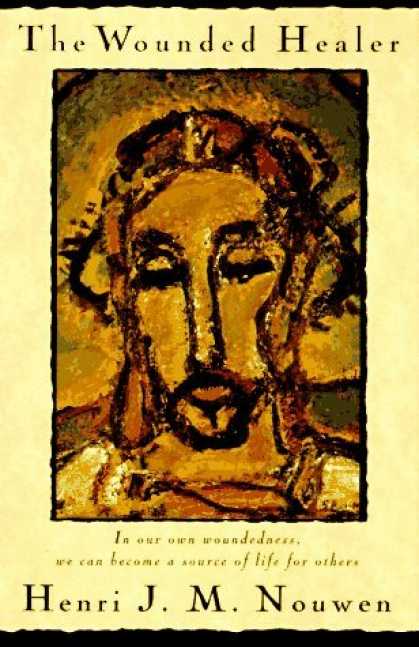
The Wounded Healer (book review)

Wounded Healer, The

“For the minister is called to recognize the sufferings of his time in his own heart and make that recognition the starting point of his service. Whether he tries to enter into a dislocated world, relate to a convulsive generation, or speak to a dying man, his service will not be perceived as authentic unless it comes from a heart wounded by the suffering about which he speaks” (from the introduction).

Henri Nouwen was a man ahead of his time. Although this book was written in the early 1970s, it sounds so applicable for today. The Wounded Healer challenged me as a Christian leader to step into the pain-filled lives as others in a more authentic way. Nouwen argues that healers must first be personally acquainted with the same type of pain that other wounded people are experiencing.

Isaiah 53 says that Christ “was wounded for our transgressions, He was bruised for our guilt and iniquities; the chastisement [needful to obtain] peace and well-being for us was upon Him, and with the stripes [that wounded] Him we are healed and made whole.” Because Jesus was wounded in the same way we are wounded, He knows how to help (see Hebrews 2:18).

One closing quote from Nouwen: “If there is any posture that disturbs a suffering man or woman, it is aloofness. … No one can help anyone without becoming involved, without entering with his whole person into the painful situations, without taking the risk of become hurt, wounded or even destroyed in the process. The beginning and the end of Christian leadership is to give your life for others.”

This book reconfirmed my desire to—like Jesus—be a wounded healer for others.

Be All There

Once a friend of mine (whom I happen to think is more tuned-in to people’s needs than almost anyone else I know) went on a first date. He said the evening was pleasant, but felt his date was a bit distant. At the end of the evening when he brought up the subject of possibly going out again she informed him, “No, I don’t think we can go out again. You’re just not emotionally available for me.”

I know this wasn’t true for my friend, but have you ever been there? Ever been with someone, but it was obvious that they weren’t really there with you in the room? Frustrating, isn’t it?

[Insert tongue firmly in cheek as you read this next paragraph.] Now I’m certain that none of the readers of my blog would ever be distracted like this. And I know I’ve never done this myself. Since you and I, dear reader, always are 100% attentive to the people in the room with us, these next two quotes probably won’t pertain to you, but here they are anyhow:
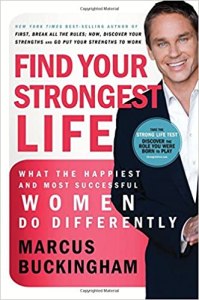
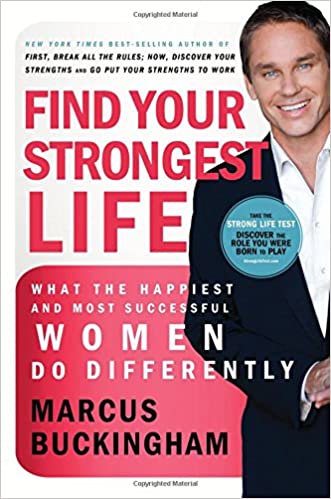
“The human brain is simply not designed to multitask. You can get by doing multiple things at once, but you can’t do them well. Your brain is physically unable to process more than one set of instructions at a time, so while you are juggling all of those actions at once, your brain is scrambling to keep up. Through a variety of experiments measuring brain activity, scientists have discovered that the constant switching back and forth from one activity to another energizes regions of the brain that specialize in visual processing and physical coordination, while simultaneously disrupting the brain regions related to memory and learning. According to the research, ‘we are using our mental energy to concentrate on concentrating at the expense of whatever it is that we’re supposed to be concentrating on.’ Got that?

“More simply: when we multitask we’re dumber. How much dumber? A recent study for Hewlett Packard exploring the impact of multitasking on performance revealed that the average worker’s functioning IQ drops ten points when multitasking…. (The analogy the researchers used is that a ten-point drop in IQ is equivalent to missing one night of sleep.)” —Marcus Buckingham, Find Your Strongest Life
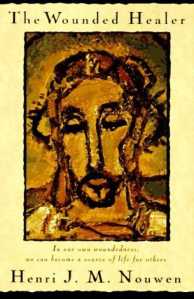
“Concentration, which leads to meditation and contemplation, is therefore the necessary precondition for true hospitality. When our souls are restless, when we are driven by thousands of different and often conflicting stimuli, when we are always ‘over there’ between people, ideas and the worries of this world, how can we possibly create the room and space where someone else can enter freely without feeling himself an unlawful intruder?” —Henri Nouwen, The Wounded Healer

This week I’m making it my goal to be all there for whomever is here with me. I’m going to try my best to eliminate multitasking and truly concentrate on the one spending time with me. Are you ready to try this with me? Let me know how it goes.

Life Lessons From College Football

Tebow & Meyer

Football is hands-down my favorite sport. I love watching coaches strategizing with their teams, and players executing so precisely the plays they have practiced over and over again. I love the emotional highs and lows I feel after great plays for and against my team.

Over the past couple of years, I have thoroughly enjoyed watching three premier college quarterbacks that are not only great players but great men too: Colt McCoy at Texas, Sam Bradford at Oklahoma, and Tim Tebow at Florida.

Saturday, in his game against Mississippi State, Tim Tebow had a rough outing. Twice he was intercepted. And if that wasn’t bad enough, both of the interceptions were returned for touchdowns. Ouch!

But then after the game, his coach Urban Meyer made an amazing statement. When asked about the interceptions he said, “I put Tim in a bad position. He shouldn’t have had to make those throws.”

This really got me thinking about the coaching I do with my own kids. Do I put them in a position where they can be successful? Do I put them in places where their strengths can come into play? Do I try my best to keep them out of positions where their weaknesses could overwhelm their strengths?

Obviously, Urban Meyer did not throw those interceptions; Tim Tebow did. But Coach Meyer took responsibility, saying, “As a coach, it’s my job to put my players in a place to be successful.” This is what I’m striving for: not yelling at my kids for their “interceptions” but looking first at my coaching skills. I want to set up my kids to be winners.

Life On Life

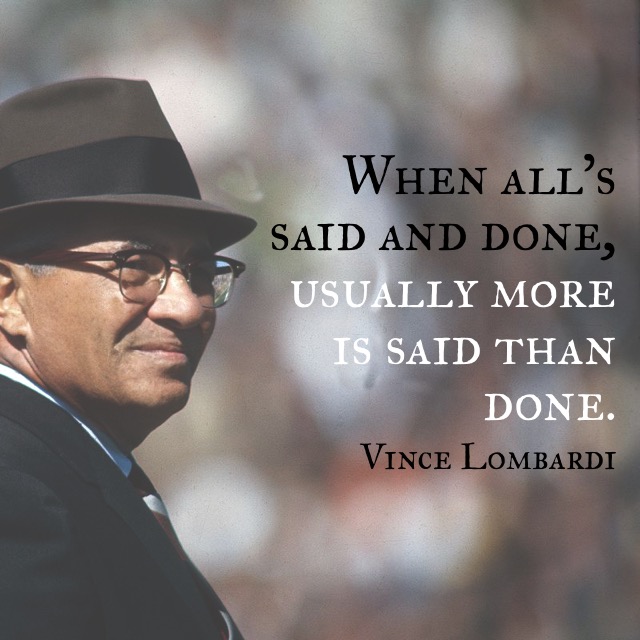
In my remarks at the funeral in which I was officiating on Wednesday, I quoted the great Green Bay Packers coach Vince Lombardi. He was reportedly addressing a couple of under-performing players when he said, “When all’s said and done, usually more is said than done.” In other words, don’t talk about what you’re going to do, just do it.

One of my passions is to mentor and equip other people to do great things. I’ve found that the best way to do this is not to just talk about what they should be doing, but to step into their life and do those things with them—to do more than I say.

This life-on-life mentoring is challenging but so incredibly rewarding. The Apostle Paul wrote, “Follow me as I follow Christ. C’mon, let’s pursue this relationship with Jesus together. I’m going to keep you close to me so that you can look in on what I’m doing, and I’m going to be right here for you too. Let’s draw closer to Jesus together” (see 1 Corinthians 11:1)

I love the one-on-one times with my kids … brainstorming with the young leaders-in-training at church … having challenging conversations with an accountability friend … opening our home to a young single mom. These interactions keep me focused on staying as close to Christ as I can. Because if I lose sight of Him, so might the others who are connected with me life-on-life.

It’s pretty hard to say, “Follow me while I do my own thing.” So I’m redoubling my efforts to stay close to the Master today.