Listen to the podcast of this post by clicking on the player below, and you can also subscribe on Apple, Spotify, or Audible.
Jesus sent us and the Holy Spirit empowers us to take the Good News to all nations—all the streets (Luke 24:47-49; Acts 1:8). As we move away from Jerusalem and into Judea, we should expect to see more differences with our audience. And then as we move into Samaria, there will probably be more differences than similarities. Regardless of how little we may have in common with those on other streets, the Holy Spirit still empowers us to witness there.
When we don’t live on someone else’s street, we tend to make some pretty big assumptions about them. For example, until I married a school teacher, I thought, “How nice it must be to be done with work by 3:00 every afternoon and have three months off in the summer!”
Mistakenly, we think we can so easily fix the problems people on other streets have—we think we can show them how simple it is to correct anything out of balance on their street. These are natural thought patterns when so little of our circles overlap.
If you live on Main Street, two streets which are quite different from you are Easy Street and Skid Row. When it comes to finances, there tends to be extremes in our thoughts about the Samaritans that live on those streets—
Those on Easy Street only cares about themselves
Those on Skid Row should work harder
Those on Easy Street have too much—it’s not fair!
Those on Skip Row don’t have enough—it’s not fair!
But here’s the thing: It’s really not about the money but it’s about our attitude about the money.
In Luke 21:1-6, Jesus saw both rich people from Easy Street placing their tithe in the temple treasury, and a poor widow from Skid Row doing the same. Jesus said this widow put in more than anyone else. He was talking in terms of quality, not quantity.
While they were still in the temple, the disciples pointed out how beautifully embellished the temple was. These decorations came from the money those on Easy Street had contributed. Jesus told them not to focus on the temporal temple but on the eternal Kingdom of God.
As I said, Jesus doesn’t have a problem with money, but He does warn us about our ungodly attitude toward money (Luke 8:1-3; Matthew 27:57; Acts 4:32-5:4; Exodus 20:17; Luke 12:13-22).
Even though Easy Street and Skid Row seem to be at opposite ends of the spectrum, I think we are effective witnesses for Jesus on these streets in exactly the same way.
(1) Guard your attitude about money. Remember that Gad often provides for us by giving us a skill, and then making a job available that can use our skill. So let’s be thankful for our God-given jobs. Then we guard our attitude about money by tithing regularly, and making sure that when we bless others financially, we do it without expecting any fanfare (Colossians 3:23; Malachi 3:10; Matthew 6:2-3).
(2) Let God be unique as unique with these folks on Easy Street and Skid Row as He is with you on Main Street. Don’t try to be someone else, and don’t expect others to be you—simply obey what God has spoken to your heart, just as you allow others to obey what God has spoken to their hearts.
(3) Don’t tell, but show how you use the resources God has given to you. It’s not our place to “preach” to others about how they should or shouldn’t be handling their finances, but simply live out the biblical principles outlined above, and let your life show your godly attitude.
(4) Always turn the focus to the eternal. Just as Jesus did with His disciples in the temple, He always reminded people that this world with its perks or tragedies is only temporary. What ultimately matters is where we will spend eternity (Luke 13:1-5).
Money is always a touchy subject with people, so let’s make sure we have our own attitude aligned with Scripture before we try to bring the subject up with others.
If you’ve missed any of the other messages in our Takin’ Him To The Street series, you can find them all here.
Listen to the podcast of this post by clicking on the player below, and you can also subscribe on Apple, Spotify, or Audible.
Jesus sent us to all nations—to all the streets in all the world (Luke 24:47-49; Acts 1:8). We are to begin in Jerusalem and move outward. As we have seen, Jerusalem is like out Main Street, where there are more similarities than differences between us and the people to whom we are taking the Good News of Jesus. Judea is our Lombard Street & Rodeo Drive, where we are starting to see more differences.
Then we move to Samaria where there are now way more differences than similarities. But still, let’s never forget that Jesus sent us and the Holy Spirit empowers us to be effective in our witness on every street—even those with whom we have very little in common.
Jesus was baptizing in the Judean countryside (John 3:22) and now He is heading back to Galilee. “The shortest route from Judea in the south to Galilee in the north went through Samaria. The journey took three days if one wanted to travel the direct route. The Jews often avoided Samaria by going around it along the Jordan River. The hatred between the Jews and Samaritans went back to the days of the exile” (Dr. Henry Halley).
There were wide differences between Jesus and this woman of Sychar:
Cultural differences—The Jews considered the Samaritans to be no longer “pure” Jews, but half-breeds and traitors (vv. 5-9).
Personal differences—She was female, Jesus was male; she was a divorcée, Jesus was single (vv. 9, 16-18).
Religious differences—The Samaritans only recognized the Pentateuch; the Jews recognized the entire Old Testament Scripture. And the Samaritans saw Mt. Gerizim as the center of worship and the place the Messiah would reign; the Jews believed Jerusalem to be the center of worship (vv. 19-20).
Our first task is to find common ground with whoever we can. Jesus used the word “whoever” three times in John 3:16, 18, 36, saying that whoever believed in Him would have eternal life. We need to have this same mindset. It’s not His desire that any should perish—not even the Samaritans!—but that all should come to know Him as Savior.
In his book Winning With People, John Maxwell presents The 101% Principle: Find the 1% we can agree upon and give that 100% of your effort.
Jesus found the 1% and gave 100% to it. For He and this Samaritan woman their common connection was water and worship (John 4:9-15, 21-26). Jesus used both of those things to open a conversation about eternal matters.
Who are the Samaritans in my life? They are people…
…I have very little in common with
…I go out of my way to avoid talking to
…I think are never going to “get it”
…who make me angry, defensive, or combative
But they are also people…
…for whom Jesus died
…who are dearly loved by our Heavenly Father
…who need to hear the Gospel
…to whom I have been sent
Our prayer should be this:
Holy Spirit, help me to notice the people to whom I have been blind or whom I have been avoiding. Help me to find the 1% on which we can agree, and then empower me to give 100% of my effort to that 1%. I want my heart to beat with the heart of my Savior: Whoever believes on Him will not perish but will have eternal life.
Listen to the podcast of this post by clicking on the player below, and you can also subscribe on Apple, Spotify, or Audible.
The apostle Paul shows us how simply sharing the good news about Jesus opened a door for him to speak to a very influential group in Athens. I experienced something similar that I think will be helpful for you to hear.
The Scripture I reference in this video is Acts 17:16-34.
You can watch the full sermon this clip came from by clicking here.
Listen to the podcast of this post by clicking on the player below, and you can also subscribe on Apple, Spotify, or Audible.
Jesus has sent us on-mission (which means we are missionaries) to every street. We don’t go in our power, but we are empowered by the baptism of the Holy Spirit (see Luke 24:46-49).
Jesus said our missionary work would take us to every street, starting with Jerusalem—which we have called Main Street. These are people very similar to us. Then our mission will expand into all Judea (Acts 1:8). These are people that have less in common with us. Last week we talked about taking the message of Jesus to Lombard Street: Talking with people who have knowledge of the Bible, but tend to twist and turn with the popular traditions of the day.
Remember that our mission is to be witnesses—share the Scripture and our personal story. It’s not our responsibility to try to open people’s minds so they can repent, but the Holy Spirit opens minds and calls people to repentance.
The apostle Paul reminded us that, “The god of this age has blinded the minds of unbelievers” (2 Corinthians 4:4). The Holy Spirit uses our witness as the catalyst to open minds. This clash of light and darkness creates acceptance and anger. Notice these contrasts in one short segment of Paul and Silas’ missionary journey in Acts 16:13-24 and 17:1-13:
Acceptance—Acts 16:13-15
Anger—16:16-24
Acceptance—17:1-4
Anger—17:5-6
Acceptance—17:10-12
Anger—17:13
The opposition in Philippi brought Paul and Silas to Thessalonica, and the opposition in Thessalonica brought them to Athens.
Athens was named for the goddess Athena, and it has been called “the university city of the Roman world.” Philo (a Jewish historian) called the Athenians “keenest in intellect.” It was the center of art, literature, and philosophy
I’m going to call Athens “Rodeo Drive.”
Rodeo Drive is called “the intersection of luxury, fashion and entertainment.” Kay Monica Rose, the Rodeo Drive Committee President, said, “There is nothing in the world comparable to Rodeo Drive. The legendary street’s magic continues thanks to the exemplary craftsmanship from today’s greatest fashion houses and brands, the architect-designed boutique spaces, the spectacular window displays, artist collaborations and pop ups, and our unrivaled customer service. At the heart of my vision for Rodeo Drive is the preservation and advancement of an unmatched legacy.”
A marketing professor once told me, “When advertising, you have to remember that everyone has radio station WIFM playing in their head—What’s in it for me?” The people on Rodeo Drive are self-focused and self-assured.
How do we take the message of Jesus to those Judeans on Rodeo Drive? Let’s learn from Paul’s time there (Acts 17:16-34).
Control your anger. Even though Paul was “greatly distressed,” he didn’t let his anger control him, but he kept his distress under control.
Use measured words. Paul “reasoned” with the people there, which means he engaged in meaningful dialogue with them.
Don’t argue. Some to the Athenians “disputed with him [Paul]” but he didn’t dispute back. Instead he was preaching the good news about Jesus and the resurrection.
Start where they are. Paul noted that the Athenians were “very religious.”He doesn’t condone their idolatry, but he simply uses it as a conversation starter.
Move to the eternal issue. He then proceeds to point them to Jesus as the “unknown god” that they are worshiping, bringing everything back to His resurrection from the dead.
Be ready for acceptance and anger. As in Philippi and Thessalonica, there were some who accepted the Gospel message and some who got angry when they heard it.
Remember: We don’t change minds—the Holy Spirit does by using our words as a catalyst.
Listen to the podcast of this post by clicking on the player below, and you can also subscribe on Apple, Spotify, or Audible.
As missionaries, we are people sent on a mission. We are sent to everyone everywhere. We are to take Him to every street where God sends us.
“Main Street” (or Jerusalem) is a great place to start, and probably a place where we will always have work to do. These will typically be the people that are most like us—people with whom we will have the most in common.
There are others that need to hear the Good news of forgiveness that Jesus has made available. As our circle of witness widens, we may have less in common with those with whom we are interacting. This may take us out of our comfort zone, but since the Holy Spirit is in us we will never be out of our empowerment zone!
But you will receive power when the Holy Spirit comes on you; and you will be My witnesses in Jerusalem, and in all Judea… (Acts 1:8).
We need to ask two questions:
What did it mean then? Judea was still compromised of Jewish people, but it was the area slightly outside the neighborhood of Jerusalem.
What does it mean now? These are people very similar to people on Main Street, but we are starting to see more differences. These differences often become the source of controversies.
I’m going to describe some people in our Judea as cultural Christians but not biblical Christians. In the time of Jesus we could think of the Pharisees: People who would call themselves godly because they have set their own standards.
Lombard Street in San Francisco is a short, curvy street. This is a one-way street and motorists are only supposed to drive 5 mph, and still there are frequent controversies on the right-of-way between homeowners, motorists, work crews, bicyclists, and pedestrians. Everyone thinks their way is the right way.
How do we take the message of Jesus to those on our “Lombard Street”?
(1) Distinguish the biblical from the non-biblical.
Both the Pharisees that interacted with Jesus and today’s cultural Christians seem to quote more from their own traditions than they do from the Scripture, so we need to distinguish that the source of our beliefs is from God’s inspired Word. (I share more about the concept of biblical, unbiblical, and non-biblical in this post.)
A great example for us is how Jesus answered two questions from an expert in the Mosaic law: How do I earn eternal life? Who is my neighbor? See Luke 10:25-37.
(2) Stick to Scripture and your personal story.
Remember that the person with an experience is never at the mercy of the person with an argument. When the Sanhedrin questioned the legitimacy of the healing of a lame man, Luke wrote, “But since they could see the man who had been healed standing there with them [Peter and John], there was nothing they could say” (Acts 4:14)!
Love the personal story of the healed blind man in John 9!
Judea can be translated “he shall be praised.” We glorify Jesus not by arguing with those on Lombard Street, but by simply proclaiming biblical truth and our personal testimony.
Sing to the Lord, all the earth; proclaim good news of His salvation from day to day. Tell of His glory among the nations, His wonderful deeds among all the peoples. (1 Chronicles 16:23-24)
As we stick with the Scripture and our personal testimony, the Holy Spirit will use our witness to open minds to the Good News of Jesus (2 Corinthians 3:18-4:5).
Follow along with all of the streets we are looking at in our series Takin’ Him to the streets by clicking here.
Listen to the podcast of this post by clicking on the player below, and you can also subscribe on Apple, Spotify, or Audible.
Just as assuredly as Jesus fulfilled God’s promise of His crucifixion and resurrection, we Christians are fulfilling God’s promise that we would take the message of forgiveness of sins to the whole world (Luke 24:45-48). We are taking Him to every street where God sends us. There is a song written by Michael McDonald called “Takin’ it to the streets.” One verse says—
Take this message to my brother
You will find him everywhere
Wherever people live together
Tied in poverty’s despair
We know what the “it” is. He is a Savior, a God, a Redeemer, a Father who has made it possible for everyone everywhere to be in a personal relationship with Him for all of eternity!
When anyone talks about taking the Good News of Jesus to people, our minds typically think “missionary.”
What is a missionary? What comes to mind when you think of a missionary?
Quite simply, a missionary is a person sent on a mission (see Luke 24:47; Matthew 28:19-20).
We are not sent on our mission unprepared, but Jesus promised us both His authority and the indwelling power of the Holy Spirit (Matthew 28:18-19; Luke 24:49; Acts 1:8). In both Luke and Acts, Jesus says that our witness is to begin in Jerusalem.
I recently looked up a list of the most common street names in America. I found that the most common street name is “Main Street.” But Main Street is also used as a way for people to describe the average setting in the USA.
Going to “Jerusalem” or “Main Street” first is foretold in the Old Testament (Ezekiel 3:4-5). We’re not first sent to people with an unknown language or obscure customs, but to people we know and understand. These are people to whom we can easily find common interests.
There are two simple steps when we take Jesus to our Main Street.
Ask the Holy Spirit to reveal truth to you today and every day.
You cannot give to others what you do not first have yourself, so you need to hear what the Holy Spirit is saying to you first. Pray before reading the Bible to ask the Spirit to give you insight (Psalm 119:18).
Find a friend and tell them what was revealed to you.
After Jesus was revealed to Andrew, he found Peter and told him what he had discovered. And after Philip met Jesus, he found Nathanael and brought him to Jesus (John 1:35-46).
Every person with whom you interact today is precious to God. Our mission is to help them realize that awesome truth.
So get filled up with the wisdom from the Spirit and then find a friend on Main Street and bring them to Jesus!
Follow along with all of the messages in this series Takin’ Him To The Streets by clicking here.
We need to be careful of overlooking details we think might be insignificant because we can easily think that our small lives are somehow insignificant. They are not! As Tom Kaastra reminded us last week, we are here on purpose and for a purpose; our lives are eternally significant.
Immediately after His resurrection, the followers of Jesus struggled to wrap their minds around what they had just experienced. Just before His ascension, Jesus explained to them both what had happened already, and what was about to happen (Luke 24:44-49).
Jesus said He had already fulfilled the promised about His crucifixion and resurrection. Luke writes that Jesus “opened their minds so they could understand” (v. 45).
Notice two important things:
The Spirit of Jesus—the Holy Spirit—opens minds
He opens minds to grasp the truth in Scripture
Jesus also says that we are still fulfilling the “what is written” (v. 46) in the the proclamation of the death and resurrection of Jesus. We are fulfilling the prophecy that says the message of Jesus will be preached everywhere to all peoples, so that they also can receive the forgiveness Jesus paid for and repent of their Godless ways.
Who opens minds? The Holy Spirit.
What does the Spirit use as a catalyst to open minds? Our witness.
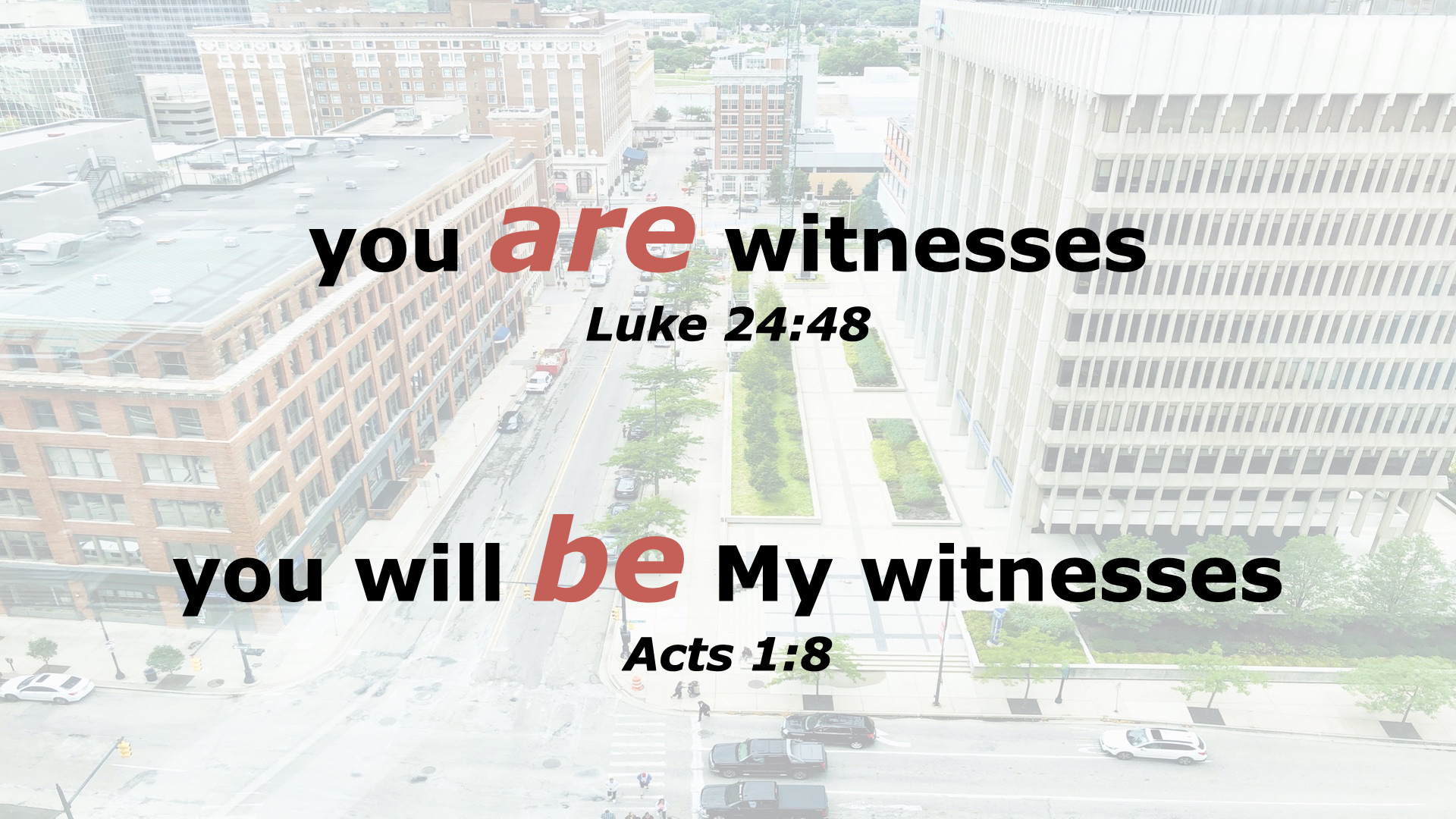
A witness is a truth-teller, who tells their firsthand story and who amplifies their verbal testimony by their Christ-honoring lifestyle. Jesus used two phrases to remind us that witnessing is not something we do, but it is who we are:
you ARE witnesses (Luke 24:48)
you will BE My witnesses (Acts 1:8)
Holy Spirit-baptized Christians are empowered to take Jesus to every street. God has strategically and purposefully placed us on our “streets” to proclaim our witness. From Easy Street to Skid Row, and everywhere in between, we are to fulfill the prophecy of proclaiming this good news to all nations (see 1 Corinthians 9:20-22).
The Holy Spirit opens minds closed to God. He uses our witness as the catalyst for people to repent from their sin and receive the forgiveness that Jesus made available.
Listen to the podcast of this post by clicking on the player below, and you can also subscribe on Apple, Spotify, or Audible.
The Gospel of John introduces John the baptizer to us like this, “He himself was not the Light; he came only as a witness to the Light” (John 1:8).
John had a similar birth announcement as Jesus had (Luke 1:11-14, 28-33)
John’s birth prompted a Holy Spirit-inspired song from his father that resonates with Mary’s Magnificat (Luke 1:46-55, 68-70)
The early years of John are described in much the same terms as how Luke describes the early years of Jesus (Luke 1:80, 2:52)
John quoted Scripture and taught with very similar authority as Jesus did (Matthew 3:1-12; Luke 3:1-19)
Yet for all their similarities, John knew that he was only a herald of Jesus (John 1:19-27).
John was not the Light—he was only a witness to the Light.
I am not the Light—I am only a witness to the Light.
You may think that this statement is pretty obvious, and I did too. But as I read these words from John 1:8 again, it caused me to reevaluate just how much I really believe this.
Do I remember this when no one compliments my sermon? Do I remember this when what I thought was an insightful comment on a verse of Scripture gets hardly any “likes” on my social media channels? Do I remember this when I am complemented and my posts are appreciated?
Who exactly am I trying to make look good: me or Jesus?
I want John’s desire to become my desire and my prayer: “Jesus must increase, but I must decrease” (John 3:30).
Listen to the podcast of this post by clicking on the player below, and you can also subscribe on Apple, Spotify, or Audible.
Last week we learned that we have a job to do. If we want to see Jesus come back to take us Home, we need to share the Good News with everyone. Jesus said that we didn’t have to obey Him in this Great Commission by ourselves, but we can go in His authority and with the empowerment of the Holy Spirit (Matthew 24:14; 28:18-20; Acts 1:8).
In Acts 1:8 notice that Jesus said we are “be My witnesses.” This isn’t an action first, but they are actions that spring out of who we are. So we need to ask: How are we to be His witnesses? Answer: By being blessed by God!
God has desired that we know the blessing of His presence since the very beginning. He instructed the priests to bless the people with these words:
The Lord bless you and keep you; the Lord make His face shine on you and be gracious to you; the Lord turn His face toward you and give you peace. (Numbers 6:24-26)
The Hebrew word for “peace” in this passage is shalom. One of the most basic definitions for shalom is “nothing missing.” In other words, we are blessed people when we realize there is nothing keeping us back from God’s presence.
If you asked someone in the Old Testament where they thought God’s presence was, they would probably point you to the Tent of Meeting or the Tabernacle in Jerusalem. But that was merely a foreshadowing of what God truly desired for His relationship with us. Jesus promised His followers, “On that day you will realize that I am in My Father, and you are in Me, and I am in you” (John 14:20). So if Jesus is in the Father, and we are in Him, that means we are also in the Father. In this position, we can experience the nearness to the Father that Jesus knows (see Ephesians 1:3-8).
This nearness is our source of peace: Now may the Lord of peace Himself give you peace at all times and in every way. The Lord be with all of you (2 Thessalonians 3:16). In this verse, the Greek word for “peace” is eirene, which means a soul at utter peace with God because it is assured of its eternal Home in God’s presence.
Blessed people are abundance people. Blessed people have all their needs supplied so that they can be a conduit of blessing to others. Our increasing awareness of God’s blessing empowers us to be witnesses for Him.
Let me take you back to the Book of Psalms. In Psalm 67, the psalmist asks for God’s blessing on his life four times in just seven short verses. Why does he desire this blessing? It’s not for himself but for others. Look at just the first two verses of this psalm:
May God be gracious to us and bless us and make His face shine on usTHAT Your ways may be known on earth, Your salvation among all nations.
Recall that Jesus commissioned us to go to all nations and that the Holy Spirit empowers our witness to all peoples. This psalmist is asking for God’s blessing so that he can be a witness to everyone. Nine times he says that he desires that all nations or all peoples will know and worship the Most High God.
God’s blessing on His people is really SO THAT all peoples and nations can see His blessing and turn to Him. One of the roles of the Holy Spirit in a believer’s life is to remind us that we are indeed blessed in Jesus, and that we have a mission to fulfill in taking that blessing to others.
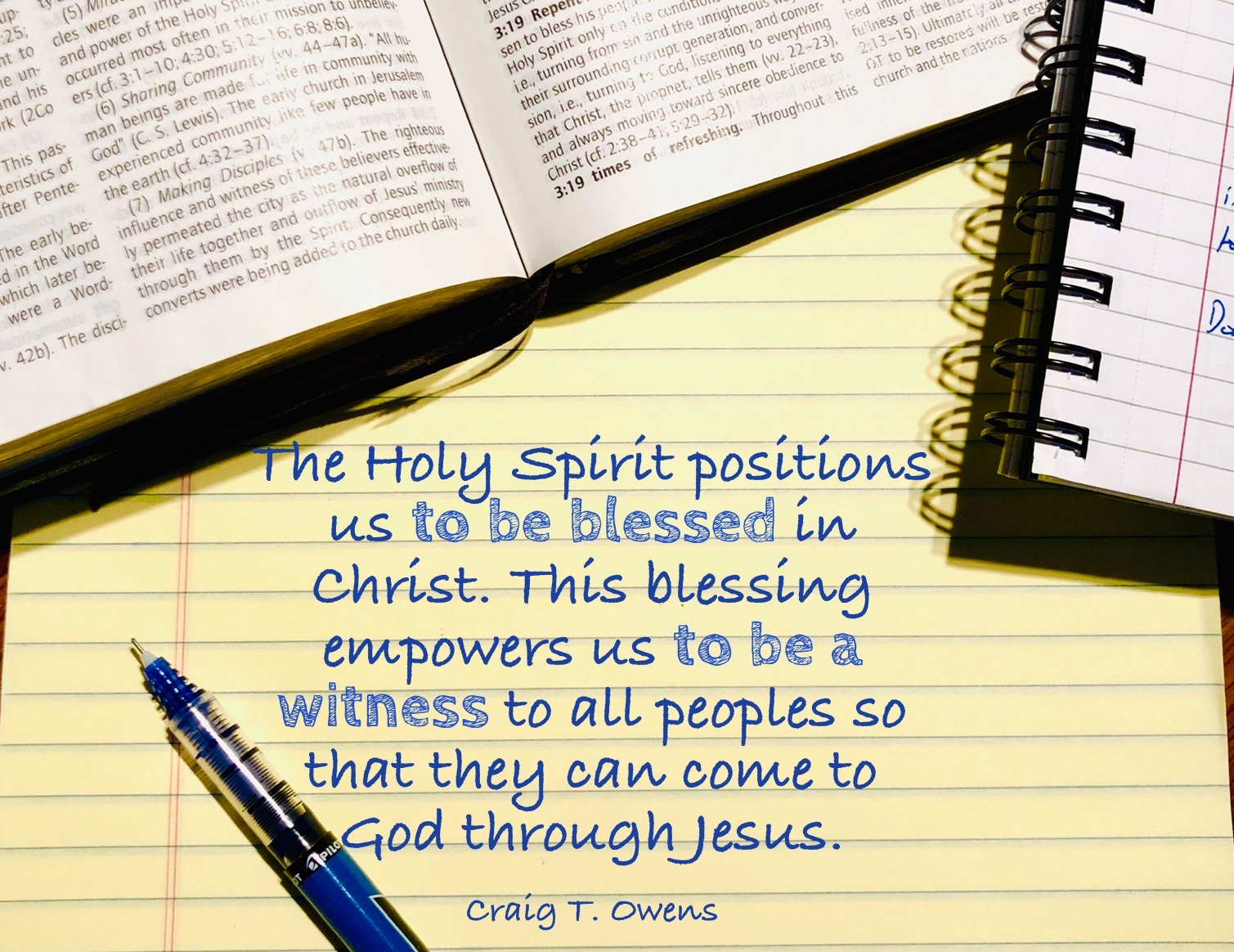
The Holy Spirit positions us to be blessed in Christ. This blessing empowers us to be a witness to all peoples so that they can come to God through Jesus.
It is good for us to pray for the Spirit’s blessing on our lives so that we can BE a blessing to all nations and peoples.
If you would like to check out all of the other messages in our series called We Are: Pentecostal, please click here.