Keep It Closed!

Keep it closedJesus told us that the Holy Spirit would help us reply the right way when someone questioned us about our faith in God. But Jesus showed us, that sometimes no reply is the best reply.

After Jesus was arrested, He was first sent to Pilate:

So again Pilate asked Jesus, “Aren’t You going to answer? See how many things they are accusing You of.” But Jesus still made no reply (Mark 15:4-5).

Then Pilate sent Jesus to King Herod:

When Herod saw Jesus, he was greatly pleased, because for a long time he had been wanting to see Him. From what he had heard about Him, he hoped to see Him perform a sign of some sort. He plied Him with many questions, but Jesus gave him no answer (Luke 23:8-9).

So Herod sent Jesus back to Pilate. And what was the bottom line? Mark 15:5 adds this important phrase about the Roman governor: “…and Pilate was amazed.”

Our ability to remain silent when the Holy Spirit bids us to be silent speaks volumes to those who witness our silence. Be careful. Be sensitive to the Holy Spirit. Sometimes keeping your mouth closed may be the best testimony for God that you can give.

No Apologies Needed

Listen to the podcast of this post by clicking on the player below, and you can also subscribe on AppleSpotify, or Audible. 

Jesus spoke.
A lot.
In fact,
He’s called the Word.
He told stories,
He quoted Scripture,
He used nursery rhymes.
He laughed,
He cried,
He thundered.
He spoke to the religious,
And the irreligious;
To Jews,
To Gentiles,
To Samaritans.
His words excited,
And angered,
Healed,
And restored.
But…
Not once did He misspeak,
Or stumble,
Or apologize.
How could He do this?
“I did not speak of My own accord,
But the Father who sent Me
Commanded Me what to say
And how to say it …
So whatever I say
Is just what the Father
Has told Me to say” (John 12:49-50)
You and I can speak like this too:
We, too, can slow down, listen, and then speak only those Holy Spirit-directed words. If we can do that, we won’t ever need to apologize.

Check out my video called Time To Check The Mirror where I talk about so-called Freudian slips, and my blog post A Leader’s Sincere Apology.

►► Would you please prayerfully consider supporting this ministry? My Patreon supporters get behind-the-scenes access to exclusive materials. ◀︎◀︎

Careless Words

Listen to the podcast of this post by clicking on the player below, and you can also subscribe on AppleSpotify, or Audible. 

“But I tell you that men will have to give account on the day of judgment for every careless word they have spoken.” —Jesus Christ, in Matthew 12:36

The King James Version uses the phrase idle words, which is a rather apt description. The root Greek word is the picture of a worker, but the prefix “a” with it means that the worker is either lazy or unemployed. Not only that but he couldn’t care less (“careless”) about his unemployed, unproductive state.

It’s lazy to use whatever word comes to mind, especially if it’s not the right word. 

It takes hard work to say the right word at the right time. 

It requires great care to leave the wrong word unspoken.

Just prior to the above quote from Jesus, His critics had just thrown out the line, “He casts out demons through the power of the devil.” They didn’t think about what they were saying, so Jesus said, “If you had thought that through before you said it, you would have realized that it makes no sense. That was an idle, unproductive, lazy thing to say.” In the meantime, who knows how many people heard that throw-away line and then turned away from Jesus (see Matthew 12:22-37).

Words have consequences. Idle, careless words may have eternal consequences. I’ll have to stand before God to explain my careless words some day.

And so will you.

►► Would you please prayerfully consider supporting this ministry? My Patreon supporters get behind-the-scenes access to exclusive materials. ◀︎◀︎

Thursdays With Oswald—Venting In Prayer

This is a weekly series with things I’m reading and pondering from Oswald Chambers. You can read the original seed thought here, or type “Thursdays With Oswald” in the search box to read more entries.

Venting In Prayer 

     When you are worked up to a pitch emotionally, read some of the Psalms, and the Spirit of God will gradually teach you how to form a spiritual nous*, a mind whereby you will not only understand but will slowly and surely get to the place where you can express your spirit, you will have a totally new language. 

* To read what Chambers means by the Greek word nous, click here. 

From Biblical Psychology 

Sometimes we’re too timid in our prayers. We think we need to hold back, or not really say what’s on our mind. We probably think that some of the language we use might be too offensive for God’s ears.

Have you ever read some of the Psalms? As Oswald Chambers suggests, this is a great place to form your prayer vocabulary. David really “lets loose” in some of his prayers, calling his enemies all sorts of names, and basically saying, “Get ‘em, God!”

So you don’t want to say those kinds of things to God? Don’t you think He already knows what you’re thinking? Wouldn’t it be much more effective to “vent” in prayer—in the safe presence of your loving Heavenly Father? It’s really only after you “get it out” that the Holy Spirit can help you work it out.

Express yourself—vent in God’s presence instead of the presence of those who are troubling you—and then listen to how God’s Spirit will help you slowly and surely get a brand new perspective on your situation.

UPDATE: I have a whole chapter called ‘Your Emergency Release Valve’ about these types of prayers in my book When Sheep Bite.

Worthy Of Imitation

I pray that my life is worthy of imitation. And, pastor, I pray yours is too!

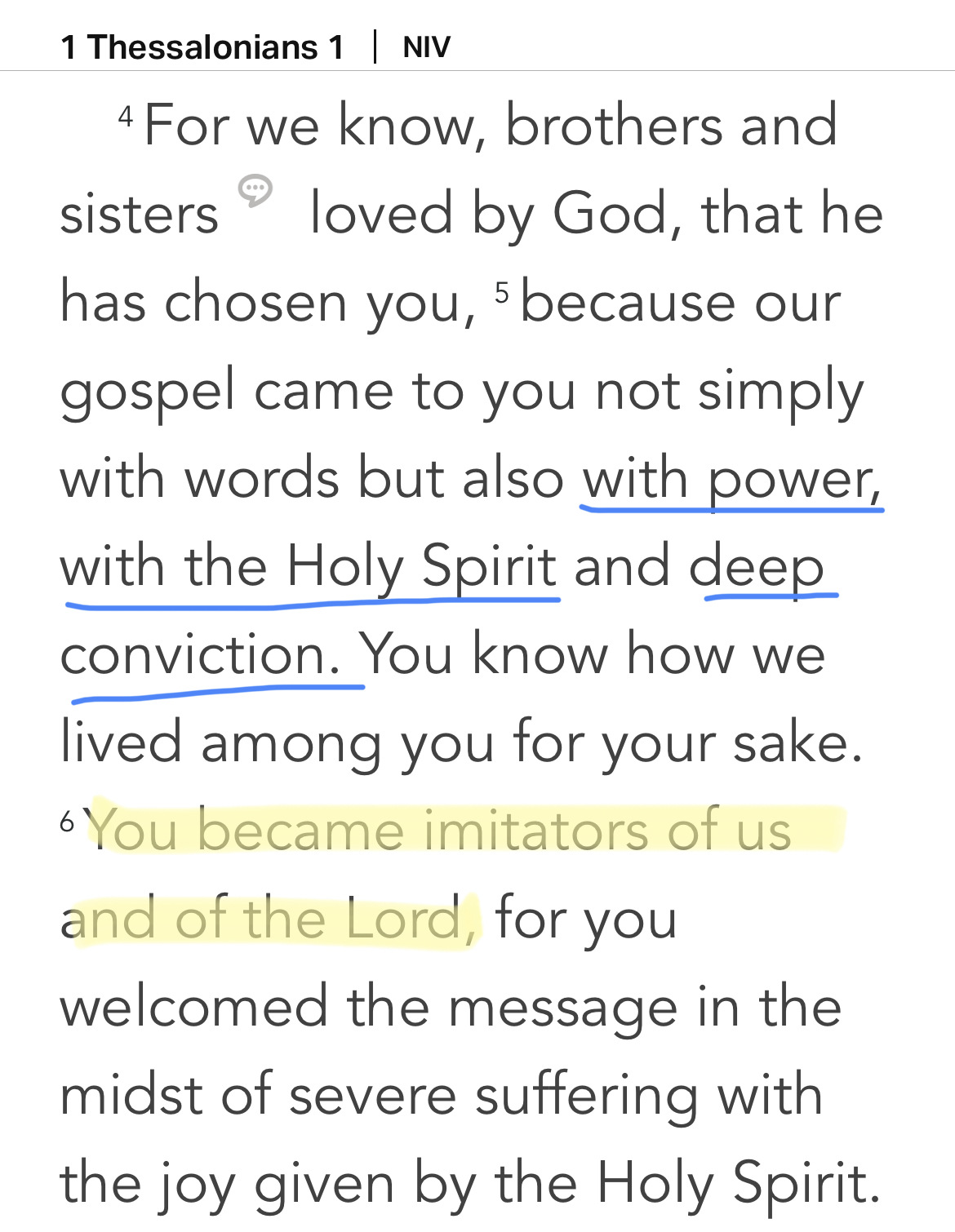
Here’s how to make sure it is an imitable life: I can’t just talk a good life. Paul wrote, Our gospel came to you not simply with words.” Words are important, but they shouldn’t be a replacement for a life that backs up those words. Paul continues his thought:

Our gospel came to you not simply with words, but also with power, with the Holy Spirit and with deep conviction…. (1 Thessalonians 1:5)

Their sermons were backed up by the help of the Holy Spirit, and the deep conviction that Paul, Silas, and Timothy lived by. This was all outwardly focused toward others. Look how Paul concludes this verse, …you know how we lived among you for your sake.

They never attempted to use the gospel or their calling to benefit themselves, but always for the benefit of others and for the glory of God.

The result (v. 6):

You became imitators of us and of the Lord. 

I pray that all of us can say this about our congregations!

Going Up, Please

I’m leading a fun discussion at the En Gedi Youth Center with a bunch of excited 6th graders. Our class is called “An Elevation, A Mirror, And A Guy Called Bob” which is based on John Maxwell’s book Winning With People.

In Winning With People, Dr. Maxwell shares 25 principles for improving our interpersonal skills. In my class at the youth center, we’ve already covered the lens principle and the elevator principle.

The elevator principle basically says that we can only take people up or take them down in our interactions with them. There are no “neutral” interactions. I’m encouraging our students to always take people up.

One way we do that is by pausing to T.H.I.N.K before we speak. Before speaking, ask yourself, “Is what I’m about to say…

  • True
  • Helpful
  • Inspiring
  • Necessary
  • Kind?”

This isn’t just good advice for 6th graders. We all would do well to remember to T.H.I.N.K. As Winston Churchill said,

“By swallowing evil words unsaid, no one has ever harmed his stomach.”

Thursdays With Oswald—Mirror

This is a weekly series with things I’m reading and pondering from Oswald Chambers. You can read the original seed thought here, or type “Thursdays With Oswald” in the search box to read more entries.

Mirror

    It is a wonderful thing that God can cleanse and purify the thinking of our hearts. That is why our Lord says, “Of the abundance of the heart his mouth speaketh” (Luke 6:45). The Bible says that words are born in the heart, not in the head. …

     Jesus Christ said He always spoke as His Father wished Him to. Did His Father write out the words and tell Him to learn them by heart? No, the mainspring of the heart of Jesus Christ was the mainspring of the heart of God the Father, consequently the words Jesus Christ spoke were the exact expression of God’s thoughts. In our Lord the tongue was in its right place; He never spoke from His head, but always from His heart. 

From Biblical Psychology

Have you ever noticed how friends begin to talk like each other? They laugh at the punchline without the joke being told any longer, because they know it so well.

Or how about married couples who can finish each other’s sentences, because they are so in tune with each other.

Biblical scholars have pointed out the similarity of the writing styles of Luke and the Apostle Paul, probably due to the huge amount of time they spent with each other.

We begin to mirror those with whom we spend the most time.

Jesus Christ had His heart filled with God’s presence, so His words mirrored the thoughts of His Father (John 12:49).

What about me? Whom do I mirror? My vocabulary will tell me who fascinates me most, who has my attention, and who has my heart.

I pray that more and more my words reveal that I mirror my Savior Jesus Christ. May my heart be fascinated and attentive to Him, and then may I never speak from my head, but always from my heart.

Thursdays With Oswald—In Christ I Can

This is a weekly series with things I’m reading and pondering from Oswald Chambers. You can read the original seed thought here, or type “Thursdays With Oswald” in the search box to read more entries.

In Christ I Can

     We are made sons and daughters of God through the Atonement and we have a tremendous dignity to maintain; we have no business to bow our necks to any yoke saving the yoke of the Lord Jesus Christ [Matthew 11:28-30]. …

     Every detail of our physical life is to be absolutely under the control of the new disposition which God planted in us by means of identification with Jesus Christ, and we shall no longer be allowed to murmur ‘can’t.’ There is no such word as ‘can’t’ in a Christian’s vocabulary if he is rightly related to God; there is only one word and that is ‘can.’

From Biblical Psychology

Sometimes Christians are known more for what we’re against than what we’re for. I think Oswald Chambers would say that is because we don’t really understand the full power of the Atonement.

We can better understand that word by saying it “at one-ment.” We have been made one with Christ. You hear this in Jesus’ prayer for us in John 17, I in them and You in Me, in order that they may become one and perfectly united, that the world may know and definitely recognize that You sent Me and that You have loved them even as You have loved Me.”

When we are in this sort of relationship, we don’t even say can’t to sin. Instead, we say I can live a holy life because of Christ in me!

As Paul said, we can say:

I CAN do everything through Christ Who gives me strength. (Philippians 4:13)

No Toleration

We need to elevate our vocabulary when it comes to God and the things about His nature and His Kingdom.

I was convicted of this a few years ago. I came home from church and was watching an NFL game on a Sunday afternoon, when a receiver made an amazingly acrobatic catch for a touchdown. I jumped off the couch and shouted, “That. Was. Awesome!!

Immediately the Holy Spirit brought something to my mind. “When you were worshiping at church this morning,” He gently reminded me, “didn’t you say how awesome God was? Is He as awesome as that catch?”

Right then and there I decided that I needed to be more careful of my vocabulary. I want to reserve words for God that I used nowhere else. Theologians do it all the time: creating new words to try to capture the majesty, omnipotence, and mind-blowing-vocabulary-defying greatness of Almighty God.

I’m certainly not perfect at this, but I’m working on it.

I was reminded of this again when I read these words from Charles Spurgeon:

“My Master has riches

beyond the count of arithmetic,

the measurement of reason,

the dream of imagination,

or the eloquence of words.

They are unsearchable!

You may look,

and study,

and weigh,

but Jesus is a greater Savior

than you think Him to be

when your thoughts are at the greatest.

My Lord is more ready to pardon

than you to sin,

more able to forgive

than you to transgress.

My Master is more willing to supply your wants

than you are to confess them.

Never tolerate low thoughts of my Lord Jesus.”

Blessing Of Becoming

“When our Lord looked at us, He saw not only what we were—He was faithful in seeing what we could become! He took away the curse of being and gave us the glorious blessing of becoming.” —A.W. Tozer

The word blessing in the Greek is a compound word made up of good + words. Just as Jesus blessed us—said the good word that He prepared us for something more than a life enslaved to sin—shouldn’t we too say good words to others about what they could become?

There is ZERO excuse for anyone who calls themselves a Christian to ever say anything but good words to others. If God only says good words to you and about you, how much more so should Christians be speaking good words to and about others!

Jesus took away the curse of being trapped as we were, and gave us the blessing of becoming who He truly intends for us to be. Let’s do the same thing for other people.

Make a covenant: I will only use my words to bless others; that is, I will only say good words to them and about them. I will speak only those words that tell them about the masterpiece that they are.