If I Only Would Have Thought That Through…

These words are usually said after we have messed up something. We look back and say, “What was I thinking?!”

The truth is: you were thinking, it was just wrong thinking.

The Apostle Paul writes this:

Clothe yourselves with the Lord Jesus Christ, and do not think about how to gratify the desires of the sinful nature. (Romans 13:14)

The King James Version, instead of do not think, says, “make no provision for the flesh.” In other words, the idea here is forethought.

We have a filter at the base of our brains called the reticular activating system (or R.A.S.). This is what lets in the important things, and keeps out the unimportant things. But here is the vital issue—

YOU CAN PROGRAM YOUR R.A.S.!

You tell your RAS what’s important and what’s unimportant. Paul says that if we use our forethought to consciously decide to clothe ourselves with Christ, we are programming our RAS to spot the things that glorify Him and ignore the things that gratify our fleshly desires.

A phrase that I use often (hat tip to Dr. Richard Dobbins) is: I need to think about what I’m thinking about.

By doing this, I’m able to see how I’ve programmed my RAS. It’s either programmed to look for God-honoring things or flesh-gratifying things.

Try it for yourself. Make the conscious decision to read the Bible every day. Then in your prayer time, ask the Holy Spirit to help you think about God-honoring things. If you will do this, you will notice that you are noticing more things that please God, and that you are ignoring more things that please your sinful nature.

Search & Seizure

The beginning of a new year is a time when many people resolve to change things in their lives. They vow to stop smoking, change their diet, exercise, take a class, or do other things that will make them “a better person.”

But my question is: Why wait until January 1 to start something new?

In one of his most intimate psalms, David prayed,

Search me thoroughly, O God, and know my heart! Try me and know my thoughts! And see if there is any wicked or hurtful way in me, and lead me in the way everlasting. (Psalm 139:23-24 AMP)

Charles Spurgeon added this thought:

“Every man who is wise in the kingdom of heaven, will cry, Search me, O God, and try me; and he will frequently set apart special seasons for self-examination, to discover whether things are right between God and his soul. The God whom we worship is a great heart-searcher; and of old His servants knew Him as the Lord which searches the heart and tries the reins of the children of men. Let me stir you up in His name to make diligent search and solemn trial of your state, lest you come short of the promised rest. That which every wise man does, that which God Himself does with us all, I exhort you to do with yourself….”

This search and seizure of unhealthy thoughts or unhealthy habits should be done alone with God. There in the quietness of God’s presence we can resolve to live differently. Oswald Chambers wrote:

“Our battles are first won or lost in the secret places of our will in God’s presence, never in full view of the world.”

Today is as good as any day will ever be to allow God to search you, and to seize those thoughts which are keeping you back from the fullness of life He wants for you. Allow His Spirit to help you today.

Thursdays With Oswald—Unblameable In The Sight Of God

This is a weekly series with things I’m reading and pondering from Oswald Chambers. You can read the original seed thought here, or type “Thursdays With Oswald” in the search box to read more entries.

Unblameable In The Sight Of God

     If the ‘Oughts’ of the Old Testament were difficult to obey, Our Lord’s teaching is unfathomably more difficult. … Jesus Christ does not simply say, ‘Thou shalt not do certain things’; He demands that we have such a condition of the heart that we never even think of doing them, every thought and imagination of heart and mind is to be unblameable in the sight of God.

     …The purity God demands is impossible unless we can be re-made from within, and that is what Jesus Christ undertakes to do through the Atonement. … It is not a question of applying Jesus Christ’s principles to our actual life first of all, but of applying them to our relationship to Himself, then as we keep our souls open in relation to Him our conscience will decide how we are to act of that relationship.

From Biblical Ethics

I want every part of my life to be unblameable in the sight of God. I have to keep the eyes of my heart fixed on Jesus.

Since, then, you have been raised with Christ, set your hearts on things above, where Christ is seated at the right hand of God. Set your minds on things above, not on earthly things. For you died, and your life is now hidden with Christ in God. When Christ, Who is your life, appears, then you also will appear with Him in glory. (Colossians 3:1-4)

Elevate

On Sunday we kicked off a new series A Season Of Thanks looking at this verse:

Since you have been raised to new life with Christ, set your sights on the realities of heaven, where Christ sits in the place of honor at God’s right hand. Think about the things of heaven, not the things of earth.

Here’s the deal: If you elevate your thinking to positive things, your life will be more positive. The best place to start is thank-fullness = being full of thanks. Make it a habit in your life to find more things for which you can give thanks.

I searched the Twitterverse for some thoughts about elevated thinking…

Feel free to add your own in the comments below. Oh yeah, and come join us next Sunday for A Season Of Thanks part 2.

Thursdays With Oswald—Integrated Life

This is a weekly series with things I’m reading and pondering from Oswald Chambers. You can read the original seed thought here, or type “Thursdays With Oswald” in the search box to read more entries.

Integrated Life

     God will never allow us to divide our lives into sacred and secular, into study and activity. We generally think of a student as one who shuts himself up and studies in a reflective way, but that is never revealed in God’s book. A Christian’s thinking ought to be done in activities, not in reflection, because we only come to right discernment in activities. Some incline to study naturally in the reflective sense, others incline more to steady active work; the Bible combines both in one life. We are apt to look on workers for God as a special class, but that is foreign to the New Testament. Our Lord was a carpenter; Paul was a weaver. If you try and live in compartments, God will tumble up the time.

From Approved Unto God

You and I don’t have sacred and secular lives. If you are a follower of God, your whole life is holy: it’s all set apart for God. Don’t slack off in areas that you think are secular; treat everything as holy.

Thought Patrol

Have you ever found yourself in circumstances that weren’t exactly what you had planned or hoped for? You know, things are just not going your way? What do you do then? How do you handle this? I suggest the first place to start is by thinking about your thinking.

I know that may sound a little unusual, but I have often times had to stop to think about what I’m thinking about. To ask myself, “Why am I thinking that?”

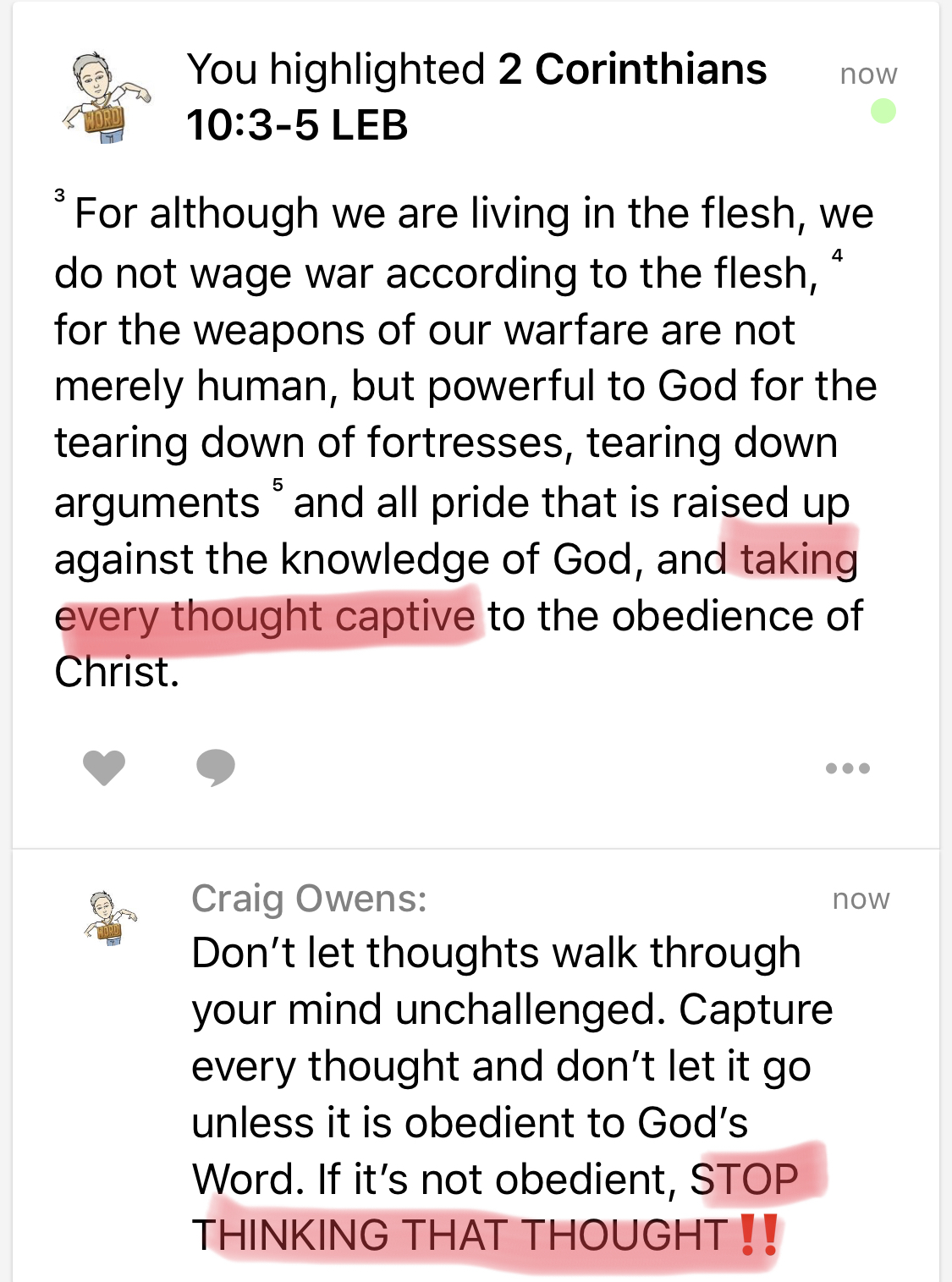
I believe this is what the Bible is really saying when it tells us to take every thought captive. If we don’t, our negative thoughts can lead us to unplanned places and can keep us trapped there. But if we will take time to think about what we’re thinking about, we can discover the key to freedom from that undesirable place.

A few quotes to get us started:

“No man has ever succeeded who kept his mind on negative things… and no man ever rises above his thoughts of himself.” —C.M. Ward

“You are today where your thoughts have brought you. You will be tomorrow where your thoughts take you.” —James Allen, As A Man Thinketh

“They themselves are makers of themselves by virtue of the thoughts which they choose and encourage; that mind is the master-weaver, both of the inner garment of character and the outer garment of circumstance, and that, as they may have hitherto woven in ignorance and pain they may now weave in enlightenment and happiness.” —James Allen, As A Man Thinketh

“Only when you assume full accountability for your thoughts, feelings, actions, and results can you direct your own destiny; otherwise, someone or something else will.” —Roger Conners, Tom Smith & Craig Hickman, The Oz Principle

“Summing it all up, friends, I’d say you’ll do best by filling your minds and meditating on things true, noble, reputable, authentic, compelling, gracious—the best, not the worst; the beautiful, not the ugly; things to praise, not things to curse. Put into practice what you learned from me, what you heard and saw and realized. Do that, and God, who makes everything work together, will work you into his most excellent harmonies.” —Philippians 4:8, The Bible

Let’s all work on patrolling our thoughts today.

More Than Worship, It’s Worthship

Church has often been called a “house of worship.” But I struggle with what that means exactly. Sometimes it’s a house of singing, or a house of preaching, or a house of socializing, but not too often is the primary focus of the gathering people worship.

It seems most of the time worship is something we do at some point during the singing.

Now I will be the first to admit that the atmosphere most conducive to worship is usually created when meaningful—“worshipful”—songs are being played sung. But is that it? Shouldn’t there be something more?

The definition of worship includes:

…a condition of being worthy of honor or renown.

In fact, the Old English spelling was worthship. In other words, the greater the worth something had, the greater the honor or renown that something should be given.

In my case, the Something should have a capital “S.” The Person worthy of greatest honor and highest renown is my God and Savior Jesus Christ.

So why do I have to wait to go to a certain building to express His worth?

Why do I have to wait until the atmosphere is right?

Shouldn’t I be expressing my adoration and honor to Him always?

What does it mean to always be in a place of expressing my worthship?

I’ve been mulling over this quote from Brother Lawrence:

I know that for the right practice of it, the heart must be empty of all other things; because God will possess the heart alone; and as He cannot possess it alone, without emptying it of all besides, so neither can He act there, and do in it what He pleases, unless it be left vacant to Him.

As the Apostle Paul wrote I’m trying to capture every thought during the day and ask myself, “Is this thought taking up space in my heart that should be God’s space? Does this thought draw me closer to my Savior, or further away.” I’m trying to express His worth to me in the way I think about Him throughout the day.

Be Careful

In the final instructions before the Israelites were going to enter the Promised Land, the book of Deuteronomy uses the phrase be careful fifteen (15) times:

  • Be careful not to forget
  • Be careful to obey
  • Be careful to avoid making idols
  • Be careful to honor your leadership
  • Be careful of your thoughts

In the dictionary careful is defined as being attentive to potential danger, error, or harm. It implies paying special attention to accuracy and being discerning.

God doesn’t ask this of me to cramp my style but to put me in a place where He can bless me. And not just me: being careful leads to generational blessings. Here’s my favorite be careful verse:

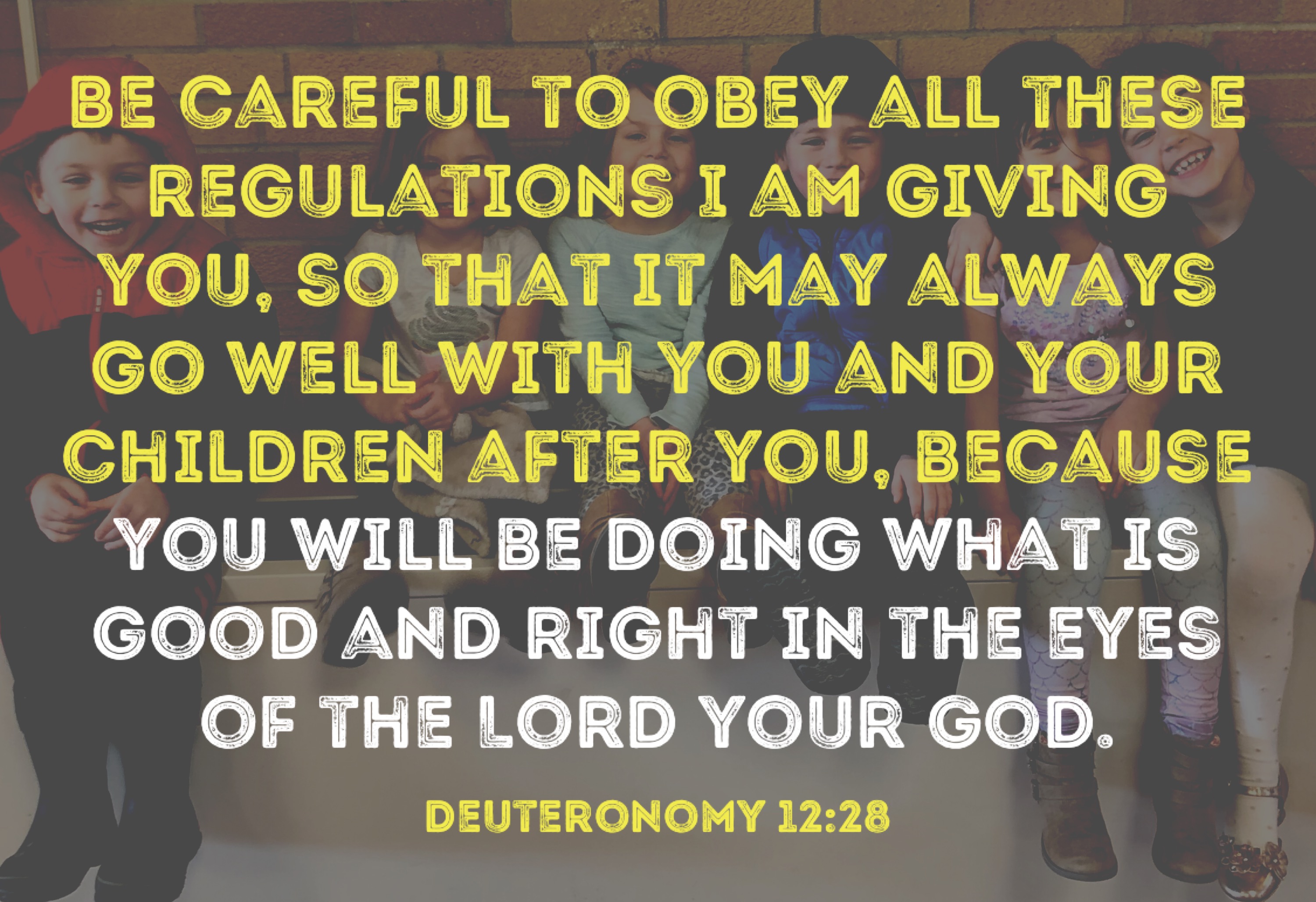
Be careful to obey all these regulations I am giving you today, so that it may always go well with you and your children after you, because you will be doing what is good and right in the eyes of the Lord your God.

Sometimes to be careful we have to slow down. We seem to want everything quickly and with as little effort as possible. Remember the cliché “Haste makes waste”?

What if you slowed down a bit today?

What if you took just a little time to be attentive to potential danger?

What if you paused long enough to discern if you were giving your best to God?

What if you took a moment to simply ask God to give you the wisdom needed to make a godly decision?

Being careful so that it may ALWAYS go well with you and your children after you….

Isn’t that worth it?

I Am What I Think I Am

Years ago I read a book that transformed the way I read and studied. This one book probably caused me to become a more discriminating reader than any other factor. Although it’s less than 50 pages long, As A Man Thinketh by James Allen revolutionized my thinking. Over the last couple of days, I’ve been listening to the audiobook as I have been driving around.

Here’s a quote from James Allen:

A man is literally what he thinks, his character being the complete sum of all his thoughts. … A noble and Godlike character is not a thing of favor or chance, but is the natural result of continued effort in right thinking, the effect of long-cherished association with Godlike thoughts.”

This is what the Bible says about the seeds of great thoughts:

“Finally, brethren, whatever things are true, whatever things are noble, whatever things are just, whatever things are pure, whatever things are lovely, whatever things are of good report, if there is any virtue and if there is anything praiseworthy—meditate on these things.”

What are you thinking about today? What’s going in? You are making yourself by what you are thinking, so choose those thought-stimulators wisely.

Beat Up

Some snippets from a few conversations I have had the past week—

  • “What’s the point?”
  • “My life doesn’t make sense.”
  • “I probably deserve this.”
  • “I don’t know how I got here … I don’t know how to get out of here.”
  • “Why me?”
  • “I feel beat up.”

C.S. Lewis got it exactly right when he wrote, “If satan’s arsenal of weapons were restricted to a single one, it would be discouragement.”

Have you ever worked with someone whose attitude changed after giving his 2-week notice? His job performance slips … his attitude stinks … he does things against company policy … and he justifies it all by saying, “What are they going to do, fire me?” He’s got nothing to lose by acting like a complete jerk!

satan has already been “fired”—he knows he’s got a terrible end coming. And all he wants to do is make other people feel rotten … beat up … discouraged … defeated. He wants to take you down. He’s a jerk!

Did you know that the word devil means slanderer? By his very nature, he only tells lies. Everything he says is intended to harm you. He slings mud at your character, tries to get you thinking you’re no good, turns your attention to anything that’s dark, picks on your faults, jumps on your weaknesses. Like a jerk, he beats you up and beats you down until you start believing his lies.

He is a LIAR!

You are invaluable.

You are a masterpiece.

You are desperately loved by God.

You are integral to God’s plan.

I know you may want to ignore satan’s slandering, to tune out his lies, but can I suggest something else? Listen to them. Listen very carefully. If you are listening closely, you will be able to identify the lies and then demolish them. satan is hoping you will simply accept what he’s saying without analyzing it.

Here’s the next step. After you’ve identified the lies, you have to speak the truth OUT LOUD that contradicts those lies. The Bible says that we defeat satan’s slander by the power of Jesus AND the true words from our mouth. If you’re not sure what biblical truth counteracts the lies that are discouraging you, email me and I’d be happy to help you.

You are so very valuable! There’s a bully who wants to intimidate you, but your Big Brother Jesus is ready to take care of him!