It’s A Love-Hate Thing

Are there things you love to do, but hate to do at the same time?

Ah, yes, that wonderful love-hate relationship. I spent most of the first part of this week in a love-hate thing, and I discovered yet again that love outweighs hate. To rediscover this, all I had to do was agree to walk through a funeral with a grieving family again.

I hate seeing families grieving. I love being able to share hope with them.

I hate how drained I feel after funerals. I love seeing the flicker of encouragement glow in others.

I hate tearful goodbyes. I love the knowledge of joyful reunions.

I hate preparing funeral messages that remind people of eternity. I love sharing that Jesus is the Promise of an eternity in heaven.

I hate having every eye in the room on me. I love seeing God speak His truth through me.

Yup, it’s true: walking through a funeral with a grieving family is—hands down—something that so drains me physically, emotionally, mentally, and spiritually more than anything else I do. But I wouldn’t trade this privilege to step into hurting people’s lives for anything. Yes, love triumphs over hate!

Familiar Conversations

DSCN0995

I read a long time ago the statement, “Leaders are readers.” I’m a wholehearted supporter of this. Thanks to a marvelously talented carpenter in our church, I have a new home for all of my books. I was so excited to get my library out of boxes and onto the shelves.

Actually, they’re more than just books, they are familiar conversations. Rene Descartes said, “The reading of all good books is like conversation with the finest men of past centuries.” I agree.

People often ask me what I’m reading or what they should be reading. As to the second question—what should they read—I answer, “What conversation would you like to have? Is there an area of your life you would love to talk with someone who’s been-there-done-that?” That’s what reading is, having a conversation with some of the great thinkers or most articulate people in past or modern history.

As to the first question—what am I reading—I try to keep readers of the blog up-to-date. Down the right column you will see the list of books I have in progress, and the ones I’ve read this year. Let me highlight just a couple of books.

Wounded Healer. To go deeper in my relationships with others, I have to be able to relate to them at deeper levels. Henri Nouwen has captured the essence of this in Wounded Healer. We cannot minister to others out of our wounds, but out of our scars. In other words, once we’ve healed, but the scar is still there to remind us of the wound, we’re ready to help others heal from the same injury.

Love & Respect. Even though Betsy and I have known each other for nearly 25 years, I know I can still learn more about being a better husband. Emerson Eggerichs is helping me do a better job.

21 Laws of Leadership. This is a classic leadership book from John Maxwell. I can’t even count how many times I’ve read through this book. But I’m going through it again with my church Board, and watching John teach the video series on this book too. Every time I have this conversation with John Maxwell I learn something new.

To be a better leader in any area of your life, don’t shy away from having better conversations with great authors. If you’ve got a book to suggest, send it my way. I’d also be happy to help you find a book as a conversation-starter for you, just ask me.

Take The Initiative

“You have not lived today until you have done something for someone who can never repay you.” —John Bunyan

I love doing something unexpected for someone. Something kind and thoughtful, but totally “out of the blue.” It’s especially nice when the person for whom you do something nice needs it the most, yet would be the last person to ask for help.

In Matthew 25 Jesus talks about people who take the initiative to help the poor, the hungry, the needy. Jesus never says that they asked for help, but simply that His followers saw the need and addressed it. Jesus concludes by saying, “When you did it to one of the least of these My brothers and sisters, you were doing it to Me!

Even better: we take the initiative to bless one of the least of these and we get a blessing from God. How cool is that!

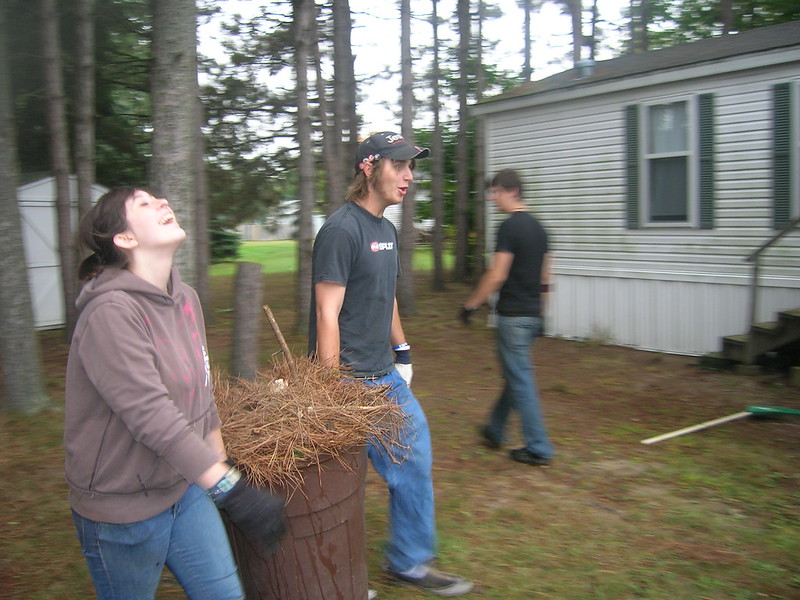
Over the weekend our youth group showed up at a precious lady’s house unannounced. We all affectionately refer to Thelma as “Grandma.” We didn’t tell her that we were coming, we just showed up and started cleaning up her yard. (Disclaimer: I have to admit that we did get an immediate blessing, in that Grandma’s daughter Joan made us a cake, so we got a slice before we left.) Pictures are here.

I’m so proud of these young servants who showed up to bless Grandma. As you helped her, you were helping Jesus. Great will be your reward in heaven—way to go!

Walking In Someone Else’s Flip-Flops

DSCN0970“Empathy is a stunning act of imaginative derring-do, the ultimate virtual reality—climbing into another’s mind to experience the world from that person’s perspective.” —Donald H. Pink
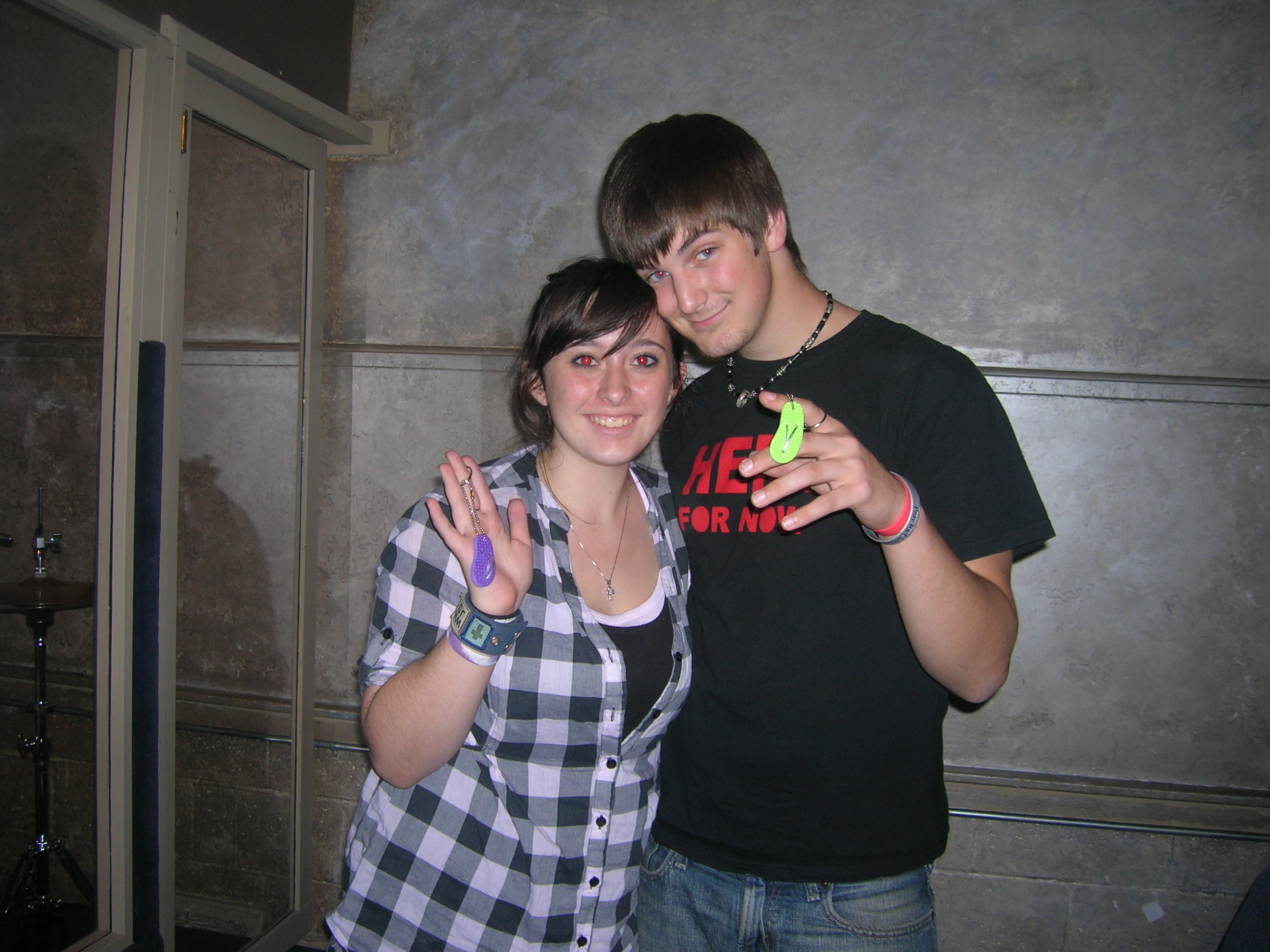
As we continued our series called Bigger Than Me last night (part 1 is here), we challenged our Impact! youth group to develop greater empathy. That word literally means to be immersed in the feelings of others … to step into someone else’s reality … to walk around in someone else’s flip-flops.

The greatest example ever of this is when Jesus Christ came to earth. He stepped into our flip-flops by coming to live among us in human flesh. He experienced everything we ever have or ever will experience; He knows our weaknesses, our dreams, our joys.

For we do not have a High Priest Who is unable to understand and sympathize and have a shared feeling with our weaknesses and infirmities and liability to the assaults of temptation, but One Who has been tempted in every respect as we are, yet without sinning. … For because He Himself [in His humanity] has suffered in being tempted (tested and tried), He is able [immediately] to run to the cry of (assist, relieve) those who are being tempted and tested and tried…. (Hebrews 4:15, 2:18)

Our youth have committed themselves to develop this Christ-like attribute of empathy. Last night they came to the altar to pick up a flip-flop keychain to remind themselves of this commitment. All of us who made this commitment are going to try to walk in others’ flip-flops by trying to find out:

  1. What do they cry about?
  2. What do they sing about?
  3. What do they dream about?

(Thank you, John Maxwell, for your instruction to me on this!)

I hope you have personally experienced the incredible empathy of Jesus. He understands your fears, your joys, and your dreams even better than you understand them yourself. And I hope that you will join us in our commitment to greater empathy with each other. What a blessing you can be to others when you choose to walk in their flip-flops for awhile.

Biodegradable Words

The day has been a good one so far: There’s been a lot of traffic through the store, all of the employees showed up for their shifts on time, and the manager is feeling great. Then because of one complaint from a finicky customer, the whole day seems to crumble.

The day has been a good one so far: You got up on time, found the right outfit to wear, got to school on time, smiled at your classmates, and got right down to business. Then a teacher points out a mistake you made yesterday, and your whole afternoon becomes gloomy.

Usually that’s all it takes. Just one complaint, one correction, one unkind word, one angry look, one unfriendly email. Just one, and it’s hard to remember any of the good stuff which happened earlier. Just one, and the rest of the day seems so hard to bear.

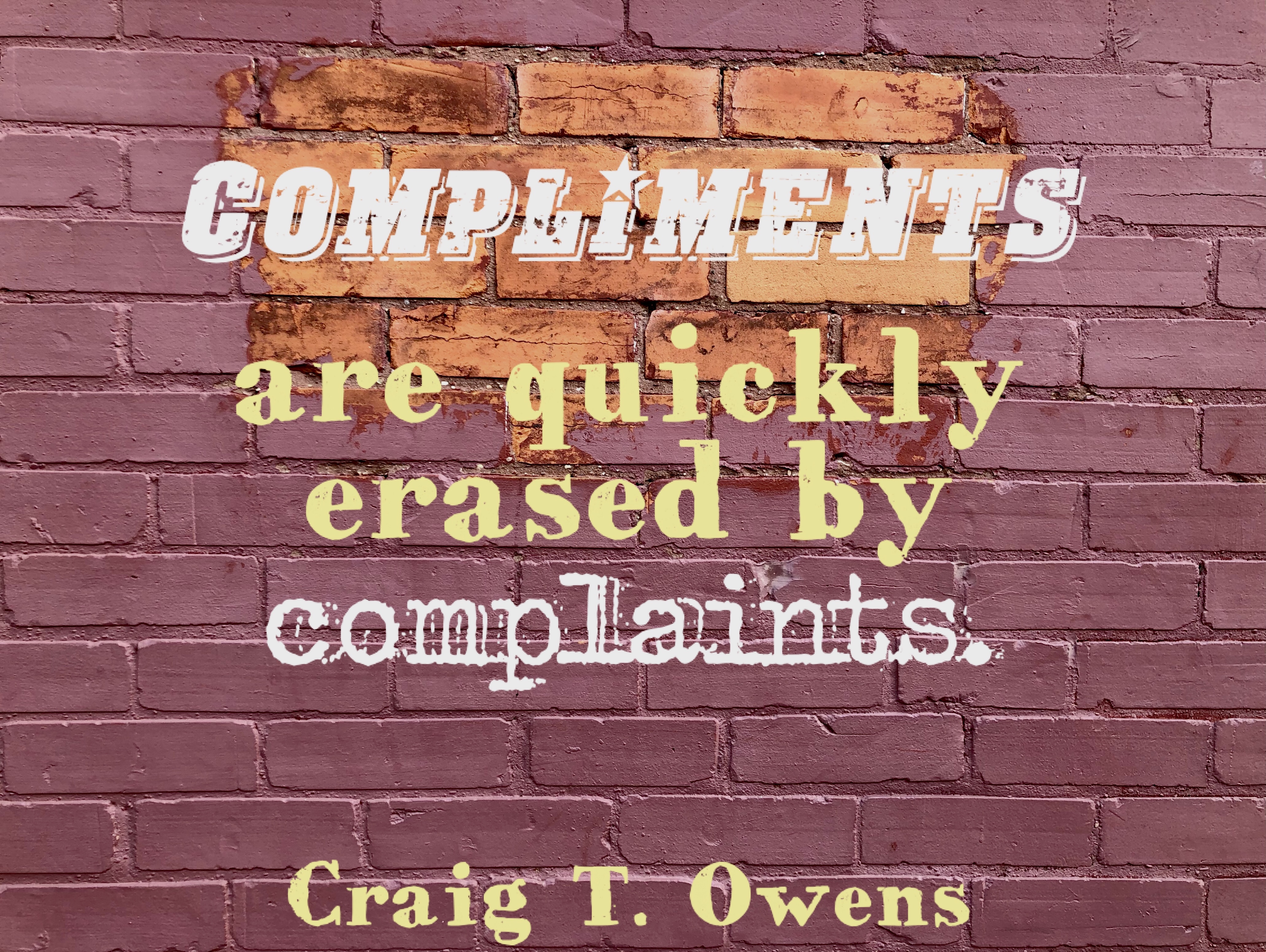
That’s because good words are biodegradable. Kind words break down faster than unkind words. Compliments are quickly erased by complaints.

“One of the commodities in life that most people can’t get enough of is compliments. The ego is never so intact that one can’t find a hole in which to plug a little praise. But, compliments by their very nature are highly biodegradable and tend to dissolve in hours or days after we receive them—which is why we can always use another.” —Phyllis Theroux

Here’s how you can help today. It might take a couple of extra minutes, but the results are so worth it! Give three compliments today.

  • Tell the barista at your coffee shop how much you appreciate her smile every morning.
  • Mention to the building custodian how nice he keeps the office looking.
  • Say “thanks” to the band for playing one of your favorite songs.
  • Compliment your kids for doing their homework without you having to ask them.
  • Thank your school teacher for her informative lesson.
  • Tell your supervisor you appreciate their extra effort.

It’s not hard to find something to compliment about anyone. Your compliment may be just the antidote they need to counteract a complaint that has gotten them down. And when you treat others this way, you can be sure that compliments will be coming your way too!

Pursuit Of Happiness?

I was driving behind an SUV this morning which had the following decal on its rear window—

In Pursuit Of Happiness

Interesting. So I began having an imaginary conversation with the driver of the SUV. (Don’t laugh; you know you’ve done the same thing with other drivers on the road!)

“So is the day a complete waste if you’re unhappy because you got fired? Or because it rained when you planned a picnic? Or because the ice cream store was out of your favorite flavor?

“How far will you go in your pursuit of happiness? Would you cut corners? Would you compromise your values? Would you break the law?”

I like what John Piper says,

“The chief end of man is not just to glorify God and enjoy Him forever. The chief end of man is to glorify God by enjoying Him forever. And if we don’t enjoy Him, we don’t glorify Him.”

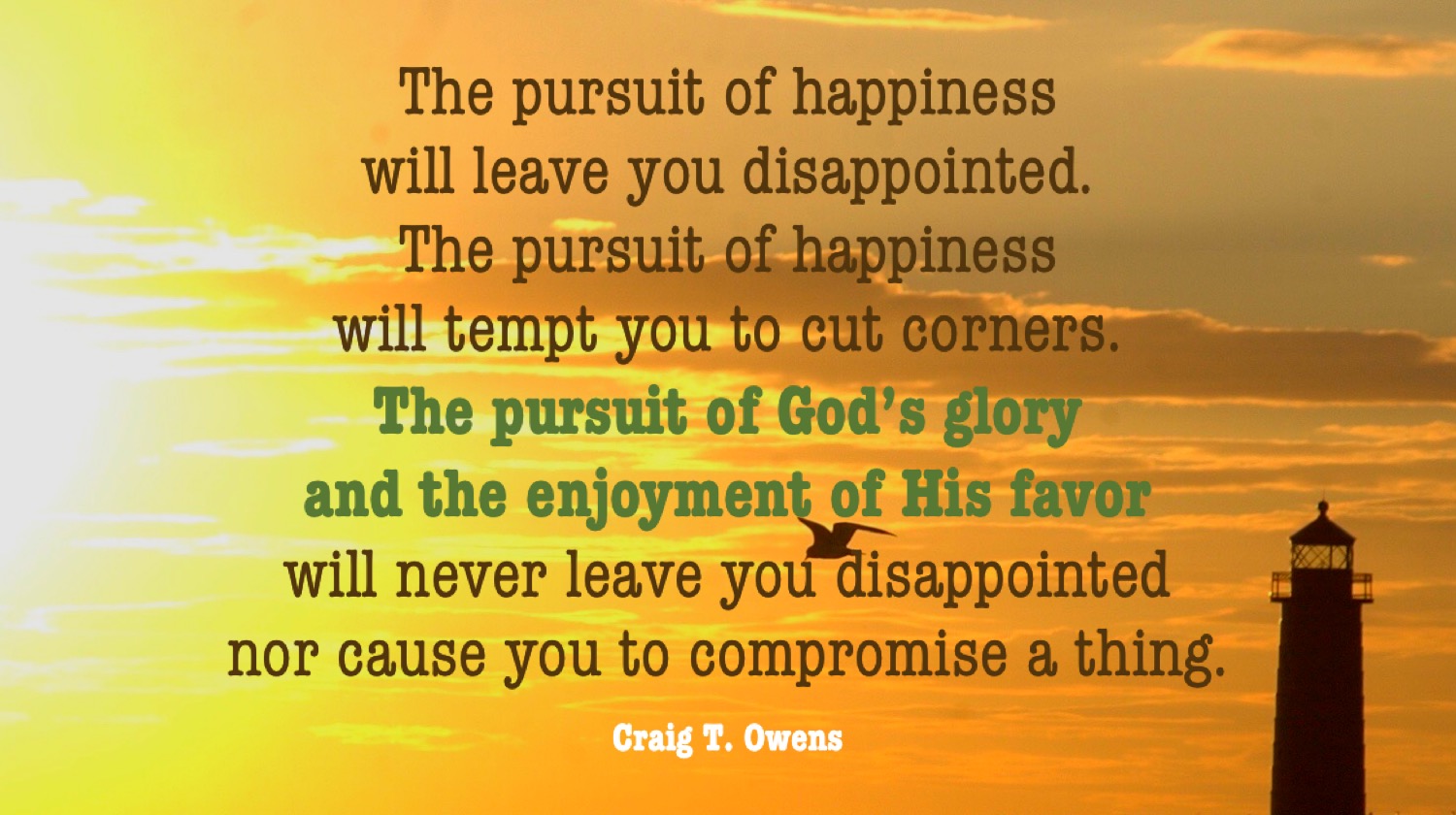
The pursuit of happiness will leave you disappointed. The pursuit of happiness will tempt you to cut corners.

But the pursuit of God’s glory and the enjoyment of His favor will never leave you disappointed nor cause you to compromise a thing. And do you know what else: the pursuit of God will bring a deep-down joy that will bubble up in happiness.

Instead of pursuing happiness, pursue God with all you got.

I’m in this pursuit with you today!

Just One

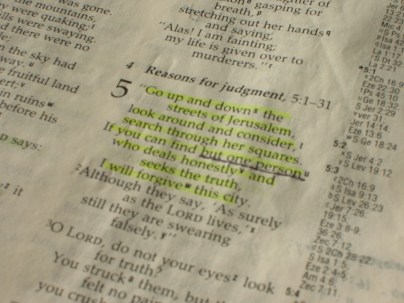
DSCN0821“If you can find but one person who deals honestly and seeks the truth, I will forgive this city” (Jeremiah 5:1).

Through just one person’s pursuit of righteousness, God will save an entire city! One person.

Just one.

Just one who decides to not give in to sin. Just one who is a radical counter-culturalist. Just one who fears God and is not afraid of man’s reaction. Just one who deals honestly. Just one who seeks God’s truth.

Just one.

“When I was young and free my imagination had no limits, I dreamed of changing the world. As I grew older and wiser, I discovered the world would not change, so I shortened my sights somewhat and decided to change only my country. But it, too, seemed immoveable. As I grew in my twilight years, in one last desperate attempt, I settled for changing only my family, those closest to me, but alas, they would have none of it. And now as I lie on my deathbed, I suddenly realized: If I had only changed myself first, then by example I would have changed my family. From their inspiration and encouragement, I would have been able to better my country and, who knows, I may have even changed my world.” —Written on the Westminster Abbey tomb of an eleventh-century Anglican bishop

God is looking for just one in your family. Will you be that one?

God is looking for just one in your city. Will you be that one?

God is looking for just one at your work. Will you be that one?

It takes just one for God to do something amazing—just one.

Please, be that just one.

Put Your Dream To The Test (book review)

Dream Test I’m a HUGE John Maxwell fan. He has been a mentor-from-afar for me for a number of years. So I know whenever I pick up a Maxwell book I’m going to be challenged and stretched in my thinking. Put Your Dream To The Test lived up to my expectations.

What’s your dream? Everyone has a dream, so what’s yours? I have always loved this quote from T.E. Lawrence:

“All men dream, but not equally. Those who dream by night in the dusty recesses of their minds, wake in the day to find that it was vanity: but the dreamers of the day are dangerous men, for they may act on their dreams with open eyes, to make them possible.”

If you are a “dreamer of the day” you will find great value in reading this. In this book, Dr. Maxwell guides you through ten questions to help you refine the pursuit of your dream—

  • Is my dream really my dream?
  • Do I clearly see my dream?
  • Am I depending on factors within my control to achieve my dream?
  • Does my dream compel me to follow it?
  • Do I have a strategy to reach my dream?
  • Have I included the people I need to realize my dream?
  • Am I willing to pay the price for my dream?
  • Am I moving closer to my dream?
  • Does working toward my dream bring satisfaction?
  • Does my dream benefit others?

In typical Maxwell fashion, I was challenged to think differently, I was encouraged to renew what I have already learned, and I realized some things I needed to give up. One of the aspects of Maxwell’s books that I especially appreciate is how energized I feel after reading them. I feel like the counsel he gives me has prepared me to live my life more fully.

If you have a dream that is bigger than you, good! If you have a dream that size, I would strongly recommend that you read this excellent book to help you see your dream and seize your dream.

Uniquely You

Thanks to Mr. Cochrane, my 10th grade English teacher, I have become somewhat of a literalist when it comes to the use of words. For instance, it bothers me when writers confuse your and you’re, or its and it’s, or their, there, and they’re.

Another vocabulary use that bothers me is when someone uses a qualifier with the word unique. It’s incorrect to say, “You’re very unique” or “It’s an unusually unique situation.” Unique, by its very definition, means there is nothing else like it.

Unique is defined as “existing as the only one or as the sole example; having no like or equal; unparalleled; incomparable.”

Do you know another great definition of unique: YOU.

Really, you are unique. You are the only one like you; you are the sole example of you; there is no one like you; you are unparalleled and incomparable. That’s you!

In one of his most intimate prayers, David says to God, “I praise You because I am fearfully and wonderfully made.” The Hebrew word for wonderfully means someone who is one-of-a-kind… unique.

You are uniquely you.

You were created in God’s image—uniquely.

You were created unlike anyone else who has ever lived—uniquely.

You are endowed by your Creator with a set of talents, strengths, and abilities (a gift package) that has never been seen before in the history of mankind, nor will it ever be seen again—uniquely.

You will cross paths with particular people at particular times in your life and their lives that can never be duplicated or recreated—uniquely.

In order to seize unique opportunities, you have to be uniquely you. In order to be uniquely you, you have to become more like Jesus. He embodied every godly attribute perfectly; He lived every moment perfectly; He handled every situation perfectly. “The more I become like Jesus the more uniquely I become myself” (Dr. George O. Wood).

How might you live your life differently today knowing that no one can do what you do the way you do it? The more you become like Jesus, the more uniquely you you will be. Try it!

Consequences

It was a beautiful sunny evening. All of my work was done, Betsy was home from school, our cooler was packed, and we were off to the park. We were all looking forward to spend this lovely evening grilling some hotdogs, splashing in the water, enjoying the breeze off the lake, and just spending time as a family.

But like an unexpected rear-end collision, all our plans for a fun evening were smashed in a single moment. As we were carrying our cooler and towels and toys toward the picnic tables, a couple of my kids acted up… they broke some of our family no-no’s.

Their actions took less than two seconds. It was just between two of them. But the entire family was affected. We turned around and headed home. No hotdogs on the open grill, no beach time, no after-dinner walk on the trails.

Two made a mistake, but all suffered because actions have consequences.

Isaac Newton said for every action there is an equal and opposite reaction. We often think of this when, for instance, in a game of billiards the cue ball hits another ball. The energy from the cue ball is transferred to the other ball, moving it in the direction it was struck. Sometimes we might be tempted to believe that the only two balls affected were the cue ball and the ball that was struck. But that is not correct. Since those two balls have now been moved to another position on the table, their new positions now affected the entire table—the entire game is now different because of action and reaction.

There are consequences for our actions. And almost always those consequences are felt by someone other than the one who acted. Sometimes the consequences are pleasant and sometimes they are painful or even disastrous.

In Old Testament history, we see good consequences. King David was a righteous man, one who loved God and obeyed God’s commands. About 300 years later King Hezekiah sat on the same throne of Israel. When the Assyrian army was headed toward Jerusalem, Hezekiah prayed and asked for God’s help. God responded, “I promise that the king of Assyria won’t get into Jerusalem, or shoot an arrow into the city, or even surround it and prepare to attack. … I will protect it for Myself and for My servant David.

And we see bad consequences. There was a wicked king of Judah named Manasseh. He is not only one of Judah’s longest-reigning kings, but he is also widely regarded as Judah’s most wicked king. Yet in his lifetime, his kingdom seemed to prosper. And even though his grandson Josiah turned away from evil and turned toward God like no other king ever had done before, just four years after his death Jerusalem fell. King Jehoiachin was defeated and all of Judah was carried off into exile by Nebuchadnezzar as a consequence of Manasseh’s sinful behavior.

Our kids that acted up wrote notes of apology which they read to the family (as we ate our hotdogs at home) and we all forgave them. And we had a nice evening playing around the house. But the evening still had the tinge of regret for what could have been.

Our choices today will have consequences tomorrow. Our actions always affect more than just ourselves—they affect everyone close to us. The people in Hezekiah’s day were grateful for the blessed consequences of David’s right choices. The people in Jehoiachin’s day were grieved for the disastrous consequences of Manasseh’s wrong choices.

What about you? What will your descendants feel about the consequences they are experiencing because of your choices today? It’s up to you, and it’s for them, so live right today.