Don’t Just Sit There

I’m convinced that in my pursuit of a deeper relationship with Christ, neutral is the most vulnerable position I can take.

I can pursue God with all I’ve got. Every day I can learn a little more what it means to love God with all my heart, with all my soul, with all my mind, and with all my strength.

Or I can make a decision that I’ve gone as far as I can in my relationship with Jesus. I can say, “I’m not willing to be stretched any further. I’m comfortable with where I am.” But when I get into this neutral position, I’m more likely to slide away from God than I am to move closer to Him. It’s hard to even stay where I was. Check this out:

BLESSED—HAPPY, fortunate, prosperous, and enviable—is the man who walks and lives not in the counsel of the ungodly—following their advice, their plans and purposes—nor stands submissive and inactive in the path where sinners walk, nor sits down to relax and rest where the scornful and the mockers gather.

It’s when I become inactive that I am vulnerable to ungodly counsel.

It’s when I sit down to relax that I can easily slip into the cynical banter of the scornful.

If I want to avoid the downward slide away from God, I can’t just sit still. I’ve got to be actively, passionately, wholeheartedly moving toward Him. Solomon wrote:

Make your ear attentive to skillful and godly Wisdom and incline and direct your heart and mind to understanding—applying all your powers to the quest for it.

Don’t just sit there! Keep on moving closer and closer to Jesus every day.

Buster

Every once in a while I need to be reminded of this truth: “We can make our plans, but the Lord determines our steps.”

Yesterday my plans were set. They were planned down to the minute. Here was my agenda:

  • Leave home early for a meeting in Kalamazoo.
  • Swing by the office to pick up a key.
  • Head to a house in downtown Kalamazoo for a meeting.
  • Complete the meeting in about an hour.
  • Drive to my parents’ house to change into a business suit.
  • Then head to downtown Grand Rapids for another meeting with some key business and ministry leaders in the inner-city.

Instead, on my way to Kalamazoo, I had the following phone conversation:

“Sorry, but I forgot to drop the key off on Friday. Can I meet you at the house to give it to you?”

“Sure. I can meet you there.”

“I need to ask another favor. I’m running late. Can you just find a coffee shop somewhere and meet me about 30 minutes later than we had planned?”

“Okay,” I said not too assuredly since this was starting to throw off my “perfect” schedule.

I pulled into a McDonald’s in downtown Kalamazoo, right across the street from the Greyhound bus station. I sat in my car for a couple of minutes, and then felt the need for a fruit and yogurt parfait. After making my purchase I had a grand total of $7.94 left in my pocket.

I walked to the restroom.

Just as I walked in, a man motioned to me. He wanted to say something quietly to me. Given the neighborhood I was in, I was expecting the usual “Can you help me out with some loose change” plea. Instead…

“Um, can you help me out,” asked the man that would later introduce himself as Buster.

“Sure. What do you need?”

“I had an accident and I need some clothes to change into,” he said quietly.

“I saw a mission around the corner,” I said. “Do they have clothes?”

“Yea.”

“Okay, c’mon. I’ll walk over there with you.” And I turned to walk out of the restroom.

Buster grabbed my coat sleeve and pulled me back. “Um, he said looking at the floor, “I … I’m HIV-positive.”

“Really,” I said as I put my arm around his shoulders, “I’m Craig.”

Buster smiled.

We walked to the mission and he picked out some sweat pants, a sweatshirt, a pair of shoes, a pair of pants, and a winter jacket. Total: $7.42.

“I’m going to pay you back for this, Craig.”

“No, you’re not, Buster. This is my gift to you.”

As we walked toward the bus station, where Buster could use a restroom to change his clothes, he asked me,

“Do you ever think about dying?”

“I’m not afraid to die, Buster, but I’m not ready to leave just yet. Why do you ask?”

“Last night I got drunk. I was trying to get up enough courage to jump in front of a bus. I’m tired of living.”

“Buster, I think that would be the worst thing you could do.”

“Why? No one cares about me.”

“God does.”

“Really?”

“Buster, I don’t believe in accidents or coincidences. I wasn’t supposed to be at this McDonald’s today. But God rearranged my schedule just so I could meet you. God sent me here.”

Buster slowly nodded his head, “I believe that, Craig. I really do.”

Before I left Buster at the bus station, he asked for my phone number. I walked over to the ticket counter to borrow a pen. After I wrote my number down and turned around, a man was standing right in my path.

“My name’s Johnson. Buster told me what you did for him.”

I smiled and shook his hand.

“Why did you do that?” he asked.

I smiled again, “God sent me here. He loves Buster so much that He rearranged my schedule.”

“Can you help me,” Johnson asked, “but Buster said you used all of your money on him.”

“What do you need?”

He held open his hand with some loose change in it. “I need 50 cents more for my bus fare.”

I handed Johnson my last 52 cents.

King Solomon also wrote, “The Lord directs our steps, so why try to understand everything along the way?”

I didn’t understand why my “perfect” schedule got rearranged. But I’m glad it did. I’m glad I got to meet Buster.

Unintended Consequences

Sometimes even with the best of intentions, our actions can create a series of events that we never anticipated. What’s worse, like a row of neatly arranged dominos, once the first one has been knocked over, it’s hard to stop the tumble of the other dominos.

Case in point: Abram (or Abraham, as he would come to be known later).

He followed God’s call to leave his homeland of Ur and travel to Canaan—the Promised Land. He came to Canaan as a fairly wealthy man, having built quite a portfolio in his home country. After he arrived, he built a couple of altars to God and things appeared to be going well.

Until the famine. [you can read the story for yourself here]

Then without asking God, Abram left Canaan and traveled to Egypt. This was the first domino to be knocked down. The rest that fell were the unintended consequences of this single decision.

Abram lied to the Egyptians about his wife, telling them that she was his sister. As a result, she was taken into Pharaoh’s harem. Did Pharaoh sleep with her? The Bible doesn’t say for sure. Was Sarai mad at Abram? The Bible doesn’t answer this one either, but I think we all know the answer to this question!

Abram got richer. Because Pharaoh was so happy with Sarai, Pharaoh gave him sheep and cattle, donkeys and camels, and servants.

But this newly acquired wealth caused yet another domino to fall.

Abram and his nephew Lot began to have arguments about their large herds of animals. To settle their dispute, they split up.

Another domino fell.

Lot, without Abram’s mentorship, moved near Sodom. He got caught up in its sinful lifestyle and lost everything he owned. All he had left were two daughters, who were wicked, manipulative young ladies.

And yet another domino.

Abram and Sarai couldn’t have children. So Sarai suggested that Abram sleep with Hagar, their Egyptian maid. Would Sarai have suggested this if Abram hadn’t abandoned her to Pharaoh? If they hadn’t gone to Egypt, Hagar wouldn’t even have been there!

And the final domino.

Hagar did get pregnant. But her son Ishmael became the father of the Arabic people. A race of people that is openly hostile to the Jewish people to this day.

So many unintended consequences. So many dominos knocked down because of just one decision.

I’m grateful that God made something good out of this, but what incredible pain and hardship exist to this day because of one decision 4000 years ago.

My takeaway: I need to lean on, trust in, and be confident in the Lord with all my heart and mind and do not rely on my own insight or understanding.

Do You Really Want To Be Accountable?

I have a great friend. He is the brother I never had, but he is more than any brother I could have ever hoped for. We are brothers like David and Jonathan were brothers in the Bible. We are covenant brothers (we’ve coined the shorthand CovBro).

What is accountability? The dictionary simply says it means “to give an account or to give an answer.” It doesn’t say “to give an excuse or to give the rationale.”

Accountability means there is only black and white. No gray. Either I did what I was supposed to do. Or I didn’t. King Solomon said it this way:

Young people, it’s wonderful to be young! Enjoy every minute of it. Do everything you want to do; take it all in. But remember that you must give an account to God for everything you do.

Before it’s time to give an account to God, wouldn’t you like someone else to hold you accountable? I would!

In this everything’s-relevant, I’m-not-responsible-for-my-own-actions world, finding someone who will actually hold you to a rigid “Yes, I did it” or “No, I didn’t do it” standard is rare. But my CovBro is one who holds me accountable.

When we meet each month, he asks me the hard questions:

  • How are your business dealings?
  • Are you spending enough time with God?
  • Are you doing what God has called you to do?
  • What’s happening in your marriage? Your relationship with your kids? Your church?

He gets my internet usage report from X3 Watch. He is the iron that sharpens my iron. He accepts no wishy-washy answers nor any flimsy excuses. I do the same for him. And we’re both better off for it.

Do you really want to be accountable? Then find someone that loves you too much to let you get away with anything less than your very best. Someone who will hold you to God’s standards. Someone who will sharpen your iron. It can be painful. But the results are so worth it!

Sharper

Yesterday was one of those days that I was in “receive” mode. As a pastor, I usually spend more days in the “dispense” mode: teaching, counseling, advising. But yesterday I was blessed to sit back and soak in some great counsel. And I’m sharper for it.

It’s too bad that many people never take the time to allow others to advise them. Or, if they do go through the motions of “listening” to advice, they never put that counsel into action.

I met with a seasoned pastor yesterday morning. He asked me several questions to assess where I was personally and professionally, and then he gave me some invaluable insight. He’s one of those “been-there-done-that” guys who has learned the lessons of history well, and he was gracious to share with me.

Last night I invited my Impact teaching team over to my house. After sharing dinner together I listened as they weighed in on our upcoming series in our youth services. Since they are closer in age to our students, their insight into the teenage mind was so keen. They were able to help me better understand the challenges and culture of middle and high school students. And I’m sharper for it.

A few thoughts from some other wise counselors:

“A wise man will hear, and will increase learning; and a man of understanding shall attain unto wise counsels.” —Proverbs 1:5 (KJV)

“Those who will not be counseled, cannot be helped. More souls are ruined by pride than by any other sin whatever.” —Matthew Henry

“Without good direction, people lose their way; the more wise counsel you follow, the better your chances.” —Proverbs 11:14 (The Message)

“Plans fail for lack of counsel, but with many advisers they succeed.” —Proverbs 15:22 (NIV)

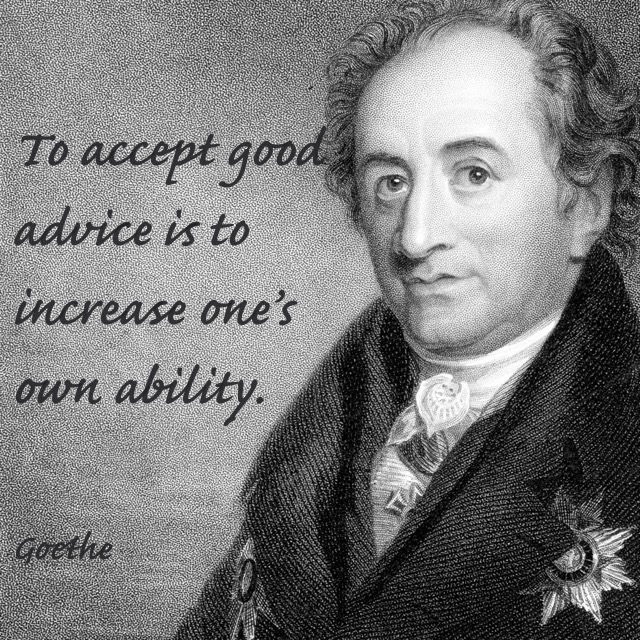
“To accept good advice is to increase one’s own ability.” —Goethe

Are you getting sharper? Are you listening to good advice?

Lots Of Stairs

Sometimes it’s hard to find a block of time to set aside exclusively for exercise, so I try to build some exercise opportunities into my day. My during-the-day exercise usually is trying to find more ways to walk. Like…

  • Parking at the back of the parking lot
  • Walking down the hall to someone’s office instead of sending an email
  • Taking the stairs

Lately, I’ve been in lots of places with stairs, and yesterday my legs were really feeling it. I learned something from climbing all those stairs: It’s a lot easier going down than it is going up.

Up gets my heart pumping more. Up works up a sweat. Up makes me breathe deeper. Up builds my leg muscles. Up is painful (but it’s a good pain).

The soreness in my legs is a reminder that I’ve exercised, that I’ve done something that’s giving me long-term benefits, that I’ve prepared myself for a healthier future.

Solomon wrote, “The path of life leads upward for the wise to keep him from going down to the grave.”

Spiritually, I can say up brings life.

Up makes me wiser. Up keeps me from going down. Up is painful (but it’s a good pain).

If you haven’t been spiritually sore lately, perhaps you’re shying away from a healthy workout.

Let God take you up today. You might be a little sore tomorrow, but the soreness will remind you that you’ve exercised, that you’ve done something that’s giving you long-term benefits, that you’ve prepared yourself for a heavenly future.

Heart Healthy

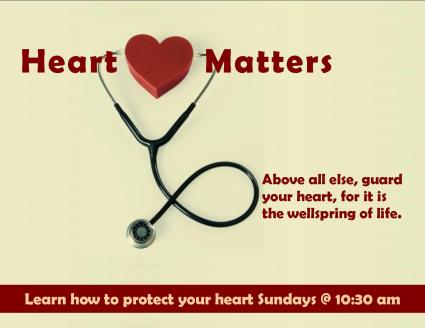
Heart Matters

It’s amazing how many parallels there are between the health of our physical heart that pumps life-carrying blood and the health of our spiritual heart that circulates life to our inner man. I’m going to be exploring what makes a healthy heart (both kinds of heart) as we launch a new 6-part series this Sunday called Heart Matters.

Whether you are having heart trouble now, or you want to maintain a healthy heart for the years to come, this will be valuable insight for you. Join us at Calvary Assembly of God at 10:30am on Sunday mornings. It will be a great investment in your heart’s future.

Pursuing

“They followed worthless idols and became worthless themselves” (Jeremiah 2:5).

Simple principle: I become what I pursue.

Pursuing things that will not last into eternity is worthless, and the pursuit of them will make my life worthless too. Allow me to elaborate with a few modified quotes:

“For where your [pursuit] is, there your heart will be also” (Jesus).

“All [pursuits] that are not eternal are eternally useless” (C.S. Lewis).

“But more than anything else, put God’s [pursuits] first and do what He wants” (Jesus).

“The impulse to [pursue] God originates with God, but the outworking of that impulse is our following hard after Him; and all the time we are [pursuing] Him we are already in His hand” (A.W. Tozer).

“But on the judgment day, fire will reveal what kind of work each of us has [pursued]. The fire will show if a person’s [pursuit] had any value” (Paul).

“The true worth of a man is to be measured by the objects he [pursues]” (Marcus Aurelius Antoninus).

“I love those who love Me, and those who [pursue] Me always catch Me” (God).

“‘Tis the business of little minds to shrink; but he whose heart is firm, and whose conscience approves his conduct, will [pursue] his principles unto death” (Thomas Paine).

As each week wraps up, I’m trying to remember to ask myself, “Did I pursue the right things this week? Were my pursuits eternal and God-honoring?” Good questions. Perhaps you could take some time to assess your pursuits too.

Remember, you will become what you pursue, so pursue wisely.

Sharper Thoughts

John Maxwell said, “Some of my best thinking has been done by others.” I believe that what Dr. Maxwell was saying is that our creative thoughts can become even better when someone else helps sharpen them.

King Solomon, a pretty fair thinker himself, said the same thing when he wrote, “As iron sharpens iron, so one man sharpens another” (Proverbs 27:17). In other words, you need some pretty sharp people to help you think better thoughts, sharper thoughts.

Check out what John Stuart Mill wrote in On Liberty

“Nor is it enough that he should hear the arguments of adversaries from his own teachers, presented as they state them, and accompanied by what they offer as refutations. That is not the way to do justice to the arguments, or bring them into real contact with his own mind. He must be able to hear them from persons who actually believe them; who defend them in earnest, and do their very utmost for them. He must know them in their most plausible and persuasive form; he must feel the whole force of the difficulty which the true view of the subject has to encounter and dispose of; else he will never really possess himself of the portion of truth which meets and removes that difficulty. Ninety-nine in a hundred of what are called educated men are in this condition; even of those who can argue fluently for their opinions. Their conclusion may be true, but it might be false for anything they know: they have never thrown themselves into the mental position of those who think differently from them, and considered what such persons may have to say; and consequently they do not, in any proper sense of the word, know the doctrine which they themselves profess.”

General George C. Marshall, chief of staff of the Army during World War II, created the largest army the world had ever seen (13 million soldiers) in the shortest time possible. General Omar Bradley tells of being called into Marshall’s office in 1939, a week after the outbreak of war in Europe. Marshall was disappointed in Bradley, “You haven’t disagreed with a single thing I have done all week!” Marshall wanted to make sure he was doing his very best so he was calling on another sharp comrade to challenge his thinking.

Do you have some sharp people around you? Do you listen to those who disagree with you? If you do, your creative thoughts can become even sharper.

Success Is Going

King David is one of the most well-known characters in the Old Testament. Such incredible stories are told about him that his life can be summed up in one phrase that occurs four times in Scripture—The Lord gave David victory everywhere he went (2 Samuel 8:6, 14; 1 Chronicles 18:6, 13).

When David was faced with a challenge or an enemy, he threw himself fully into meeting the enemy head-on, and he was always successful. There is no record of David ever being defeated in battle. If he went out, he won.

Aha, keyword alert—The Lord gave David victory everywhere he WENT.

The only times David was defeated was when he stood still:

• When his son Absalom killed another of David’s sons, Amnon, David didn’t do anything. Even when Absalom returned from exile, David stayed home and didn’t reconcile with his son (2 Samuel 13-15).

• David’s son Adonijah behaved inappropriately and eventually rebelled against David, too. But David “never interfered with him by asking, ‘Why do you behave as you do?’” (1 Kings 1:6).

• David lusted after and then committed adultery with Bathsheba when, “In the spring, at the time when kings go off to war, Joab led out the armed forces. … But David remained in Jerusalem” (1 Chronicles 20:1).

• David angered God by ordering that a census be taken of all of the men eligible for military service in Israel. “So David said to Joab and the commanders of the troops, ‘Go and count…” (1 Chronicles 21:2). In other words, David stayed while others went.

Solomon correctly noted, “The path of life leads upward for the wise to keep him from going down to the grave” (Proverbs 15:24). There are only two directions: forward (or up) OR backward (or down). There is no standing still.

The Lord gave David victory everywhere he WENT, not everywhere he stood still. To stand still is to begin to go backward.

Is there a battle you need to fight? Is there a challenge you’ve been avoiding? Is there something you need to complete? Are you waiting for something to happen? Are you content just to stand still?

Stop standing still and start going! If you are following God, He will give you victory everywhere you go.