12 Quotes From “Tactics

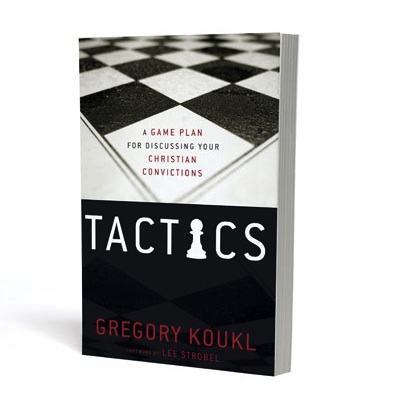
TacticsIn Tactics Greg Koukl gives Christians more how than what/why in defending the Biblical faith. It is an outstanding read that I recommend to all Christians (young or old). You can read my full book review by clicking here. Below are just a few of the quotes I highlighted in this empowering book.

“First, Christ’s ambassadors need the basic knowledge necessary for the task. They must know the central message of God’s kingdom and something about how to respond to the obstacles they’ll encounter on their diplomatic mission. … However, it is not enough for followers of Jesus to have an accurately informed mind. Our knowledge must be tempered with the kind of wisdom that makes our message clear and persuasive. This requires the tools of a diplomat, not the weapons of a warrior, tactical skill rather than brute force. Finally, our character can make or break our mission. Knowledge and wisdom are packaged in a person, so to speak. If that person does not embody the virtues of the kingdom he serves, he will undermine his message and handicap his efforts.” 

“The tactical approach requires as much careful listening as thoughtful response.”

“It is not the Christian life to wound, embarrass, or play one-upmanship with colleagues, friends, or even opponents, but it’s a common vice that anyone can easily fall into.” — Hugh Hewitt 

“Always make it a goal to keep your conversations cordial. Sometimes that will not be possible. If a principled, charitable expression of your ideas makes someone mad, there’s little you can do about it. Jesus’ teaching made some people furious. Just make sure it’s your ideas that offend and not you, that your beliefs cause the dispute and not your behavior.”

“The ability to argue well is vital for clear thinking. That’s why arguments are good things. Arguing is a virtue because it helps us determine what is true and discard what is false. … Paul warns against wrangling about words and quarreling about foolish speculations (2 Timothy 2:14, 23). But he also commands us to be diligent workmen, handling the word of truth accurately (2 Timothy 2:15). And, because some disputes are vitally important, Paul solemnly charges us to reprove, rebuke, and exhort when necessary (2 Timothy 4:112). This cannot be done without some confrontation, but disagreement need not threaten genuine unity.”

“If you want skeptics to believe in the Bible, don’t get into a tug-of-war with them about inspiration. Instead, invite them to listen—to engage Jesus’ words firsthand—then let the Spirit do the heavy lifting for you.”

“You have to know why Jesus is the only way before it is helpful to tell people that He is the only way.” 

“There are three specific things you can do to ‘ready’ yourself to respond. You can anticipate beforehand what might come up. You can reflect afterward on what took place. And in both cases you can practice the responses you think of during these reflective moments so you will be prepared for the next opportunity.”

“Knowing when to step back requires the ability to separate the hogs and the dogs from the lost sheep looking for a shepherd. But how do you know when someone has crossed the line? When do we have an obligation to speak, and when should we save our pearls for another time? Part of the answer can be found in Jesus’ next words in Matthew 7:6: ‘…lest they trample [the pearls] under their feet, and turn and tear you to pieces.’ Be generous with the truth except with someone who shows utter contempt for the precious gift being offered him. He will simply trample it in the mud and then viciously turn on you. … There is an exception to this principle, however. I have learned from my radio show that sometimes my real audience is not the person I’m talking to, but the people who are listening in, eavesdropping on the conversation. … Lee Strobel calls this ‘ricochet evangelism.’” 

“When I face an aggressive challenger, I often give him the last word. Not only is this gracious, it’s also powerful, conveying a deep sense of confidence in one’s own view. Instead of fighting for the final say-so, give it away. Make your concluding point clearly and succinctly, and then say, “I’ll let you have the last word.” But don’t break this promise. Grant him his parting shot, and then let it rest.”

“Know the truth. Know your Bible well enough to give an accurate answer. Tactics are not a substitute for knowledge. Cleverness without truth is manipulation.”

“Culture is most profoundly changed not by the efforts of huge institutions, but by individual people.” —Chuck Colson


 

Helpers

HelpersI was at the University of Michigan with a friend who is on the list waiting for a liver transplant. We spent a half-day listening to doctors, nurses, dietitians and others tell us what to expect through this process.

One social worker really emphasized the care of the patient’s body prior to the transplant as a way to help with recovery from the surgery. He said, Pre-habilitation helps rehabilitation.” 

I like that!

It’s sort of a variation on Benjamin Franklin’s maxims, “An ounce of prevention is worth a pound of cure,” and “A stitch in time saves nine.” Even wise King Solomon wrote, “A prudent person sees trouble coming and ducks; a simpleton walks in blindly and is clobbered” (Proverbs 22:3, The Message).

To help things go better later, we need to start working sooner. Later things go better with helpers that begin sooner. 

Here are a few helpers I thought of:

Pre-habilitation helps rehabilitation. 

Preparing helps repairing. 

Exercise helps recovery. 

Proaction helps better reaction. 

Accepting responsibility helps apologizing. 

Praying helps working. 

Daily study helps studying the night before a test. 

What other helpers would you add to the list? (Add them in the comments below….)

Bright Lamps

photoPastor, please carefully consider these words from Charles Bridge (1794-1869)—

“It is indeed a ‘neglect of the gift of God that is in us,’ to trifle either in the study or in the pulpit. God will bless our endeavors—not our idleness. Our Master, and our people for our Master’s sake, have a just claim to our best time and talents, our most matured thoughts, and most careful studies. To venture upon this infinite work of God with slender furniture, proves a guilty unconcern to our high responsibility.” 

These words remind me of Christ’s words at the end of the parable of the wise and foolish virgins (Luke 12): Be dressed ready for service and keep your lamps burning, like men waiting for their Master to return.

We cannot be idle. Even our “down time” should be preparation time for renewed ministry.

Don’t neglect the gift God has given you to minister to others, to glorify Him, and to be a servant working to hear his Master say, “Well done!”

Effective Pastoring

Andrew MurrayNever has a teacher taken such trouble with his scholars as Jesus Christ will with those who preach His Word. He will spare no pain; no time will be too limited or too long for Him. In the love that took Him to the Cross, He wants to fellowship and converse with us, fashion us, sanctify us, and make us fit for His holy service. Will we not commit ourselves entirely to the love that gave up all for us and look upon it as our greatest joy to have daily fellowship with Him? All you who long for blessing in your ministry, He calls you to abide in Him. Let it be the greatest delight of your life to spend time with God; it will be the surest preparation for fruitful service.” —Andrew Murray

Thursdays With Oswald—Stair-step Growth

Listen to the podcast of this post by clicking on the player below, and you can also subscribe on AppleSpotify, or Audible. 

This is a weekly series with things I’m reading and pondering from Oswald Chambers. You can read the original seed thought here, or type “Thursdays With Oswald” in the search box to read more entries.

Stair-step Growth

     There are stages in spiritual development when God allows us to be dull, times when we cannot realize or feel anything. It is one of the greatest mercies that we have those blank spaces, for this reason, that if we go on with spiritual perception too quickly we have no time to work it out; and if we have no time to work it out, it will react in stagnation and degeneration. 

From Bringing Sons Unto Glory

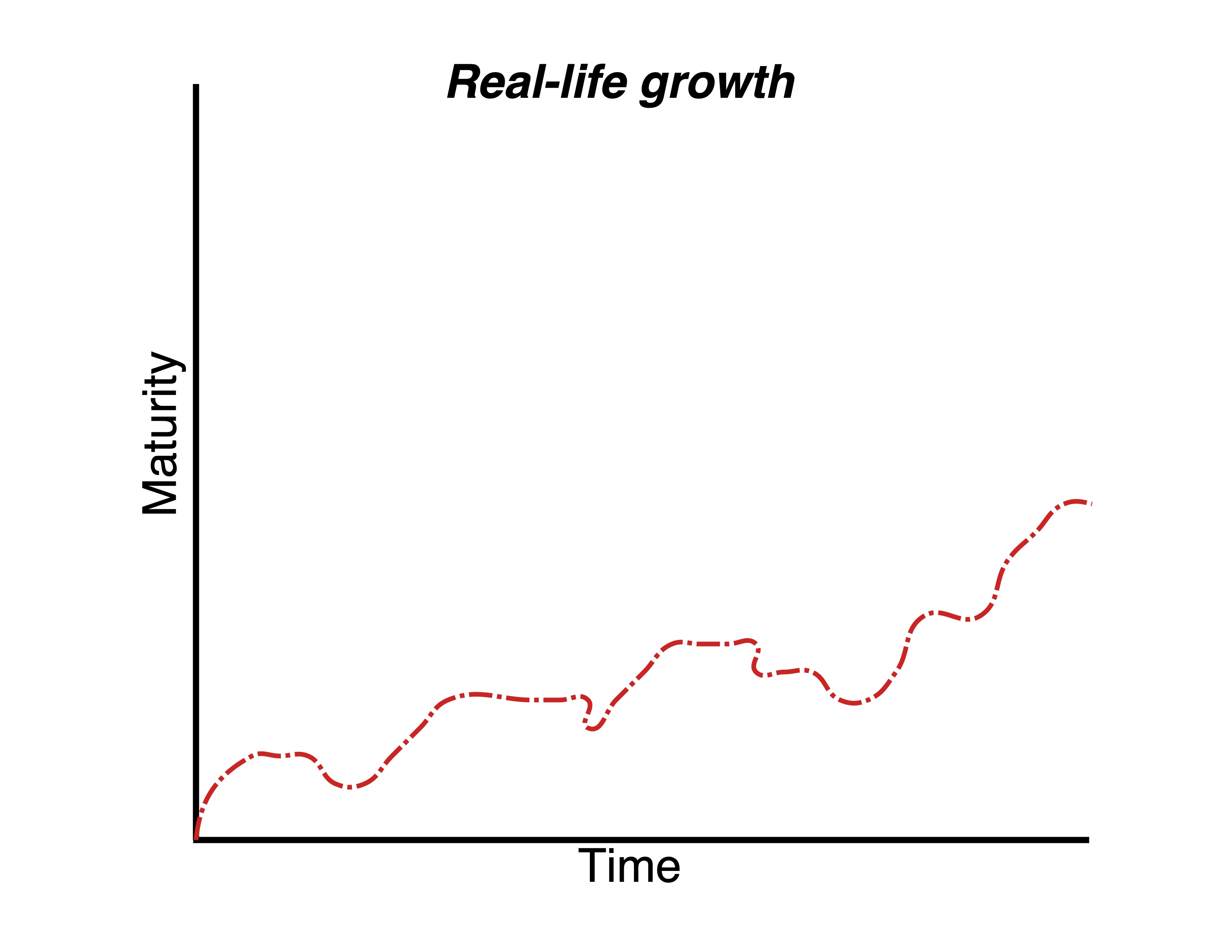
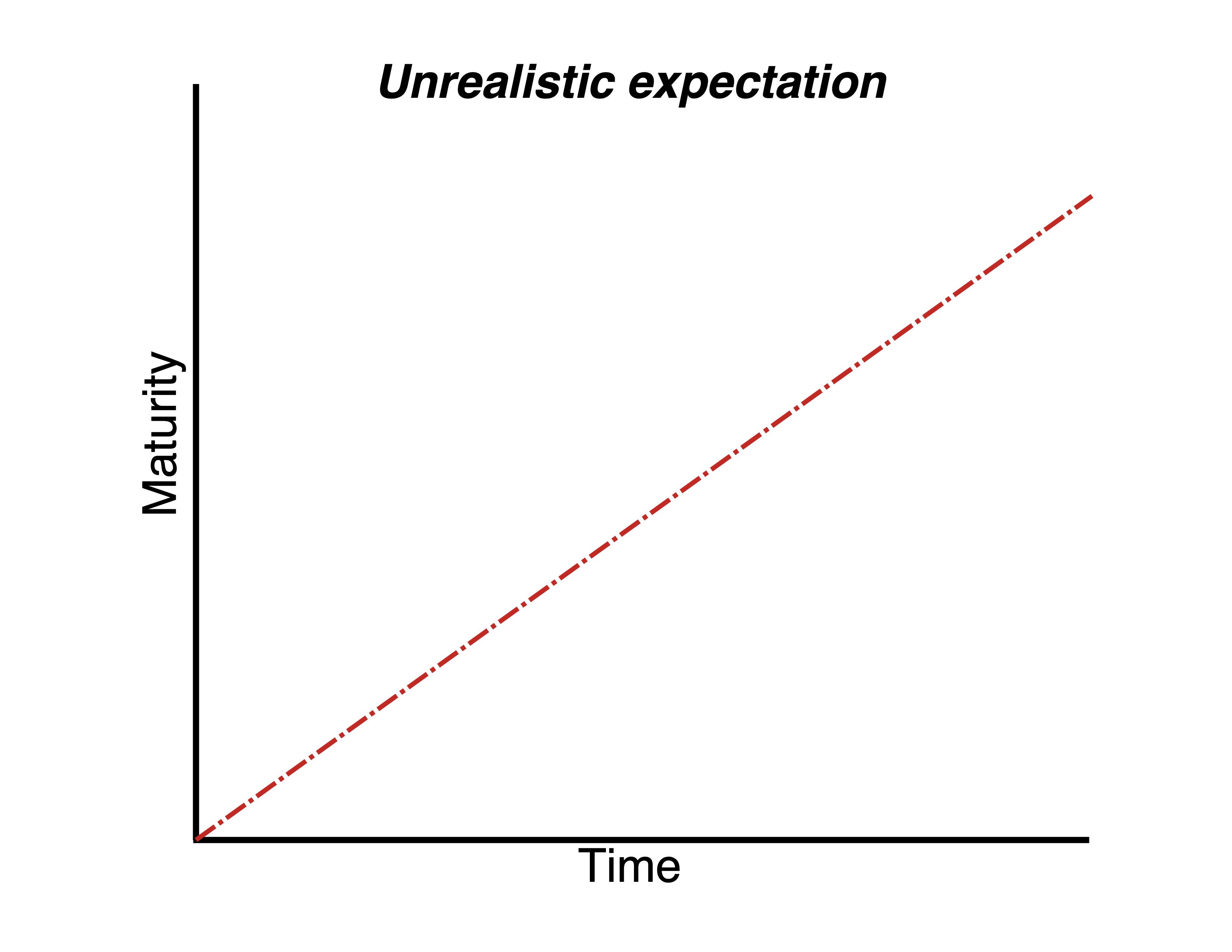
Many people mistakenly think that their growth in spiritual maturity should be a steady, unbroken climb. They think that the line on the “spiritual growth graph” should always move upward and to the right. This is not only an inaccurate view, but an unhealthy view as well. It simply isn’t possible.

In reality, our growth looks more like a staircase. There are times of growth, times of relapse, and times of plateau. Growth and relapse we usually understand, but many of us have a hard time with the “blank spaces” when we don’t feel anything going on one way or the other. But God purposely gives us these flat times.

I’ve learned that these God-given plateaus are for two things:

  1. Assimilating what we have learned <or>
  2. Preparing for the next upward climb

So don’t get frustrated by the plateaus, for they are, as Chambers say, one of the greatest mercies God gives us.

►► Would you please prayerfully consider supporting this ministry? My Patreon supporters get behind-the-scenes access to exclusive materials. ◀︎◀︎

The Pastor & Prayer

E.M. BoundsMy fellow pastor, please consider these wise words from E.M. Bounds—

“No one having any knowledge of the existing facts, will deny the comparative lack of expository preaching in the pulpit effort of today. And none, we should, at least, imagine, will do other than lament the lack. Topical preaching, polemical preaching, historical preaching, and other forms of sermonic output have, one supposes, their rightful and opportune uses. But expository preaching—the prayerful expounding of the Word of God is preaching that is preaching—pulpit effort par excellence. For its successful accomplishment, however, a preacher needs must be a man of prayer. For every hour spent in his study-chair, he will have to spend two upon his knees.”

I believe God will be honored if we spend twice as much time praying our sermons as we do preparing our sermons. 

Insights From Oswald Chambers On Sermon Preparation

When Oswald Chambers taught at the Bible Training College in London, he frequently presented his lectures in a short, bullet-point format to give his students something to ponder.

Here are some of the “bullet points” he shared for sermon preparation:

“The greatest thing is not to hunt for texts, but to live in the big comprehensive truth of the Bible and the texts will hunt you.”

“To talk about ‘getting a message,’ is a mistake. It is preparation of myself that is required more than of my message.”

“To develop your expression in public you must do a vast amount of writing in private. Write out your problems before God. Go directly to Him about everything.”

“The work we do in preparation is meant to get our minds into such order that they are the service of God for His inspiration.”

“Conscious inspiration is mercifully rare or we would make inspiration our god.”

“Spiritual insight is in accordance with the development of heart-purity.”

“Spiritual sloth must be the greatest grief to the Holy Ghost.”

“In order to expound a passage, live in it well beforehand. Keep yourself full with reading. Reading gives you a vocabulary. Don’t read to remember; read to realize.”

“Get moved by your message, and it will move others in a corresponding way.”

I found these very thought-provoking. What did you learn?

Preparing The Preacher

A friend of mine was preparing to preach his first sermon at a new church, and he was (as anyone might understand) nervous. He had all sorts of concerns: Is this the right word for this congregation? Will my thoughts make sense to them? Have I prepared enough for this message?

It was that last question that jogged my memory of a quote I had read from Oswald Chambers in his book Approved Unto God. The title of that book comes from a passage a Scripture in which preachers are told to correctly handle the Word of God as a worker that is approved unto God (2 Timothy 2:15).

Check out this pearl of wisdom:

“Keep yourself full to the brim in reading; but remember that the first great Resource is the Holy Spirit Who lays at your disposal the Word of God. The thing to prepare is not the sermon, but the preacher.” —Oswald Chambers (my emphasis)

God doesn’t need His Word prepared—it’s already perfect. But He does need to prepare me to deliver the message. He needs to remove my opinions, my preconceived ideas, my hang-ups with that particular passage, my hesitation to share it.

The Holy Spirit of God needs to prepare me. And I need to let Him do it.

It’s a heavy, awesome responsibility to be “the one” sharing God’s Word to a group of precious people. I dare not even attempt it unless I have let the Spirit prepare me first.

Sharp Enough?

Long before Stephen Covey wrote about Habit 7: Sharpening The Saw, Solomon saw the value of taking time to sharpen the saw.

Using a dull ax requires great strength, so sharpen the blade. That’s the value of wisdom; it helps you succeed. (Ecclesiastes 10:10)

What are you doing TODAY to gain wisdom?

J. Wilbur Chapman asked F.B. Meyer, “What is the matter with me? So many times I fail, so many times I am powerless.”

Dr. Meyer responded, “Have you ever tried breathing out three times without breathing in once?”

What are you doing TODAY to breathe in?

Look at the mower in the summer’s day, with so much to cut down ere the sun sets. He pauses in his labor—is he a sluggard? He looks for his stone, and begins to draw it up and down his scythe, with rink-atink, rink-atink, rink-atink. Is that idle music—is he wasting precious moments? How much he might have mowed while he has been ringing out those notes on his scythe! But he is sharpening his tool. And he will do far more when once again he gives his strength to those long sweeps which lay the grass prostrate in rows before him. —Charles Spurgeon

What are you doing TODAY to sharpen yourself?

Taking A Rest

“This Sabbath is then kept holy unto the Lord, when men, after a due preparing of their hearts, and ordering of their common affairs beforehand, do not only observe an holy rest all the day from their own works, words, and thoughts about their worldly employments and recreations; but also are taken up the whole time in the public and private exercises of his worship, and in the duties of necessity and mercy.” —Westminster Confession

“A holy rest” is usually a hard concept to grasp. When we rest we often feel one of two things:

  • There is something I should be doing <or>
  • I’m just lazy!

But rest is not the same thing as inactivity.

Rest is really different activity—rest is preparation for activity. The rabbis teach that a day of rest is supposed to be a day of distinction: a day that’s so different from the other six days of the week. Creating this day of distinction requires a lot of serious thought to prepare (“a due preparing of their hearts,” as the Confession says).

We need to take time to be OFF. You and I are not wired to be ON all the time. So as you contemplate a Sabbath day of rest for your life, think about this:

I’m going to be OFF tomorrow, so that I can be better ON to start the week.

Read the rest of this entry »