MVP: Most Valuable Praise

Listen to the podcast of this post by clicking on the player below, and you can also subscribe on AppleSpotify, or Audible. 

In preparing for our Be Thankful series at my church, I have been reading and studying quite a bit about gratitude. For example, my wife and I are reading a devotional on the YouVersion Bible app call “Practicing Gratitude.” 

The other morning, our devotional writer shared this thought: “When the prophet Jonah was having a terrible day at work, he found gratitude by looking at God’s provision through the physical environment. God made a bush for shade and ‘Jonah was very happy about the bush’ (Jonah 4:6).” 

In our shared notes, my wife had an insightful word. She wrote, “Jonah’s gratitude didn’t last long. This is a great reminder to pursue a lifestyle of gratitude. It is sometimes very challenging in the midst of hard days to recognize God’s blessings, but it forces me to take my eyes off myself and place them back on my Lord and Savior!” 

My studies, this devotional plan, and Betsy’s insight got me thinking even more about the most valuable praise we can offer to our God. 

Jonah was indeed happy about the shade. But as soon as the shade was gone because the plant withered, he was back to his sullen complaining all over again! 

Ah, yes, poor Jonah is a microcosm of the whole Old Testament: God’s blessings are only appreciated for a moment until the complaining starts up again. 

Oh, wait! That’s still our story today. All of God’s blessings are so quickly forgotten unless we are intentionally grateful.

Especially in the hard times where it feels like our difficulties are just so unfair. 

Paul wrote, “In everything give thanks; for this is the will of God for you in Christ Jesus” (1 Thessalonians 5:18). 

In everything” is not the same thing as “for everything.” This means that I can still be God-focused in my painful circumstances, even though I may not be thankful for those circumstances. 

But as I remain thankfully God-focused, perhaps I may begin to see what He is accomplishing because of my painful circumstances. Just as Jesus saw “the joy set before Him” (Hebrews 12:2) and knew that His Father would triumph even in that horrific time, perhaps as I keep my eyes on Jesus I can begin to get a glimpse of God’s coming glory. 

Isn’t it “the will of God” that I know—beyond a shadow of a doubt—that I am irremovable from my position “in Christ Jesus”? 

For I am convinced that neither death, nor life, nor angels, nor principalities, nor things present, nor things to come, nor powers, nor height, nor depth, nor any other created thing will be able to separate us from the love of God that is IN Christ Jesus our Lord. (Romans 8:38-39 NASB)

Shouldn’t my assurance of that truth produce a joy that prompts praise from my lips that brings glory to God? Isn’t that praise of greater value precisely because it comes from a person in a setting where thankfulness seems impossible? 

God is magnified even more when praise comes from a thankful heart that is in a place where humanly there seems to be absolutely nothing praiseworthy. 

It is in this place that my praise is to God simply because He is God and He is worthy to be praised simply because of who He is! 

So I will praise Him no matter what—“in all things”—because I am secure that I am “in Christ Jesus.” That hope produces a reward that is invaluable. That hope produces a praise that is beautiful in God’s ears. 

…And we boast IN the hope of the glory of God. Not only so, but we also glory IN our sufferings, because we know that suffering produces perseverance; perseverance, character; and character, hope. And hope does not put us to shame, because God’s love has been poured out INTO our hearts through the Holy Spirit, who has been given to us. (Romans 5:2-5) 

We give God our MVP—our most valuable praise—when it is lifted to Him in that place and time where the natural response would be grumbling and complaining. In those moments, remind yourself that you are IN Christ Jesus, which means even here in this dark moment you can be thankful IN all things. 

(You may also be interested in my post and video Praising God in the Troughs.) 

►► Would you please prayerfully consider supporting this ministry? My Patreon supporters get behind-the-scenes access to exclusive materials. ◀︎◀︎

Save Your Breath

Listen to the podcast of this post by clicking on the player below, and you can also subscribe on AppleSpotify, or Audible.

I know you want to lash out against those evil people who come at you—just to say something that will “put them in their place.” 

I get it. I feel like that at times too. 

But pause. 

Think about the last rain storm that came your way. The rain beat down on your roof and the wind blew against the walls of your house. You knew that there was no reason to yell at the rain because you were safe in your house. You also knew that yelling at the wind and the rain wouldn’t do a thing to it. 

Isaiah describes the breath of ruthless, wicked people as “a rain storm against a wall.” The wicked may rain on you, but you have an unshakable house.

Recall the words of Jesus—

Therefore everyone who hears these words of Mine and acts on them, may be compared to a wise man who built his house on the rock. And the rain fell, and the floods came, and the winds blew and slammed against that house; and yet it did not fall, for it had been founded on the rock. (Matthew 7:24-25)

When you abide in Jesus—when His words are the foundation of your life—you are safe and secure. There is no reason to fret about the breath of the ruthless, there is no reason to lash out at them. In fact, there might not be any reason to speak to them at all.

The stormy breath of the wicked will eventually give out. Their power has a limit. But you are secure inside the Limitless One, the Omnipotent One! The One who is eternal will never run out of strength and love for you. 

Let the evildoers rage, but you can save your breath. Instead of using your breath to respond to their howling words, use your breath to praise the One who holds you securely forever!

►► Would you please prayerfully consider supporting this ministry? My Patreon supporters get behind-the-scenes access to exclusive materials. ◀︎◀︎
Magnifying God

Listen to the podcast of this post by clicking on the player below, and you can also subscribe on AppleSpotify, or Audible.

No one likes to be around a complainer! 

Complainers, ironically, find things wrong everywhere else but with themselves. Complainers know how everyone else should raise their kids, run their businesses, operate their government, lead their sports teams to victory, but they seldom apply their so-called wisdom to their own lives. Complainers find the one thing that’s wrong in an otherwise perfect situation.   

Complaining is easy because it comes so naturally. What do I mean by that? Take a look at the magazine covers at your grocery store—do they have good news or complaints? Take a look at the lead news stories—are they celebrations or complaints? Those magazines want to sell copies. Those news stations want viewers. Those websites want clicks. They wouldn’t promote the complaints if they didn’t get them the attention (and the advertising revenue) they desire! 

Let me see a show of hands on this: How many of you want to be around complainers? 

I noticed no one raised their hand, so I need to ask a follow-up question: Why do you complain? If you don’t like to be around a complainer, why do you do what others obviously don’t like either? 

I think we complain because we think our situation is unique—no one has experienced anything quite like what we’re going through. We often make a list to “prove” to everyone that we have earned the right to complain. This is what Job did. Check out his list in Job 7:1-11, and then notice his conclusion where he says, “Therefore I will not keep silent; I will speak out in the anguish of my spirit, I will complain in the bitterness of my soul.” 

But we need to be careful because the Bible makes it clear that complainers make God angry (see Numbers 11:1; 1 Corinthians 10:10-11). Why? I think there are two reasons. 

First, I think God gets angry about complaints because of how quickly they spread to everyone around them—like cancer cells they destroy the whole body. 

Second, complainers take everyone’s eyes off God and point their attention to the lousy situation about which they are complaining. 

On the other hand, grateful people stand out because they can find the one thing worthwhile in an otherwise lousy situation. Being a grateful person takes discipline to overcome the downward pull of everyone else’s complaints. 

Paul wrote a letter to the church at Philippi that is bursting with thankfulness! We only have to get three verses in when he says, “I thank my God every time I remember you” (Philippians 1:3). 

Paul stood out because of his great attitude of gratitude. Consider what happened the very first time he visited the city of Philippi. He and Silas were wrongly accused, beaten, and locked in prison. Paul didn’t start a petition, he didn’t give the jailer a bad review on Yelp, he didn’t organize a rally, he didn’t call the Roman governor. Instead, Paul and Silas were praying and singing hymns to God while the other prisoners listened in (Acts 16:16-25). 

In a lousy, unfair, dark situation, Gratitude says, “God is still God, and He is still worthy of abundant praise!” 

So in the middle of his letter to the Philippians, Paul instructs these Christians to: Do all things without murmurings and disputings (Philippians 2:14 KJV). Murmurings are the vocalizing of the faults we have found. Disputings, though, are internal. In the Greek, this word almost always refers to complaining and grumbling thoughts, and many times it’s translated as “evil thoughts.” 

When the complaining comes out of our mouths, that is just the ugly weed. The root of that complaint is in our hearts. We don’t need a vocabulary change, we need a heart change. 

When we praise God, we magnify Him. That doesn’t make God bigger because He is infinite. But it does put a “telescope” on Him. Telescopes bypass everything that is close by and focus on something majestic. Our praise—like Paul and Silas’ song from prison—invites others to look through our telescope to see the God we are magnifying. 

Gratitude can start with one person, and then it can spread. Gratitude can counteract the cancerous complaints. Will you be that one grateful person at this Thanksgiving season and beyond? Will you be the one that says, “No matter what, God is still God, and He is still worthy of abundant praise”? Will you be that one that sings praise at the exact moment everyone else expects complaints? If you do, your gratitude will entice others to want to worship this all-good God too! 

Follow along with all of the messages in our series called The Great Attitude Of Gratitude by clicking here. 

►► Would you please prayerfully consider supporting this ministry? My Patreon supporters get behind-the-scenes access to exclusive materials. ◀︎◀︎

Thursdays With Spurgeon—Bragging About God

This is a weekly series with things I’m reading and pondering from Charles Spurgeon. You can read the original seed thought here, or type “Thursdays With Spurgeon” in the search box to read more entries.

Listen to the podcast of this post by clicking on the player below, and you can also subscribe on AppleSpotify, or Audible. 

Bragging About God

I will extol the Lord at all times; His praise will always be on my lips. I will glory in the Lord; let the afflicted hear and rejoice. Glorify the Lord with me; let us exalt His name together. (Psalm 34:1-3)

     Boasting is a very natural propensity, and if it were used as in this case, the more it were indulged the better. The exultation of this verse is no mere tongue bragging; the soul is in it, and the boasting is meant and felt before it is expressed. 

     What scope there is for holy boasting in Jehovah! His Person, attributes, covenant, promises, works, and a thousand things besides are all incomparable, unparalleled, matchless; we may cry them up as we please, but we shall never be convicted of vain and empty speech in so doing.

From Spurgeon And The Psalms

What is even more remarkable about the praise David offers up in this psalm is the setting. The introduction to the psalm tells us it is while David is running from Saul and trapped in a Philistine stronghold. 

And yet David still chooses to praise God.

It is a choice of his will. David didn’t wait until he felt like praising God, or until his circumstances were improved. We are more likely to act ourselves into feeling than we are to feel ourselves into action. So David says, “I will extol the Lord … His praise will be on my lips.” 

This bragging about God—when from a human standpoint there appears to be nothing to brag about—becomes a testimony. David’s personal pronouns “I” and “my” quickly turn into the plural pronoun “us” as David invites others to ponder the beauty of Jehovah! “Glorify the Lord with me; let us exalt His name together. 

Our bragging about God, especially in the face of difficult circumstances, is a powerful testimony that will draw others to Him. You may start out praising Him on your own, but it won’t be long until others join your worship chorus. 

Friends, your praising and bragging about God is more powerful than you may realize. When God is worshipped, He is lifted up for all to see, so keep on bragging about Him!

►► Would you please prayerfully consider supporting this ministry? My Patreon supporters get behind-the-scenes access to exclusive materials. ◀︎◀︎

Thursdays With Spurgeon—New Songs Everyday

This is a weekly series with things I’m reading and pondering from Charles Spurgeon. You can read the original seed thought here, or type “Thursdays With Spurgeon” in the search box to read more entries.

Listen to the podcast of this post by clicking on the player below, and you can also subscribe on AppleSpotify, or Audible. 

New Songs Everyday

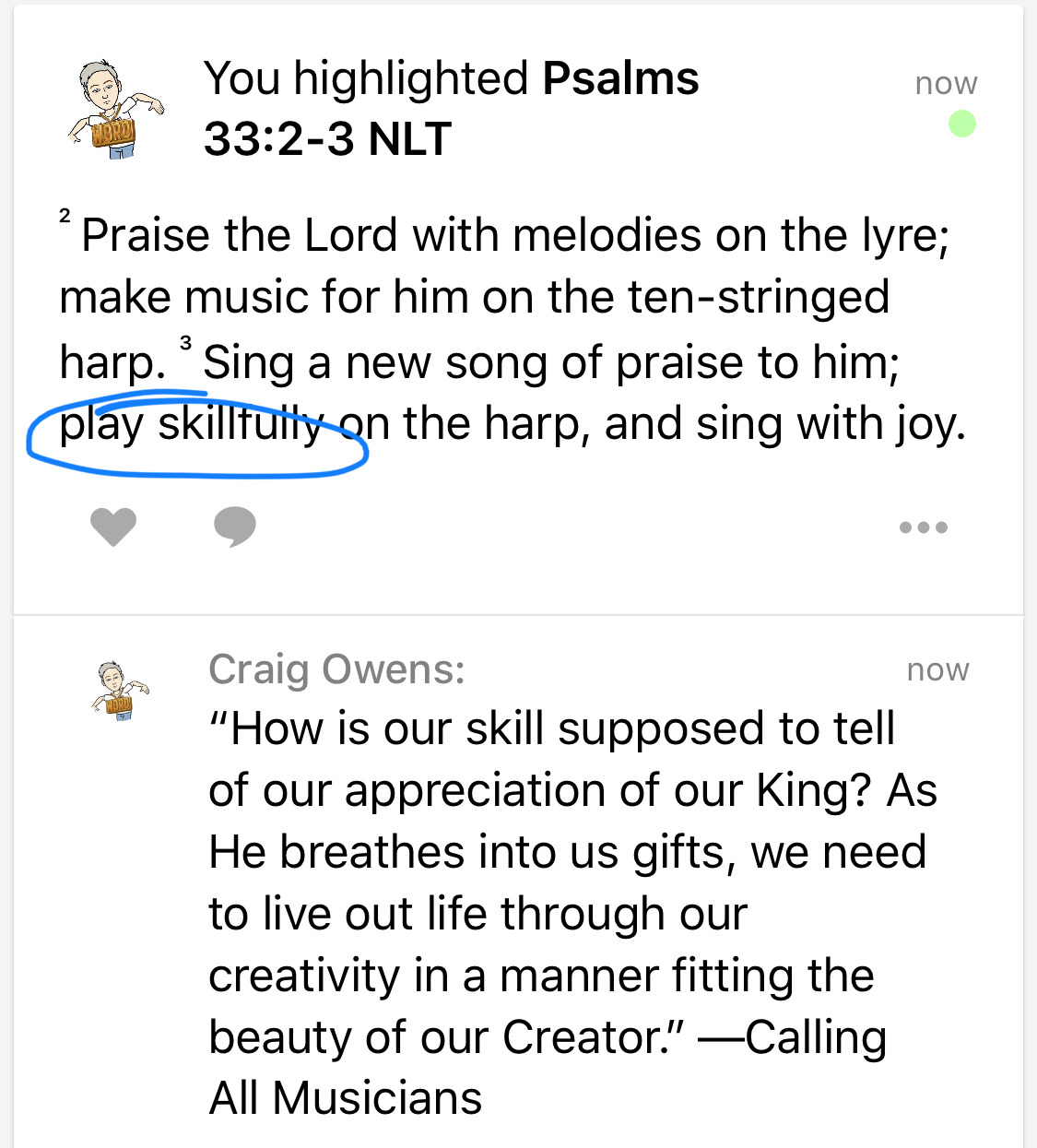
Sing joyfully to the Lord, you righteous; it is fitting for the upright to praise Him. Praise the Lord with the harp; make music to Him on the ten-stringed lyre. Sing to Him a new song; play skillfully, and shout for joy. (Psalm 33:1-3)

     To keep up the freshness of worship is a great thing, and in private, it is indispensable. Let us not present old, worn-out praise but put life and soul and heart into every song, since we have new mercies everyday and see new beauties in the work and Word of our Lord. 

     It is wretched to hear God praised in a slovenly manner. He deserves the best we have. All Christians should endeavor to sing according to the rules of the art so that they may keep time in tune with the congregation. The sweetest tunes, and the sweetest voices, with the sweetest words, are all too little for the Lord our God; let us not offer Him limping rhymes, set to harsh tunes, and growled out by discordant voices.

From Spurgeon And The Psalms

Imagine if I told my wife something like this—

Every Thursday night is going to be our date night. I’m going to plan something special, dress up in some nice clothes, and be totally tuned in to your needs. I’m going to listen to everything you have to say to me, express my unending love to you, ask forgiveness for areas I may have messed up that week, and then endeavor to put into practice everything you tell me that you would like. 

I promise I’ll be there every Thursday. 

The other days of the week, I’ll think about you every once in a while—especially if I need something—but other than that I’ll be doing my own thing. 

How rich and meaningful would you expect that relationship to be? 

Sadly, this is how many people who call themselves Christians view their relationship with Jesus. They put on nice clothes every Sunday, show up at church, sing some songs, listen to a sermon, repent of sins, and promise to live a better life in this new week. But after they leave their church service, they seldom give their Savior another thought—unless they get themselves into trouble where they really need a Savior’s immediate help. 

In Psalm 33, the psalmist is calling us to—as Spurgeon puts it—“freshness in worship” not just in a public worship service, but in private worship at every moment of every day. Our God is continually revealing Himself to us in new and fresh ways, so our worship should be equally as fresh, vibrant, and passionate—both planned times of worship and spontaneous songs of praise. 

Both our relationship with God and with our loved ones will go to new levels of intimacy when we seek to know the other one more deeply. Our God is worthy of the very best praise we can give Him, which means we will always be finding new ways to sing our worship to Him every single day.

►► Would you please prayerfully consider supporting this ministry? My Patreon supporters get behind-the-scenes access to exclusive materials. ◀︎◀︎
Poetry Saturday—All People That On Earth Do Dwell

Listen to the podcast of this post by clicking on the player below, and you can also subscribe on AppleSpotify, or Audible.

All people that on earth do dwell,
sing to the Lord with cheerful voice;
Him serve with fear, His praise forth tell,
come ye before Him and rejoice.

The Lord ye know is God indeed;
without our aid He did us make;
we are His folk, He doth us feed,
and for His sheep He doth us take.

O enter then His gates with praise,
approach with joy His courts unto;
praise, laud, and bless His name always,
for it is seemly so to do.

For why? The Lord our God is good,
His mercy is forever sure;
His truth at all times firmly stood,
and shall from age to age endure. —William Kethe

►► Would you please prayerfully consider supporting this ministry? My Patreon supporters get behind-the-scenes access to exclusive materials. ◀︎◀︎

Poetry Saturday—Praise II

Listen to the podcast of this post by clicking on the player below, and you can also subscribe on AppleSpotify, or Audible.

King of Glorie, King of Peace,
      I will love Thee:
And that love may never cease,
      I will move Thee.

Thou hast granted my request,
      Thou hast heard me:
Thou didst note my working breast,
      Thou hast spar’d me.

Wherefore with my utmost art
      I will sing Thee,
And the cream of all my heart
      I will bring Thee.

Though my sinnes against me cried,
      Thou didst cleare me;
And alone, when they replied,
      Thou didst heare me.

Sev’n whole dayes, not one in seven,
      I will praise Thee.
In my heart, though not in heaven,
      I can raise Thee.

Thou grew’st soft and moist with tears,
      Thou relentedst:
And when Justice call’d for fears,
      Thou disentedst.

Small it is, in this poore sort
      To enroll Thee:
Ev’n eternitie is too short
      To extoll thee. —George Herbert (**spelling is 1663 English**)

►► Would you please prayerfully consider supporting this ministry? My Patreon supporters get behind-the-scenes access to exclusive materials. ◀︎◀︎

The Incomparable Jesus

Listen to the podcast of this post by clicking on the player below, and you can also subscribe on AppleSpotify, or Audible. 

C.S. Lewis, like many atheists, wondered if the God of the Bible might be an egomaniac because He is always encouraging people to praise Him. In his book Reflections on the Psalms, Lewis wrote a thoughtful response to this after he had become a Christian: 

“Just as men spontaneously praise whatever they value, so they spontaneously urge us to join them in praising it. ‘Isn’t she lovely? Wasn’t it glorious? Don’t you think that magnificent?’ … I think we delight to praise what we enjoy because the praise not merely expresses but completes the enjoyment; it is its appointed consummation. It is not out of compliment that lovers keep on telling one another how beautiful they are; the delight is incomplete till it is expressed. … This is so even when our expressions are inadequate, as of course they usually are. But how if one could really and fully praise even such things to perfection—utterly ‘get out’ in poetry or music or pain the upsurge of appreciation which almost bursts you? Then indeed the object would be fully appreciated and our delight would have attained perfect development. The worthier the object, the more intense this delight would be.” 

His phrase, “our expressions are inadequate” is especially true when we are attempting to appreciate and praise the Infinite, the Eternal, the Omnipresence, the Omnipotence of our God and Savior! But the biblical authors call for Christians to mature in this—we want to keep praising, keep expressing, until we finally find the perfect fulfillment in His presence. 

Paul talks about the maturing nature of love—when I was a child, I talked like a child, I thought like a child, I reasoned like a child (1 Corinthians 13:11)—but then he prays for us to grow in both our understanding and our expressions of our Savior’s love (Ephesians 1:17-19). 

I like the wording of Ephesians 1:19 in the King James Version: the exceeding greatness of His power to us-ward. The word “exceeding” means God pours out in a way that is beyond human imagining. The Greek word that Paul uses for “greatness” is only used here, and it reinforces the truth that God is beyond our full comprehension. And then Paul adds that this overflowing, incomparable power is directed “to us-ward”! 

Paul then prays for us to be able to understand ever-increasing new dimensions of this transcendent power and ability that God directs to us through His Son Jesus, and for us to be able to express it (Ephesians 3:14-19). In other words, we are to grow in our experience of Jesus so that we can grow in our praise to Jesus. 

The incomparable Jesus means at least four things for us. It means Jesus is…

  1. …beyond comparison. Isaiah, God Himself, and the psalmists ask rhetorically, “Who is like God? Who could ever compare to Him?” (Isaiah 40:13-14, 18, 25; Psalm 89:5-8).  
  1. …matchless in His power. Isaiah 40:12 says God holds the waters of the world in the hollow of His hand. How much water is this? Scientists estimate the Earth’s water supply to be 326 quintillion gallons of water (that’s 326 followed by 18 zeros)! Not only does God hold all of the water, but He directs its activities on behalf of His children (Exodus 15:11-13). 
  1. …unequaled in knowledge. Isaiah 40:12, 26 tell us that all of the stars in our universe fit onto God’s outstretched hand, and that He knows all of the stars by name. How many stars is this? Astronomers calculate the heavens to contain 10 septillion stars (that’s 10 followed by 24 zeros)! Not only does God know each star by name, He knows each human by name, and the smallest of details about each of them (Isaiah 49:16; Matthew 10:29-31). 
  1. …inimitable in His care. We humans can get to the end of our strength, but God never does. He cares for us unlike anyone else or anything else ever can (Isaiah 40:28-31). The Lord hears His people when they call to Him for help. He rescues them from all their troubles (Psalm 34:17). 

Knowing we have a Savior like this, why would you ever settle for anything less The Genuine?! 

Our incomparable Jesus wants us to pray in His incomparable name so that our incomparable Father can answer in a way that brings Him incomparable glory! We’re helped, He’s lifted up, and others are drawn to Him. 

►► Would you please prayerfully consider supporting this ministry? My Patreon supporters get behind-the-scenes access to exclusive materials. ◀︎◀︎
If you’ve missed any of the messages in this series on prayer, you can find a list of all of the messages by clicking here. 

Poetry Saturday—All For Jesus

Listen to the podcast of this post by clicking on the player below, and you can also subscribe on AppleSpotify, or Audible.

All for Jesus! All for Jesus!
All my being’s ransomed power;
All my thoughts and words and doings;
All my days and all my hours.

Let my hands perform His bidding;
Let my feet run in His ways;
Let mine eyes see Jesus only;
Let my lips speak forth His praise.

Worldlings prize their gems of beauty,
Cling to gilded toys of dust;
Boast of wealth, and fame, and pleasure;
Only Jesus will I trust.

Since mine eyes were fixed on Jesus,
I’ve lost sight of all beside—
So enchained my spirit’s vision,
Looking at the Crucified.

Oh what wonder! How amazing!
Jesus, glorious King of kings,
Deigns to call me His beloved,
Lets me rest beneath His wings. —Mary Dagworthy James

►► Would you please prayerfully consider supporting this ministry? ◀︎◀︎

Hope-Fueled Praise

Listen to the podcast of this post by clicking on the player below, and you can also subscribe on Apple or Spotify.

Do not be far from me, my God; come quickly, God, to help me. (Psalm 71:12) 

This is the middle verse of this psalm and the heart of this psalm’s message. This verse speaks not only of God’s omnipresence and His omnipotence, but it also speaks of a lifelong, increasing awareness of His presence and power. 

What a blessing to know that I have a sure Rock to which I can always go (v. 3), and a Savior whom I have had as my confidence since my youth (v. 5). This hopeful assurance causes me to praise God—the more I hope, the more I praise. As a result, my praise grows from an occasional response, to a daily practice, to a moment-by-moment lifestyle. 

Listen to these words from the psalmist: 

  • I will ever praise You
  • my mouth is filled with Your praise, declaring Your splendor all day long 
  • I will always have hope; I will praise You more and more 
  • my mouth will tell of Your righteousness, of Your salvation all day long 
  • I declare Your marvelous deeds 
  • my tongue will tell of Your righteous acts all day long

My hope fuels my praise. My praise strengthens my hope. The more I realize hope, the more I praise God, and the more I praise God, the more hope-filled I become! 

My friend, there are more reasons to praise God than you can possibly count but go ahead and start counting them anyway. As the words of the old hymn remind us, “Count your blessings, name them one by one … and it will surprise you what the Lord has done.” 

May our tongues be continually telling of God’s blessings, and may our praise be continually filling us with renewed hopefulness of His future blessings! 

►► Would you please prayerfully consider supporting this ministry? ◀︎◀︎