8 Quotes From “Secret Power”

D.L. Moody’s book Secret Power is addressed to both individual Christians and church leaders (you can read my full book review by clicking here).

Here are eight quotes for Christians to consider.

“Joy is love exulting; peace is love in repose; long suffering is love on trial; gentleness is love in society; goodness is love in action; faith is love on the battlefield; meekness is love at school; and temperance is love in training.”

“Before we pray that God would fill us, I believe we ought to pray Him to empty us.”

“The reason why the Church cannot overcome the enemy is, because she doesn’t know how to use the sword of the Spirit. People will get up and try to fight the devil with their experiences, but he doesn’t care for that, he will overcome them every time. People are trying to fight the devil with theories and pet ideas, but he will get the victory over them likewise. What we want is to draw the sword of the Spirit. It is that which cuts deeper than anything else. …The sword of the Spirit is the Word of God, and what we need specially is to be filled with the Spirit, so we shall know how to use the Word.”

“The fact is, we are leaky vessels, and we have to keep right under the fountain all the time to keep full of Christ, and so have a fresh supply.”

“The Holy Spirit tells a man of his faults in order to lead him to a better life. In John 16:8, we read: ‘He is to reprove the world of sin.’ Now, there are a class of people who don’t like this part of the Spirit’s work. Do you know why? Because He convicts them of sin; they don’t like that. What they want is some one to speak comforting words and make everything pleasant; keep everything all quiet; tell them there is peace when there is war; tell them it is light when it is dark, and tell them everything is growing better; that the world is getting on amazingly in goodness; that it is growing better all the time; that is the kind of preaching they seek for. …It is my work to preach and hold up the Cross and testify of Christ; but it is His work to convict men of sin and lead them to Christ.”

“I think there is no way so sure to win our families and our neighbors, and those about whom we are anxious, to Christ, than just to adorn the doctrine of Jesus Christ in our lives, and grow in all these graces. If we have peace and joy and love and gentleness and goodness and temperance; not only being temperate in what we drink, but in what we eat, and temperate in our language, guarded in our expressions; if we just live in our homes as the Lord would have us, an even Christian life day by day, we shall have a quiet and silent power proceeding from us, that will constrain them to believe on the Lord Jesus Christ. But an uneven life, hot today and cold tomorrow, will only repel. Many are watching God’s people.”

“Love will rebuke evil, but will not rejoice in it. Love will be impatient of sin, but patient with the sinner. To form the habit of finding fault constantly, is very damaging to spiritual life; it is about the lowest and meanest position that a man can take.”

“Oh, the privilege, the blessed privilege, to be used of God to win a soul to Christ, and to see a man or woman being led out of bondage by some act of ours toward them. To think that God should condescend to allow us to be co-workers with Him. It is the highest honor we can wear.”

(You may also be interested in quotes from this book that are especially for pastors and church leaders, which you can read by clicking here.)

Secret Power (book review)

Dwight L. Moody is my kind of pastor: he said exactly what was on his mind. He wasn’t worried about political correctness, or couching his words in comfortable words. He was a modern-day prophet of his day, clearly stating, “Thus says the Lord!” Thankfully for us in our day, D.L. Moody’s books sound just like his sermons. In Secret Power, Moody calls Christians and churches back to a fuller understanding of the role of the Holy Spirit in our lives.

Moody writes:

“How much we have dishonored Him [the Holy Spirit] in the past! How ignorant of His grace, and love and presence we have been? True, we have heard of Him and read of Him, but we have had little intelligent knowledge of His attributes, His offices and His relations to us. I fear He has not been to many professed Christians an actual existence, nor is He known to them as a personality of the Godhead.”

I am convinced that this is true. The Holy Spirit seems “spooky” or out-of-date or inapplicable in many churches. Moody explains this is the reason why our churches are not experiencing the same miracle-working power that was seen in the New Testament church.

As a result, individual Christians are lacking in power in their personal lives, too, because they are not being taught about the role of the Holy Spirit in their churches. As a result, Christians are not soul winners as were New Testament Christians.

A secondary title for this book is “The Secret Of Success In Christian Life And Work.” That success can be yours today if you will only allow God to operate in your life and church in all of His fullness. 

If you are thirsty for this sort of fuller relationship with the Holy Spirit, I encourage you to read this book! You may also want to check out some quotes I shared from this book here and here.

God’s Truth, Not Your Comfort

Some time ago I was asked to speak in a church setting outside of my church. The audience was a blend of people from all different church backgrounds, and perhaps even some without any church background. I talked about the hopelessness of trying to pay-off our sin debt on our own, and the amazing love that Jesus showed when He paid our debt in full.

After the service, a couple of pastors in the audience wanted to speak with me about my message. They were moved by what they called “the impact” of the message, and especially about the way I called sin “sin.” As I spoke with them further, I discovered that they were somewhat hesitant to speak so openly and plainly about sin, because it unsettled some people in their congregations.

But here is the sober reality—

The Word of God IS unsettling because we cannot read it or hear it and remain unchanged.

Our job as pastors or preachers is to speak the Word. When we do, the Holy Spirit will bring the necessary conviction and pull hearts toward repentance. Here’s what Oswald Chambers wrote about this:

“When we preach, we are not simply proclaiming how people can be saved from Hell and be made moral and pure; we are conveying good news about God.

“In the teachings of Jesus Christ the element of judgment is always brought out—it is the sign of the love of God. Never sympathize with someone who finds it difficult to get to God; God is not to blame. It is not for us to figure out the reason for the difficulty, but only to present the truth of God so that the Spirit of God will reveal what is wrong. The greatest test of the quality of our preaching is whether or not it brings everyone to judgment. When the truth is preached, the Spirit of God brings each person face to face with God Himself.”

Pastor, just speak the truth. You’re not trying to win a popularity contest, but to share with people how to step into a deeper relationship with God Almighty!

One final thought from Chambers: “Never water down the truth of God. Let it have its way and never apologize for it.

What Is Successful Church Ministry?

I like to keep asking myself and my leadership team this question: How do we know if our church is successful? 

The apostle Paul uses two words to help answer these questions: Quality and Faithfulness.

But each one’s work will be shown for what it is; the Day will disclose it, because it will be revealed by fire—the fire will test the quality of each one’s work. (1 Corinthians 3:13)

Now it is required that those who have been given a trust must prove faithful. (1 Corinthians 4:2)

So here are two important questions we need to ask ourselves:

  • Am I doing quality work?
  • Am I faithfully doing my work?

To help answer those questions, I like this thought from Leonard Sweet’s book I Am A Follower:

“The most important metrics we must rely on, the crucial ‘deliverables’ we can present, must focus on the newly formed lives of the disciples we are making, the followers who are following Christ into a place of serving Him by serving others. The most important measure of our faithfulness to Christ must be the extent of transformation into the living image of Christ Himself. …

The quantifiable fruit of our church is not found in the number of people we can gather on a weekly basis. What counts is what is happening in the lives of those who have gathered. …It is quite possible to have a ‘successful’ life—and a ‘successful’ church—without God. But it is absolutely impossible to have a truly fruitful one.”

Again, Paul’s advice here is invaluable:

My conscience is clear, but that does not make me innocent. It is the Lord who judges me. Therefore judge nothing before the appointed time; wait till the Lord comes…. (1 Corinthians 4:4, 5)

Pastor, you need to think about these questions about “success.” But they should be questions framed around your quality and faithfulness of work as revealed to you by the Holy Spirit, not by some “expert” or anyone else.

(By the way, if you’re interested in exploring this further, I framed this question a different way in this post.)

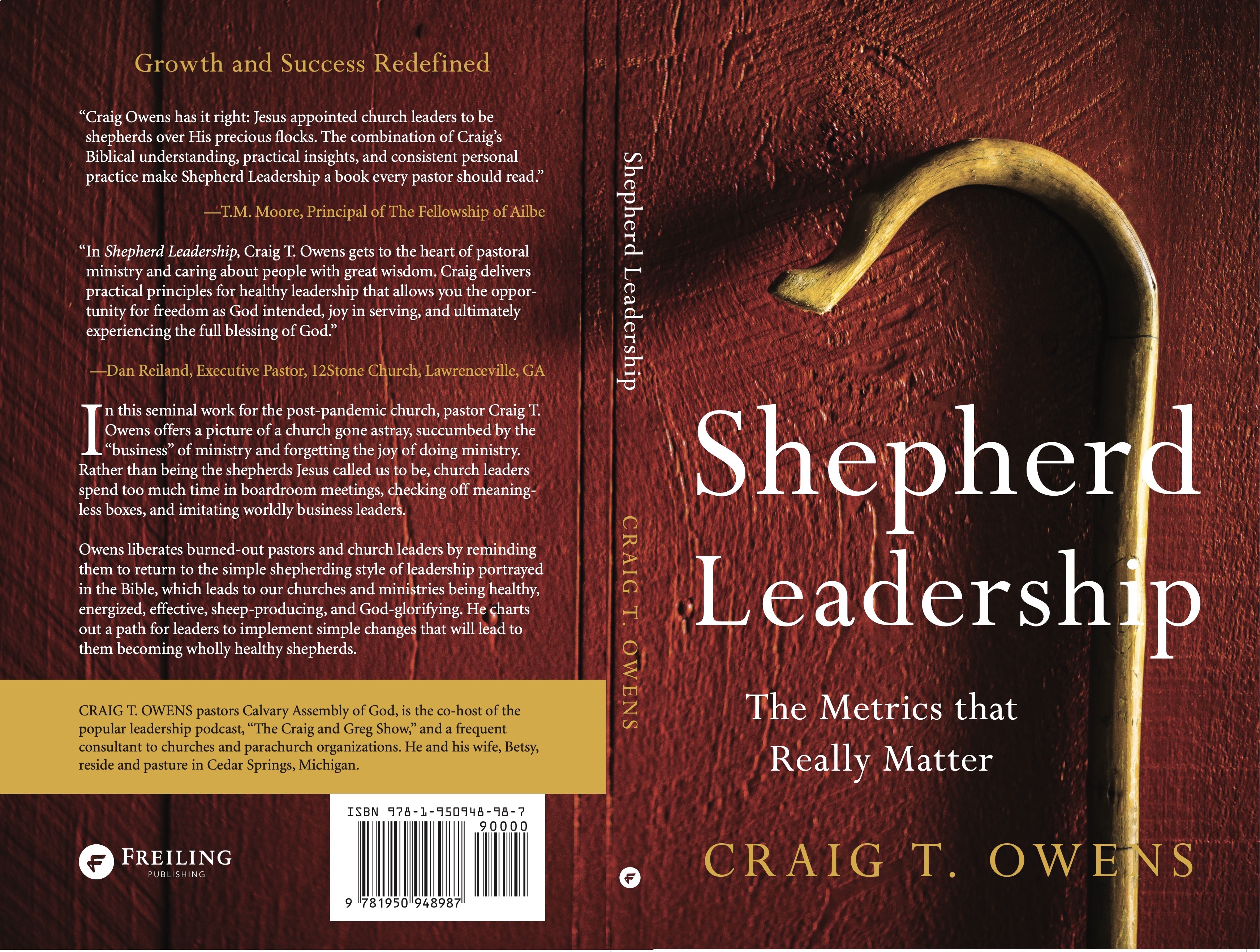
UPDATE: This post was one of the seed thoughts that went into fashioning my book Shepherd Leadership: The Metrics That Really Matter.

It’s Not Me; It’s You

Listen to the podcast of this post by clicking on the player below, and you can also subscribe on AppleSpotify, or Audible. 

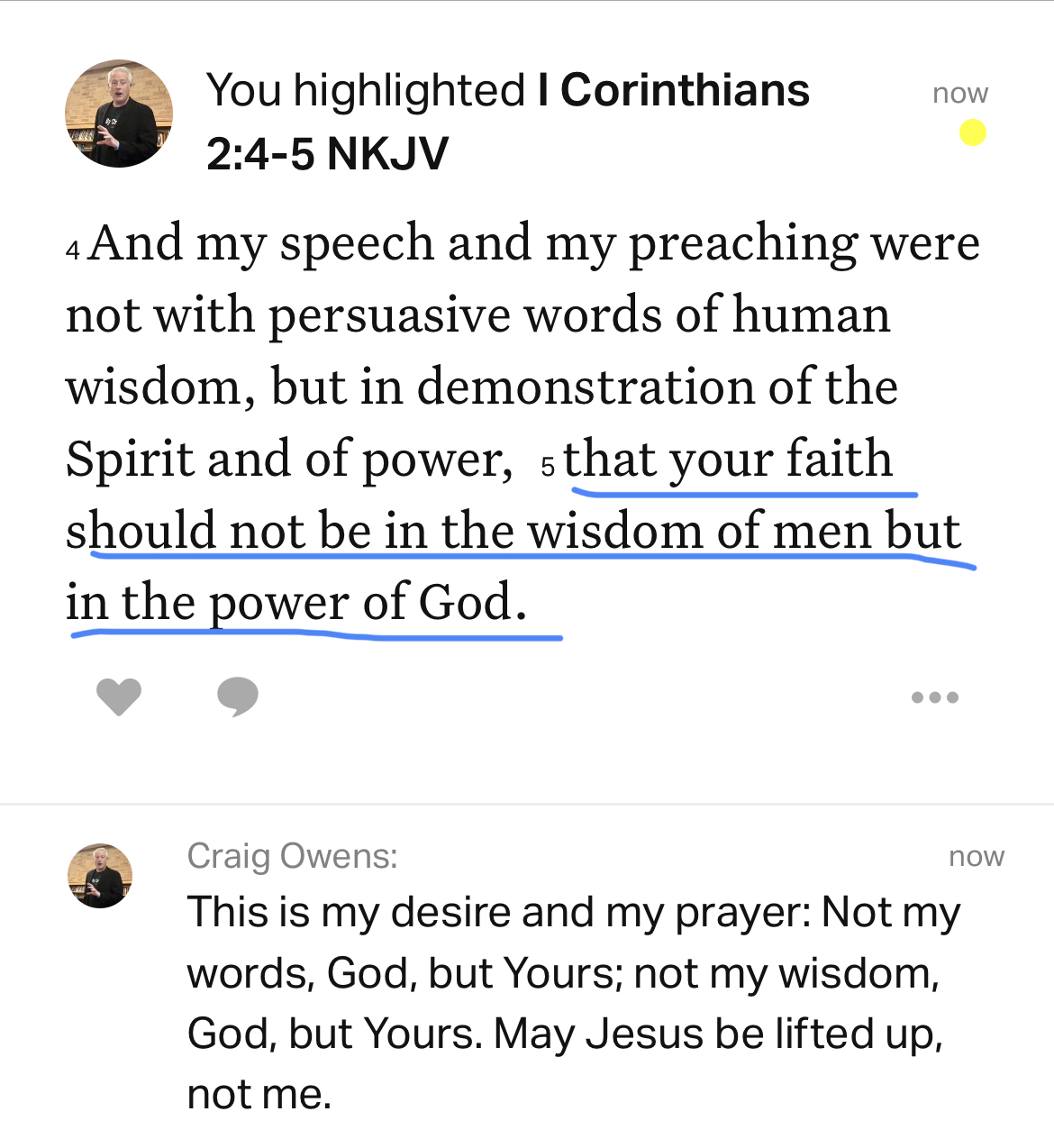
When I first came to you, dear brothers and sisters, I didn’t use lofty words and impressive wisdom to tell you God’s secret plan. For I decided that while I was with you I would forget everything except Jesus Christ, the One Who was crucified. I came to you in weakness—timid and trembling. And my message and my preaching were very plain. Rather than using clever and persuasive speeches, I relied only on the power of the Holy Spirit. I did this so you would trust not in human wisdom but in the power of God. (1 Corinthians 2:1-5)

I only want Jesus lifted up; not me.

As Your Spirit gives me words to share, may people turn to You; not me.

May anyone who hears me desire more of You; not me.

May my messages create a hunger and thirst for You; not me.

I want people to find encouragement in You; not me.

May I find my strength to minister in You; not in me.

May people only follow You; not me.

May everyone who hears me be impressed with You; not me.

It’s all about You, Jesus; not me.

►► Would you please prayerfully consider supporting this ministry? My Patreon supporters get behind-the-scenes access to exclusive materials. ◀︎◀︎

Do You LOVE Your Church?

Okay, pastors, here are some tough questions:

  • Do you love your congregation?
  • Do you think they’re some of the greatest people on earth?
  • If you didn’t pastor your church, would you attend your church?
  • Do you enjoy recreating with your church family?

This is an important principle: You cannot treat someone differently than you think about them.

Listen to what Paul said about the church in Rome:

I myself am convinced, my brothers, that you yourselves are full of goodness, complete in knowledge and competent to instruct one another. (Romans 15:14)

Do you hear what high regard Paul had for them? He told them that they were good people, growing in their relationship with Christ, and were competent to be teachers themselves!

Not only did Paul write this to them, but he bragged about them to others too:

Everyone has heard about your obedience, so I am full of joy over you. (Romans 16:19)

Pastor, Jesus called us to feed and care for His sheep. We can do this so much more effectively if we think so highly of those precious people.

I pray that you can answer a resounding, whole-hearted “YES!” to those four opening questions. I think that’s what Jesus would want.

The Hard Word

As a pastor, you are going to have to deliver the hard word from time to time. You will have to address touchy subjects, both corporately and privately. It is very instructive to see how the apostle Paul approached the hard word.

In Romans 9, Paul is getting ready to address one of the most sensitive subjects of his day. The Jews felt they were “in” with God just because they were Jews, and the Gentiles were “out” with God just because they weren’t Jews. Paul is going to have to deliver the word that both Jews and Gentiles can be accepted by God because of what Jesus did on the Cross.

So notice how he begins:

I speak the truth in Christ—I am not lying, my conscience confirms it in the Holy Spirit—I have great sorrow and unceasing anguish in my heart.

1. I speak the truth in Christ. It wasn’t his opinion, but the word from God. I must settle this matter before delivering the hard word. Far too often we can put our preferences on par with God’s Word. I cannot do this!

2. My conscience confirms it in the Holy Spirit. Before I speak a hard word that people may not like to hear, I need to make sure my conscience is right before the Holy Spirit. He alone confirms His Word. The reaction of the audience, however, may or may not confirm what God says.

3. I have great sorrow and unceasing anguish in my heart. It should be a major red flag if I looked forward to delivering a painful/challenging/correcting word. I need to put myself in their place, not try to put someone else in their place!

My job as a pastor is not to condemn, nor even to convict; the Holy Spirit will do that. My job is to (a) hear God’s truth, (b) get my conscience right with the Spirit, and (c) empathize with people as I lovingly speak the truth to them.

Co-Workers

Obvious statement #1: Church ministry is not lone ranger work.

I needed to state that not only as a reminder to myself, but to my other pastor friends too. It seems like we can often lose sight of this fact. We can become so focused on the next sermon, the next appointment, the next Board meeting, the next outreach that we are actually worshiping the ministry instead of worshiping God through our ministry.

Oswald Chambers gave this warning:

“Beware of any work for God that causes or allows you to avoid concentrating on Him. A great number of Christian workers worship their work. The only concern of Christian workers should be their concentration on God. … A worker who lacks this serious controlling emphasis of concentration on God is apt to become overly burdened by his work. … Consequently, he becomes burned out and defeated. There is no freedom and no delight in life at all. His nerves, mind, and heart are so overwhelmed that God’s blessing cannot rest on him.”

When we are more focused on the work than on God, we can easily begin to feel over-worked and under-appreciated. And this usually leads to us either bearing down to work harder or to simply throwing in the towel.

There is a healthy alternative: link arms with The Co-Worker—

Walk with me and work with Me—watch how I do it. Learn the unforced rhythms of grace. I won’t lay anything heavy or ill-fitting on you. Keep company with Me and you’ll learn to live freely and lightly.” (Matthew 11:29, The Message)

Link with The Co-Worker, and then you will do ministry out of the overflow of your personal worship. Remember, you are a co-worker, not a solo-worker.

Obvious statement #2: Church ministry is not just for the pastor.

Church member, you too are a co-worker with Christ. And with your pastor.

The apostle Paul reminded the church at Corinth that “we are God’s fellow workers” (1 Corinthians 3:9). In other words, we’re all in this together. You need your pastor, and your pastor needs you.

Allow me to paraphrase a quote from President Dwight Eisenhower:

“Never let yourself be persuaded that one [pastor] is necessary to the salvation of America. When [the Church] consists of one leader and [a bunch of] followers, it will no longer be [the Church].”

The Church is a beautiful thing! It functions best when:

  • Pastor and church member are both linked with Christ
  • The pastor is not a lone ranger
  • The church members are not spectators

Ready? Go BE the Church of Jesus Christ!

“Too Long”?

Check out these words of insight from Seth Godin:

“Too long.” You’re going to hear that more and more often.

The movie, the book, the meeting, the memo… few people will tell you that they ran short.

(Shorter, though, doesn’t mean less responsibility, less insight or less power. It means less fluff and less hiding.)

As a pastor, I laughed when I read few people will tell you that [your sermon] ran short. That is so true!

But Seth’s conclusion is right on target. In the attempt to keep our message at just the right length, we must be cautious of reducing the insight or the power. Instead, get rid of the fluff and the posturing.

Cry Before You Confront

Listen to the podcast of this post by clicking on the player below, and you can also subscribe on AppleSpotify, or Audible.

As a pastor, one of your responsibilities is to point out what may be harmful in someone’s life. We have a word for that: confrontation.

Handled correctly, confrontation can lead to restoration and newfound maturity. Handled incorrectly, and, well, let’s just say it can get very ugly!

I just heard the story of a pastor who felt like he needed to confront one of his board members. I don’t really know this pastor, nor do I know the board member; I don’t know what was said in their meeting, but I have heard about the outcome, and it got ugly.

Samuel was going to be sent by God to confront King Saul about the sin he had committed. Look at this passage:

Then the word of the Lord came to Samuel: “I am grieved that I have made Saul king, because he has turned away from Me and has not carried out My instructions.” Samuel was troubled, and he cried out to the Lord all that night. (1 Samuel 15:10-11)

Did you catch how Samuel responded? He cried out to the Lord all that night.

Perhaps if we, as pastors, cried before we confronted the results might be more healthy.

“Tears shed for self are tears of weakness, but tears shed for others are a sign of strength.” —Billy Graham

Nehemiah was another pastoral/prophetic figure that was going to confront the inhabitants of Jerusalem about their sin.

When I heard these things, I sat down and wept. For some days I mourned and fasted and prayed before the God of heaven. Then I said: …I confess the sins we Israelites, including myself and my father’s house, have committed against You. (Nehemiah 1:4-6)

Before Nehemiah confronted the sins of the people, he tearfully took a hard look at himself, and then asked for forgiveness. Jesus shared this same concept with these words:

Why do you look at the speck of sawdust in your brother’s eye and pay no attention to the plank in your own eye? How can you say to your brother, “Let me take the speck out of your eye,” when all the time there is a plank in your own eye? You hypocrite, first take the plank out of your own eye, and then you will see clearly to remove the speck from your brother’s eye. (Matthew 7:3-5)

So before you confront your brother or sister, let the Holy Spirit confront you. Then, if it’s needed, confess your sin and ask God’s forgiveness. Let the Holy Spirit remove things in your life so that you can see clearly how to lovingly confront your brother.

Cry before you confront. Cry over your sin. Cry over the sinful state of your brother or sister. Plead with the Lord for this time of confrontation to lead to restoration and maturity.

►► Would you please prayerfully consider supporting this ministry? My Patreon supporters get behind-the-scenes access to exclusive materials. ◀︎◀︎