14 Quotes From John Maxwell In “Mentoring 101”

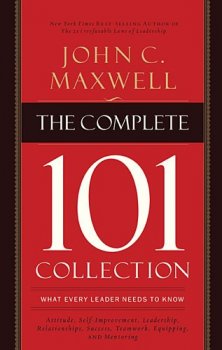
The Complete 101 SeriesI recently reviewed The Complete 101 Collection by John Maxwell. These are a great introduction to many of his more in-depth books (you can read my review by clicking here). Here are some quotes from Dr. Maxwell in Mentoring 101.

“Most people who desire success focus almost entirely on themselves, not others, when they start to make the journey. They usually think in terms of what they can get—in position, power, prestige, money, and perks. But that’s not the way to become truly successful. To do that, you have to give to others.”

“A person consumed with himself never considers spending time raising others up.”

“I believe that innate sense of motivation continues to exist in adults, but for too many people it has been beaten down by lack of support, busyness, stress, bad attitudes, lack of appreciation, scarce resources, poor training, or faulty communication. To get people excited about growing to their potential, you need to re-motivate them. Once you help them overcome the old things that knocked them down, they often motivate themselves.”

“As you develop people, remember that you are taking them on the journey towards success with you, not sending them. Stay with them until they’re ready to fly. And when they are ready, get them on their way.”

“The people closest to me determine my level of success or failure. The better they are, the better I am. And if I want to go to the highest level, I can do it only with the help of other people. We have to take each other higher.”

“When we examine ourselves, we naturally give ourselves the benefit of the doubt. Why? Because we see ourselves in the light of our intentions. On the other hand, when we look at others, we usually judge them according to their actions. Think about how much more positive our interaction with others would be if we believed the best in them and gave them the benefit of the doubt, just as we do for ourselves.”

“A study of 105 executives determined many of the characteristics shared by successful executives. One particular trait was defined as the most valuable: they admitted their mistakes and accepted the consequences rather than trying to blame others.”

“You can hire people to work for you, but you must win their hearts by believing in them in order to have them work with you.”

“Encouragement helps them reach their potential; it empowers them by giving them an energy to continue when they make mistakes. Use lots of positive reinforcement with your people. Don’t take acceptable work for granted; thank people for it. Praise a person every time you see improvement. And personalize your encouragement any time you can.”

“When you equip people, you teach them how to do a job. Development is different. When you develop people, you are helping them improve as individuals. You are helping them acquire personal qualities that will benefit them in many areas of life, not just their jobs.”

“There is no development without hard lessons. Almost all growth comes when we have positive responses to negative things.”

“When you don’t want to have a difficult conversation, you need to ask yourself: Is it because it will hurt them or hurt me? If it is because it will hurt you, then you’re being selfish. Good leaders get past the discomfort of having difficult conversations for the sake of the people they lead and the organization. The thing you need to remember is that people will work through difficult things if they believe you want to work with them.”

“Experience alone isn’t a good enough teacher—evaluated experience is. As the leader, you need to evaluate what looks like a win to make sure it is actually teaching what your employee needs to learn in order to grow and develop.”

“There is no greater accomplishment for mentors than when people they develop pass them by!”
15 More Quotes From “Success 101”

Susscess 101One of the things I enjoy about John Maxwell’s books is the number of other resources he employs to make his point: motivational sources, historical sources, quotes, stories, personal examples, and more. Here are some of the quotes Dr. Maxwell shared in his Success 101 book.

“Everyone has his own specific vocation or mission in life. Everyone must carry out a concrete assignment that demands fulfillment. Therein he cannot be replaced, nor can his life be repeated. Thus everyone’s task is as unique as his specific opportunity to implement it.” —Viktor Frankl

“There is no man living who isn’t capable of doing more than he thinks he can do.” —Henry Ford

“A blind man’s world is bounded by the limits of his touch; an ignorant man’s world by the limits of his knowledge; a great man’s world by the limits of his vision.” —E. Paul Hovey

“Failure is really a matter of conceit. People don’t work hard because, in their conceit, they imagine they’ll succeed without ever making an effort. Most people believe that they’ll wake up someday and find themselves rich. Actually, they’ve got it half right, because eventually they do wake up.” —Thomas Edison

“Sir, I salute you not only as a great leader of men, but as an indomitable Christian gentleman who wouldn’t give up.” —General Charles Cornwallis, when he surrendered to George Washington

“I start where the last man left off.” —Thomas Edison

“Success is a little like wrestling a gorilla. You don’t quit when you’re tired—you quit when the gorilla is tired.” —Robert Strauss

“Every successful person finds that great success lies just beyond the point when they’re convinced their idea is not going to work.” —Napoleon Hill

“The greatest mistake one can make in life is to be continually fearing you will make one.” —Elbert Hubbard

“He who makes no mistakes, makes no progress.” —Theodore Roosevelt

“Nobody whoever gave their best ever regretted it.” —George Halas

“If you do what you can, with what you have, where you are, then God won’t leave you where you are, and He will increase what you have.” —Bill Purvis

“Each time you decide to grow again, you realize you are starting at the bottom of another ladder.” —Ken Rosenthals

“Start doing what is necessary; then do what is possible; and suddenly you are doing the impossible.” —Francis of Assisi

“The only conquests which are permanent and leave no regrets are our conquests over ourselves.” —Napoleon Bonaparte

I also shared some quotes from John Maxwell himself in Success 101. You can read those by clicking here.

17 Quotes From “Winning With Principle”

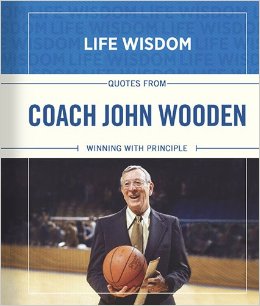
Winning With PrincipleJohn Wooden won the right way: with principle and integrity. And his wins were not short-lived, but they can last a lifetime. Check out a few quotes from Winning With Principle, a collection of quotes from Coach. You can read my full book review by clicking here.

“You learn as much from those under your supervision as they do from you.”

“Truth will always stand the test of scrutiny.”

“There is no substitute for hard work. If you are looking for the easy way, the shortcut … you’ll not be developing your talents.”

“The best competition I have is against myself to become better.”

“Time spent getting even would be better spent getting ahead.”

“Success is peace of mind, which is a direct result of the self-satisfaction in knowing you did your best to become the best you are capable of becoming.”

“There is nothing stronger than gentleness.”

“You can do more good by being good than any other way.”

“If you’re not making mistakes, then you’re not doing anything. I’m positive that a doer makes mistakes.”

“Failure is not fatal, but failure to change might be.”

“Don’t measure yourself by what you have accomplished, but by what you should have accomplished with your ability.”

“Players with fight never lose a game; they just run out of time.”

“The shining trophies on our shelves can never win tomorrow’s game.”

“Always try to be better today than you were yesterday.”

“Success is never final; failure is never fatal. It’s courage that counts.”

“Things turn out the best for the people who make the best of the way things turn out.”

“Consider the rights of others before your own feelings and the feelings of others before your own rights.”

Links & Quotes

link quote

Some good reading from today…

Thrilled for the pro-life victory in today’s Supreme Court ruling!

[VIDEO] This is a really straightforward explanation behind the horror of the Plan B pill that Hobby Lobby stood firm against providing.

“We are always on the anvil; by trials God is shaping us for higher things.” —Henry Ward Beecher 

“Whatever we may undertake with a sincere desire to promote His glory, we may comfortably pursue. Nothing is trivial that is done for Him.” —John Newton

“I would never follow a leader who doesn’t follow a leader.” —John Maxwell

“A government that robs Peter to pay Paul can always depend on the support of Paul.” —George Bernard Shaw

[VIDEO] Why didn’t anyone tell me that Star Wars’ Mark Hamill did the voice of Joker in the animated Batman series?!?

“Quiet heroes dot the landscape of our society. They don’t make the headlines, but they do sew the hemlines and check the outlines and stand on the sidelines. You won’t find their names on the Nobel Prize short list, but you’ll find their names on the carpool, and Bible teacher lists. They are parents! Heroes! Their kids call them mom. Dad. And these moms and dads, more valuable than all the executives and lawmakers, quietly hold the world together. Be numbered among them. Read books to your kids. Play ball while you can and they want you to. Make it your aim to watch every game they play, read every story they write, hear every recital in which they perform. Children spell love with four letters:  T-I-M-E. Not just quality time, but hang time, downtime, anytime, all the time! Cherish the children who share your name. Succeed at home first!” —Max Lucado

Dr. Tim Elmore has a great post called How Failure Can Be Your Kid’s Best Friend. And exciting news … he has a new book coming out! I cannot wait to read Twelve Huge Mistakes Parents Can Avoid.


“The cosmos exists to help you know God, the Maker. And the main message is that He is very great and that we are very small. We need to feel this greatness. We need to be able to say, ‘You are great, O Lord God; for there is none like You’ (2 Samuel 7:22).” —John Piper

21 Quotes From “Sometimes You Win, Sometimes You Learn”

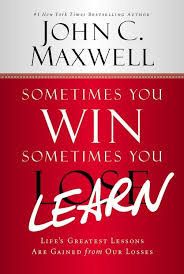
Sometimes You WinAs I mentioned in my book review (which you can read by clicking here), John Maxwell always expands my horizons with his writings. I appreciate his ability to use his own life experiences as well as historical and contemporary examples and writings. So some of my favorite quotes from Sometimes You Win, Sometimes You Learn are from Dr. Maxwell, and some are from others that he quotes. Enjoy!

“I sometimes react to making a mistake as if I have betrayed myself. My fear of making a mistake seems to be based on the hidden assumption that I am potentially perfect and that if I can just be very careful, I will not fall from heaven. But a mistake is a declaration of the way I am, a jolt to the way I intend, a reminder that I am not dealing with facts. When I have listened to my mistakes, I have grown.” —Hugh Prather

“Those who profit from adversity possess a spirit of humility and are therefore inclined to make the necessary changes needed to learn from their mistakes, failures, and losses. … When we are focused too much on ourselves, we lose perspective. Humility allows us to regain perspective and see the big picture. … Humility allows us to let go of perfection and keep trying.” —John Maxwell

“Most people spend their entire lives in a fantasy Island called ‘Someday I’ll.’” —Denis Waitley 

“An idealist believes the short-run doesn’t count. A cynic believes the long run doesn’t matter. A realist believes that what is done or left undone in the short-run determines the long run.” —Sydney J. Harris

“Those things that hurt, instruct.” —Benjamin Franklin

“You can’t grow and learn if your focus is on finding someone else to blame instead of looking at your own shortcomings.” —John Maxwell

“The highest reward for our toil is not what we get for it but what we become by it. … Mistakes are not failures. They are proof that we are making an effort. When we understand that, we can more easily move out of our comfort zone, try something new, and improve. … Improvement demands a commitment to grow long after the mood in which it was made has passed.” —John Maxwell 

“Success in most things comes not from some gigantic stroke of fate, but from simple, incremental progress.” —Andrew Wood

“The main trouble with despair is that it is self-fulfilling. People who fear the worst tend to invite it. Heads that are down can’t scan the horizon for new openings. Bursts of energy do not spring from a spirit of defeat. Ultimately, helplessness leads to hopelessness.” —Norman Cousins

“Positive thinking must be followed by positive doing.” —John Maxwell

“When you are influential and highly respected, people tend to tell you what you want to hear, not what you need to hear. They are seeking your approval, or they flatter you. Unfortunately, this creates a gap between what you hear and reality. If you find yourself in that situation, you will need to work extra hard to get the people close to you to speak honestly into your life. And you will have to become highly intentional in observing and listening.” —John Maxwell 

“Wisdom is the reward you get for a lifetime of listening when you would have preferred to talk.” —Doug Larson

“Circumstances are the rulers of the weak; but they are the instruments of the wise.” —Samuel Lover 

“Mistakes are painful when they happen, but years later a collection of mistakes is what is called experience.” —Denis Waitley

“Ninety percent of those who fail are not actually defeated; they simply quit. … As you face bad experiences, it’s important for you to remember that you can rarely see the benefits while you’re in the midst of them. You usually gain perspective on the other side of it.” —John Maxwell 

“Most people would rather change their circumstances to improve their lives when instead they need to change themselves to improve their circumstances. They put in just enough effort to distance themselves from their problems without ever trying to go after the root, which can often be found in themselves. Because they don’t try to change the source of their problems, their problems keep coming back at them.” —John Maxwell

“To grow, you must be willing to let your present and future be totally unlike your past. Your history is not your destiny.” —Alan Cohen

“If I had my life to live over again, I’d make the same mistakes, only sooner.” —Tallulah Bankhead

“Maturity is doing what you are supposed to be doing, when you’re supposed to be doing it, no matter how you feel.” —Dom Capers 

“Have you not succeeded? Continue! Have you succeeded? Continue!” —Fridtjof Nansen, Nobel Peace Prize winner

“How we think when we lose determines how long it will be until we win.” —G.K. Chesterton

Sometimes You Win—Sometimes You Learn (book review)

Sometimes You WinIf you’re like me, you grew up being able to quickly finish the phrase, “Sometimes you win, sometimes you… lose.” But John Maxwell gives us a far better way to finish this well-worn phrase in his latest book Sometimes You Win—Sometimes You Learn: Life’s Greatest Lessons Are Learned From Our Losses.

As in his other books, Dr. Maxwell shares very candidly about his own missteps, and the lessons he learned from them. He also brings in the insight from other friends and authors who have also learned the value of making mistakes and learning the hard lessons from them.

What always amazes about John Maxwell’s writing is the depth of insight. On the surface you would think there wouldn’t be much to say about learning from our losses except another well-worn cliche, “If at first you don’t succeed, try, try again.” But that try-again spirit is only one part of the learning process. John shows us the value of:

  • Humility
  • Reality
  • Responsibility
  • Improvement
  • Hope
  • Teachability
  • Adversity
  • Problems
  • Bad experiences
  • Change

Following through on all of these aspects leads to the most important step in the learning process: Maturity.

The insight, historical stories, personal anecdotes, and wisdom of other been-there-done-that people are woven together with John’s unique teaching style to give us a book that is highly beneficial. I’d especially recommend this book to parents, coaches and mentors.

I am a Center Street book reviewer.

One Of The Most Unusual Stories

There is one of the most unusual stories inserted in Genesis 38. I say “inserted” because it almost seems out of place. In chapter 37, Joseph’s brothers have just sold him into slavery and convinced their Dad that a wild animal killed him. In chapter 39, we pick up Joseph’s story again as he arrives in Egypt.

Genesis 38 has a story that doesn’t fit in Joseph’s story. It’s sort of a giant parenthesis. Not only that, it’s a story of mistake after error after mess up after bad judgment after more mistakes.

Judah, an older brother of Joseph, came up with the idea of selling him instead of killing him. Perhaps being around his co-conspirators was too difficult for him, so Judah left town.

  • Mistake #1: not dealing with his guilt and sin, but running away from it.

Judah married a Canaanite woman.

  • Mistake #2: inter-marrying with a non-God-fearing culture.

Judah gave his son Er in marriage to Tamar.

  • Mistake #3: allowing his son to inter-marry with the Canaanites too.

Er sinned. The Bible doesn’t say what it was, but it was so offensive that God put him to death.

  • Mistake #4: sin against God.

Onan (Judah’s second son) sinned. He had a familial responsibility to his brother and sister-in-law’s family line, but he snubbed them both.

  • Mistake #5: more sin against God.
  • Mistake #6: disregard for family.

Judah promised Shelah (his third son) to Tamar. But he procrastinated in following through on that because he thought Tamar was a black widow.

  • Mistake #7: deception.

Tamar disguised herself as a prostitute and waited along the road for Judah.

  • Mistake #8: more deception.

Judah slept with his daughter-in-law Tamar (yuck!), thinking she was a prostitute.

  • Mistake #9: fornication.
  • Mistake #10: incest.

Tamar became pregnant, and Judah wanted to have her publically punished for her infidelity.

  • Mistake #11: hypocrisy.

That’s a whole lot of sin and error and lapses in judgment and mistakes for just one family. What a mess this family had become! So, why in the world is this story inserted here? Because Tamar had twins: Perez and Zerah. In listing the royal, kingly genealogy of Jesus, Matthew writes

A record of the genealogy of Jesus Christ the son of David, the son of Abraham:
Abraham was the father of Isaac, Isaac the father of Jacob, Jacob the father of Judah and his brothers, Judah the father of Perez and Zerah, whose mother was Tamar.

Perez is listed in the genealogy of Jesus. God took all of those mistakes and made something great come from it!

It doesn’t matter how many mistakes you’ve made. It doesn’t matter how many times you think you’ve blown it. It doesn’t matter how many lapses in judgment you’ve had. God still has a plan for you. He wants to do something great through you. Will you let Him?

Square One

One of my all-time favorite movies is The Princess Bride. There is a scene about halfway through the movie where Inigo and Fezzik are reunited:

[Scene: Outside a hut. Inigo is sitting, nursing a bottle]

Inigo:      I am waiting for you, Vizzini. You told me to go back to the beginning. So I have. This is where I am, and this is where I will stay. I will no be moved.

Assistant Brute:    Ho there!

Inigo:      I do not budge. Keep your “Ho there.”

Assistant Brute:     But the prince gave orders.

Inigo:      So did Vizzini. When the job went wrong he went back to the beginning. Well, this is where we got the job, so it’s the beginning. And I am staying till Vizzini come.

Even though Inigo was slightly the worse for alcohol, he gives some sage advice. When we run into problems—when we get off track—it’s good to go back to the beginning.

After his ill-advised trip to Egypt, Abraham returns to square one. He goes back to the last place he heard from God.

He moved on from the Negev, camping along the way, to Bethel, the place he had first set up his tent between Bethel and Ai and built his first altar. Abram prayed there to God. (Genesis 13:3-4)

When I seem to be on the wrong path, I must go back to the place I last heard from God. Perhaps it’s significant where Abraham’s tent and altar were set up. Between two cities:

  • Ai which means “heap of ruins.” It comes from a root word meaning “bend, twist, distort.”
  • Bethel which is made up of two words beth (house) + El (God) = house of God.

This is my life: always between two options. I can have a distorted/twisted view that leads to a heap of ruins, or I can live where God dwells.

I can have my way or God’s way.

I can have blessing or ruin.

When I find what I’m doing is a mess, it’s time to go back to the beginning—to go back to square one—to go back to the last place I heard from God.

Learning Tough Lessons

In my role as a book reviewer, I am presently reading Derailed. This book has really jolted me wide awake!

Dr. Tim Irwin is walking through the profiles of six high-profile business leaders who got derailed on their path to success. These CEOs seemed to have everything: talent, opportunity, great ideas, a proven track record of success. In short, everything they would need to be successful.

Yet they got derailed.

Here’s the wake-up call for me: The same thing can happen to me. The Apostle Paul wrote his own “derailed” story about the Israelite leaders:

These are all warning markers—danger!—in our history books, written down so that we don’t repeat their mistakes. Our positions in the story are parallel—they at the beginning, we at the end—and we are just as capable of messing it up as they were. Don’t be so naive and self-confident. You’re not exempt. You could fall flat on your face as easily as anyone else. Forget about self-confidence; it’s useless. Cultivate God-confidence.

I don’t want to get derailed, so I’m focusing on God-confidence today.