Links & Quotes

link quote

Some great reading and watching from today…

[VIDEO] Thanks to my friend Rich for telling me about the friendliest restaurant in America.

“No state is so blessed as that wherein one is free from sin, is filled with innocence, and is fully supplied with the grace of God.” —Ambrose

[VIDEO] John Maxwell has a good reminder about the power of personal discipline.

There are few who can express the love of God as Charles Spurgeon in The Glorious Love Of The Father.

Tim Elmore shares some counter-intuitive thinking for preparing our kids for success.

“If you want to hear from Heaven you must seek it on your knees.” —D.L. Moody

“Don’t be forced into this false dichotomy. Truth and love are not at odds. Rather, for the sake of love, cherish the truth. Let this love for truth and truth for love govern the use of language….” —John Piper

“Who will grant me to find peace in You? Who will grant me this grace, that You would come into my heart and inebriate it, enabling me to forget the evils that beset me and embrace You my only good?” —Augustine 

Don’t buy into it when Islam is called a religion of peace: ISIS terrorists targeting Christians in Iraq.

A Few More “Generation iY” Thoughts

Generation iYIn a recently-released last chapter to his ground-breaking book Generation iY, Tim Elmore added material that made me realize more than ever that this book is a must read for anyone who works with youth. You can read my book review by clicking here, and you can read some other quotes I shared from this chapter by clicking here.

Just a few additional thoughts Dr. Elmore shared in this chapter that I wanted to pass along to you—

“We did a better job preventing, presuming and protecting then we did preparing.” 

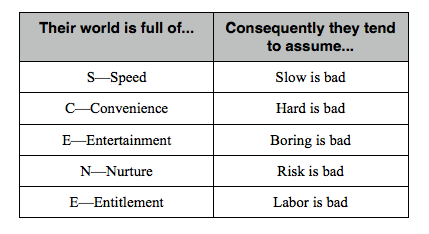
Gen iY assumptions

“Examine the right-hand column for a moment. Notice the words slow, hard, boring, risk and labor. Are those not the very ingredients that build a mature adult? When a task is hard and it moves slowly, it builds patience and work ethic in me. When things are boring, it forces my mind to be creative on its own. When I have to take risks, I learn that failure is not final or fatal, and that it’s only when I risk failure that I feel the satisfaction of true success. And when I learn to embrace labor, using my strengths to add value to others, I learned the value of service.”

“Wherever you see a lacking virtue, there’s likely an activity you can do to build it, just as one would lift weights to improve physical muscle strength. … We can no longer assume those emotional muscles will develop naturally in kids. We must initiate a plan to build them. Will likely need to discuss this issue over with them, and agree to balance the virtual with the genuine; the screen with the real. In short: 

  • More time interacting with the real people. 
  • More time outside in active movement. 
  • More time working and waiting on answers. 
  • More time initiating and less time reacting.” 

“It’s important to strike a balance between utilizing the conveniences of modern technology and building the life skills that require no technology.”


Generation iY (one more chapter)

Generation iYThree years ago I posted this—

I’m going to make a statement about Dr. Tim Elmore’s book Generation iY that I rarely make: This book is a MUST READ for parents and anyone who works with youth!

Yes, a must read. The subtitle of this book is not over-dramatized, but really is an understated truth: Our last chance to save their future.

Recently Tim Elmore released in ebook format a final chapter to Generation iY. After reading this I was just as convinced that anyone who works with our youth must read this book (read my full book review by clicking here). Here are a few quotes from this chapter.

“Historical trends suggest that every time there is a population explosion among the youth (between 15-29 years old), violence follows. Sociologist Gunnar Heinson reported that countries are vulnerable when the youth population is 30 percent or higher.” 

“Our assessment of 8,500 high school and college students clearly reveals a drop in:

  • Resilience—we removed the ability to bounce back after a failure.
  • Empathy—we have pushed them toward self-expansion.
  • Work ethic—their short attention spans make the daily grind a turn-off.
  • Stamina—sticking with the task when the novelty’s going is difficult.
  • Ambition—the internal drive to succeed is replaced by external stimuli.
  • Self-awareness—few adults have been honest about their blind spots.”

“Condoleezza Rice and Joel Klein released a report recently saying that the state of our youth is now an issue of national security. Seventy-five percent of America’s youth are not even fit for the military due to obesity, criminal records or failure to graduate high school.”

  1. As technology goes up, empathy goes down. We can find a direct parallel between screen time and the lack of empathy in adolescence. It makes sense, doesn’t it? A text that says ‘I am having a bad day’ doesn’t elicit the same empathy as being face to face with a person in tears, in the midst of a crisis. It seems virtual, so our empathy is virtual. Kids often laugh at what they cried about a decade ago.
  2. As information expands, attention spans diminish. Resilience, patience, and attention spans have dropped thanks to today’s quick, convenient, and saturated world. When overwhelmed, we surrender readily. Herbert Simon said it best: “A wealth of information creates a poverty of attention.”
  3. As options broaden, long-term commitment shrinks.
  4. As life speeds up, patience and personal discipline drop.
  5. As external stimulation increases, internal motivation decreases. Experiments among students show that external rewards actually reduce internal drive and ambition. Kids work for the reward, not the satisfaction of the work. The external (and possibly artificial and superficial) reduces incentive and, consequently, self-sufficiency.
  6. As consequences for failure diminish, so does the value of success.
  7. As virtual connections climb, emotional intelligence declines.
  8. As free content swells, so does our sense of entitlement.


Links & Quotes

link quote

These are links to articles and quotes I found interesting today.

“It is better to offend men than to grieve the blessed Spirit of God which dwells in the church.” —A.W. Tozer

A good reminder for pastors, parents, teachers and mentors:

“And just as the helmsman does not always yield to the winds, but sometimes, turning the prow towards them, opposes the whole force of the hurricanes; so the Instructor never yields to the blasts that blow in this world, nor commits the child to them like a vessel to make shipwreck on a wild and licentious course of life; but, wafted on by the favoring breeze of the Spirit of truth, stoutly holds on to the child’s helm—his ears, I mean—until He bring him safe to anchor in the haven of heaven.” —Clement of Alexandria

“Whenever the Lord sees one of His children wrestling with some lust or bondage, He moves in quickly to bring us back to a path of obedience, peace and rest. How does He do this? He brings about conditions in our lives that force us to face our sin!” Read more from David Wilkerson in his post The Arrow Of Truth.

Chilly Chilton says, “Use social media but don’t let social media use you” in his blog post Don’t Pet The Dragon.

The former cofounder of Greenpeace has some startling statements about climate change.

[PHOTOS] 18 Mind-Blowing Images From The World Of Science

The Bare Facts (book review)

The Bare FactsBoth parents and teens should arm themselves with the facts, biblical information, scientific research and solid common sense in Josh McDowell’s book The Bare Facts: 39 Questions Your Parents Hope You Never Ask About Sex.

Let me state it simply: parents, teens, and youth pastors all need to get this book. 

Parents—Don’t wait for someone else to talk to your kids about sex and the strong urges their hormones are generating; take the lead and talk to your kids. This book is written in a question-and-answer format, so it would be an easy conversation starter to ask one of the questions Josh McDowell covers.

Teens—The information you are getting about sex, love, sexually-transmitted disease, and how-far-is-too-far from your peers is most likely wrong. Josh gives you the facts, and you need to arm yourself with truth.

Youth Pastors—You should be teaching this stuff! Will it feel awkward? Maybe. But I bet it’s a lot less awkward to talk to your students about purity than it is to counsel a brokenhearted teen who has become pregnant or contracted a sexually-transmitted disease. The discussion questions at the end of Bare Facts will help you in your 1-on-1 or small group discussion times with the students in your youth group.

What would be even better: Parent and teens and youth pastors reading The Bare Facts together. Get the information on the table and start talking about the truth.

I am a Moody Publishers book reviewer.

Habitudes (book review)

HabitudesWhen you combine a memorable visual image with the challenge of a new leadership habit you create something powerful: a habitude. That’s exactly what Dr. Tim Elmore does in his series of exceptional books called Habitudes.

Our minds store information in picture format. For example, when you read “elephant,” you don’t think of the letters e-l-e-p-h-a-n-t, but you think of a huge, floppy-eared, tusk-bearing, mammal on the African savannah. So combining visual images (a right-brained exercise) with life-changing data (a left-brained activity) creates a concept that really sticks with us.

For each one of the 13 habitudes in this book, an image is first presented (for instance, a flood-ravaged home, with the brown swirling water flowing through the front door). Then add to this image some powerful insights from Dr. Elmore about a leader’s responsibility to keep everyone’s energies inside the banks for maximum effectiveness. If a leader doesn’t keep the river’s flow within the banks where it can do some good, the flood of misguided energies can lead to devastation.

Each habitude includes some workspace to help you work through the concepts presented with each image. The pictures create a great “hook” for the concepts to hang in your mind, and the follow-up exercises in each chapter help make the concepts applicable to your unique circumstances.

Each chapter is fairly short, but as the cliche goes, “A picture is worth a thousand words,” so expect each habitude to teach you a lot without using a lot of written words.

This is a great resource for anyone wanting to improve his or her leadership capabilities. But it would be especially useful for young leaders-in-training in a mentoring/protege role.

Check out some notable quotes from this book here.

You Need “Grey Heads”

Tim DilenaI know that all of us can benefit from an older, wiser person speaking into our lives, but I am especially concerned about pastors. Too many times pastors are seen by others as the “go-to guy” for anyone who needs help, and we pastors begin to believe that we don’t need to go to anyone else for help.

This is a dangerous attitude of pride!

Check out this short 4-minute teaching from my friend Rev. Tim Dilena about the value of “grey heads” in our lives—

My fellow pastor, humble yourself and accept the help of a wise mentor. It will not only enhance your ministry, it could literally save your ministry from crumbling.

Artificial Maturity—How To NOT Move From College To Career

Artificial Maturity is a must-read book by Dr. Tim Elmore for parents, pastors, youth pastors, teachers, coaches, and managers—anyone who works with youth. You can read my full review of this invaluable book by clicking here.

Artificial Maturity—How To NOT Break Up With Your Girlfriend

Artificial Maturity—How To NOT Get A Job