What Jesus Didn’t Say

All throughout the first four books of the New Testament—Matthew, Mark, Luke, and John—there are lots of “red letters” (words spoken by Jesus). But as each of these gospel writers begins to recount the arrest and sham trial of Jesus, I’m struck by how many “black letters” there are. This fulfilled an Old Testament prophesy—

He was oppressed and treated harshly, yet He never said a word. He was led like a lamb to the slaughter. And as a sheep is silent before the shearers, He did not open His mouth (Isaiah 53:7).

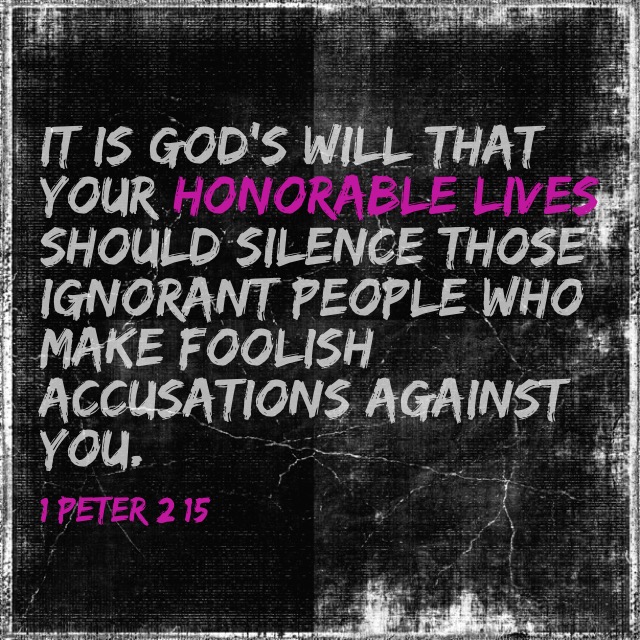
The chief priests and the Sanhedrin brought out a string of witnesses to falsely accuse Jesus, but even then these witnesses couldn’t get their stories to jive, so Jesus remained silent. In exasperation the chief priest Caiaphas lashed out at Jesus, “Aren’t You going to answer these charges? Don’t You hear what they’re saying about You? Why won’t You defend Yourself?”

So here’s how Jesus responded to His accusers: But Jesus remained silent (Matthew 26:63). His silence resonated louder than any words could have!

How could Jesus do this? How could He stand silently when all of these nasty things were being said about Him?

He looked back—”…He had done no violence, nor was any deceit in His mouth…” (Isaiah 53:9). All four Gospels record Jesus saying, “You heard Me speaking in public all the time. My life has been on display for You. If I had said or done anything wrong, you could have arrested Me earlier, but the facts are: I haven’t said or done anything sinful.”

He looked forward—”…Because of the joy awaiting Him, He endured the Cross, disregarding its shame…” (Hebrews 12:2). He knew that one wrong word could undo all of the good words which He previously spoke, so He looked forward to the joy that would come after this was over.

I just went through a period of my life where people threw incredibly hurtful lies at me, but what was that compared to the horrific abuse heaped upon Jesus? If He could remain silent, how much more should I?

While I was in the midst of this difficult time, a prayerful friend handed me a notecard which I have kept close to me. Perhaps these words will be helpful to you, too—

May kindness be the response in you
where such a response is not expected.
May gentleness have the power
to overrule an offense and the power to heal. (David Teems)

May this Good Friday be a time of reflection in what Jesus didn’t say. And may I, along with you, learn this power of silence when falsely accused.

Choice Four-Letter Words

Listen to the podcast of this post by clicking on the player below, and you can also subscribe on Apple, Spotify, or Audible.

Have you ever been “cursed out” by someone? I mean had a stream of four-letter obscenities hurled at you? What happens inside you? Isn’t your natural reaction to strike back? To begin to a counter-attack with a few choice four-letter words of your own?

It’s natural to feel this way; it’s a very human response.

On the other hand, have you ever been “blessed out” by someone? Had someone shower you with niceties and accolades and compliments? What happens inside you this time? Isn’t your natural reaction the complete opposite? Don’t you want to say, “Well, I think you’re pretty special, too”?

It’s natural to feel this way; it’s a very human response.

But Jesus commanded us to do something counter-cultural, something which requires a spiritual response: “Bless those who curse you” (Luke 6:28). Paul amplified this thought: “Bless those who persecute you; bless and do not curse” (Romans 12:14).

These words curse and bless are challenging for me. Curse means to hope for someone’s downfall; bless means to say good words to or about someone. Cursing can be done internally or verbally; blessing has to be done verbally. Eugene Peterson captures the essence of this in his paraphrase of Romans 12:14: “Bless your enemies; no cursing under your breath.”

If my natural response is to match curse for curse, obscenity for obscenity, then to respond in a Christ-like fashion is going to take a change of character. To respond with the right four-letter words, I have to do the opposite of my natural response.

In the Old Testament, the Hebrew word for bless carried the understanding that it all hinged on God—He is the focal point. All of the definitions of this word involve a close relationship with God: (a) bless God; (b) bless men in the name of God; (c) ask for divine favor for persons or things created by God; or (d) salute someone because we know God has saluted us.

In the New Testament, the Greek word for bless makes it clear that this has to be done verbally, out loud. It is impossible to bless under your breath. In the Greek, bless is the compound word eulogeo = eu- (good) + –logos (words): saying good words out loud.

Only God is good, so only a closer relationship with our good God will help us say good words to others. Especially to those who curse us.

The right four-letter words to use—the un-natural words to use—are: Good words.

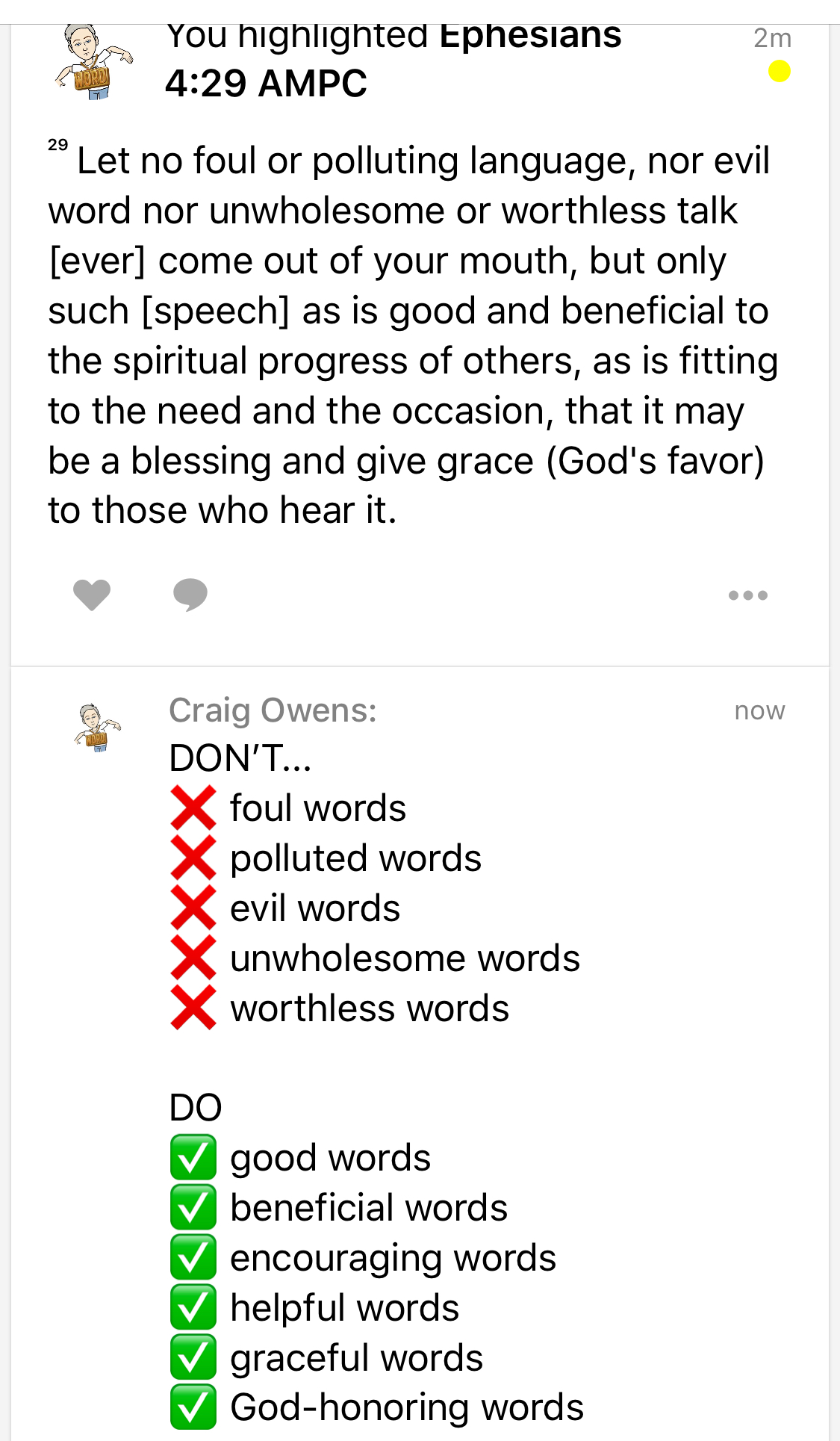
I’m challenging myself today to bless others, especially those who curse me. I only want to say good to and about others today. I’m attempting to live out Ephesians 4:29—

  • Do not let any unwholesome talk come out of your mouths, but only what is helpful for building others up (New International Version)
  • Let no foul or polluting language, nor evil word nor unwholesome or worthless talk ever come out of your mouth, but only such speech as is good and beneficial to the spiritual progress of others (Amplified Bible)
  • Watch the way you talk. Let nothing foul or dirty come out of your mouth. Say only what helps, each word a gift (The Message)
  • When you talk, do not say harmful things, but say what people need—words that will help others become stronger (New Century Version).

So let me ask you: How will you say the right four-letter words to others today?

►► Would you please prayerfully consider supporting this ministry? My Patreon supporters get behind-the-scenes access to exclusive materials. ◀︎◀︎

My Big Three

three1Busy. Commute. Busy. Lesson prep. Busy. Kids’ schedules. Very busy. Meetings. Extremely busy. Household chores. Hectic busy. Hospital visits. Running-to-catch-myself busy.

In my busyness, something gets squeezed out of my life very easily. I don’t intend for this to happen, in fact it’s the last thing that should ever get squeezed out, but it does. I can tell when it does. Not right away, but soon it catches up with me and I’m running on vapors. I know that when I take the time to put it back into my life, the busyness doesn’t seem so busy anymore.

What is this power source? Consider the life of Jesus.

No one had more to accomplish in such a short period of time than Jesus. He only had three years to find, equip and launch the men who would take His message to all the world. No small task, and not a minute to lose. Yet instead of seeing Jesus run at the frantic pace I so easily slip into, I see these incredible pauses.

Very early in the morning, while it was still dark, Jesus got up, left the house and went off to a solitary place, where He prayed. (Mark 1:35)

How long did He pray? The Bible doesn’t say, but I suspect He was in prayer with His Heavenly Father until His conversation was concluded. It may have been a while, or it may have been somewhat shorter.

Then all throughout the day, Jesus was never rushed or pushed or running helter-skelter, but He seemed to move at just the right speed. This is because Jesus was taking His cues from His Father all day long:

For I did not speak of My own accord, but the Father who sent Me commanded Me what to say and how to say it. I know that His command leads to eternal life. So whatever I say is just what the Father has told Me to say. (John 12:49-50)

Sometimes when there were big decisions or momentous occasions facing Him, Jesus would spend an extended time in prayer. For example:

 One of those days Jesus went out to a mountainside to pray, and spent the night praying to God. When morning came, He called His disciples to Him and chose twelve of them, whom He also designated apostles. (Luke 6:12-13)

I’m trying to make Jesus’ big three my big three:

  1. An untimed conversation with God every morning.
  2. All-day sensitivity to the prompting of the Holy Spirit.
  3. Periodic prayer retreats before making big decisions.

This is taking all of the discipline I can muster, but I must make this my top priority!