Battling Depression

Have you ever been depressed? I have. I know all too well how depression robbed me of sleep, sapped joy from my day, kept me from smiling and on the verge of tears all the time, made sunny days seem cloudy, caused me to sigh all the time and lose interest in the things that used to bring me pleasure, and brought such a sense of loneliness and isolation.

Did you know that Jesus felt the crushing load of depression too? As He was praying in the Garden of Gethsemane just before His arrest, listen to these words—

  • He began to be sorrowful and troubled
  • He became anguished and distressed
  • He began to show grief and distress of mind and was deeply depressed
  • He said to them, “My soul is overwhelmed with sorrow to the point of death”
  • He prayed more fervently, and He was in such agony of spirit that His sweat fell to the ground like great drops of blood
  • “Abba, Father,” He cried out, “everything is possible for You. Please take this cup of suffering away from Me. Yet I want Your will to be done, not Mine.” (see Matthew 26:37-38; Mark 14:36; Luke 22:44)

The writer of Hebrews wrote this about Jesus—

While Jesus was here on earth, He offered prayers and pleadings, with a loud cry and tears, to the One who could rescue Him from death. And God heard His prayers because of His deep reverence for God. Even though Jesus was God’s Son, He learned obedience from the things He suffered. In this way, God qualified Him as a perfect High Priest, and He became the source of eternal salvation for all those who obey Him. (Hebrews 5:7-9)

We learn something in suffering that we can’t learn any other way. Jesus learned how to experience all of the grief, anxiety, and depression that you and I will ever feel. And that is what qualifies Him to be a perfect High Priest for us.

Our part is to pray. Time and time and time again, not only did Jesus pray, but He encouraged His disciples to pray as well. As you continue to pray, Jesus is your High Priest praying for you. Only He truly knows how to translate the cry of your heart into a language Abba Father can understand.

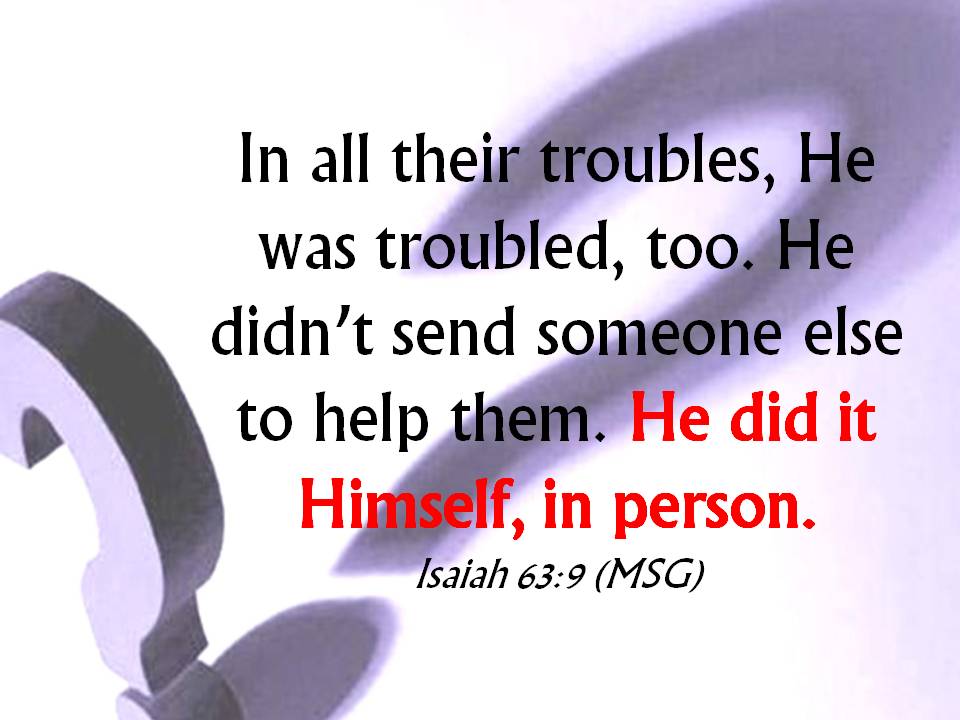
In all their troubles, He was troubled, too. He didn’t send someone else to help them. He did it Himself, in person. (Isaiah 63:9)

If you’ve missed any of the messages in this series called Where’s God, please check them all out by clicking here.


Mammon

It’s a funny-sounding word, but it has deadly consequences!

Jesus said we cannot serve both God and mammon (Luke 16:13 KJV). That word mammon had no direct translation in the English language, so the translators of the King James Version of the Bible simply did a transliteration: they took the Greek word and carried the same word into English. The translators of the New International Version did something different with this word: they made it Money, with a capital M.

The idea behind this word is placing our trust or reliance in anything except God. For us, the means of our security and basic living needs seems to be money, so Money (with a capital M) seems like an appropriate way to translate mammon.

Jesus recommended giving an offering—above and beyond our tithe—as a way to defeat the Mammon Monster. Giving our tithe is simply obedience to God’s commands. But giving our offering shows our trust in God’s provision.

Giving an offering to God is counterintuitive.

After all, less money is less than more money! If I receive money, I tend to hang on to it. I tell myself, “This might come in handy if the economy nosedives, or if something unexpected comes up.” When I start thinking this way, I start to make money Mammon, because I see money as my provider, instead of God.

What an appropriate way to wrap up our Live Dead series yesterday, as we made faith promises to God. We said, “God, I believe You will provide the amount of money I should give as an offering. And when You do provide, I promise to give it.” Placing my trust in God not only helps me to live dead to the pull of Mammon, but also Jesus promised—

Give, and it will be given to you. A good measure, pressed down, shaken together and running over, will be poured into your lap. For with the measure you use, it will be measured to you. (Luke 6:38)

I don’t give to get. I give because I trust God to provide.

P.S. By the way, all of the offerings that come in as a result of these faith promises will be going directly to missions. Calvary Assembly of God will not be keeping one cent of these faith promise offerings.

If you’ve missed any messages in our series called Live Dead, you can find them all by clicking here.

Thursdays With Oswald—Serving Like Christ

This is a weekly series with things I’m reading and pondering from Oswald Chambers. You can read the original seed thought here, or type “Thursdays With Oswald” in the search box to read more entries.

Am I Serving Like Christ?

The Son of Man did not come to be served, but to serve… (Matthew 20:28)

     Jesus also said, ‘Yet I am among you as the One who serves’ (Luke 22:27). Paul’s idea of service was the same as our Lord’s—‘…ourselves your bondservants for Jesus’ sake’ (2 Corinthians 4:5). We somehow have the idea that a person called to the ministry is called to be different and above other people. But according to Jesus Christ, he is called to be a ‘doormat’ for others—called to be their spiritual leader, but never their superior. Paul said, ‘I know how to be abased…’ (Philippians 4:12). Paul’s idea of service was to pour his life out to the last drop for others. And whether he received praise or blame made no difference. As long as there was one human being who did not know Jesus, Paul felt a debt of service to that person until he did come to know Him. But the chief motivation behind Paul’s service was not love for others but love for his Lord.

     …The institutional church’s idea of a servant of God is not at all like Jesus Christ’s idea. His idea is that we serve Him by being the servants of others. Jesus Christ actually ‘out-socialized’ the socialists. He said that in His kingdom the greatest one would be the servant of all (see Matthew 23:11). The real test of a saint is not one’s willingness to preach the gospel, but one’s willingness to do something like washing the disciples’ feet—that is, being willing to do those things that seem unimportant in human estimation but count as everything to God.

From My Utmost For His Highest

I cannot add anything to this brilliant observation. But I can tell you the parts that the Holy Spirit is really working in my heart:

  • “…called to be a ‘doormat’ for others—called to be their spiritual leader, but never their superior.” God, help me to keep my pride in check.
  • “The real test of a saint is not one’s willingness to preach the gospel, but one’s willingness to do something like washing the disciples’ feet.” May I never shrink back from willingly serving at the lowest level of society.

UPDATE: This idea of servant-leaders plays prominently in my book Shepherd Leadership: The Metrics That Really Matter.

Whose Reputation?

When I graduated from high school and began to look for a job, I had very little to put on my resume. Over time, however, I gained some experience, and began to accumulate some skills and accomplishments. Every once in awhile someone would even tell me, “That will look good on your resume!”

This might work fine in a job-hunting role, but it will never do as a disciple of Jesus Christ. In fact, Jesus told a pretty pointed story about a resume-building Pharisee in Luke 18. This man was described as one who was “confident of [his] own righteousness and looked down on everybody else.” He emphasized all his good qualities, and did his best to make himself look good at the expense of others (see vv. 11-12). Jesus said, this type of man who exalts himself, will be humbled by God.

Another man was praying at the same time as this reputation-conscious Pharisee. But this man didn’t try to make himself look good. Instead he prayed, “God, be merciful to me, a sinner” (v. 13). Jesus said this man “went home justified before God” (v. 14). As C.S. Lewis said,

“Humility is not thinking less of myself. Humility is thinking of myself less.”

I’m not trying to promote my accomplishments, but God’s accomplishments.

I’m not trying to put my skills in the spotlight, but God’s magnificence.

I’m not trying to make myself famous, I want God to be famous.

I don’t need to look good, but I certainly do want God to look good.

If you want to live this way, I challenge you to pray this prayer:

Dear God, I am humbled by my sins. But I am confident that through the forgiveness paid for by Jesus You receive me as justified. May I die to my reputation so I may live exalted by You.

To check out all of the messages in our Live Dead series, please click here.

Don’t Get Pulled Back Down

We wrapped up our series on The Danger Of Prayerlessness by looking at a very innocent thing: just doing what seems the natural thing to do.

In Luke 18, Jesus told a story about a persistent widow who would not stop approaching a judge to get justice. She had been wronged, but she didn’t take matters into her own hands, nor did she get tired of asking the judge for help. Either of these responses would have been very natural responses. But that’s the point: they would be natural, and not spiritual; they would depend on us, and not on God.

Luke introduces this story like this: Jesus told His disciples a parable to show them that they should always pray and not give up (Luke 18:1).

The word for give up is one that means to slide back to the natural way of doing, feeling or acting. In other words, to handle things like we always have before. But Jesus said there was a better way: keep taking your request to our Heavenly Father.

Prayer overcomes the “gravitational pull” of my natural tendencies to do things on my own. Prayer is the rocket fuel to help me break free!

Do not fret or have any anxiety about anything, but in EVERY circumstance and in EVERYthing, by prayer and petition (definite requests), with thanksgiving, continue to make your wants known to God. (Philippians 4:6 AMP)

Don’t get pulled back down. Instead always pray and never, ever give up! Let your prayers take you higher and higher!

Great Plans!

As Jesus was approaching Jerusalem just prior to His passion, He told His disciples, “Everything that is written about the Son of Man will be fulfilled” (Luke 18:31).

Nothing about Jesus Christ’s life was haphazard, or random, or coincidental. Everything was a part of a perfect plan. So in order for everything about His life to fulfill the prophesies, every word He spoke and every action He completed also had to be fulfilling. And they were (see John 12:49-50)!

Sadly, His followers “did not understand any of this” (Luke 18:34).

Sadly, many people today don’t understand their own life’s purpose.

Sadly, often times I don’t either.

But God has a perfect plan for you and me.

All the days ordered for me were written in Your book before one of them came to be. (Psalm 139:16)

For we are God’s workmanship, created in Christ Jesus to do good works, which God prepared in advance for us to do. (Ephesians 2:10)

I don’t have to lack understanding in this (John 14:16).

I can pray for wisdom (James 1:5).

And Jesus Himself is praying for me to follow the Father’s plans (Hebrews 7:25).

God has great plans for my life—and for your life. Don’t be like the disciples that did not understand any of this. Pray … ask for God’s wisdom … ask for the Holy Spirit’s illumination … and trust in Christ’s interceding prayer for you.

May your words and actions today fulfill the plans God has for you!

Pray Long

How long is a long prayer? Do you get tired (or bored!) after just a few minutes? Do you start to nod off to sleep if the prayer goes longer than expected? Does your mind wander? Are you too busy to pray more than just bullet-point prayers?

Jesus was about to make a huge decision. Of all of the people who called themselves His disciples (there were a lot of them), Jesus was going to choose twelve to be His apostles (Luke 6:13, 17). These were the men who would spend the most time with Jesus; the ones who would hear His most explicit instructions; the ones who would be called upon to take the gospel to the four points of the globe after Christ’s ascension into Heaven.

How did Jesus choose The Twelve from the huge multitude?

“He spent the night praying to God” (Luke 6:12).

This Greek word for spent the night is unique in all of Scripture. Only Luke uses it here to describe how Jesus prayed. Doctor Luke—who would know better than most how the body craves sleep—uses this unique word. In essence Jesus was going to cease from all activity AND avoid any inactivity (like sleep) to pray about this important decision.

Principle: The bigger the issue = the longer the prayer.

  • How many times do I pray just one-and-done prayers?
  • How many times am I too distracted/tired/busy to pray more than a few minutes?
  • What wisdom am I robbing myself of by my short prayers?

Don’t get me wrong, God does answer the one word prayers (like HELP!). But there is something powerful about praying long.

Watch Your Prepositions

Prepositions are interesting words: they tell us the position of something relative to something else. Changing just one small preposition changes the whole meaning—“I left my wallet in the car” or “I left my wallet on the car.” In the first case, you can probably find your wallet again. In the second case, your wallet could be anywhere along the side of the road!

There’s a well-known story in the Gospels where a woman anoints Jesus with an expensive perfume. Some people are upset that she would “waste” something so valuable. But as Jesus corrects their incorrect view of this, notice the preposition He uses:

She has done a beautiful thing TO Me. (Matthew 26:10)

Most of the time we think we do things for Jesus. But He really doesn’t need us to do anything for Him, does He? After all, He is all-sufficient, all-powerful, all-knowing.

But Jesus loves when we do something beautiful TO Him!

We often praise God because of what He has done; that is, we praise Him for His deeds. But what if we praise God for Who He is; that is, give praise TO Him?

For is good, but TO is best.

I’m going to be watching my prepositions, to make sure I’m not only doing things for Jesus, but to Him as well—not just giving praise for what He’s done, but praise TO Him for Who He is.

Inventive Faith

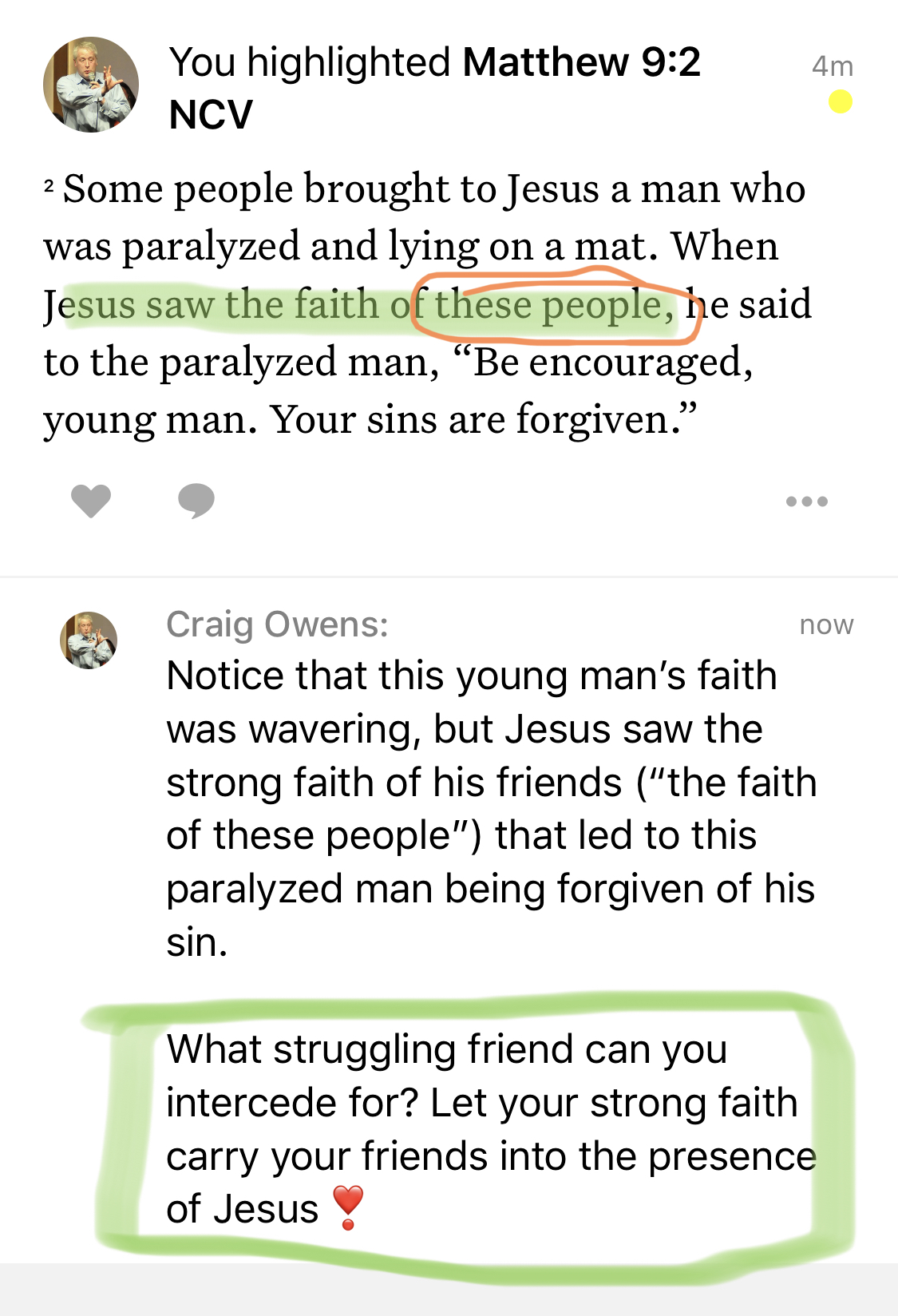
I love the story of the four friends who wanted to get their sick companion in to see Jesus. They had heard about Jesus healing others, and they believed that He would heal their friend too. But when they arrived at the house where Jesus was, they found it packed with people, and the doors and windows blocked by crowds who also wanted to see and hear Jesus. So these four friends made an appointment with one of Jesus’ disciples to come back at a more convenient time.

Ummm, not so much!

These guys were so convinced that Jesus could heal their friend, that they didn’t let crowds stop them. They climbed up on top of the house, ripped off some of the roof tiles, and lowered their friend down to Jesus. I love their inventive faith!

How many times do circumstances stop me?

  • there were too many people
  • or not enough people
  • they seemed busy
  • they seemed uninterested
  • it was raining

Oh, so many flimsy excuses that seem to derail my faith!

I love this thought from Charles Spurgeon:

“Faith is full of inventions. The world is constantly inventing; genius serves all the purposes of human desire: cannot faith invent too, and reach by some new means the outcasts who lie perishing around us?

“…Through door, through window, or through roof, let us, breaking through all impediments, labor to bring poor souls to Jesus. All means are good and decorous when faith and love are truly set on winning souls. If hunger for bread can break through stone walls, surely hunger for souls is not to be hindered in its efforts. O Lord, make us quick to suggest methods of reaching thy poor sin-sick ones, and bold to carry them out at all hazards.”

How much more inventive can your faith be?

Does Either-Or Work?

Sometimes I read about this debate whether churches should be “attractional” or “missional.” The first approach says that church should attract people first, and then share the gospel with them. The second approach says that if churches simply focus on sharing the gospel they will then attract people.

Either-or. Either missional or attractional.

What about both-and?

Consider the life of Jesus. No one would ever argue that He wasn’t “on mission” all the time. In fact, numerous times He says, “I’m doing what My Father wants me to do,” or even, “It’s not time for me to do that yet.” Jesus was missional.

And yet… “Tax collectors and other notorious sinners often came to listen to Jesus teach. This made the Pharisees and teachers of religious law complain that He was associating with such sinful people—even eating with them! (Luke 15:1-2). People loved being around Jesus. Jesus was attractional.

Jesus exemplified both-and missional-attractional. I think He was able to perfectly balance this because of the work of the Holy Spirit. I can aim for the both-and of missional-attractional in my life … I can give it my best shot. But the only way I can truly achieve anything is by allowing the Holy Spirit to shape and direct my life, just as He did for Jesus. Henry & Melvin Blackaby, in their book Experiencing The Holy Spirit, wrote:

“The world doesn’t need to see good people giving their best to God; they need to encounter God doing in and through us what only He can do! …Our best isn’t good enough when it comes to kingdom work; we need the Holy Spirit in our lives if we’re going to be of use to God.”

I need the Holy Spirit in my life if I’m going to be of use to God, and be of any benefit to people.

I need the Holy Spirit in my life if I’m going to balance both-and missional-attractional like Jesus.